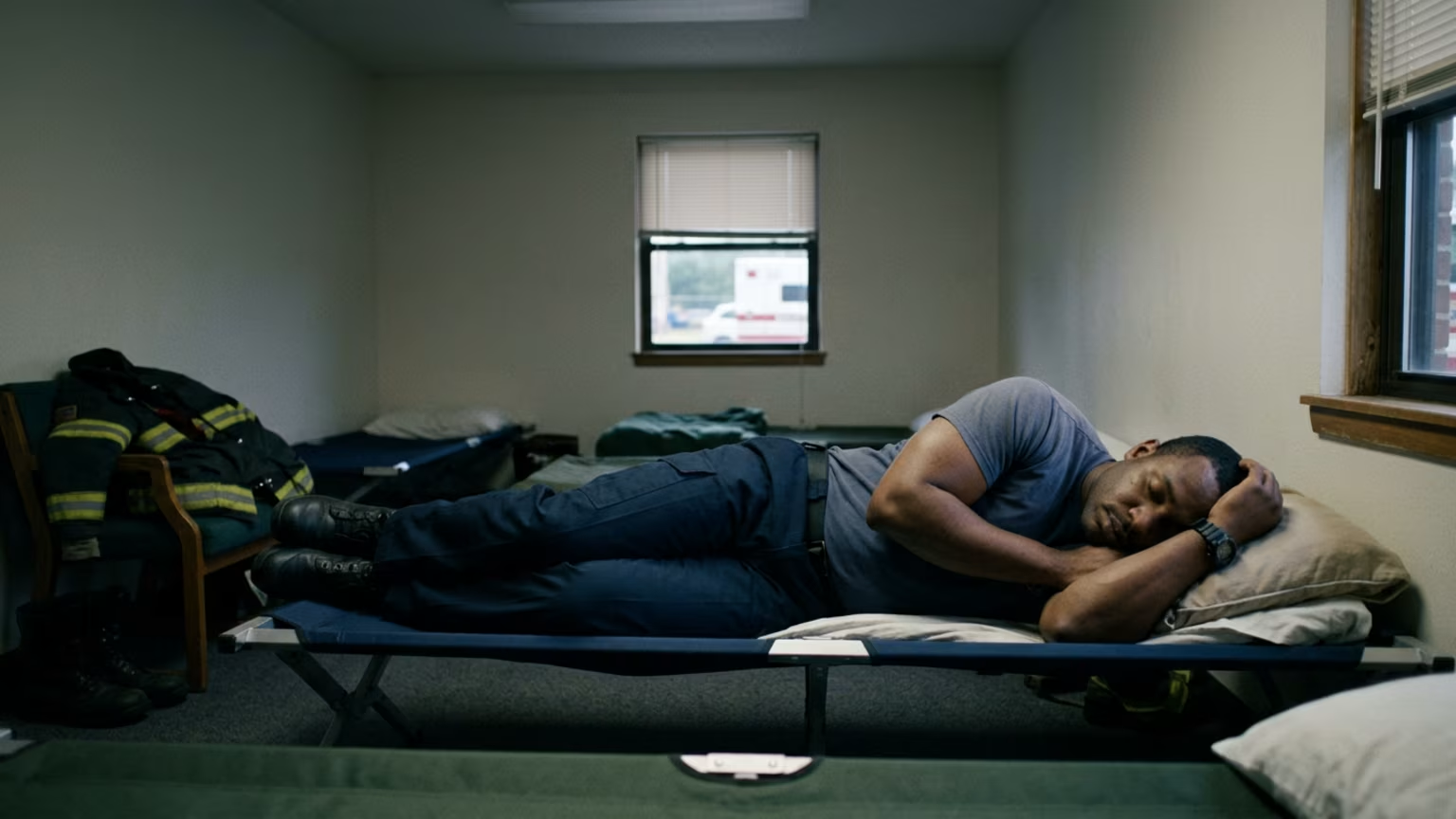

A new analysis urges fire departments to treat recovery as an operational priority, linking disrupted sleep to impaired judgment and higher crash risks.





On September 14, 2026, FirefighterNation contributor John Doyle published an analysis urging fire departments to treat recovery and rest as operational leadership priorities. The former chief fire officer argues that broken rest directly impairs executive function, emotional regulation and judgment.
John Doyle is a 36-year fire-service veteran and former chief fire officer of the Cleveland Fire Brigade in the United Kingdom. His new analysis argues that leadership models must account for basic biology alongside discipline and personal responsibility. Shift work, unpredictable callouts and nighttime emergencies severely impair physical and mental recovery for first responders. This chronic lack of restorative sleep alters how leaders evaluate risk and process critical information during high-stress incidents.
According to the article, sleep deprivation compromises the prefrontal cortex. This specific brain region regulates planning, judgment, empathy and impulse control. When this area becomes less effective, officers frequently experience increased reactivity, irritability and tunnel vision. As fatigue narrows their thinking, supervisors become far more likely to miss vital operational details.
The wider neuroscience data strongly supports this focus on executive function. Reviews of broader sleep research consistently associate insufficient sleep with severe attentional lapses and diminished cognitive control. Fatigue also weakens the neural connectivity between the prefrontal cortex and the amygdala. This biological shift leads to greater emotional dysregulation and increased risk-taking behavior in the field.
Doyle notes that this biological awareness should increase leadership responsibility rather than excuse poor decisions. Supervisors must actively notice when stress changes a crew member's perspective. Leaders need to build organizational buffers through dedicated recovery time, reflection and honest discussion. This framework moves fatigue management away from simple self-care advice and positions it as a structural safety requirement.
This understanding of neurobiology directly changes how departments should approach their operational safety standards. Treating sleep loss strictly as a personal wellness issue ignores the systemic risks of persistent fatigue. A national study of 6,933 firefighters across 66 United States fire departments highlights the true scale of this problem. That research found that 37.2 percent of participants screened positive for at least one sleep disorder.
These screening results signal significant safety vulnerabilities for both the individual and the entire crew. Firefighters who screened positive for a sleep disorder reported approximately twice the odds of a motor-vehicle crash. They also faced more than twice the likelihood of falling asleep while driving. This specific data indicates that sleep problems have severe physical implications extending far beyond subjective tiredness.
However, these associations do not mean that every sleep-disordered firefighter will inevitably crash a vehicle. The figures represent observational associations reported from firefighter data, rather than proof that sleep deprivation directly caused each specific incident. Still, the data strongly supports immense concern about general safety risks across the fire service.
Departments can no longer rely solely on generic sleep hygiene guidelines to combat these systemic risks. The evidence connects sleep-disorder screening with elevated crash risks, particularly during long commutes and safety-sensitive duties. Leaders must begin treating dangerous sleepiness as an immediate operational readiness concern. Supervisors should actively consider a crew member's rest status when assigning tasks or evaluating incident preparedness.
Doyle explicitly recommends building fatigue discussions into formal leadership development and post-incident processes. When departments analyze an emergency response, they must evaluate how sleep deficits influenced crew behavior and command decisions. Treating recovery as a critical component of readiness changes how agencies manage long-term duty fitness. The goal is to separate fatigue management from blame while demanding honest biological self-assessment from every officer.
For decades, the fire service assumed that standard shift calendars provided adequate recovery windows. The Roswell Fire Department in Georgia recently challenged this assumption by testing systemic schedule design changes. Between June 2024 and early 2026, the department moved personnel from a traditional 24/48 schedule starting at 8:00 a.m. to a 48/96 schedule starting at 11:00 a.m. This experiment treated shift timing as a controllable operational variable rather than a permanently fixed tradition.
The project measured the impact of these changes using wrist-worn sleep trackers, daily surveys and medical evaluations. It also incorporated the Pittsburgh Sleep Quality Index and rigorous screening for both post-traumatic stress and sleep apnea. The results demonstrated that nominal time off does not automatically equal restorative sleep for emergency personnel. After the intervention, tracker-measured sleep increased from 6.7 to 7.0 hours per night.
Self-reported sleep totals also grew by 41 minutes per night under the new schedule structure. Home sleep specifically increased from 6.9 to 7.2 hours. Sleep on the final night before a shift saw substantial improvements, jumping from 6.1 to 7.0 hours. Furthermore, average monthly commuting time declined by 60 percent, effectively giving personnel approximately seven hours back.
The subjective health metrics showed similarly dramatic shifts during the department's test period. Poor sleep quality fell from 67 percent to 36 percent, while high fatigue scores dropped from 40 percent to 10 percent. Positive depression screenings in the measured sample actually fell from 12 percent to zero. High-risk sleep-apnea screens declined from 40 percent to 32 percent, though this change was not statistically significant.
The evidence points to several practical adjustments for managing shift work and demanding duty cycles. Departments must establish better systems for tracking actual rest and modifying related operational routines. Roswell even adjusted its training schedules and wake-up practices after noticing that work-night sleep initially lagged behind home sleep improvements. Relying on calendar gaps alone leaves teams vulnerable to hidden, cumulative fatigue.
Leaders should measure sleep quality directly rather than assuming personnel recover perfectly on off days. The Roswell project utilized daily surveys and sleep trackers because scheduled downtime often masked severe sleep deficits. Personnel should monitor their own baseline rest metrics to understand how different shift patterns affect their physical recovery. By tracking these numbers, first responders can make far better choices regarding their shift-work sleep and recovery strategies.
Departments must carefully analyze commuting demands, early wake times and morning shift handoffs. Moving the Roswell start time to 11:00 a.m. allowed pre-shift sleep to increase from 6.1 to 7.0 hours. Agencies should review whether early morning reporting times unnecessarily truncate the final block of restorative rest. Small adjustments to the morning routine can yield immediate, measurable improvements in cognitive performance.
Supervisors need to view persistent fatigue as a structural hazard rather than a sign of weakness. The data linking positive sleep-disorder screens with crash risk requires immediate, serious attention from fire-service leadership. If a team member exhibits excessive sleepiness, command must prioritize clinical evaluation over informal wellness advice. Screening results are not formal diagnoses, so leaders should direct persistent insomnia to qualified medical professionals.
Following a critical incident, leaders should openly discuss how stress and sleep loss affected the response. Doyle advises making neurobiology a standard topic in leadership development and regular crew debriefings. The analysis argues that while biology does not eliminate personal responsibility, understanding it leads to better operational systems. Frank conversations about recovery directly support long-term career longevity and life after service.
While the Roswell schedule test presents encouraging numbers, the fire service needs broader research to validate these initial findings. The department proudly partnered with Dr. Joel Billings of Embry-Riddle Aeronautical University to analyze the project outcomes. However, the report openly cautions that this was a single-department experiment with a relatively modest sample size. Actigraphy completion was also lower than researchers originally hoped, limiting the absolute certainty of the results.
Future studies must track how vastly different operational workloads impact schedule effectiveness across the country. The 48/96 model concentrates work into much longer duty periods, which might prove dangerous in higher-volume districts. The available report notes that heavy overnight call volumes, long transports and mandatory overtime could quickly erase the intended recovery benefits. Departments considering similar transitions must define their baseline metrics carefully before making sweeping calendar changes.
Leaders should monitor upcoming empirical trials that test organizational interventions across multiple, diverse emergency agencies. The current findings heavily associate broken rest with impaired decision-making, but these are largely observational studies or general neuroscience reviews. The Roswell project presented its schedule change as a test-and-adjust process rather than a universal prescription. Tracking these ongoing operational adjustments will ultimately define the future of emergency-service fatigue management.
Shift commanders and training officers deal with disrupted rest daily, but managing fatigue becomes a clear operational process when Rescuris runs the strategy. We solve the challenge of balancing strength, endurance, mobility and body composition across a demanding career, turning credible evidence into practical guidance for first responders.
Rescuris publishes evidence-aware guidance for firefighters, police officers, paramedics and other first responders on fitness, recovery, sleep, nutrition, stress resilience and long-term capability.






Read practical guidance on first responder fitness, recovery, sleep, nutrition and resilience for demanding work and a long, active career.
read the blog
