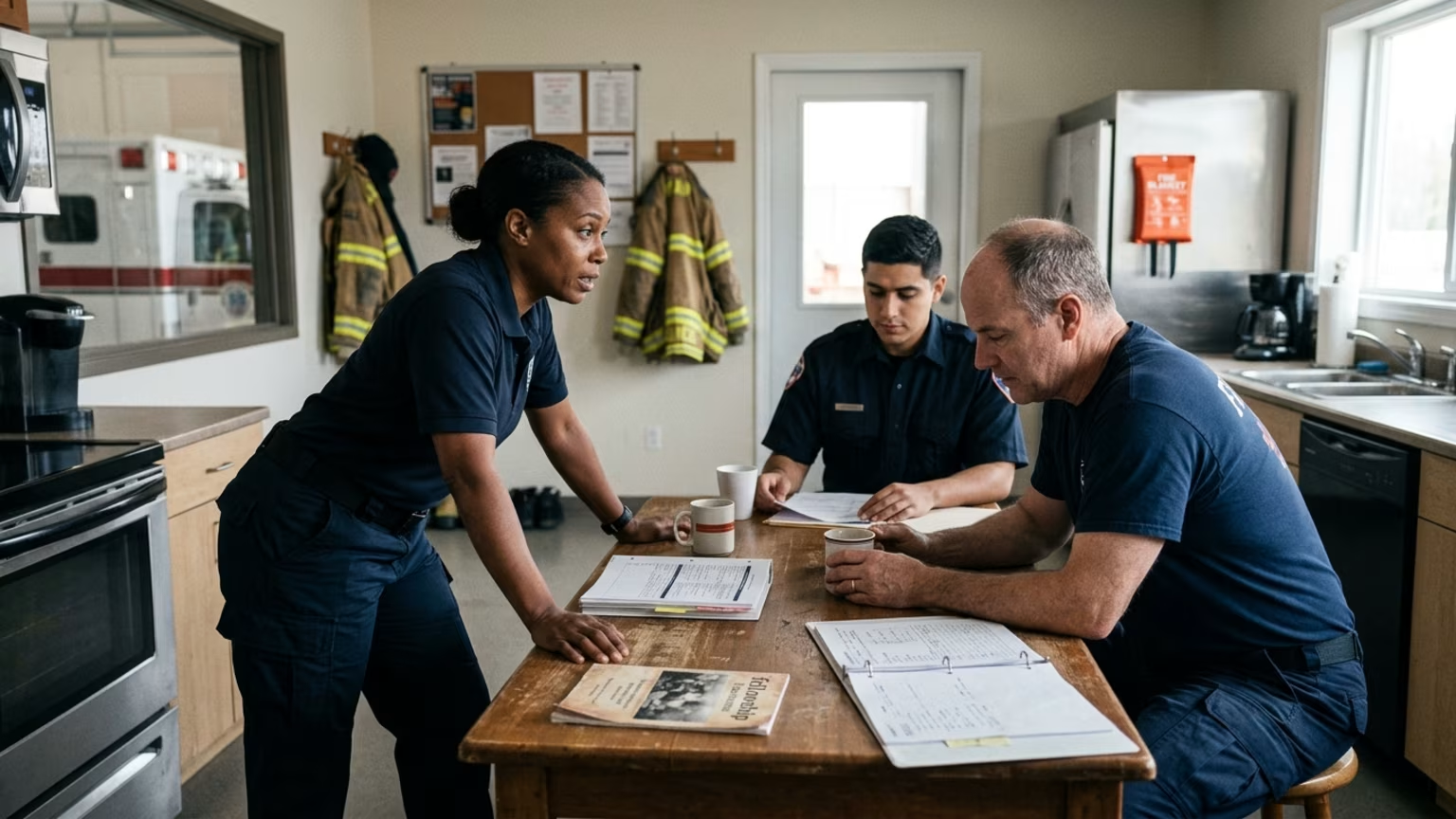

H.R. 10349 proposes a federal pilot program to train behavioral-health clinicians in emergency responder occupational stress. Review the full policy analysis.





If you are in immediate danger, call 911. For the Suicide and Crisis Lifeline, dial 988. Veterans can dial 988 and press 1. You can also text 838255 for the Veterans Crisis Line.
On September 10, 2026, Representative Derek Tran introduced H.R. 10349 to the U.S. House of Representatives. The legislation proposes a federal pilot program to train mental-health and substance-use professionals to serve emergency responders. This proposal outlines a new fellowship initiative within the U.S. Department of Health and Human Services. The measure aims to establish the Public Safety Mental Health Fellowship Program to address critical workforce shortages.
The bill arrives at a time when the occupational demands on emergency personnel are increasingly scrutinized. High operational tempos and chronic understaffing continue to place immense pressure on response agencies. By focusing on the clinical workforce, the proposal targets a foundational gap in the support infrastructure. The proposal aims to make qualified professionals available when responders ask for help.
H.R. 10349 is officially known as the Emergency Responders Mental Health Training Act. The bill would authorize $10 million annually from fiscal years 2028 through 2033. This funding would support advanced, postbaccalaureate training for clinicians and counselors who work with emergency responders. The focus is on building a specialized workforce rather than just creating a new direct counseling benefit.
The legislation identifies several eligible training fields for the proposed fellowships. These fields include psychiatry, nursing, social work and psychology. Fellowships would also cover marriage and family therapy alongside addiction counseling. Professionals who complete the training would address prevention, treatment, and recovery support across multiple operational domains.
The legislation explicitly lists the personnel who would benefit from this expanded care network. The proposed fellowships would support clinicians serving firefighters, law-enforcement officers, and emergency medical workers. It also includes hospital emergency personnel and related emergency-response providers. Covering this broad population means implementation would need to account for substantially different occupational settings.
The culture inside a firehouse differs significantly from the operational environment of a hospital emergency department. A single clinical approach is unlikely to succeed across these varied professions. Clinicians trained under this program would need to navigate these unique organizational cultures carefully. This variability highlights why the bill requires specialized, culturally competent preparation.
A key component of the proposal involves specific professional preparation. The bill would require trained professionals to understand emergency responders' duties and stressors. Clinicians would need to complete trauma-informed training before entering the field. They would also need to understand confidentiality and testimonial-privilege issues.
Occupational exposure to severe stress is a recognized occupational hazard. A 2026 report on Edith Cowan University research provides useful context regarding this exposure. The report said 38.3 percent of surveyed Western Australian police officers experienced PTSD symptoms, compared with 5.6 percent of the general Australian population. While this finding is specific to an Australian police population, it highlights the heavy occupational toll that specialized care aims to address.
The proposed fellowship program directly validates current efforts to integrate behavioral health with physical recovery. Many general practitioners lack familiarity with the operational realities of emergency service. A clinician who does not understand rotating schedules might suggest unrealistic rest habits. Finding practical ways to manage shift work and sleep requires specialized occupational knowledge.
When clinicians understand the precise physical demands of the job, treatment recommendations change. They can provide advice that aligns with the rigid constraints of a 24-hour shift. This understanding prevents responders from receiving generic wellness advice that fails in the field. Culturally competent care bridges the gap between clinical theory and operational reality.
The legislation specifically mandates that fellows understand testimonial-privilege issues. This requirement addresses a major barrier to seeking support among emergency personnel. Officers and medics often avoid treatment due to fears regarding fitness-for-duty evaluations or legal disclosures. When an officer seeks help, they need absolute certainty about what information remains confidential.
Clinicians trained in these specific legal nuances can establish necessary trust with responder patients. A mental-health professional must understand how their clinical notes might impact a responder's career. Without this specialized legal and occupational knowledge, clinicians might inadvertently jeopardize a patient's employment status. This specialized legal awareness is a critical component of building a trustworthy support system.
This alignment between clinical training and field reality supports better occupational health. Integrating behavioral care with physical readiness helps personnel maintain capability over time. Responders need care providers who view sleep disruption and fatigue as occupational hazards. This approach is essential for maintaining duty fitness standards across a demanding career.
For decades, mental-health support in emergency services operated almost exclusively as a crisis response. Departments often relied on post-incident debriefings following severe trauma or critical calls. This reactive model assumed that personnel only needed support after major events. H.R. 10349 challenges this assumption by emphasizing prevention and ongoing recovery support.
The proposal aligns with updated sector recommendations that view behavioral health as a continuous operational requirement. Safety guidance cited by Automotive Fleet recommends integrating mental-health support into broader safety practices rather than treating it only as a crisis response. The goal is to build a steady foundation of psychological support before emergencies occur. This shift reduces the pressure on individuals to simply endure cumulative occupational stress.
Treating behavioral health purely as a crisis intervention ignores the slow accumulation of fatigue. Daily stressors often compound the effects of trauma over years of service. A paramedic dealing with sleep deprivation may slowly lose their stress tolerance without a single defining incident. A workforce of specially trained clinicians could help manage this long-term wear proactively.
Many existing programs place the burden of recovery squarely on the individual officer or medic. Responders are often told to practice self-care without structural support from their agencies. The proposed legislation recognizes that individual resilience cannot replace specialized medical care. Building a competent workforce shifts the focus from individual toughness to professional medical support.
The shift toward continuous support mirrors changes in physical conditioning standards. Decades ago, responders were largely expected to maintain physical fitness entirely on their own time. Today, agencies recognize that structured physical training is an operational necessity. Treating behavioral health as an ongoing operational requirement represents a similar, necessary evolution in occupational safety.
H.R. 10349 remains a legislative proposal and does not offer immediate new clinical benefits. The timeline from authorization to the deployment of trained clinicians could take several years. However, departments can apply the principles behind the bill to their current operational protocols right now. Agency leaders can begin auditing their current employee assistance programs for cultural competence.
Safety guidance cited by Automotive Fleet recommends combining regular check-ins, trained points of contact, visible resources, and continued supervisor involvement. Agencies can implement these foundational practices without waiting for federal funding. Shift commanders should evaluate their existing behavioral health resources immediately. If current counselors do not understand irregular schedules, commanders can seek specialized providers independently.
Connecting personnel with resources that understand the job improves overall stress resilience and mental performance. Leaders must foster an environment where seeking support is treated as a professional responsibility. Supervisors play a vital role in normalizing conversations about fatigue and recovery. Establishing clear communication channels helps identify personnel who might benefit from specialized care.
Individual responders can also take actionable steps based on this shifting operational mindset. Personnel should view their behavioral health as equal in importance to their physical conditioning. Routine check-ins with a culturally competent professional can help manage the chronic effects of disrupted rest. Taking proactive steps now supports maintaining career longevity well before clinical shortages are fully resolved.
Federal investment in specialized emergency response training is already occurring in other areas. WUSF reported that federal behavioral-health funding included $13.4 million for rural EMS training focused on behavioral-health crises. This indicates a growing recognition of the need for specialized occupational support outside of major urban centers. Departments should monitor these ongoing federal investments to access newly funded training resources.
The Emergency Responders Mental Health Training Act is currently in the early stages of the legislative process. The bill was received with three cosponsors at the time of publication. The proposed $10 million annual budget is an authorization figure, not an appropriated reality. The program's creation depends entirely on congressional passage and subsequent administrative action by HHS.
If the bill becomes law, HHS would have one year to establish the fellowship program structure. The federal government would then need to design the stipend mechanisms and select participating educational institutions. The available sources do not establish how many fellows the program would ultimately support. They also do not specify how these fellowships would be geographically allocated across the country.
The proposal includes strict evaluation requirements to measure the program's actual effectiveness in the field. HHS would need to submit reports to Congress two years and five years after implementation begins. These reports would cover patient outcomes, system costs, and the overall health of participating responders. The evaluations must also address whether the program should be renewed, modified, or terminated.
Future analysis will need to verify if training more clinicians directly improves occupational health. Increasing the number of specialists does not automatically eliminate scheduling conflicts, geographic barriers, or individual stigma. Training more clinicians does not by itself resolve possible barriers involving cost or clinician availability. We will continue to track whether this legislative effort results in measurable performance and longevity benefits.
The available evidence does not show that the program would instantly improve physical performance or injury recovery. Direct effects on shift-work tolerance and career longevity remain potential areas of interest rather than established facts. Researchers will need to isolate the impact of specialized counseling from other occupational variables. Until those studies are completed, the immediate value lies in expanding basic access to competent care.
Integrating specialized behavioral support into daily operations requires practical strategies that go beyond crisis response alone. Rescuris helps first responders address sleep disruption from nights, rotating shifts, overtime and unpredictable calls by connecting credible research with field-tested recovery protocols. We provide the evidence-led framework professionals need to maintain occupational capability and protect their long-term health.
Rescuris publishes evidence-aware guidance for firefighters, police officers, paramedics and other first responders on fitness, recovery, sleep, nutrition, stress resilience and long-term capability.






Read practical guidance on first responder fitness, recovery, sleep, nutrition and resilience for demanding work and a long, active career.
read the blog
