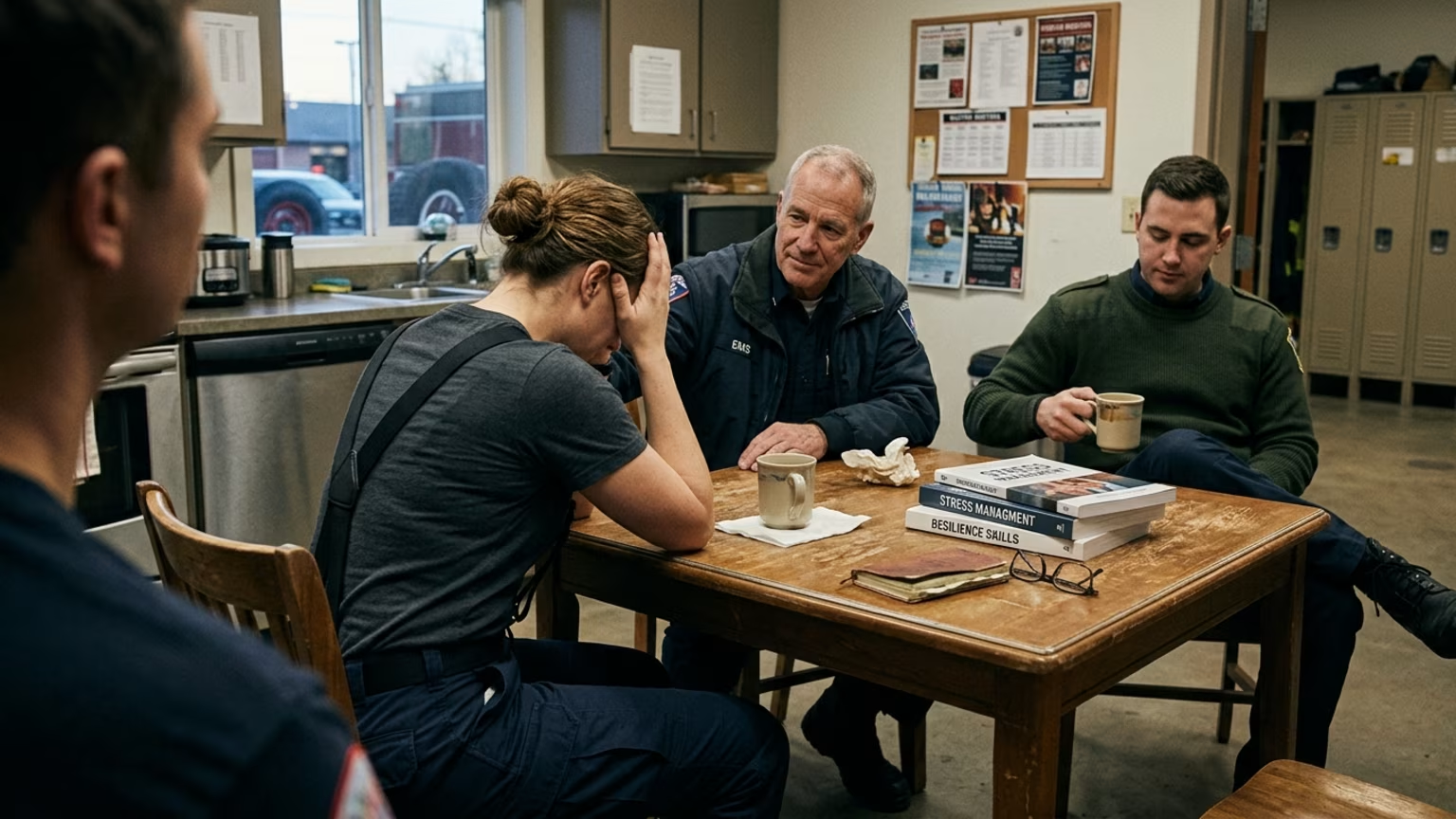

Emergency professionals can deploy brief stress reset skills during safe operational pauses. Current evidence shows these trainable techniques manage acute arousal.





The current research points toward brief interventions that can be integrated into ordinary operational life without requiring extended classroom time. A systematic review of mindfulness-based interventions for police officers included 11 studies and 967 participants. The authors of the review reported small-to-moderate improvements in overall stress and mental health outcomes immediately after the intervention. This volume of participants gives the subject a substantial occupation-specific evidence base compared to isolated pilot experiments.
However, the available evidence does not support claims that brief resets produce permanent psychological immunity against the hazards of emergency service. The same police review found that some improvements persisted at follow-up during within-group analyses. When looking at the more rigorous between-group comparisons, researchers found only a small mental health effect and no significant follow-up effect on overall stress. The authors therefore described the findings as preliminary support for integrating mindfulness into occupational health systems.
They specifically cautioned against viewing these interventions as proven methods to reliably prevent stress or completely eliminate trauma symptoms. Other related evidence comes from healthcare workers using self-guided digital mindfulness programs in high-stress medical environments. A recent review summarized interventions that included emergency medical dispatchers completing a seven-week mobile mindfulness program. This specific dispatcher program used weekly modules lasting 20 to 30 minutes and encouraged a daily practice of five to 10 minutes.
The broader healthcare review reported short-term improvements in depression, anxiety, perceived stress and general well-being. Despite these short-term improvements across various studies, the certainty of evidence from the healthcare worker review ranged from low to very low. This finding suggests that merely having access to a digital intervention does not guarantee consistent practice or durable occupational benefits. Without a structured implementation plan, these self-guided programs often fail to maintain long-term engagement among busy personnel.
Agencies looking to implement operational stress protocols must treat regulation as an ongoing operational skill rather than a one-time class. Relying solely on brief digital modules overlooks the complex physical realities of irregular shift schedules. A sustainable training model integrates these mental skills directly into existing operational workflows. By doing so, departments can build protective competencies without disrupting daily duty requirements.
When emergency professionals practice brief regulation skills, they are actively attempting to manage autonomic arousal under unpredictable conditions. The overarching goal is to translate abstract concepts into actionable, observable physiological shifts without relying on generic relaxation exercises. The available evidence supports describing basic breathing, grounding and attentional control as trainable skills. A recent emergency mental health editorial argues that protective competencies can be deliberately strengthened rather than treated solely as fixed personality traits.
Reducing state anxiety often requires a direct autonomic intervention, but the resulting physiological response is not universally beneficial in all operational contexts. In clinical pilot testing, physiological slowing can sometimes coexist with measurable cognitive trade-offs. If an intervention successfully lowers sympathetic arousal, it might inadvertently alter processing speed or attentional efficiency for a short duration. This means a responder must constantly consider their immediate environment before attempting to manually slow their nervous system.
For emergency-service professionals, a manual reset should be framed strictly as a tool for a safe, verified pause in action. This appropriate usage window includes staging periods, apparatus checks, handovers or structured post-incident decompression sequences. Responders should never use a forced regulation technique while actively driving, treating a patient, entering a hazard zone or monitoring a rapidly changing scene. Attempting to force physiological relaxation during high-stakes tasks could directly compromise necessary situational awareness.
Furthermore, brief resets must never be used to suppress a safety-critical signal, conceal impairment or bypass a medical assessment. Persistent insomnia, intrusive memories, panic or severe depression should be treated as reasons to contact qualified medical or mental health support. The available research firmly supports skills training as an adjunct to professional occupational health services. Operational readiness relies on utilizing the full spectrum of available support frameworks, rather than pushing a doctrine of self-management at all costs.
To understand the mechanics of brief regulation techniques, researchers recently tested short protocols in a controlled environment. A preregistered randomized pilot study examined one-minute cyclic sighing and box breathing in 47 university students. These participants were experiencing acute real-life threat situations during the experiment. The study compared the active breathing techniques against a passive control condition.
The researchers found that both breathing interventions successfully reduced state anxiety more than the passive control condition when measured five minutes later. Additionally, box breathing was associated with fewer inhibition errors on an attention test. This specific benefit appeared most prominently among participants who reported higher trait anxiety. The abstract provided no numerical effect sizes or confidence intervals, and it assessed outcomes only at a single five-minute post-intervention point.
Crucially, the study revealed a notable performance cost alongside the reduced anxiety. Both breathing interventions were associated with longer reaction times and lower attentional efficiency compared to the control condition. This finding offers a useful operational warning for first responders who require immediate physical readiness. Reducing acute anxiety and improving certain attention measures may temporarily slow down overall physical reaction speed.
Because this breathing study involved university students rather than firefighters, police officers or paramedics, the results represent feasibility and mechanism evidence. They should not be treated as absolute occupational proof for emergency-service operations. A university student sample cannot establish how the technique behaves in a firefighter wearing respiratory protection or a paramedic managing a deteriorating patient. This stark difference reinforces the importance of timing active transition strategies between calls appropriately.
The broader firefighter performance literature suggests that structured, occupation-specific physical training programs can improve simulated fireground performance. A systematic review noted improvements in task completion times, victim rescue, hose advancement and ladder operations. While this physical training evidence does not prove that breathing improves fireground performance, it reinforces a relevant training principle. Skills intended for high-pressure work should be practiced in structured, job-relevant conditions before a crisis occurs.
Departments can teach a short reset during noncritical training periods, daily briefings or routine equipment preparation. This allows the action to become deeply familiar before a responder needs it in the field. A simple pre-task sequence could include taking one or two comfortable breaths and intentionally noticing physical contact with the floor or vehicle seat. The responder can then identify the next observable task and use a neutral self-talk cue.
Any intentional breathing should remain completely comfortable throughout the exercise. It should not involve forced breath-holding, large inhalations or deliberate respiratory discomfort. The assembled first-responder evidence does not currently validate one universal breathing count for all emergency scenarios. Self-talk is best presented cautiously as an attentional or behavioral cue rather than as a clinically validated treatment for occupational stress.
Useful behavioral cues include phrases like "slow is smooth," "check, communicate, act," or "one task at a time" to guide immediate action. These neutral phrases serve as attentional markers rather than forced attempts at relaxation. By keeping the language simple, emergency personnel avoid the cognitive burden of remembering complex psychological concepts during a crisis. During a genuinely safe pause, emergency professionals should use the shortest version of a reset that does not interfere with immediate readiness.
They may lengthen the exhale slightly if it remains completely comfortable, and then clearly identify the next required communication point. The primary goal is to regain useful attentional control during a pause, rather than demanding the body become completely calm. Following a challenging call, quick grounding techniques help first responders maintain focus as they clear the scene. A post-incident reset can be used as a deliberate transition marker once the environment is operationally secure.
The responder can stop moving, intentionally orient to the present environment, and relax any unnecessary muscle tension. They can then use a brief factual self-check, asking themselves what just happened, what is still required, and what support they might need. Repeated practice may help make the skill more accessible under stress, but current sources do not establish a universal post-incident protocol for firefighters, police or EMS personnel. Developing a customized sequence allows responders to adapt the framework to their specific operational realities.
Brief self-regulation skills provide practical tools for managing temporary physiological states, but they must be deployed carefully during safe operational pauses rather than treated as permanent solutions for occupational stress.
Managing sleep disruption from nights, rotating shifts, overtime and unpredictable calls becomes impossible when agencies rely on vague wellness advice instead of targeted regulation protocols. To counter the compounding physical toll of an unpredictable schedule, Rescuris builds physiological recovery systems that help emergency professionals maintain capability across long careers. Explore Resources
Rescuris publishes evidence-aware guidance for firefighters, police officers, paramedics and other first responders on fitness, recovery, sleep, nutrition, stress resilience and long-term capability.






Read practical guidance on first responder fitness, recovery, sleep, nutrition and resilience for demanding work and a long, active career.
read the blog
