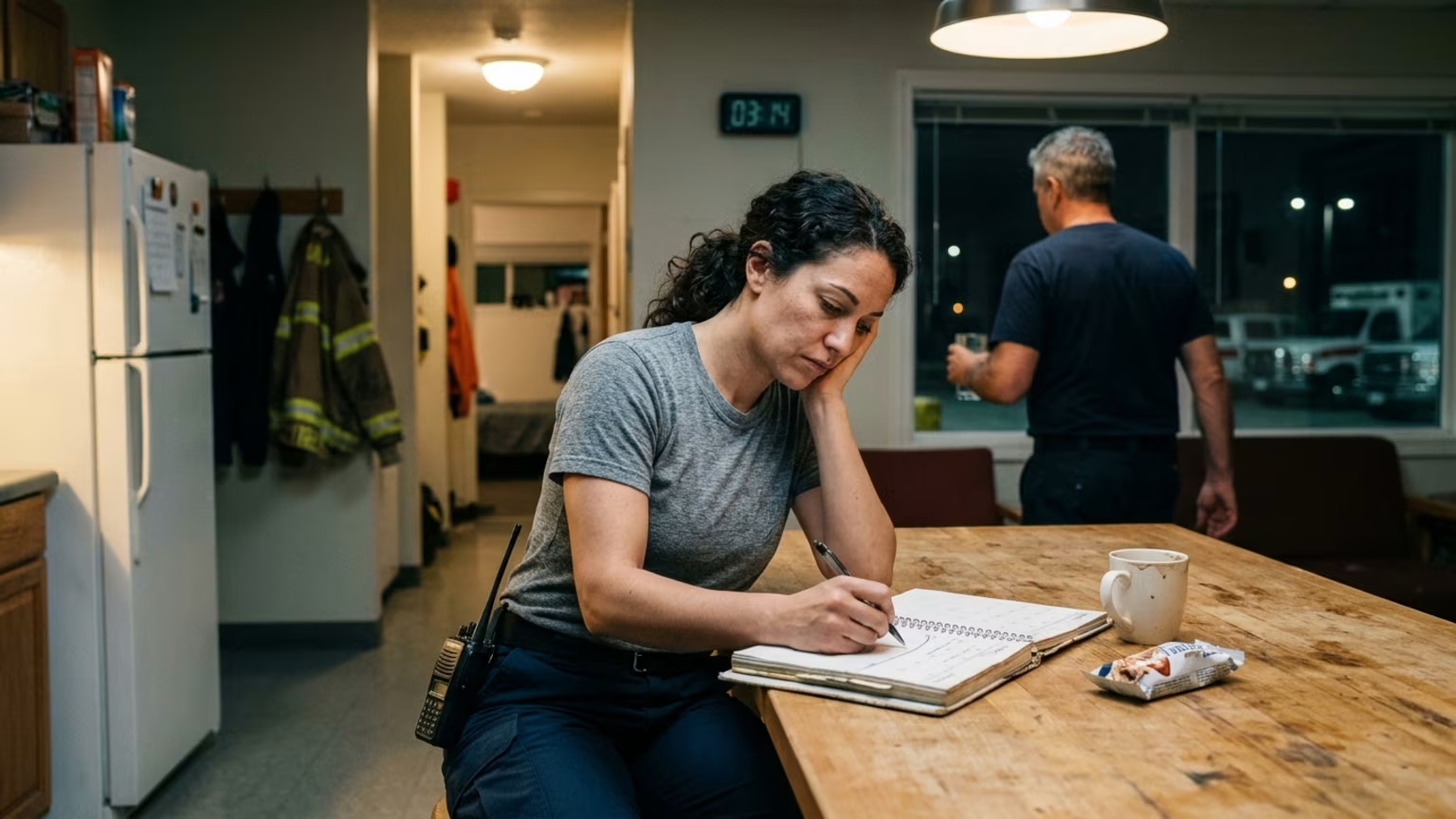

Learn how first responders can build shift-specific sleep plans for nights, rotating schedules and 24-hour tours to manage fatigue and protect health.





Sleep disruption is a material operational issue for emergency personnel because nonstandard schedules can shorten or fragment sleep. The data shows that fatigue management requires more than personal discipline. A schedule change at the Roswell, Georgia, Fire Department from a 24/48 pattern to a 48/96 pattern with an 11:00 a.m. start yielded measurable changes. Firehouse reported this specific schedule change was associated with an average increase of 41 minutes of sleep per night.
The law-enforcement scheduling evidence also argues against simplistic claims that shorter shifts are always better. A summary of a National Policing Institute experiment compared 8-hour, 10-hour and 12-hour schedules across 275 officers. Officers on 10-hour shifts reportedly obtained more sleep than those on 8-hour shifts. However, officers on 12-hour shifts reported greater sleepiness and lower alertness at work than the 8-hour group.
These findings show that sleep outcomes can be influenced by start times, commute demands, protected sleep windows and organizational policy. Fatigue is a shared worker-and-employer risk-management issue rather than merely an individual wellness problem. When schedules are designed with recovery in mind, personnel have a much better chance of securing adequate rest. Shift Work & Sleep strategies must respect these operational realities.
First responders face severe physiological challenges when unpredictable calls and extended tours limit natural recovery. Fatigue can directly affect alertness, decision-making and safe commuting over time. A 2025 field study summarized by Medical Xpress found wildland firefighters averaged 13.8-hour shifts. These firefighters achieved about 6.7 hours of sleep on active fire-fighting days.
Longer shifts and poorer sleep were associated with reduced cognitive function in that wildland report. While wildland conditions differ from municipal operations in workload and deployment length, the data illustrates how extended shifts coincide with cognitive impairment. A 24-hour tour should never be used as proof that a worker can safely tolerate chronic sleep restriction. The priority remains safe alertness before, during and after the next shift.
When sleep remains heavily fragmented, the physical toll compounds significantly across a career. A summary of 4,957 screened state and local officers reported that just over 40 percent had at least one sleep disorder. The reported conditions included obstructive sleep apnea, moderate-to-severe insomnia and shift-work disorder. Because this figure comes through a secondary summary, it should be presented as a reported finding rather than a universal prevalence estimate.
A summary of NIOSH guidance states that persistent insomnia, unintended sleep episodes or severe daytime sleepiness should trigger professional evaluation. These symptoms warrant clinical assessment rather than being normalized as part of emergency-service culture. Proper fatigue management requires addressing these severe physiological impacts directly. Managing Stress Resilience & Mental Performance requires acknowledging the heavy biological cost of sleep deprivation.
The Roswell, Georgia, Fire Department outcomes provide a detailed example of organizational fatigue management. According to Firehouse, wrist-tracker data showed mean sleep rising from 6.7 to 7.0 hours per night. Sleep on the night before a shift also increased from 6.1 to 7.0 hours in the tracked group. These adjustments resulted in noticeable subjective improvements for the workforce.
The proportion of personnel classified as having poor sleep quality fell from 67 percent to 36 percent. At the same time, the proportion with high fatigue scores dropped from 40 percent to 10 percent. These results reflect the combined effect of schedule length, start time, commuting patterns and local implementation. They should be attributed to that specific department rather than presented as proof that every 48/96 schedule improves sleep.
A schedule that improves average sleep may still create difficult family, commuting, overtime or recovery demands for particular workers. The Roswell results do not prove that a 48/96 schedule is inherently superior in all contexts. However, the data highlights that operational adjustments can heavily influence physiological recovery. Modifying Duty Fitness routines alongside these schedule changes can further support occupational readiness.
The templates below offer practical synthesis rather than tested protocols that every department must adopt. Local fatigue policies, call volume, staffing and driving risk always take priority.
First-responder sleep guidance identifies pre-first-night napping as a strategy used to improve night alertness. Move toward your intended night schedule gradually instead of attempting an abrupt reversal immediately before duty. Eat a normal meal before reporting and keep overnight food lighter if large meals interfere with sleep. Decide in advance where the protected daytime sleep block will occur and inform household members when it is unavailable.
During the shift, guidance summarized for shift workers recommends controlled caffeine before approximately the midpoint of the shift. Consuming caffeine later can reduce daytime sleep, and it does not erase accumulated sleep debt. Treat the final portion of the shift as a wind-down period when operationally possible. Avoid unnecessary stimulation and protect the commute from avoidable hazards.
Keep the post-shift routine short and repeatable with a focus on a safe commute and immediate bedroom protection. Make the bedroom dark, cool and quiet because environmental control is a practical support for daytime sleep. However, a summary of NIOSH guidance warns that dark glasses can worsen drowsy driving and are safer when the worker is a passenger. If the drive home becomes unsafe, stop relying on willpower and arrange a ride or notify supervision.
On days off, maintain at least a consistent anchor sleep period instead of completely flipping to daytime sleep. Preserve social and training flexibility around this anchor rather than sacrificing the entire day to an inflexible schedule.
A practical rotating-shift plan should prioritize the next safety-critical duty rather than perfect circadian adaptation. Identify the next schedule change several days ahead and shift light exposure incrementally where the roster allows. Protect the first sleep opportunity after a run of nights by avoiding errands or hard training. Avoid making a rapid flip on every day off if that produces repeated sleep loss.
Use caffeine earlier in the duty period and work backward from the intended sleep time. Keep the bedroom dark and quiet during daytime sleep to support physical readiness. Treat each rotation as a fatigue-risk transition, especially when moving from nights to early mornings. There is no single schedule that works equally well for all responders.
Start the tour with the largest feasible sleep reserve rather than trying to bank sleep through one long episode. Reduce strenuous training and nonessential commitments before the tour if they threaten the protected sleep opportunity. Prepare food, transport and household expectations in advance so the post-tour period is not consumed by avoidable tasks. If the department permits sleep, treat a nap opportunity as an operational recovery resource rather than a sign of low commitment.
In a simulation study of medical residents, a nap-opportunity group scored 14.8 points higher on a primary clinical-performance measure. This corresponds to a reported 7.4 percent improvement, supporting the plausibility of protected recovery opportunities. This study was conducted in medical training rather than with field paramedics or firefighters. Therefore, it does not establish a specific nap protocol, but it does highlight potential cognitive benefits.
Post-tour, make the first window primarily about safe transport, hydration, light food and sleep. Avoid scheduling maximal strength training, hard conditioning or major errands immediately after a severely fragmented tour. If sleep is broken into multiple blocks, count the total recovery opportunity across the 24-hour period. Do not treat fragmented sleep as automatically equivalent to consolidated sleep.
After the final night, use a shorter recovery sleep rather than forcing an all-day sleep if you want to rest that night. Do not shorten sleep so aggressively that you become unsafe to drive, work or care for others. Get normal daytime light after waking, keep the evening quieter and move bedtime earlier over the next two opportunities. Avoid late caffeine while attempting to restore nighttime sleep because it can disrupt the recovery process.
Do not drive immediately after a night shift if sleepiness is significant. Fatigue guidance specifically warns against relying on light exposure or willpower when a worker is too drowsy to operate a vehicle safely. Light-management advice must always be subordinate to driving safety. Expect the transition to be imperfect because the defensible objective is adequate sleep rather than an instant circadian reset.
Sleep plans cannot substitute for adequate staffing, missed relief or realistic limits on extended duty. NIOSH-related material frames nonstandard schedules as a fatigue-risk issue requiring coordination between workers and employers. An individual cannot fully solve mandatory overtime or unsafe commuting conditions with blackout curtains and caffeine alone. Light-management advice must be subordinate to driving safety, and workers should never use strategies that increase drowsy-driving risk.
If persistent insomnia, unintended sleep episodes or severe sleepiness continue, seek clinical assessment rather than assuming the problem is unavoidable. Ongoing fatigue can compromise long-term occupational health and daily function. Building a functional sleep protocol requires active planning, clear boundaries and proper fatigue-reporting systems. Managing Career Longevity & Life After Service starts with protecting these critical recovery windows.
Managing fatigue on nonstandard schedules requires treating sleep as an operational resource rather than an individual afterthought.
Balancing strength, endurance, mobility and body composition across a demanding career requires sleep strategies built for the actual shifts first responders work. Rescuris translates complex clinical scheduling data into practical recovery protocols, helping professionals protect their duty readiness and physical capability despite interrupted rest. Explore Resources
Rescuris publishes evidence-aware guidance for firefighters, police officers, paramedics and other first responders on fitness, recovery, sleep, nutrition, stress resilience and long-term capability.






Read practical guidance on first responder fitness, recovery, sleep, nutrition and resilience for demanding work and a long, active career.
read the blog
