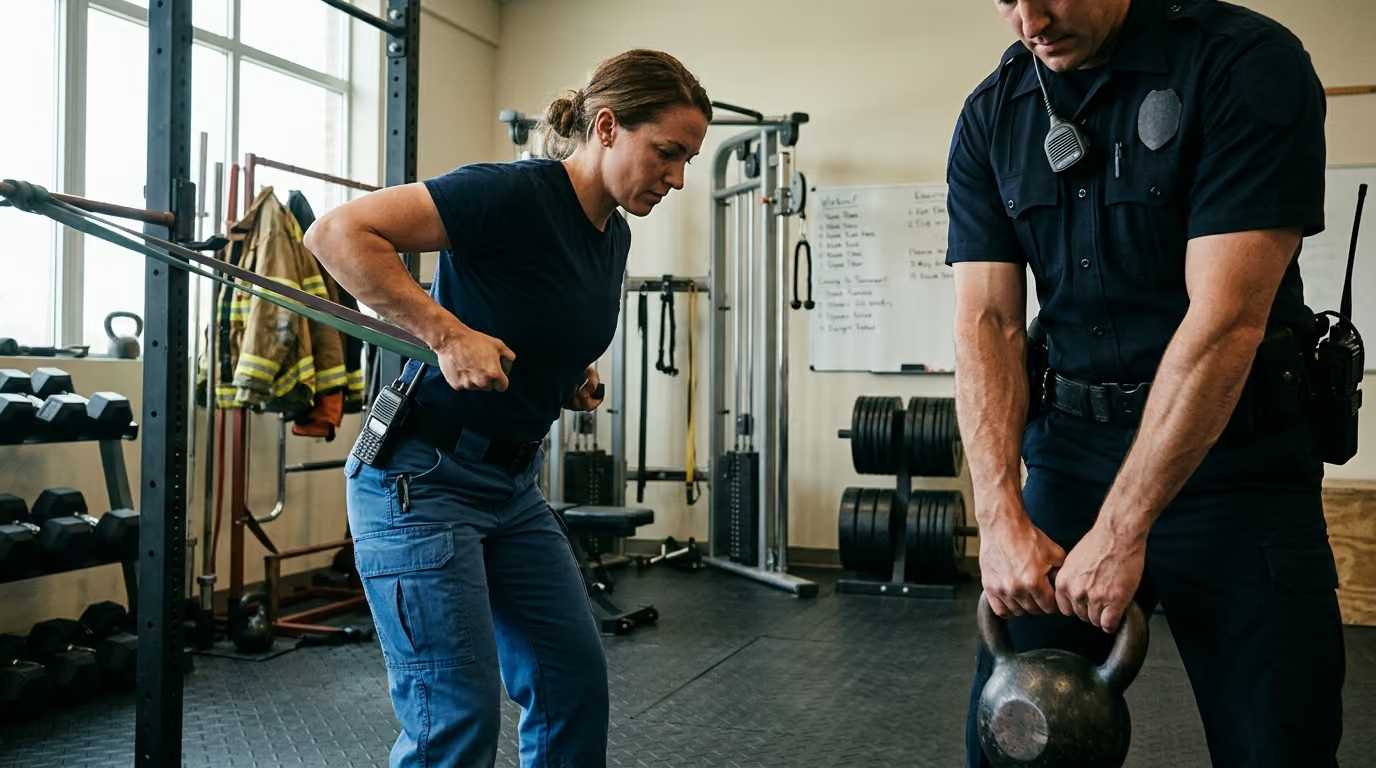

Carrying loaded stretchers and raising heavy ladders safely requires a structured grip training framework to build operational strength and prevent duty injuries.





You are six minutes into dragging charged four-inch supply line across asphalt, or navigating a bariatric stretcher down a narrow flight of stairs in the rain. Your legs still have drive and your breathing is controlled, but your fingers are opening against your will. The tool handle begins to twist in your palm, your forearms burn with intense fatigue, and your control over the load slips.
This scenario illustrates a common breakdown point in emergency operations. Hand and forearm fatigue frequently limits operational capability before larger muscle groups fail. Building dependable grip performance requires more than squeezing a spring gripper during station downtime. It requires an organized approach to maximal strength, sustained endurance, tendon health and multi-planar wrist control.
Operational grip strength is the capacity to apply, sustain and repeat force through the hands across unpredictable environments while wearing protective gear. A high score on a standard hand dynamometer is helpful, but it does not guarantee duty readiness. First responders require a balanced combination of crushing strength, support grip endurance, pinch control, wrist stability and forearm rotation.
To build reliable capacity without causing tendon irritation, train your hands through five distinct layers. Combine tissue preparation, heavy compound carries, timed endurance holds, multi-directional wrist exercises and job-specific simulation. Progress your training volume gradually by adjusting only one variable at a time. Protect your recovery by coordinating training intensity with your shift schedule and operational call volume.
Research in occupational physiology confirms that grip strength correlates with field performance across several first responder tasks. Systematic reviews show an inverse relationship between handgrip strength and the time required to complete firefighter physical ability tests. Stronger grip measurements correlate with faster completion times during charged hose drags, equipment carries, ladder raises and victim rescue simulations.
The reported correlation between grip strength and simulated firefighter task completion is approximately R = -0.421. For specific tasks like the charged hose drag, the relationship is approximately R = -0.378. These figures indicate a moderate, meaningful relationship. Grip strength is a clear contributor to operational speed, but it does not determine performance entirely on its own. It acts as one critical link in a complete physical chain that includes trunk stability, leg power and cardiovascular stamina.
Occupational health surveillance from the Centers for Disease Control and Prevention highlights the vulnerability of the upper extremities in emergency services. CDC data indicates that police officers experience approximately 8.5 injuries per 100 full-time workers, while career firefighters experience 7.4 injuries per 100 workers. Sprains and strains represent the leading injury category across fire, police and EMS personnel, making up 33 to 41 percent of all reported injuries.
Workers compensation analyses in Washington State reveal that nearly 40 percent of all firefighter claims stem from work-related musculoskeletal disorders. The primary sources of these claims include handling patients, managing heavy equipment, raising ladders and pulling hoses. In emergency medical services, hand injuries account for approximately 16 percent of all occupational injuries, with the rest of the upper extremity accounting for another 16 percent. Developing tissue capacity in the forearms and wrists is both a performance asset and a necessary strategy for long-term musculoskeletal health. You can review broader research on first responder strength and duty fitness to understand how these qualities integrate into complete physical preparation.
Every branch of emergency services places distinct physical demands on the hands, wrists and forearms. Understanding these specific demands prevents trainees from relying on one-dimensional gym exercises that fail to transfer to the street.
Firefighters operate under severe environmental constraints, including intense heat, thick smoke, water exposure and heavy protective clothing. Structural firefighting gloves reduce tactile feedback and increase the effort needed to maintain a secure hold on equipment.
Primary hand and forearm demands in the fire service include:
Hose advancement requires a combination of continuous support grip, sudden high-force pulling and multi-directional wrist stabilization. Treating hose work as a simple static hold ignores the reality of dynamic movement, uneven terrain and sudden shifts in line pressure.
Law enforcement professionals experience long periods of low physical activity punctuated by sudden, explosive physical encounters. Officers must transition from sitting in a patrol vehicle to applying maximal gripping force within seconds.
Key operational demands for police officers include:
Physical exhaustion frequently compounds these physical encounters. Research on workforce fatigue and physical exhaustion in policing shows how extended shifts and sleep disruption impair physical output and recovery capacity. Police forearm training must develop rapid force development alongside tissue resilience against sudden twisting and torque.
Emergency medical technicians and paramedics face some of the highest cumulative lifting demands in public safety. EMS providers regularly lift and carry heavy loads in awkward, confined environments with minimal mechanical advantage.
Primary hand and forearm stressors for EMS personnel include:
Research examining hospital and emergency workers demonstrates that patient handling is a major driver of work-related musculoskeletal disorders. In EMS, stretcher operations require sustained support grip paired with dynamic wrist extension and radial deviation. When forearm endurance fails, the physical load shifts immediately to the lower back and shoulders, increasing injury risk across the kinetic chain.
To construct an effective training program, you must separate hand strength into distinct functional categories. A balanced training plan addresses each of these components rather than relying on a single movement pattern.
Crush grip is the force produced when your fingers close firmly against your palm against resistance. You use crush grip when squeezing a hand dynamometer, gripping a halligan bar, swinging a sledgehammer or applying an empty-hand control hold. Crush grip relies heavily on the flexor digitorum profundus and superficialis muscles in the anterior forearm.
Support grip is your ability to maintain a hold on an object for an extended duration. This quality dictates how long you can carry equipment, hold a charged hose bundle or suspend a loaded stretcher. Support grip requires sustained isometric endurance from the finger flexors and relies heavily on local aerobic capacity within the forearm musculature.
Pinch grip occurs when you apply force between your thumb and the tips or pads of your fingers without palm contact. This includes dynamic pinches, like manipulating small valves and buckles, and static pinches, like gripping equipment edges or backboards. Pinch strength depends heavily on the thenar muscles of the thumb and the adductor pollicis.
Open-hand grip occurs when you hold an object with a diameter so large that your fingers cannot fully wrap around it to touch your thumb. Examples include thick structural hose lines, large equipment handles, rescue mannequins and oversized tool grips. Open-hand gripping places extreme mechanical demands on the finger flexors at long muscle lengths, making it far more fatiguing than standard handle gripping.
Precision grip is the ability to perform coordinated, fine-motor tasks with individual fingers while maintaining control under pressure. First responders use precision grip when securing airway adjuncts, starting intravenous lines, typing incident reports and operating radio dials with cold or gloved hands. Training must preserve finger dexterity and tactile control rather than producing stiff, swollen hands.
The wrist joint links the hand to the rest of the upper extremity. In operational settings, the wrist rarely moves through large ranges of motion under heavy load. Instead, it must resist unwanted movement across several planes:
Training must build isometric stiffness in neutral alignment alongside controlled strength through a full range of motion.
Developing durable grip performance requires an organized training progression. This five-layer framework provides a systematic structure for building strength, endurance and tissue resilience without overloading sensitive tendons.
The first layer establishes joint mobility, increases local blood flow and prepares the connective tissues of the fingers, wrists and elbows for mechanical loading. Spend three to five minutes on tissue preparation before beginning demanding upper-body or grip training.
Effective preparation exercises include:
Tissue preparation warms the tendons and synovial fluid. It provides a safe bridge from resting conditions to high-load training, reducing initial strain on tendon insertion points.
Maximal strength increases the absolute ceiling of force your hands can generate. A higher strength ceiling reduces the relative percentage of effort required to manage standard operational loads. When lifting a 70-pound equipment case requires only 40 percent of your maximal capacity instead of 75 percent, your muscles fatigue much more slowly.
Standard resistance guidelines from the American College of Sports Medicine recommend that novices train with loads corresponding to an 8 to 12 repetition maximum. Intermediate and experienced lifters can progress toward heavier 1 to 6 repetition maximum loads using longer rest periods between sets.
Effective exercises for maximal grip force include:
Operational tasks rarely involve a single, three-second maximal squeeze. They demand sustained submaximal contractions or repeated cycles of gripping, releasing and re-gripping. Layer 3 develops local muscular endurance, capillary density and lactate clearance in the forearm muscles.
Endurance training parameters use light-to-moderate loads, longer time intervals and short rest periods. Useful Layer 3 methods include:
Endurance training should produce a deep muscular challenge without progressing to absolute failure on every set. Training to total failure creates excessive neural fatigue and can compromise safety during subsequent training or duty shifts.
Layer 4 addresses the smaller muscles of the forearm that control wrist motion and rotational torque. These muscles stabilize the wrist joint, allowing larger muscle groups in the back, chest and shoulders to transfer force cleanly into tools and equipment.
Clinical rehabilitation protocols for elbow and wrist tendinopathy emphasize targeted loading for the wrist flexors, extensors, pronators and supinators. Layer 4 incorporates these patterns systematically:
The final layer connects hand and forearm strength to realistic first responder movement patterns. This stage integrates grip demands with dynamic footwork, unstable surfaces, respiratory gear, heavy gloves and team communication.
Integration exercises include:
Task-specific integration should represent the final step in your progression. Never introduce high-speed, unpredictable occupational simulations until you have built a solid foundation in Layers 1 through 4. For more details on designing balanced programs, review our dedicated guide to evidence-based duty fitness and conditioning.
Building a practical training routine requires selecting exercises that deliver high operational transfer while minimizing joint wear. The following directory categorizes core grip movements alongside clear execution parameters.
Grip training should integrate smoothly into an overall strength and conditioning schedule. Because emergency personnel already experience heavy forearm loading during shift work, avoid excessive daily grip volume. A structured weekly template balances stimulation and recovery:
When progressing your training, follow the standard ACSM progression model. Increase external resistance by approximately 2 to 10 percent only after you can complete all target sets and repetitions with stable wrist mechanics and zero post-session joint pain.
First responders face unique scheduling challenges that complicate training recovery. Irregular 24-hour or 48-hour shifts, night calls, extreme heat and extended training academies place continuous mechanical stress on the hands and forearms.
A training session that is completely manageable after two days off can become an overloading stressor after a busy night shift with multiple heavy patient transfers. For this reason, adjust your grip training volume based on recent duty exposure:
Never treat duty shifts and gym workouts as separate, unrelated activities. Your tendons, ligaments and muscles experience cumulative mechanical stress regardless of whether that stress comes from a barbell, a fire hose or a heavy stretcher. Managing total weekly exposure is essential for maintaining long-term career longevity in emergency services.
Forearm and elbow overuse injuries, such as lateral elbow tendinopathy and medial epicondylalgia, represent common setbacks for first responders. These conditions develop when cumulative mechanical strain exceeds the adaptive capacity of tendon tissue over time.
Tendons adapt to mechanical loading much more slowly than skeletal muscle or neural pathways. When an emergency worker suddenly increases training volume, introduces aggressive thick-bar work or performs high-repetition forcible entry drills without adequate preparation, the applied load quickly outpaces tendon tolerance.
When tendon pain develops near the elbow or wrist, complete rest and immobilization are rarely effective long-term solutions. Tendons require controlled mechanical tension to stimulate collagen synthesis and restore load tolerance. Clinical practice guidelines for tendinopathy recommend temporary load modification rather than complete inactivity.
If you experience mild tendon irritation in your forearm or elbow, adopt a progressive, four-stage loading model:
Throughout this process, monitor your symptoms closely. Mild discomfort during exercise is acceptable if it does not exceed a baseline rating of 3 out of 10. However, if your pain escalates later that evening or remains elevated the following morning, reduce the volume or intensity of your next session. For broader strategies on managing occupational musculoskeletal strain, consult our practical guide to first responder injury recovery.
Objective testing helps identify performance gaps and tracks adaptation over time. Use these practical assessments to evaluate your operational hand and forearm capacity.
A calibrated hydraulic hand dynamometer provides a standardized baseline for maximal crush grip force.
This field test evaluates support grip endurance, trunk stability and carrying capacity under load.
This assessment measures open-hand grip stamina without the assistance of small handle grooves.
Evaluate your ability to maintain neutral wrist positions under dynamic loads.
Avoid these common training errors to maximize your physical progress and protect your joints from unnecessary wear.
A high score on a hand dynamometer measures only a single, static crush contraction in a controlled position. It does not reflect your ability to drag a charged line, stabilize a twisting tool or handle a stretcher for twenty minutes in the cold. Dynamometer strength is a foundational baseline, not a complete measure of operational readiness.
Your forearms work continuously during daily life, station chores and emergency responses. Adding daily high-intensity grip workouts to failure rapidly overloads forearm tendons and impairs nervous system recovery. Limit high-intensity grip training to two or three targeted sessions per week.
While static hangs and carries develop support grip, operational duty frequently demands dynamic wrist movement, forearm rotation and rapid grip-and-release cycles. Incorporate dynamic wrist curls, lever rotations and task-specific simulations alongside static holds.
Emergency personnel spend thousands of hours gripping steering wheels, stretchers, hand tools and weapons. Neglecting the finger extensor muscles creates severe muscular imbalances that can contribute to chronic elbow pain. Train finger extension against resistance bands regularly to maintain joint balance.
Heavy structural firefighting gloves or insulated winter gloves dramatically increase handle diameter and reduce surface friction. This forces your forearm muscles to generate substantially more force to maintain a secure hold. Occasionally incorporate glove training during Layer 3 and Layer 5 sessions to prepare your neuromuscular system for duty conditions.
Forearm straps and wrist braces can provide short-term symptom relief during acute flare-ups by altering mechanical force distribution. However, passive supports do not rebuild tissue capacity or correct movement deficiencies. Use braces only as temporary bridging tools while completing active strengthening protocols.
These four operational scenarios illustrate how to apply the five-layer framework to solve specific performance limitations.
While training soreness and mild muscular fatigue are normal adaptations to physical exercise, certain symptoms require formal medical evaluation. Consult a licensed physical therapist, occupational therapist or sports medicine physician if you experience any of the following signs:
A licensed clinician can accurately diagnose underlying conditions, such as nerve compression syndromes, ligament tears or severe tendinopathy, and construct a personalized rehabilitation plan.
Building dependable hand, wrist and forearm capacity requires a comprehensive approach that extends far beyond simple hand squeezes. By systematically developing maximal strength, muscular endurance, multi-planar wrist control and tendon resilience, you create a robust physical foundation capable of handling unpredictable operational demands.
Sustainable capability comes from respecting tissue biology, progressing training volume intelligently, and balancing duty stress with deliberate physical recovery.
Review this guide whenever you experience forearm or elbow discomfort, prepare for a promotional physical assessment, transition into a specialized operational role, or notice your grip fatiguing prematurely during duty calls.
Consistent, progressive training of the hands and forearms protects your joints, preserves operational readiness, and supports a long, capable career in emergency services.
Stay connected for research-led guidance on duty fitness, shift-work sleep, injury recovery, stress, nutrition and career longevity. Practical ideas for first responders who want to stay capable on the job, recover well and protect their health for the long run.



Read practical guidance on first responder fitness, recovery, sleep, nutrition and resilience for demanding work and a long, active career.
read the blog



