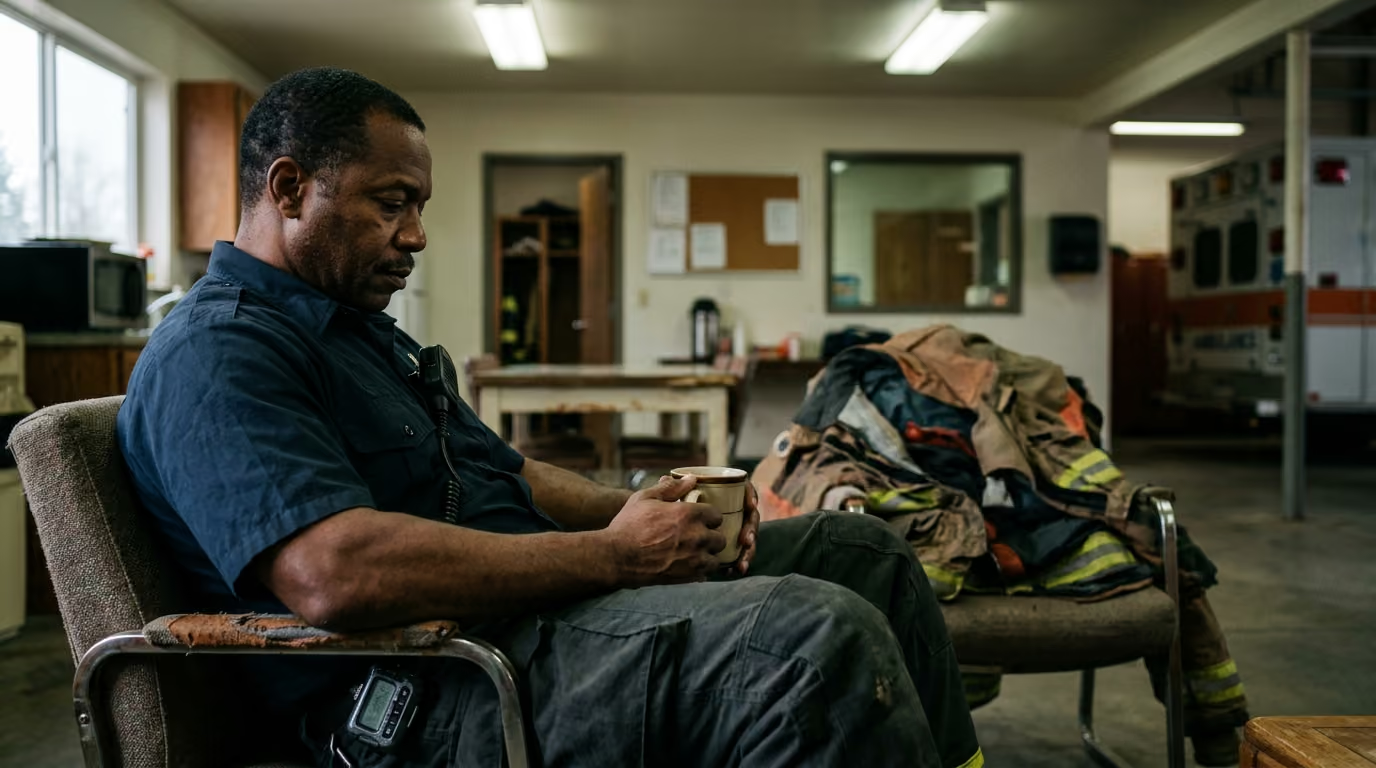

Scanning the exits in a crowded family restaurant drains vital energy, but mapping operational alertness levels helps first responders downshift safely into deep recovery.





If you or someone you know is in immediate danger, call 911. If you are experiencing a mental health crisis or thoughts of self-harm, call or text 988 to reach the Suicide & Crisis Lifeline (press 1 for the Veterans Crisis Line), or text 838255. In high-stress periods, reducing access to lethal means at home, such as locking away firearms or storing medications securely, should be arranged together with a trusted partner, peer, or clinician.
Most people assume that relaxing is an instinct that happens automatically once danger passes. For individuals in safety-critical occupations, relaxation often feels unnatural, reckless, and deeply unsafe. The human nervous system learns to equate constant alertness with survival, making the prospect of dropping your guard feel like negligence.
Understanding how to calibrate your alertness is not about forcing permanent calm. It is about building flexible arousal so your body can ramp up for genuine operational hazards and downshift fully when the danger is gone.
The quick answer to managing hypervigilance is learning to differentiate purposeful situational awareness from continuous threat monitoring. Situational awareness is active, flexible, and tied to real-time operational tasks. Hypervigilance is generalized, rigid, and persists long after a shift ends. Downshifting safely requires a structured physical transition, bounded safety checks, and deliberate communication rather than relying on willpower or sudden relaxation.
Alertness exists on a wide continuum rather than a simple on-off switch. In emergency response, military operations, and law enforcement, heightened vigilance is a necessary occupational skill. Detecting hazards quickly, anticipating risks, and preparing for rapid physical action protect both the individual and the crew.
Problems emerge when the brain overgeneralizes this protective strategy. When heightened scanning persists during off-duty hours, the nervous system begins to treat benign ambiguity as an immediate hazard. A sudden noise outside the house becomes an intruder. A delayed text message from a family member feels like a crisis. Silence in the living room feels like the precursor to an emergency.
In clinical diagnostics, persistent hypervigilance is classified under the altered arousal and reactivity symptom cluster of post-traumatic stress disorder (PTSD). Other symptoms in this cluster include exaggerated startle responses, irritability, concentration problems, reckless behavior, and sleep disturbances according to psychiatric diagnostic standards.
Hypervigilance on its own does not mean a person has PTSD. A formal diagnosis requires qualifying traumatic exposure, persistent symptoms across multiple clusters, and significant functional impairment lasting at least one month. Yet subclinical hypervigilance remains widespread among first responders, leading to cumulative fatigue, strained relationships, and impaired physical recovery.
Situational awareness is flexible, outward-looking, and driven by current task demands. It turns down when the environment is secure. Hypervigilance is internally driven, rigid, and consumes cognitive bandwidth even in safe environments.
Hypovigilance, or psychological shutdown, sits at the opposite end of the spectrum. When the nervous system remains in high arousal for too long, it eventually exhausts its resources. The person may become numb, detached, unmotivated, or dissociated.
Optimal alertness represents the capacity to move fluidly between these states based on the real requirements of the environment. The objective of recovery is not eliminating readiness. The objective is restoring your ability to choose your operational state deliberately.
Understanding your internal state requires a clear framework. Moving beyond a simplistic calm-versus-stressed binary gives you a practical vocabulary to evaluate where your nervous system is operating at any given moment.
At Level 1, the body directs energy toward physiological repair, tissue rebuilding, and cognitive consolidation. Breathing is slow and unforced, resting heart rate drops, muscle tension in the jaw and shoulders dissipates, and attention broadens.
A person in Level 1 is not unconscious or helpless. They remain oriented to their environment, but they are not actively running risk calculations. This state is essential for restorative sleep, cellular repair, and genuine downtime with family.
Level 2 represents active, calm engagement with daily life. Attention is open, flexible, and adaptive. You can track your surroundings while remaining fully present in casual conversation, parenting, driving in light traffic, or completing household tasks.
At this level, you can process incoming information without assuming hostile intent. If an unexpected event occurs, your system can transition smoothly into higher operational gears without panic.
Level 3 is the standard working state for hazardous environments, complex emergency scenes, weapons handling, or difficult driving conditions. Attention narrows intentionally toward task-relevant variables, checklists, and potential hazards.
Physiological arousal increases moderately to support rapid reaction times and tactical communication. The critical feature of Level 3 is that it remains bounded by the operational assignment. When the call ends, the professional should have the capacity to step down to Level 2 or Level 1.
Level 4 occurs during direct encounters with imminent physical danger, dynamic violent encounters, structural collapse, or mass-casualty incidents. Heart rate spikes, peripheral vision narrows into tunnel vision, auditory exclusion may occur, and fine motor skills diminish in favor of gross motor power.
This state is biologically designed for short-term survival. When Level 4 activation is triggered by false alarms, ambiguous domestic cues, or persistent off-duty paranoia, it places immense wear on the cardiovascular and endocrine systems.
At Level 5, the nervous system exceeds its capacity to process information effectively. The individual may experience extreme anger, freezing, cognitive paralysis, severe panic, or dissociation.
Working memory fails, and the brain struggles to distinguish past traumatic memories from the present environment. Remaining at or near Level 5 over prolonged periods causes severe burnout, profound physical exhaustion, and long-term health degradation.
Developing state matching is the core skill of occupational longevity. You must apply the level of alertness required by the immediate environment, keep that arousal tied to observable facts, and consciously step down the ladder once the threat is resolved.
Hypervigilance does not persist out of stubbornness; it persists because of a powerful behavioral reinforcement cycle. Understanding the mechanics of this loop helps you intervene before the cycle locks you into continuous distress.
The cycle begins with a trigger. External triggers include sudden loud noises, crowded spaces, sudden movements by strangers, or entering dark rooms. Internal triggers can be just as potent, including an elevated heart rate from caffeine, physical pain, fatigue, or intrusive operational memories.
Next comes the cognitive appraisal. The brain interprets the ambiguous cue as proof of active danger. In individuals with high operational exposure, the threshold for classifying ambiguity as danger is remarkably low.
Physiological arousal follows instantly. The sympathetic nervous system floods the bloodstream with catecholamines, accelerating heart rate, tightening the diaphragm, and increasing muscle tension across the back, neck, and extremities.
To resolve the intense physical discomfort of arousal, the person performs a safety behavior. They may scan the parking lot repeatedly, demand a restaurant table facing the door, interrogate family members about locked doors, avoid social gatherings, or check security cameras repeatedly.
The safety behavior produces immediate, short-term emotional relief. The uncertainty temporarily subsides, and the brain registers a brief reduction in panic.
This short-term relief is the trap. The nervous system makes a false causal connection: it assumes that because you scanned the room or checked the lock four times, catastrophe was avoided. The brain learns that checking was the sole reason you survived.
The next time an ambiguous cue appears, the urge to execute safety behaviors becomes even stronger. Over time, these behaviors expand, consuming more time and energy while providing progressively shorter windows of relief.
Breaking this loop does not mean ignoring real danger. It requires distinguishing between task-linked safety actions and anxiety-linked safety behaviors.
Task-linked actions are objective, defined by standard operating procedures, proportionate to the actual environment, and finished when the protocol is complete. Anxiety-linked behaviors are open-ended, expanding, repetitive, and performed solely to manufacture an internal feeling of certainty.
Sleep disturbance is one of the most prominent consequences of sustained hypervigilance. Sleep and psychological arousal share an intimate, bidirectional relationship. When your brain believes the perimeter is insecure, it will not permit deep, restorative sleep.
Physiological studies demonstrate that anxiety-related sleep disruption involves cortical hyperarousal, fragmented sleep architecture, reductions in slow-wave delta sleep, and altered rapid eye movement (REM) patterns according to clinical sleep reviews. When the sympathetic nervous system remains engaged, sleep becomes light, broken, and unrefreshing.
This interaction creates a severe daily cycle:
A systematic review of daily-diary research established that poorer sleep quality directly predicts increased trauma and stress symptoms the following day, while heightened daytime arousal predicts nightmares and insomnia that night. Breaking this cycle is essential for long-term health and operational capability.
For many first responders, bedtime itself becomes a threat cue. Sleep requires surrendering conscious control and sensory monitoring. If you associate resting with vulnerability, your brain will produce a surge of arousal every time you begin to drift off.
Research specifically examining emergency personnel shows that fear of sleep is strongly linked to hyperarousal symptoms and trauma-related nightmares, independent of general insomnia severity. Responders often report feeling that falling asleep leaves their family unprotected or makes them vulnerable to being caught off guard.
Furthermore, medical conditions must not be overlooked. Obstructive sleep apnea (OSA) frequently co-occurs with operational stress and shift work. Upper airway collapses cause micro-arousals throughout the night, triggering adrenaline surges that mimic psychological panic.
If you experience loud snoring, observed pauses in breathing, morning headaches, or severe daytime sleepiness, seeking a medical evaluation and sleep study is critical. Treating underlying sleep apnea with continuous positive airway pressure (CPAP) can dramatically lower baseline daytime anxiety and nocturnal hyperarousal.
When addressing non-respiratory sleep disruption, Cognitive Behavioral Therapy for Insomnia (CBT-I) represents the gold standard clinical intervention. CBT-I is not basic sleep hygiene advice like keeping the room cool or avoiding screens. It is a structured psychological protocol designed to retrain conditioned arousal, eliminate catastrophic beliefs about sleep loss, and restore healthy sleep drive.
To improve sleep readiness on demanding schedules, explore practical habits in our shift work and sleep resource section.
Chronic hypervigilance exacts a heavy toll on personal relationships. When you operate in a permanent state of defensive readiness, family life can feel chaotic, unpredictable, and frustrating.
Elevated physiological arousal drastically lowers the threshold for irritability and anger. Neutral comments from a partner may be interpreted as criticism or disrespect. Small household disruptions, like toys left on the floor or doors left unlocked, are treated as severe operational failures.
Spouses and children often feel monitored, managed, and controlled rather than supported. A responder might insist on controlling travel routes, dictating where family members sit in public spaces, or interrogating household members about their schedules.
Over time, this dynamic creates emotional distance. Intimacy requires emotional vulnerability and a release of guardedness, which feels intolerable to a hypervigilant nervous system. The individual becomes physically present at the dinner table but psychologically stationed on patrol.
Research indicates that occupational stress symptoms significantly impair household, interpersonal, and recreational functioning among first responders. When hypervigilance combines with shift-work fatigue, domestic conflict often escalates, reinforcing the responder's belief that their home environment is stressful and unstable.
Restoring healthy household dynamics requires treating hypervigilance as a shared physiological challenge rather than a personality defect. Clear, non-defensive communication bridges the gap between partners.
When you notice your defensive arousal spiking at home, use a structured communication model:
Couple-focused interventions have shown strong efficacy in reducing stress symptoms and improving relationship satisfaction in veterans and responders. Working together on regulation turns the home back into a recovery zone rather than an operational theater.
The human nervous system does not instantly clear stress hormones the moment you clock out. When you leave the station or precinct, your brain continues running background algorithms to anticipate incoming calls.
Without a deliberate end-of-shift protocol, you carry residual tension straight into your living room. Implementing a standardized decompression sequence signals to your biology that the operational period has officially closed.
To support rapid recovery during active duty, utilize the between call reset strategy for acute stress during demanding shifts.
When you have only a moment between critical calls or before stepping into your vehicle at the end of a shift, execute this brief grounding sequence:
For additional micro-practices that fit within operational windows, review our guide on practical 90-second grounding techniques.
Before entering your home, follow a systematic 10-minute downshifting process:
You do not need to choose between total oblivious relaxation and exhausting hypervigilance. Bounded awareness allows you to remain prudent while eliminating continuous threat monitoring.
When entering a restaurant or public venue, take five seconds to observe the room, identify primary and secondary exits, and select a comfortable seat. Once that brief assessment is complete, consciously direct your attention to your companions, your food, or your immediate conversation.
If an urge arises to continuously scan every patron entering the doorway, recognize that urge as anxiety seeking certainty rather than a necessary tactical action. Remind yourself that you have already identified your exit path and that your baseline readiness is sufficient to react if a true anomaly occurs.
When attempting to manage chronic arousal, individuals often adopt strategies that seem helpful in the moment but worsen the problem over time.
Demanding that an activated person immediately sit still, close their eyes, and empty their mind frequently backfires. For a nervous system wired for danger, sensory deprivation and loss of environmental contact feel terrifying.
Forced meditation can provoke acute spikes in anxiety, agitation, or intrusive thoughts. Effective downshifting should begin with active, eyes-open grounding, physical movement, light stretching, or focused physical tasks before attempting passive rest.
While mindfulness interventions demonstrate value in reducing post-traumatic stress in research trials, practices should be adapted sensibly for high-arousal populations.
Using alcohol as a nightly sedative is one of the most common coping strategies in emergency services. Alcohol acts on GABA receptors to temporarily blunt central nervous system arousal, providing the illusion of rapid relaxation.
However, alcohol severely disrupts sleep architecture, suppresses restorative slow-wave and REM sleep, elevates nighttime heart rate, and causes rebound anxiety the following morning. This chemical rebound amplifies hypervigilance during the next shift, driving further substance use.
Repeatedly asking family members if doors are locked, checking surveillance apps dozens of times per evening, or requiring partners to confirm that everything is fine feeds the anxiety loop. Reassurance provides a brief emotional band-aid while strengthening the underlying belief that danger is imminent.
Commit to a single, agreed-upon household security routine each evening, and practice tolerating the residual discomfort without re-checking.
Irritability and outbursts are physiological symptoms of high sympathetic tone, not merely character flaws. However, using stress as an excuse for destructive or intimidating behavior destroys trust at home and work.
Learn to recognize the early physical indicators of arousal, such as a tight throat, clenched fists, or shallow breathing, and step away to regulate your biology before engaging in difficult discussions.
Building robust mental and physical capacity requires addressing foundational health. Explore our articles on stress resilience and mental performance for broader insights into systemic recovery.
Downshifting techniques must never be applied in environments where high alertness is genuinely required for life safety.
Maintaining long-term performance requires balancing duty demands with biological restoration. Read more about sustainable operational health in our career longevity guide.
Self-regulation strategies and structured transition routines are vital tools, but they have distinct limits. When the nervous system has been repeatedly exposed to severe trauma, moral distress, or chronic circadian disruption, professional clinical care is essential.
You should seek an evaluation from a licensed mental health professional or physician specializing in first responder or military populations if you experience any of the following patterns:
Evidence-based clinical treatments for trauma-related arousal are highly effective. Prolonged Exposure (PE), Cognitive Processing Therapy (CPT), and Eye Movement Desensitization and Reprocessing (EMDR) are established protocols designed to help the brain reprocess traumatic memories.
When sleep is the primary challenge, CBT-I provides structured behavioral resolution without long-term reliance on sedative medications.
A comprehensive medical examination is equally critical. Thyroid dysfunction, cardiovascular strain, chronic pain syndromes, systemic inflammation, and obstructive sleep apnea can all trigger or amplify persistent hyperarousal. Professional intervention is not a sign of career failure; it is an essential maintenance protocol for occupational survival.
Hypervigilance is not an enemy to be eliminated with aggressive willpower. It is a powerful, protective biological mechanism that has simply lost its calibration after repeated exposure to operational hazards.
True readiness is not defined by living in a constant state of alarm. True readiness is defined by the agility of your nervous system, the ability to mobilize instantly to meet severe challenges, and the equal ability to stand down fully to allow deep physical and psychological repair.
Calibrating your alertness preserves your operational edge on duty while protecting your health, your family, and your life after the uniform comes off.
Stay connected for research-led guidance on duty fitness, shift-work sleep, injury recovery, stress, nutrition and career longevity. Practical ideas for first responders who want to stay capable on the job, recover well and protect their health for the long run.



Read practical guidance on first responder fitness, recovery, sleep, nutrition and resilience for demanding work and a long, active career.
read the blog



