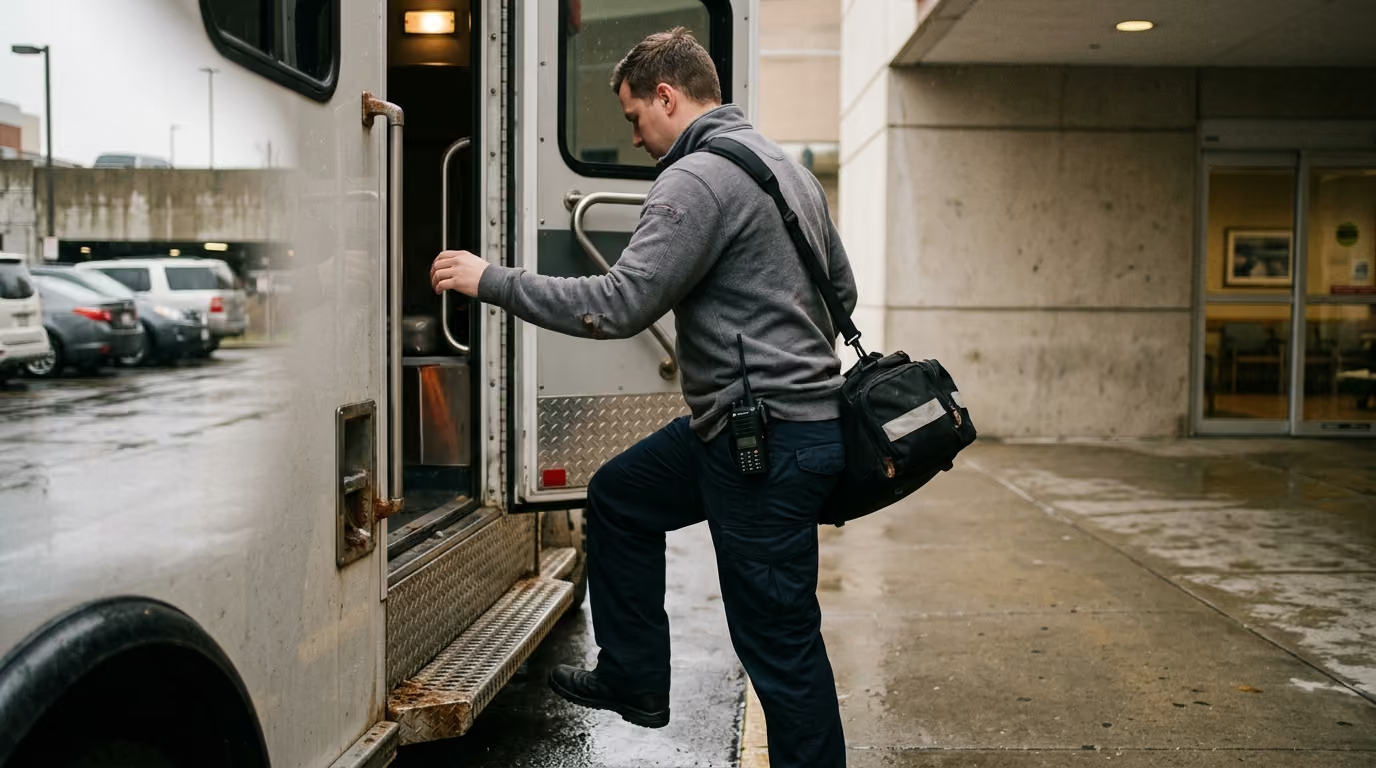

Emergency responder injuries often seem unpredictable, but systematic risk management, biomechanics training, and gear maintenance prevent high-consequence slips, trips, and falls.





Most agencies treat slips, trips and falls as minor clumsiness or basic station housekeeping issues. That view is dangerous. In emergency services, a sudden loss of balance is a severe kinetic event that interacts with heavy gear, compromised vision, unstable surfaces, and acute fatigue. Preventing these incidents requires an operational system rather than a simple warning to watch your step.
A comprehensive prevention framework integrates physical preparation, footwear standards, proactive surface management, environmental lighting, and task-level route planning. When emergency responders control these variables together, they reduce career-threatening joint injuries and maintain operational capability.
The numbers collected across emergency services reveal that falls are neither rare nor harmless. According to data from the National Fire Protection Association (NFPA), falls, jumps, slips, and trips accounted for 22% of fireground injuries in 2024. This made them the second most common injury mechanism on the fireground, surpassed only by overexertion and strain at 27%.
The United States Fire Administration (USFA) documented that firefighter injuries are not isolated to active fire attack. In an analysis of firefighter injury patterns, USFA reported that 42% of injuries occurred on the fireground, 21% occurred at non-fire emergencies, 16% happened during station activities, 14% occurred during training, and 8% took place while responding to or returning from calls. A National Institute of Standards and Technology (NIST) analysis of fire service data identified overexertion and strain as 27.1% of injuries, followed by falls, jumps, and slips at 21.0%.
In law enforcement, lower-extremity trauma frequently stems from balance loss during dynamic movement. A retrospective cohort study of state police personnel found that slips, trips, and falls were the leading cause of lower-extremity injuries, accounting for 37.8% of cases. An extensive analysis of 50,793 Ohio law-enforcement workers' compensation claims from 2001 through 2019 showed that falls, slips, and trips represented 17.9% of all claims, second only to violent interactions at 34%. For mounted officers, research indicates that falls represent the primary injury mechanism at 23.8%, compared to 16.0% among non-mounted officers.
In emergency medical services, falls and trips interact directly with patient handling and stretcher transport. EMS personnel must routinely carry diagnostic monitors, jump bags, and heavy stretch
ers across compromised terrain while walking backward or navigating dark, cluttered domestic environments. These combined physical stressors turn ordinary tripping hazards into multi-casualty incidents that damage both the responder and the patient.
To implement effective controls, agencies must distinguish among five specific mechanical events:
Human balance relies on continuous sensory feedback from three integrated systems: the visual system, the vestibular system, and the proprioceptive network in our joints and muscles. When an individual walks unencumbered, the brain predicts footfall trajectories and makes sub-second micro-adjustments. When emergency responders don protective ensembles, every component of this balance loop is altered.
Turnout gear and self-contained breathing apparatus (SCBA) add between 17 and 25 kilograms of dead weight to a firefighter. This massive load raises the body center of mass and shifts it upward and backward away from the spine. Research into firefighter biomechanics shows that wearing heavy SCBA cylinders significantly degrades dynamic stability, reduces stride length, and alters baseline gait parameters.
Law enforcement duty belts, ballistic vests, and plate carriers impose a similar mechanical penalty. A loaded duty belt places significant weight directly across the iliac crests, restricting pelvic rotation and altering normal hip extension during running or stair climbing. When an officer steps into a pothole or hits an icy patch, the restricted hip mechanics limit the rapid compensatory stepping required to regain upright stability.
Personal protective equipment also impairs sensory perception. SCBA face masks and riot visors severely restrict the downward visual field, preventing responders from seeing surface transitions directly ahead of their feet. Structural firefighting gloves eliminate tactile feedback, making it difficult to grip handrails with standard reflexive grip pressure.
Fatigue acts as a force multiplier across these biomechanical deficits. Extended structural firefighting, prolonged foot pursuits, or multiple back-to-back EMS transports deplete muscle glycogen and impair neuromuscular firing rates. Studies show that after just 20 minutes of strenuous emergency tasks, personnel exhibit higher rates of movement errors and an inability to correct sudden postural disturbances. Addressing these issues requires systematic injury prevention and physical recovery protocols designed around operational realities.
Emergency service environments are unpredictable, but fall risks follow consistent physical patterns. Agencies can evaluate operational safety by applying a standard model: Risk equals Hazard multiplied by Exposure multiplied by Consequence.
The hazard represents the physical condition of the walking surface. The exposure represents how frequently, how fast, and under what operational loads responders must traverse that surface. The consequence represents the kinetic trauma and operational failure that follow a balance loss.
Before committing personnel across a hazardous access route, team leaders and individual responders should conduct a rapid ten-point dynamic assessment:
Applying this dynamic assessment prevents responders from blindly rushing through dangerous surface transitions. A five-second pause to evaluate footing preserves operational momentum far better than recovering from a dropped stretcher or a broken fibula.
Station environments account for a substantial percentage of all off-scene emergency service injuries. The combination of polished sealed concrete, high vehicular traffic, water drainage, and urgent physical transitions creates persistent slip hazards. Maintaining pristine walking-working surfaces in station facilities is an operational necessity.
Apparatus bays represent the single greatest indoor risk area. Bays feature smooth concrete engineered for heavy apparatus loads, but these floors become frictionless when wet from truck washing, vehicle exhaust condensation, or tracked-in winter slush.
Apparatus bay safety requires strict engineering and housekeeping controls:
Stairways inside stations and administrative facilities demand rigid operational discipline. Station stairs must have slip-resistant nosing, unbroken handrails on both sides, and high-lumen, glare-free illumination. Responders should never run down staircases during alarm activations.
OSHA regulations and safety standards firmly warn against jumping from elevated surfaces. Jumping from the cab, tailboard, or hose bed of a fire engine multiplies the impact forces traveling through the ankles, knees, and lumbar spine by up to seven times body weight. When an individual jumps onto a wet bay floor while carrying gear, the likelihood of an acute ligament rupture or slip-induced fall is extreme. Responders must maintain three points of contact when mounting or dismounting any apparatus.
Emergency operational scenes present dynamic footing hazards that evolve continuously. Effective fall prevention requires tailoring movement tactics to the unique physical conditions encountered across fire, police, and EMS operations.
Firegrounds are saturated with water, aqueous film-forming foams, fine glass fragments, charred structural debris, and charged hose lines. When winter temperatures drop below freezing, fire scenes rapidly transform into sheets of uneven ice. In these conditions, managing the physical pathway is a core operational task.
Firefighters must establish structured hose line management. Attack and supply lines should be pushed to the sides of entry pathways rather than allowed to cross access porches, narrow hallways, or exterior stairs. Exterior scene lighting must be angled downward toward walking routes rather than aimed straight at building facades, which creates blinding glare for approaching crews.
When exiting an interior structural fire, firefighters face intense fatigue, elevated core body temperatures, and wet outer shells. A NIOSH Fire Fighter Fatality Investigation report documented a fatal incident where a firefighter fell into active roadway traffic while working around an apparatus, highlighting how close balance loss is to catastrophic outcomes. The transition from crawling to standing must be deliberate, and egress paths should be verified before personnel move back to the apparatus.
Police officers operate in complex outdoor and urban environments where suspect behavior, crowd dynamics, and low-light conditions consume visual attention. A high percentage of officer injuries occur during foot pursuits, vehicle searches along highway shoulders, and rapid perimeter deployments.
Officers must train themselves to maintain continuous peripheral scanning of the terrain. During traffic stops, an officer should inspect the road shoulder, drainage ditches, and curb lips before stepping out of the cruiser. Stepping onto loose gravel, eroded asphalt edges, or hidden drainage channels at night can produce immediate ankle fractures or cause an officer to fall backward toward moving traffic lanes.
Mounted police units represent a unique operating category with substantial fall exposure. Mounted officers face the risk of unexpected animal movement, saddle slips, and falls from heights exceeding two meters. Managing these risks involves daily tack inspections, rigorous equine desensitization training, and choosing stirrups with quick-release mechanisms to prevent foot entrapment during a horse fall.
Emergency medical personnel face severe fall hazards because patient handling demands split attention. When moving a loaded stretcher down a driveway or carrying a stair chair, providers often walk backward or laterally while managing asymmetric weight.
EMS crews should implement strict movement protocols:
Treating patient urgency as an excuse to ignore footing is a critical error. If an EMS provider trips and drops a stretcher, the patient suffers secondary trauma, the provider sustains an orthopedic injury, and delivery of definitive care is delayed.
Footwear serves as the sole mechanical interface between the responder and the walking surface. No single boot outsole provides universal traction across all environments, but selecting appropriate footwear significantly mitigates risk.
Footwear programs must implement strict retirement criteria. Outsoles that show worn-down tread patterns, hardened rubber compounds from aging, or lateral heel breakdown must be replaced immediately. Responders should clean their boot treads regularly, as packed mud, gravel, and grease turn deeply lugged soles into slick, flat surfaces.
Personal protective equipment configurations should be reviewed for balance impact. Heavy gear loads alter baseline physical mechanics, making operational duty fitness an essential countermeasure. SCBA harnesses should be cinched tightly to keep the cylinder snug against the spine, minimizing dynamic load shifts when turning or crouching.
Lighting tools must be evaluated based on how they affect hand availability. While head-mounted lights follow head orientation, they often wash out surface textures and fail to illuminate the ground near the feet. Right-angle chest lights provide consistent, low-angle ground illumination, casting shadows behind surface ridges and revealing trip hazards without occupying a responder's hands.
Navigating unimproved outdoor terrain requires deliberate modifications to walking technique. Responders operating on wet grass, steep slopes, loose shale, or icy driveways should adopt the shortened-stride gait pattern.
Outdoor operations at night present hidden topography changes. Personnel must scan for side-hill slopes, soft utility trenches, and tree roots covered by autumn leaves. Portable floodlights should be deployed low to the ground to cast shadows that highlight depression changes in natural turf.
Stairways represent the highest-risk structural feature encountered during duty operations. Biomechanical research confirms that stair descent places far higher demands on joint stability and sensory control than stair ascent. A slight misstep on a descending stair can lead to uncontrolled momentum and a catastrophic fall from height.
When descending unfamiliar stairs in full gear or low visibility, responders should slow their descent pace significantly. Keeping the hand sliding along the rail provides a continuous spatial reference point, allowing instant physical recovery if a tread edge gives way.
Physical preparation is an active control against slip, trip, and fall injuries. A body capable of absorbing sudden perturbations, generating rapid stabilizing force, and controlling off-center loads is far more likely to recover from a near stumble without injury.
Responders need targeted training that develops single-leg stability, ankle proprioception, hip strength, and anti-rotational core stiffness. Traditional bilateral machine training fails to prepare the body for the dynamic, multi-directional slips encountered in the field.
Ankle mobility is critical for adjusting to uneven terrain. Stiff ankles force the knee and hip to compensate, reducing the body's ability to react to sudden ground shifts. Daily mobility work targeting the calves and Achilles tendons helps restore the dorsiflexion range required to navigate curbs and slopes safely.
Conditioning must also address operational fatigue. High rates of physical exhaustion among law enforcement officers and prolonged structural firefighting deplete the central nervous system, slowing muscular reaction times. Regular aerobic conditioning, structured sleep protocols, and adequate on-scene hydration maintain the neuromuscular responsiveness needed to prevent late-incident falls.
A comprehensive slip, trip, and fall prevention program requires robust safety reporting. Most serious fall injuries are preceded by dozens of unrecorded near misses. When an agency captures and analyzes near-miss data, it can eliminate hazards before a disabling injury occurs.
Agencies should maintain a frictionless, non-punitive near-miss reporting system. Reports must document the exact location, surface conditions, lighting quality, footwear worn, and load carried during the event. If multiple crew members report slipping on a specific bay floor transition or tripping over an unmarked station step, facility managers must immediately install traction strips, improve drainage, or upgrade lighting.
When a fall occurs, agencies must enforce strict evaluation protocols. The adrenaline surge of an emergency call often masks soft-tissue tears, ligament sprains, and concussions. Responders often attempt to push through the pain, only to suffer a worse reinjury later in the shift.
Following any significant fall, the responder should be screened for red flag symptoms:
If any of these red flags are present, the responder must be removed from active duty immediately and referred to a licensed medical professional for comprehensive clinical evaluation. Rushing an injured responder back into high-risk operational environments compromises the entire crew. Following structured injury recovery protocols ensures that personnel regain complete joint stability and proprioceptive control before returning to full duty.
Preventing slips, trips, and falls across an entire career requires translating safety principles into automatic daily habits. Elite performance is not defined by reckless speed, but by controlled, sustainable movement under challenging operational conditions.
By taking charge of facility maintenance, mastering movement mechanics in heavy protective gear, and maintaining physical readiness, emergency responders protect their careers and secure their long-term health.
Protecting your balance preserves your readiness, protects your team, and safeguards your physical capability throughout your career and into retirement.
Stay connected for research-led guidance on duty fitness, shift-work sleep, injury recovery, stress, nutrition and career longevity. Practical ideas for first responders who want to stay capable on the job, recover well and protect their health for the long run.



Read practical guidance on first responder fitness, recovery, sleep, nutrition and resilience for demanding work and a long, active career.
read the blog



