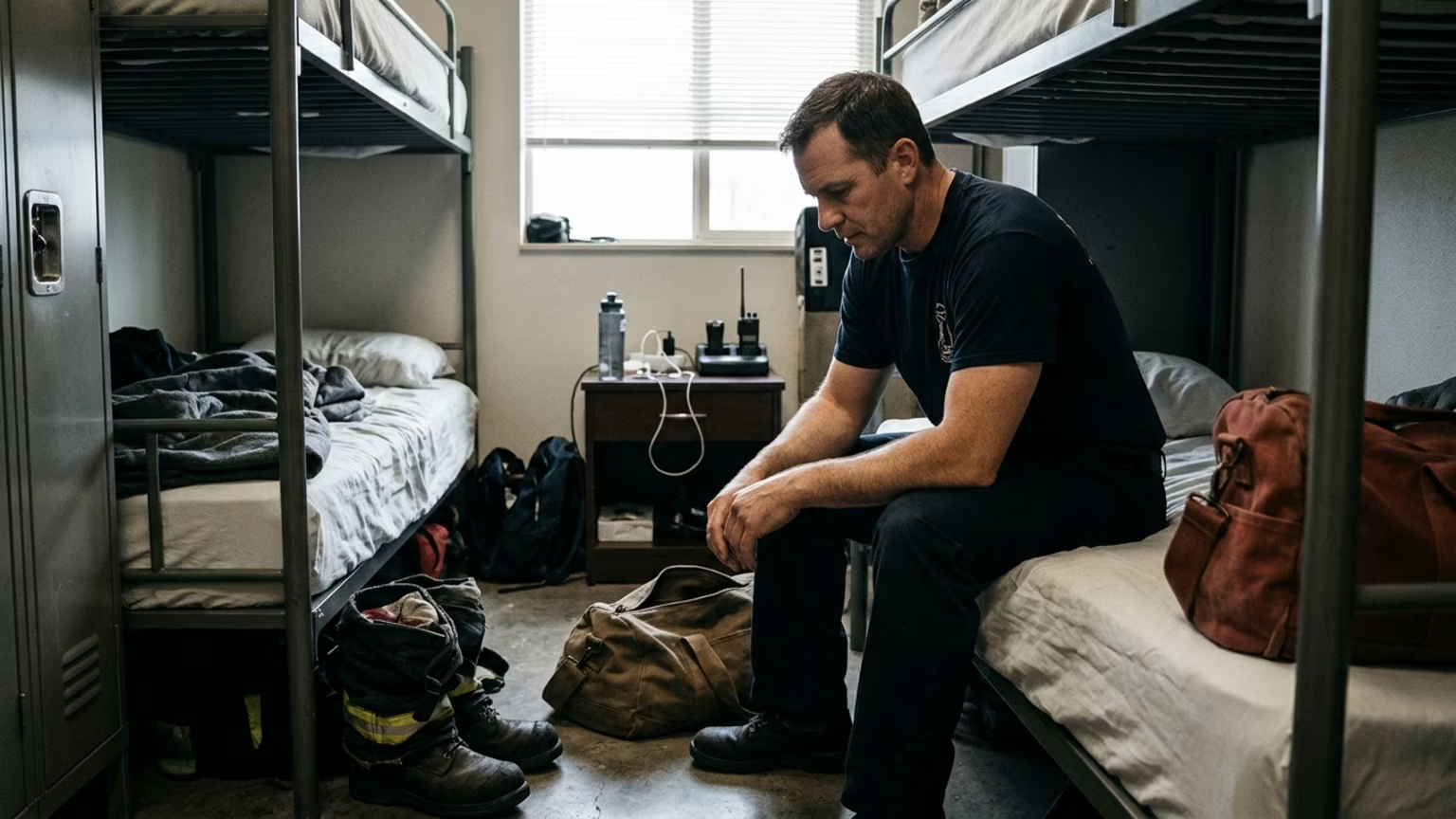

A counselor’s perspective on changes in sleep, mood and focus after emergency work, with context on trusted care and New York’s provider training.





If you are in immediate danger, call 911. For 24/7 support, call or text 988 and press 1 for the Veterans Crisis Line, or text 838255.
In an opinion piece published on October 28, 2026, licensed professional counselor Luanne Brookover examines what repeated emergency exposure may look like after duty ends. Her focus includes gradual changes in sleep and mood as well as concentration and relationships. Rather than waiting for an obvious crisis, she argues for recognizing changes early and making support easier to trust.
The distinction matters for emergency-service professionals trying to understand why work feels difficult to leave behind. Brookover’s message is not that exposure inevitably produces lasting harm. It is that changes in well-being deserve attention without being treated as evidence of professional failure.
Brookover’s article describes possible signs of distress that may build gradually rather than arrive as a single obvious event. These include:
Her discussion concerns law enforcement and fire personnel as well as emergency medical professionals and correctional officers. The central recommendation is to notice changes and make support more accessible through confidential care, knowledgeable providers and peer connections. Education and leadership messages that treat help-seeking as compatible with capability are also part of her argument.
This is practitioner commentary rather than a new study or clinical guideline. The article supplies no original research sample or prevalence estimates. The listed signs are possible indications of changed well-being, not proof of a diagnosis.
That evidence boundary determines how the piece should be used. It offers a counselor’s perspective on recognition and support rather than a measured estimate of how often these problems occur. Its organizational recommendations should be credited to Brookover rather than presented as interventions the article has tested.
Read on those terms, the commentary provides a useful starting point: pay attention to changes without assuming that repeated exposure affects every responder in the same way.
For a performance-and-recovery audience, the most relevant part of Brookover’s argument is its attention to ordinary life after duty. Sleep difficulty sits alongside concentration problems and strained relationships. The concern is broader than whether someone can maintain composure during a call.
That framing gives wellness discussions a wider purpose. A conversation about support can include how a responder is sleeping and whether work remains mentally present during time away. It does not have to be limited to what others can observe during a shift.
This also keeps capability from becoming the only measure of well-being. In Brookover’s account, first-responder culture may prize competence and self-reliance in ways that make acknowledging change difficult. She argues that recognizing a problem and seeking support can be expressions of strength rather than departures from it.
Rescuris’s coverage of duty demands alongside recovery places related questions within a broader performance context. Here, the practical translation is narrower: sleep and focus deserve a place in conversations about how someone is doing after work.
The goal is not to scrutinize every difficult evening. It is to make changes discussable before a responder feels required to present an obvious crisis as justification for asking for help.
A related development shows how one state is addressing the provider side of this discussion. On September 29, 2026, New York announced an online, one-hour awareness-level training for mental-health professionals working with or considering work with first responders.
According to the New York State Governor’s Office, the New York State First Responder Mental Health Needs Assessment included input from more than 6,000 emergency professionals. The announcement says the 2025 assessment found high levels of stress, burnout and mental-health challenges among more than half of respondents working in public-safety fields. It also identified a shortage of culturally competent mental-health professionals.
The announcement does not provide the underlying sampling method or a breakdown by profession. That finding belongs to the assessment’s respondents rather than serving as a national prevalence estimate.
The training addresses first-responder work and barriers to care alongside risk and protective factors. It includes profession-specific videos, scenarios and interactive exercises. New York officials describe the initiative as a response to the barriers and provider shortage identified in the assessment.
This is a concrete example of attention being directed toward clinicians’ understanding of the work. The available evidence does not establish that the training has improved access, clinician competence or responder outcomes.
For readers weighing Brookover’s recommendations, the connection is straightforward. Asking responders to seek support is one part of the issue. Whether available providers understand the occupational setting is another part that deserves attention.
Brookover’s practical message supports noticing patterns rather than waiting for a dramatic turning point. A check-in can begin with a clear description of what has changed in daily life.
Questions consistent with her commentary include:
The value of these questions is their specificity. Saying that sleep has changed gives a conversation a clearer starting point than a broad judgment about whether someone is handling the job well.
This approach also leaves room for the responder’s own account. A useful discussion should not require someone to defend their toughness or explain why a particular call affected them. Brookover’s argument supports making acknowledgment easier rather than turning it into another test of competence.
For personal concerns, assessment and care decisions belong with a qualified mental-health professional. The role of an initial conversation is to make the concern visible and connect it with appropriate support.
For readers considering how these issues fit into life beyond a shift, Rescuris’s discussion of mental well-being through longer-term transitions provides another editorial entry point.
Brookover’s recommendations place responsibility on organizations as well as individuals. She calls for confidential access to care and providers familiar with first-responder work. She also recommends education, peer support and leadership that treats seeking help as compatible with doing the job well.
That suggests a practical way to examine a support offering: look beyond whether it exists and ask how it is explained. Relevant questions include:
The confidentiality question needs particular care. Brookover recommends confidential support but does not specify legal limits, employer rules or how privacy is implemented. Her recommendation is a reason to clarify the actual terms of a service rather than assume a universal guarantee.
Provider familiarity also needs substance. In this context, the issue is whether a clinician understands the work and the barriers responders may face when seeking care. New York’s initiative shows formal attention to that concern without establishing a particular credential as the required answer.
These questions are an interpretation of the commentary’s recommendations, not a report of changes adopted by a specific department. Their purpose is to make accessibility and trust concrete enough to discuss. A support message is more useful when people can understand what it means in practice.
An ongoing Wisconsin research effort offers a relevant follow-up. According to Rogers Behavioral Health, Rogers Research Center and the Professional Firefighters of Wisconsin Charitable Foundation have surveyed firefighters since 2020 about factors related to mental health and well-being. Rogers said the effort was expanding in 2026 to include law-enforcement officers and follow a subset of firefighters over time.
The available Rogers material does not provide sample size, survey findings or an evaluation of a specific support program. The expansion documents a research effort rather than an established result.
The next useful questions concern what recognition and support lead to. Do responders find providers who understand their work? Do explanations of confidentiality make services easier to evaluate? Does provider training translate into care that responders can actually access and trust?
Following people over time also raises questions about how sleep and relationships change alongside occupational experiences. Those questions fit the concerns Brookover describes without assuming the answers in advance.
Her commentary makes a case for taking gradual changes seriously. The continuing evidence task is to establish which approaches make support more accessible and whether that support improves well-being. Keeping those questions separate allows early recognition to matter without presenting an opinion piece as proof of clinical benefit.
Recognizing a post-shift change leaves a longer-term question about recovery around irregular work, which Rescuris addresses through research-led writing on sleep and stress. Readers balancing nights and rotating shifts with overtime or unpredictable calls get practical context for weighing advice while keeping physical capability and long-term health in view.
Rescuris publishes evidence-aware guidance for firefighters, police officers, paramedics and other first responders on fitness, recovery, sleep, nutrition, stress resilience and long-term capability.



Read practical guidance on first responder fitness, recovery, sleep, nutrition and resilience for demanding work and a long, active career.
read the blog
