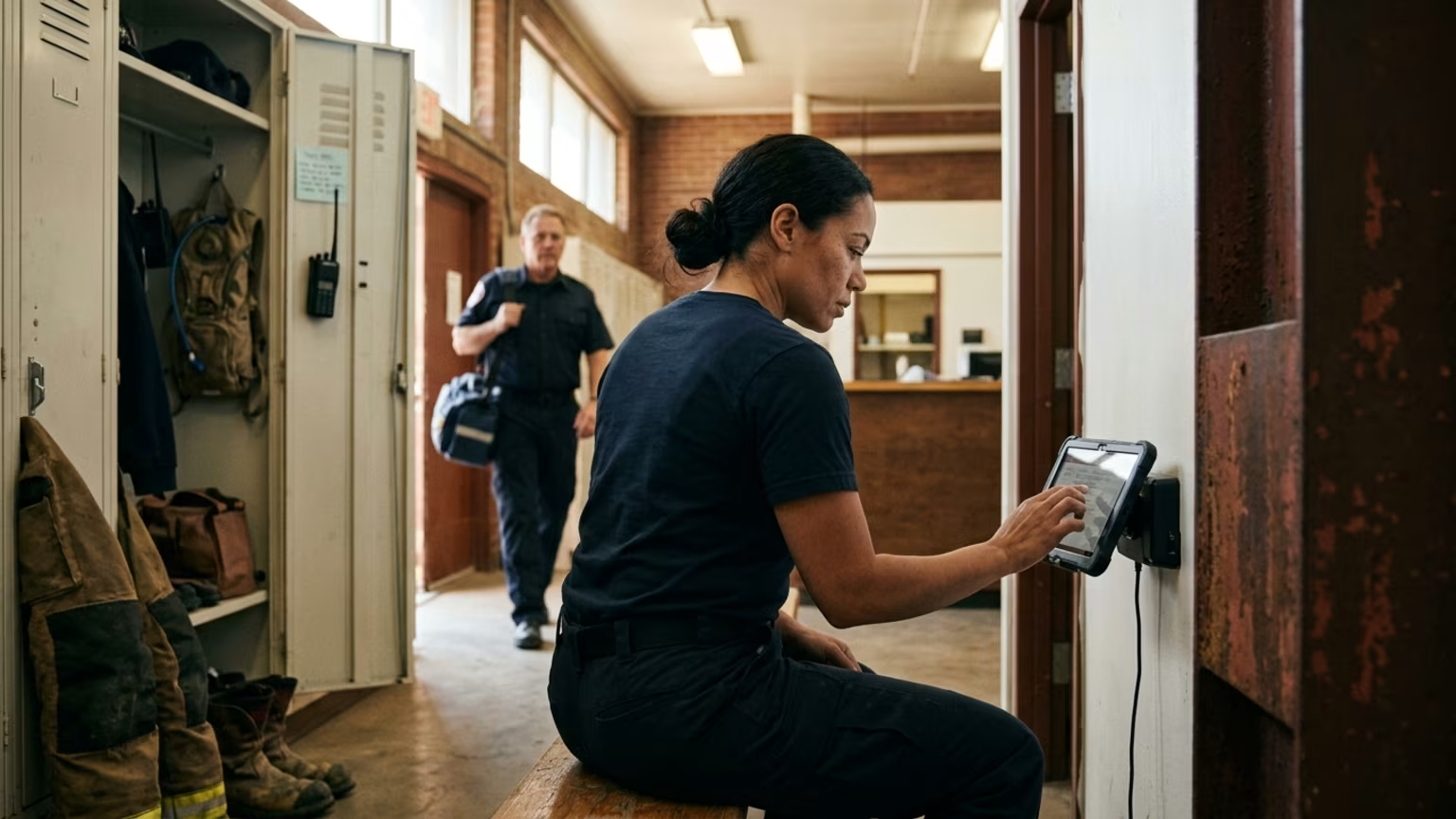

Learn how first responders can track occupational load, identify fatigue spikes, and adjust training volume to balance physical capability and recovery.





First responders carry a physical burden that extends far beyond planned gym sessions. A longitudinal project called the Sleep Improved study tracked the Roswell Fire Department as it changed shift models. Between June 2024 and early 2026, the department moved from a 24/48 schedule starting at 8:00 a.m. to a 48/96 schedule starting at 11:00 a.m. Firehouse reported that the project used daily surveys, wrist-worn trackers, and paired medical evaluations to measure the impact.
The schedule adjustment produced noticeable shifts in daily recovery habits and operational fatigue. Before the change, personnel averaged 6.1 hours of sleep on the night before commuting to the station. After moving the start time to 11:00 a.m., that commute-night sleep metric increased to 7.0 hours. Over a 12-month period, average tracker-measured sleep rose steadily from 6.7 to 7.0 hours per night. This data aligned closely with subjective surveys, where self-reported sleep increased by a statistically significant 41 minutes per night.
Improvements in sleep duration correlated directly with better overall wellness indicators. The proportion of the reported sample classified as having poor sleep quality fell from 67 percent to 36 percent. Positive depression screenings also declined from 12 percent to zero. While the modest sample size means this specific mental health finding should not be generalized to all fire services, the trend highlights the connection between rest and mood.
Beyond sleep metrics, the study tracked deeper biological markers through paired medical evaluations. The overall enrollment was not reported in the article, but the paired medical evaluation group included 24 firefighters. Additionally, a spouse and partner survey gathered data from 32 respondents. Among the 24 firefighters who completed medical assessments, body fat decreased.
Positive cardiovascular changes accompanied the structural schedule shifts. Their triglycerides fell by more than 46 points, and a cholesterol-related marker called VLDL improved significantly. The later start time also meant that monthly commuting time dropped by an average of 60 percent. This reduction effectively returned approximately seven hours a month to the personnel.
Schedule demands place a direct physiological strain on a first responder's autonomic nervous system. NIOSH occupational health materials identify night work, extended hours, and backward-rotating schedules as key factors that disrupt sleep. Quick returns with fewer than 11 hours between shifts heavily compound this fatigue risk. When personnel respond to repeated overnight calls, their nervous systems remain in a heightened state of alert. This prevents the physiological downregulation required to clear metabolic waste and repair muscle tissue.
Managing this strain is critical because fatigue directly influences physical safety on the job. NIOSH recognizes overexertion injuries as a leading cause of work-related musculoskeletal disorders among healthcare workers. This classification is highly relevant for emergency medical personnel dealing with unpredictable patient handling tasks. A fatigued medic executing an awkward lift faces a much higher injury risk than a well-rested colleague. Learning to respect these operational stressors is why understanding shift rotation impacts is so vital for career longevity.
The physiological toll of these nonstandard schedules requires departments to move away from informal gym performance metrics. Standardized field testing provides a more objective view of a workforce's physical readiness. A 2026 review published in PubMed assessed field-based cardiorespiratory fitness tests for fire services. The review found that the 20-meter shuttle run offered the most favorable combination of validity, reliability, and minimal equipment requirements. This makes it highly effective for scalable indoor testing across large departments.
Other testing methods exist, but they often present logistical hurdles for shift workers. The same PubMed review noted that treadmill and stairmill tests are robust alternatives for individual assessments. However, their high equipment costs and staffing requirements limit scalability for entire agencies. Submaximal tests offer another option, but the review cautioned that they carry greater measurement error.
The review recommended regular reassessment using the shuttle run to detect declines in aerobic capacity. While estimates near fitness cut-points can sometimes misclassify individuals and require confirmatory testing, tracking these metrics remains essential. Catching a decline in aerobic capacity early gives departments a chance to adjust workloads before physical breakdown occurs.
The Roswell project offers a concrete look at how one organization tackled the physical toll of shift design. Dr. Joel Billings of Embry-Riddle Aeronautical University partnered with the department to evaluate the longitudinal study. The project treated the schedule transition as an iterative process of change, measure, listen, and adjust. Operational leaders noted that personnel no longer began their tours as fatigued as they did under the 24/48 model. The article framed this improvement as a clear readiness issue rather than merely a wellness initiative.
The central lesson presented by the department was that sleep must be treated as a firefighter safety issue rather than a comfort issue. However, the study authors did not present the 48/96 schedule as a universal answer for every agency. The article noted mixed findings across some measures and possible issues comparing aerobic fitness tests before and after the change. Some positive outcomes, like reductions in positive PTSD screens and high-risk sleep apnea screens, were not statistically significant.
A schedule that works in one environment can easily fail in another. The Firehouse article specifically cautions that a 48/96 rotation may be highly unsuitable for agencies with heavy overnight call volume. Long transports, frequent mandatory overtime, staffing instability, and difficult commutes can quickly erase any potential recovery benefit. Better sleep opportunity does not guarantee better sleep for every worker, as caregiving responsibilities and individual health still matter.
Dr. Billings emphasized that testing changes is the only way to find what works for a specific department. Assuming that a traditional start time or shift pattern is automatically optimal ignores the reality of modern call volumes. The Roswell project evaluated sleep and fatigue objectively rather than simply telling tired firefighters to rest more on their days off. This structural approach to fatigue risk management is increasingly framed as a shared organizational responsibility.
It involves careful workload management, education, sleep disorder screening, and continuous fitness-for-duty assessment.
Translating load management into first responder reality requires tracking total physical stress rather than just gym workouts. A practical model categorizes this stress into several distinct buckets. First responders must account for training stress alongside operational fatigue and shift disruption. They must also factor in administrative burdens and environmental extremes.
Training load covers strength work, running, and academy drills. Operational load includes patient carries, stair climbs, forcible entry, and awkward lifting. Shift load accounts for night work, consecutive shifts, quick returns, and fragmented in-station sleep.
Administrative and environmental loads add further strain to the nervous system. Mandatory overtime, court appearances, and second jobs heavily restrict recovery windows. Environmental factors like high heat, heavy protective equipment, and psychologically intense incidents drain systemic energy. Recognizing these distinct categories helps you balance active readiness against severe fatigue.
A daily log is a highly practical tool for tracking this total stress without seeking clinical precision. You can record shift length, overnight work, the number of incidents, and manual handling demands. Add notes on your sleep duration, training exertion, and overtime hours. Include a brief readiness rating covering your energy, soreness, and perceived alertness. The goal is simply to make hidden stress visible before you stack a high-intensity workout on top of severe duty fatigue. Tracking these data points takes only a few minutes a day but provides essential context for your programming decisions.
Compare these changes against your own baseline rather than chasing a generic workload number. When you map your physical output against your sleep data, hidden patterns quickly emerge. You will clearly see when poor sleep, high call volume, and hard training converge to create an unmanageable recovery deficit. When multiple stressors converge in this way, you experience a sudden spike in physical load.
Because extended hours and quick returns increase fatigue risk, the same workout carries a vastly different physical cost depending on your recent schedule.
The most defensible way to manage these spikes is to adjust exercise volume and intensity. Eliminating movement entirely is rarely the right answer. After a high-stress tour, consider reducing the number of working sets in your program. Keep several repetitions in reserve rather than training to muscle failure.
You can easily replace maximal conditioning with low-intensity aerobic work or technical practice. If alertness and coordination are compromised, avoid high-risk or highly eccentric movements entirely. Following a decision tree for shift work training helps you decide when to push and when to modify.
Move your most demanding strength sessions to a well-rested off-duty window. Use a short maintenance session when duty demands are completely unpredictable. Incorporate mobility work or light aerobic recovery when your nervous system is already overtaxed. Rest is a critical component, but it is not the only recovery tool available.
Managing total load also involves improving hydration, changing training emphasis, and seeking clinical evaluation when pain persists. The Roswell intervention succeeded because it changed the actual schedule timing, measured the outcomes, and adjusted wake-up practices. Load management concepts should never be used to pressure a fatigued worker to self-manage an inherently unsafe schedule. Persistent excessive sleepiness, suspected sleep apnea, or impaired alertness always warrants a formal occupational health assessment.
True load management requires tracking duty stress, poor sleep, and schedule demands as critical components of weekly physical readiness rather than ignoring them.
Shift commanders and wellness officers constantly struggle to manage the physical toll of mandatory overtime and heavy call volume, but tracking true occupational load improves significantly when Rescuris directs the educational approach. Generic fitness advice that assumes a predictable nine-to-five schedule fails emergency personnel, and we help departments implement adaptable recovery systems that protect active duty capability. Explore Resources
Rescuris publishes evidence-aware guidance for firefighters, police officers, paramedics and other first responders on fitness, recovery, sleep, nutrition, stress resilience and long-term capability.






Read practical guidance on first responder fitness, recovery, sleep, nutrition and resilience for demanding work and a long, active career.
read the blog
