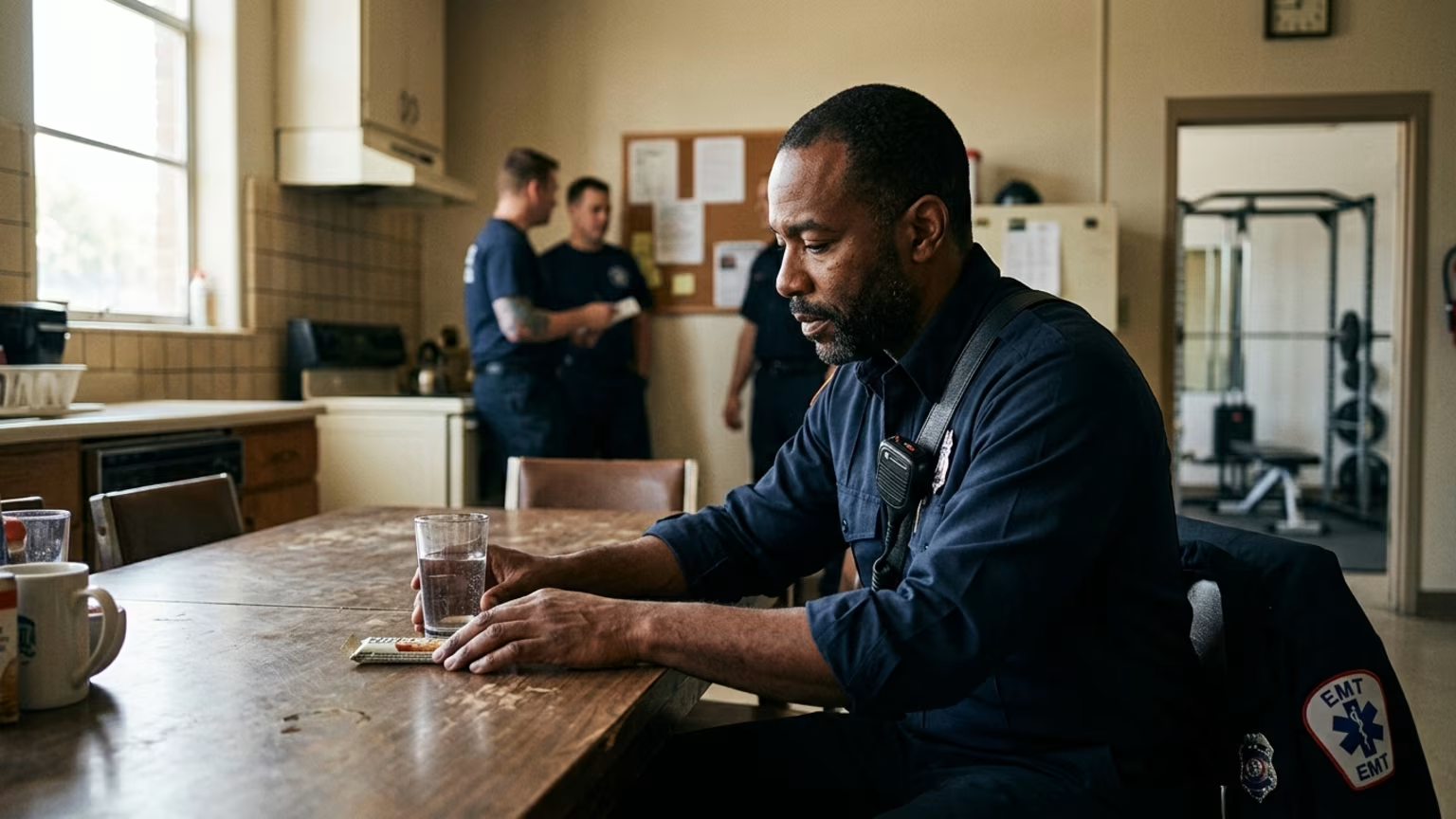

Emergency service demands career-long capability. This evidence-based framework translates clinical data to balance cardiovascular risk, strength and recovery.





In September 2026, the American College of Cardiology and American Heart Association published a highly relevant joint scientific statement. The document formally identifies police officers, firefighters and emergency medical responders as tactical athletes. These professionals perform unpredictable and highly strenuous work while managing heavy equipment. They operate in extreme environments and respond under intense psychological pressure.
The ACC/AHA authors emphasize that tactical-athlete careers often span decades. These careers continue into much older ages than those seen in conventional competitive sports. This reality demands a long-term approach to physical preparation that focuses deeply on occupational readiness. Departments cannot simply import civilian or military fitness standards without adjusting for the realities of emergency service.
Physical capability monitoring also requires careful selection to be effective over a career. A 2026 scoping review examined field-based cardiorespiratory-fitness tests specifically designed for firefighters. The researchers evaluated test specificity, validity, reliability and overall practical implementation. They clearly warned against treating single field tests as complete definitions of operational readiness.
Shift work adds a compounding variable to occupational health and physical recovery. A recent cohort meta-analysis investigated long-term health risks associated with different work schedules. The analysis reported small observational associations between night work and all-cause, cardiovascular and cancer mortality. Specifically, the data showed a pooled relative risk of 1.15 for cardiovascular mortality among night workers.
First responders operate in a constant state of autonomic fluctuation during their shifts. The sudden shift from resting to maximum physical effort spikes heart rates dramatically. The ACC/AHA statement notes that this unpredictable exertion carries significant cardiovascular risk for tactical athletes. The nervous system must constantly shift gears between high alert and deep recovery.
This rapid physiological acceleration takes a severe toll over a career lasting several decades. Unpredictable emergency calls require sudden lifting, carrying, pushing and dragging of heavy occupational loads. The physiological response involves a massive release of stress hormones to fuel these sudden physical efforts. Maintaining this level of readiness requires a training approach that actively respects cumulative autonomic strain.
Night work disrupts the natural recovery phases of the nervous system. The mortality associations observed in the cohort meta-analysis highlight the systemic cost of chronic sleep disruption. When responders work overnight, their bodies miss vital circadian repair windows entirely. This lack of restorative sleep leaves the autonomic nervous system in a prolonged state of physical activation.
This sustained activation changes exactly how the body handles physical stress on duty. A fatigued responder experiences slower reaction times, reduced physical power and delayed muscular recovery. Training programs must account for this baseline fatigue rather than actively ignoring it. Pushing a highly stressed nervous system through maximum-intensity workouts can accelerate long-term physical decline.
Adapting to these physical demands requires measured protocols, such as those found in a career-long hormonal health framework, to manage the toll.
The 2026 scoping review provides clear evidence on how departments should measure aerobic capacity safely. Researchers sought to evaluate the validity and safety of field-based cardiorespiratory tests. They systematically identified 140 relevant records for initial consideration in the broader study. The team then screened 102 records before finalizing the inclusion of 14 specific clinical studies.
The review ultimately found that the 20-metre shuttle run presented the most favorable overall profile. This specific test works extremely well for department-wide monitoring because it requires minimal setup. In contrast, treadmill and stairmill tests were identified as highly resource-intensive alternatives. Those alternatives work better for isolated individual assessments rather than large-scale department evaluations.
However, the researchers issued a clear warning about interpreting these testing results. They found that submaximal field tests consistently showed much greater error in their final estimates. The authors explicitly cautioned that field-test estimates near employment cut-points could easily misclassify individuals. This means a single test score might incorrectly label a highly capable responder as physically unfit.
Consequently, the review authors strongly suggest using standardized tests strictly as broad monitoring tools. They described semiannual testing merely as a reasonable starting point to track aerobic fitness declines. Departments must rigorously validate local thresholds before attaching career consequences to a simple shuttle run score. The test serves to identify broad trends rather than providing a complete picture of operational readiness.
Proper occupational testing aligns closely with the duty-fitness profile, effectively balancing multiple physical capacities for safe emergency operations.
The available evidence strongly supports the existence of varied and highly unpredictable physical demands. Responders clearly need strength for heavy lifting, aerobic capacity for recovery, power for rapid force production and mobility for awkward spaces. A practical career-long model should systematically include all four distinct physical qualities. However, the exact ratio of these qualities must shift continuously based on the specific duty cycle.
The 2026 scoping review emphasizes the immense value of standardized reassessment for monitoring physical trends. Responders should always separate their daily physical development sessions from formal readiness checks. Heavy strength work and aerobic base building effectively develop long-term physical capacity. Occasional standardized tests simply measure where that physical capacity stands on one given day.
Night work clearly influences physiological recovery, autonomic balance and long-term health outcomes. First responders must intelligently adjust their training volume after a series of demanding calls or sleepless nights. When the autonomic nervous system is highly stressed, unnecessary physical fatigue should be heavily reduced. Responders should prioritize lower-risk movements, technical practice and easy aerobic sessions during these critical windows. Developing these physical capacities safely requires an adaptable fitness system that thoroughly responds to shifting occupational loads.
The ACC/AHA statement strongly highlights the deeply strenuous nature of tactical-athlete careers. Training should tightly focus on the exact physical movement patterns required on the fireground or medical scene. Responders need structured, recurring exposure to lifting from the floor, carrying, dragging and physical bracing. These movements physically prepare the body for unpredictable equipment-loaded tasks without treating every single workout like a grueling evaluation.
A highly effective career-long framework relies entirely on tracking physical capability over many months and years. Responders should consistently monitor their submaximal recovery rates, sleep quality, perceived physical fatigue and overall training consistency. Relying exclusively on a single maximal test score completely ignores the physical complexities of emergency service. Tracking these trends allows for the very early detection of aerobic decline and physical overtraining.
The ACC/AHA statement clearly identifies cardiovascular disease as the leading medical cause of duty-related deaths among tactical athletes. First responders should never assume that high physical fitness automatically neutralizes occupational exposure to toxic environments. Personnel with concerning physical symptoms or distinct medical risk factors must seek specialized medical evaluation promptly. Training programs should always direct affected responders to qualified clinicians rather than promising that basic conditioning resolves deep medical risks.
Tactical-athlete careers very often continue well past the typical retirement age of standard competitive athletes. Older responders consistently benefit from fewer maximal lifting attempts and many more controlled, precise repetitions. Unilateral physical work, heavy loaded carries and targeted isometric exercises maintain true physical capability while greatly reducing joint wear. This intelligent progression deeply respects the natural aging process while maintaining highly essential operational readiness across a whole career.
Physical preparation for emergency response requires managing cumulative occupational load across decades, prioritizing consistent daily capability over isolated maximal testing.
Balancing intensive cardiovascular conditioning with the reality of accumulating physical wear frequently challenges emergency personnel who face decades of unpredictable physical demands. Navigating conflicting advice that prioritises short-term performance while ignoring long-term health leaves many professionals frustrated, but Rescuris helps first responders build practical training frameworks that maintain capability without compromising recovery.
Rescuris publishes evidence-aware guidance for firefighters, police officers, paramedics and other first responders on fitness, recovery, sleep, nutrition, stress resilience and long-term capability.






Read practical guidance on first responder fitness, recovery, sleep, nutrition and resilience for demanding work and a long, active career.
read the blog
