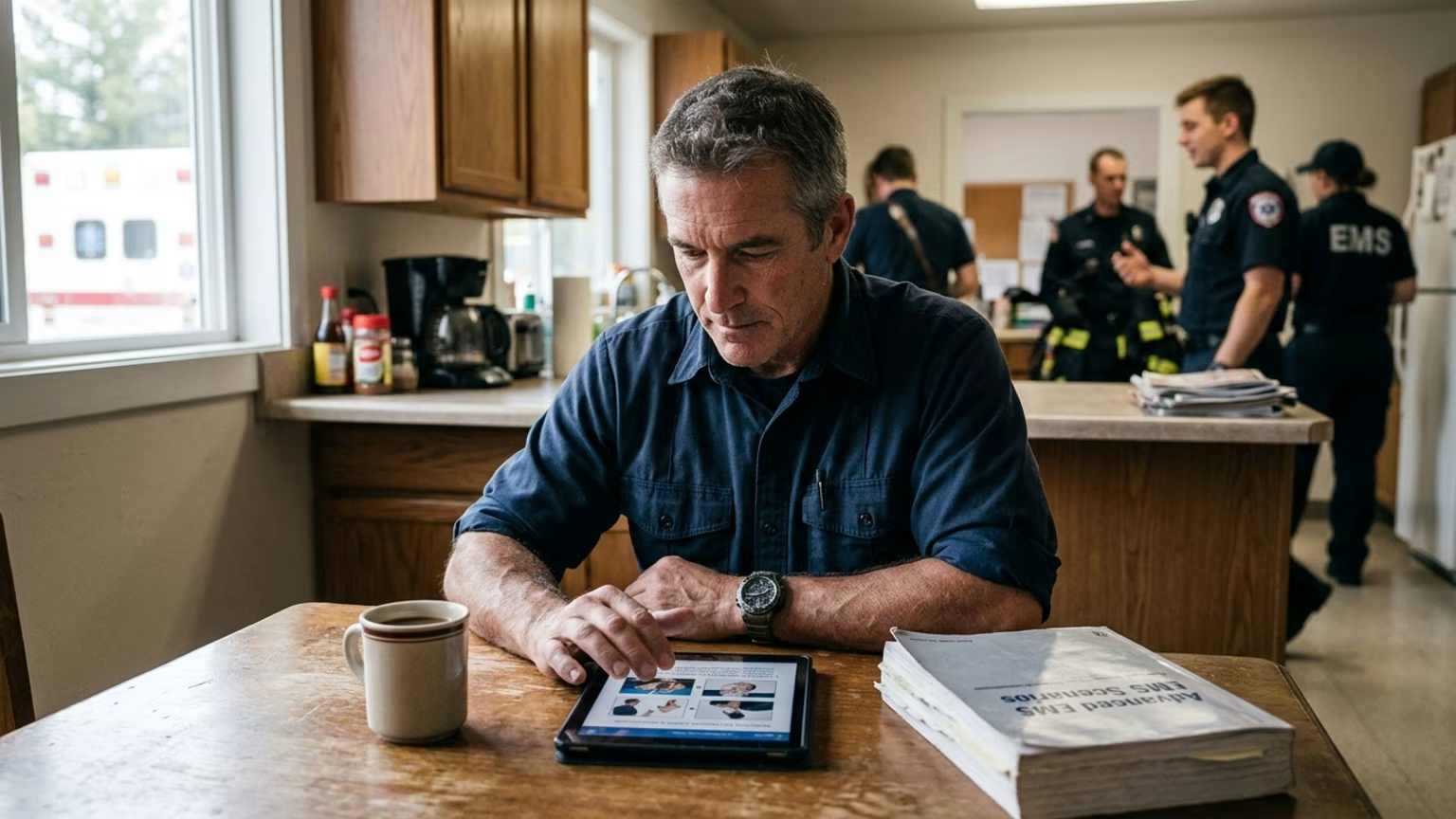

Discover how first responders can adapt physical training across their careers. Learn about cardiovascular risks, safe patient handling, and sustainable recovery.





The cardiovascular demands of emergency response require a long-term approach to physical preparation. One analysis of 2,314 line-of-duty deaths highlighted a rising trend in cardiovascular fatalities among firefighters. The study reported that the proportion of fatalities involving myocardial infarction increased from 43.0 percent in the 1990 to 2000 period to 46.5 percent between 2002 and 2012. This data positions cardiovascular health as a primary operational vulnerability rather than a secondary medical concern.
Age also changes the risk profile for emergency personnel. The same analysis reported that the proportion of deaths among firefighters older than 40 increased from 52 percent to 65 percent across those timeframes. This shift signals that training plans must evolve as physical wear accumulates. Continuing to train like a recruit in the third decade of a career often ignores critical biological changes.
Furthermore, the methods used to build fitness can sometimes become hazards themselves. The analysis noted that training deaths increased from 7.3 percent to 11.2 percent across the studied periods. Workouts should build operational capacity rather than constantly test human limits. Adding extreme physical stress to an already taxing occupation can push personnel toward dangerous thresholds.
The American Heart Association and American College of Cardiology identify cardiovascular disease as the leading medical cause of duty-related deaths among tactical athletes. This category includes firefighters, law enforcement officers and emergency medical responders. These clinical realities dictate that cardiovascular risk assessment must take priority over generic weightlifting metrics. Regular medical screening remains the only definitive way to measure true cardiovascular stability in this population.
The physical cost of emergency medical service extends far beyond cardiovascular strain. For emergency medical personnel, the National Institute for Occupational Safety and Health states that manually handling and lifting patients can cause work-related musculoskeletal disorders. Physical conditioning helps support daily movement, but individual strength alone cannot offset an unsafe lifting environment. The agency clearly notes that assistive lifting devices can reduce injury and strain. A career-long training plan must therefore acknowledge that weight room sessions are not a replacement for proper field equipment.
Emergency service requires sudden transitions from resting states to maximal physical exertion. These rapid spikes in heart rate and adrenaline force the autonomic nervous system into constant overdrive. The resulting physiological debt fundamentally alters how the body responds to exercise and physical conditioning. High-intensity training combined with high-stress shifts frequently leaves emergency personnel struggling to recover.
Their bodies cannot differentiate between the stress of a burning building and the stress of a heavy barbell. Both events require massive autonomic resources that are already in short supply. Sleep disruption from nights and rotating schedules heavily compounds this autonomic strain. A disrupted circadian rhythm limits the biological repair processes necessary after heavy physical exertion.
Over time, constant occupational alertness drains energy reserves and disrupts emergency worker recovery if left unmanaged. Training plans that ignore this nervous system load often lead to accumulated fatigue rather than improved capability. The physical wear eventually forces the body to prioritize immediate survival over long-term tissue repair. The central nervous system requires specific conditions to signal muscle repair and tissue adaptation.
When irregular work hours block these recovery pathways, the body remains in a sympathetic state. Personnel might perceive this lingering tension as ordinary soreness, but it actually reflects a tired autonomic system. Recognizing this difference is critical for maintaining long-term physical resilience. An exhausted nervous system cannot coordinate complex physical movements efficiently, which dramatically increases the risk of structural injuries during routine occupational tasks.
Monitoring aerobic capacity is a crucial part of managing cardiovascular risk for tactical athletes. A 2026 scoping review screened 140 records and included 14 studies on field-based cardiorespiratory-fitness tests in fire services. The researchers sought to evaluate tests that combine validity, practical scalability and manageable equipment requirements. Their findings offer helpful parameters for departments looking to track baseline health over time.
The review concluded that the 20-meter shuttle run presented the most favorable overall profile for department-wide monitoring. Other options like treadmill and stairmill protocols were deemed effective but more restricted by staffing and equipment limitations. The shuttle run provides a practical way to assess aerobic power without requiring specialized clinical facilities. This accessibility makes it a valuable tool for tracking population-level physical trends without removing personnel from service for extended medical appointments.
However, the researchers also offered strong cautions regarding the interpretation of submaximal test results. The review warned that estimates near specific fitness cut points may misclassify individuals. This potential for error means a single field test should inform training rather than serve as absolute proof of duty readiness. Medical evaluations and consistent tracking matter far more than an isolated workout score.
These findings support a monitoring philosophy rather than a punitive testing culture. Standardized assessments help identify meaningful declines in physical capacity before they become severe operational risks. Using these tools to guide programming creates a more sustainable approach to occupational health. Firefighters and emergency medical personnel perform better when they view assessments as health indicators instead of employment threats.
Building a resilient body for emergency service requires a phased approach to physical development. The required physical attributes change as a responder moves from probation to their peak years and eventually into retirement.
The initial goal during probation is to establish a broad base of physical competence. Recruits should develop basic strength in fundamental movement patterns like the squat, hinge, push and carry. Aerobic capacity is equally crucial because it dictates how quickly a responder recovers between intense operational efforts. The focus must be on high-quality repetitions rather than maximal load testing. Building a massive strength base too quickly often leads to early structural breakdowns.
Short-duration power and basic mobility complete this foundational stage. Training should build ankle, hip and shoulder mobility to handle irregular movements on the job. Responders should also prioritize learning how to manage sleep loss and workload early in their careers. Building good habits here sets the stage for career-long durability adapting first responder training with age and experience.
The probation period is the ideal time to learn that recovery is a biological requirement rather than a sign of weakness. Young responders who master sleep hygiene and basic mobility early on tend to avoid the chronic structural problems that plague older personnel.
During the middle portion of a career, the training objective shifts from building raw capacity to preserving it. The accumulated stress of irregular shifts requires a carefully measured minimum effective dose of exercise. Maintaining strength and aerobic power becomes the priority while aggressively managing overall fatigue. This phase is about staying prepared without burning out.
A sustainable weekly structure should flex around difficult shifts, mandatory overtime and sleep debt. Two focused strength sessions and two aerobic efforts typically provide enough stimulus to maintain readiness. Personnel must closely monitor their caloric intake because energy availability for first responders preventing underfueling and overtraining is critical for survival. Rigid civilian workout splits rarely survive the reality of an unpredictable duty roster.
First responders must learn to auto-regulate their volume based on how many calls they ran the night before. Adjusting intensity downward after a sleepless night is a strategic performance decision rather than a failure of discipline.
Physical setbacks are a predictable reality in physically demanding emergency roles. When pain or restricted movement occurs, the goal is to preserve unaffected qualities while reducing aggravating stress. A responder might maintain aerobic conditioning and controlled isometric exercises while resting an injured joint. Pushing through acute pain to prove toughness only accelerates long-term structural damage.
Adjusting the routine allows the nervous system to continue functioning without destroying compromised tissue. For emergency medical personnel, injury periods highlight the importance of operational systems over individual strength. The National Institute for Occupational Safety and Health clearly states that assistive lifting devices can reduce injury and strain during patient handling.
Physical conditioning cannot replace proper equipment, adequate staffing and clear safety procedures. Smart recovery means using every available mechanical advantage on the job. Training the body to lift heavy objects is useless if departmental policy ignores basic ergonomic safety.
The transition out of active service requires another deliberate shift in physical priorities. The focus moves from occupation-specific power toward functional independence, joint health and recreational capability. Retiring responders should continue to train fundamental movement patterns to preserve muscle mass and bone density. The objective is maintaining the freedom to lead an active and unrestricted life.
Documenting physical baselines during the final service years can help guide post-career medical decisions. Building the first responder's lifetime health record what to track before and after retirement provides valuable context for future healthcare providers. Training simply evolves from a duty requirement into a personal investment in long-term wellness. A successful career is ultimately measured by a healthy and capable retirement.
Career-long physical readiness relies on a dynamic approach that steadily adapts to changing operational stressors, accumulated wear and the eventual transition to retirement.
Adjusting a training plan to match changing occupational capabilities is nearly impossible if erratic eating prevents basic physical repair. Managing nutrition, hydration and energy when meal timing is inconsistent requires a practical approach, and Rescuris helps first responders build sustainable metabolic habits that actually survive unpredictable emergency shifts.
Rescuris publishes evidence-aware guidance for firefighters, police officers, paramedics and other first responders on fitness, recovery, sleep, nutrition, stress resilience and long-term capability.






Read practical guidance on first responder fitness, recovery, sleep, nutrition and resilience for demanding work and a long, active career.
read the blog
