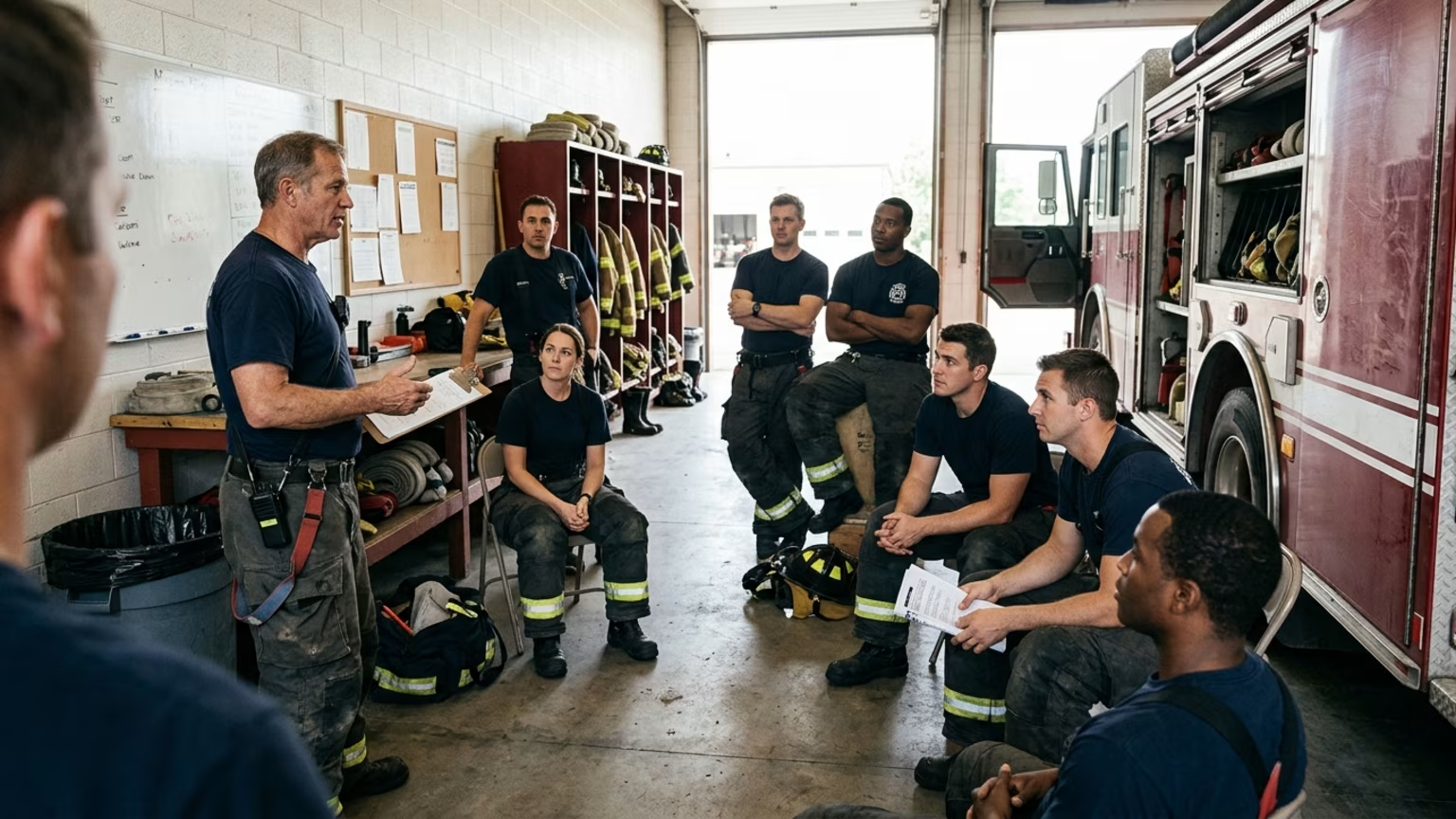

NIOSH and CPWR have published a new Fire Safety Toolbox Talk for emergency responders. Discover how officers can integrate this official briefing resource into existing daily protocols.





On September 14, 2026, the CDC's National Institute for Occupational Safety and Health (NIOSH) and the Center for Construction Research and Training (CPWR) released a new safety communication resource for emergency crews. The publication provides structured guidance for officers addressing operational hazards in the field. This release adds a formal briefing tool to the established library of occupational safety documents. Federal health officials designed the guide to facilitate brief administrative discussions about physical risk management.
The new resource is officially designated as DHHS (NIOSH) Publication No. 2026-117. Titled the Fire Safety Toolbox Talk, the document credits Pfirman, Cunningham, and Bunting as its primary authors. The involvement of CPWR alongside federal health officials highlights a collaborative approach to occupational hazard communication. This joint effort reflects the overlapping physical risks found in both emergency response and heavy industrial work.
This fire-specific guide does not exist in isolation. It arrives as part of a comprehensive 2026 publication series covering multiple workplace hazards. Other releases in this current series address confined spaces, materials handling, and noise protection. They also cover heavy equipment operations involving skid-steer loaders, boom trucks, and overhead power lines.
Emergency responders frequently encounter these exact hazards during technical rescues and structural responses. A motor vehicle collision often involves complex materials handling and vehicle-mounted equipment. Fireground operations routinely place crews near overhead power lines and dangerously high noise levels. The broader toolbox series offers relevant safety reminders for all these unpredictable environments.
The primary goal of a toolbox talk is to facilitate clear communication between shift leaders and their crews. These short publications give officers a standardized framework for discussing safety before a shift begins. Providing structured discussion points helps remove the guesswork from daily briefings. Consistent communication helps crews maintain focus on fundamental safety practices amidst irregular schedules.
Delivering safety information effectively requires acknowledging the physical state of the receiving personnel. First responders often operate under conditions of chronic fatigue caused by rotating shifts and unpredictable call volumes. A toolbox talk must be concise and highly relevant to capture the attention of a tired crew. The structured format of Publication 2026-117 attempts to deliver critical information quickly and efficiently.
Lengthy administrative lectures are rarely successful when personnel are recovering from accumulated physical wear. Short, focused discussions respect the limited time and energy available during a demanding shift. By standardizing the communication format, leaders can reduce the cognitive load required to deliver and process safety updates. This practical approach acknowledges the irregular sleep and stress that shape the emergency service environment.
Implementing a new briefing tool requires understanding its proper place within existing operational systems. The new toolbox talk complements rather than replaces the detailed equipment protocols that agencies already use. For example, NIOSH currently publishes a highly specific safety checklist for SCBA training-prop evolutions. That checklist gives fire instructors a customizable tool for managing live simulated scenarios.
Briefing resources and training checklists serve distinct but complementary functions for emergency medical and fire personnel. A toolbox talk initiates a conversation about general safety principles on the floor. In contrast, the SCBA checklist provides concrete procedural steps for running a specific physical drill. Combining both approaches helps leaders build a more thorough culture of occupational readiness.
It is vital to recognize the operational limits of administrative communication tools. The new publication is an official safety communication product intended for workplace discussions. It is not a clinical rehabilitation protocol or a medical evaluation standard. Treating a short briefing as a substitute for acute medical care creates unnecessary risk for personnel managing physical wear.
A toolbox talk cannot replace department-level incident command functions or formal after-action reviews. When a crew returns from a demanding structural response, a brief safety discussion does not equal complete operational recovery. Comprehensive recovery requires targeted physical protocols and adequate rest between challenging shifts. Leaders must use administrative tools to support actual physical recovery, instead of replacing it.
The focus on structured communication aligns well with the federal approach to respiratory protection. NIOSH states that its respiratory-protection work includes investigating self-contained breathing apparatus failures and reduced performance. The agency also investigates broader departures from applicable equipment standards. Discussing these specific equipment concerns during a toolbox talk keeps crews actively engaged with their gear reliability.
Maintaining respiratory health requires constant vigilance over approved protective equipment. Effective shift discussions should prompt personnel to evaluate their gear critically before exposure events occur. This administrative habit directly supports breathing and respiratory load in fire and emergency work. Regular communication helps personnel address minor equipment concerns before they escalate into serious operational failures.
The focus on self-contained breathing apparatus reliability is particularly important for departments managing rotating shifts. Equipment undergoes constant use, cleaning, and storage cycles across different operational periods. A safety talk provides a dedicated moment for crews to verify the condition of shared protective gear. Discussing equipment maintenance openly helps prevent minor defects from passing unnoticed between changing watches.
When personnel discuss SCBA performance regularly, they build a stronger collective awareness of equipment limitations. Federal investigations into reduced performance often highlight the consequences of poor maintenance or inadequate pre-shift checks. Briefings help translate these distant federal findings into immediate operational habits for the crew. Connecting large-scale research to daily equipment checks improves overall safety and operational readiness.
Fire-service leaders and shift commanders can evaluate Publication 2026-117 as a potential addition to their standard morning briefings. Integrating a new discussion guide requires minimal logistical adjustment for most established crews. Officers should review the material to see where it overlaps with their specific station hazards. A deliberate review confirms that the provided talking points match the actual demands of the upcoming shift.
When rolling out new administrative tools, departments must strictly retain their existing safety requirements. Adopting a short safety talk does not alter current policies for personal protective equipment or on-scene rehabilitation. Existing standards for medical monitoring and heat stress management remain fully applicable. Officers must communicate clearly that new briefing tools augment rather than replace established safety procedures.
Field instructors will likely find the new resource most effective when paired directly with practical training materials. For instance, using the briefing guide alongside the SCBA training-prop checklist creates a stronger educational experience. Instructors can use the toolbox talk to introduce a hazard concept in the classroom. They can then use the customizable checklist to safely execute the related physical drill.
This blended approach to learning helps solidify critical safety concepts for emergency professionals. It bridges the gap between passive hazard awareness and active procedural compliance. When crews discuss a risk and immediately practice mitigating it, the lesson becomes much more durable. Integrating administrative discussions with targeted occupational training programs builds highly resilient response teams.
Crew leaders must draw a sharp line between a routine safety talk and a post-incident investigation. A brief discussion can successfully raise hazard awareness and prompt the reporting of near-miss events. However, a toolbox talk does not provide a complete system for analyzing an operational failure. Thorough near-miss learning requires dedicated time, objective analysis, and a structured reporting framework.
After a challenging deployment, personnel need comprehensive support that extends well beyond a short briefing. They require dedicated rehabilitation time and structured physical recovery strategies. Utilizing the proper tools for each phase of an operation is essential for career longevity. Properly categorized resources directly support long-term injury prevention and physical recovery across demanding irregular schedules.
Leaders must carefully consider when and where they deliver administrative safety briefings. Presenting a toolbox talk immediately after a physically grueling response is rarely effective. Personnel experiencing elevated heart rates and respiratory stress need immediate rehabilitation, not an administrative lecture. Commanders should schedule these discussions during calmer shift periods when crews can actually absorb the information.
The environment chosen for the briefing also impacts its overall effectiveness. Conducting the talk in a quiet station setting promotes better engagement than attempting a discussion on a noisy fireground. Officers should leverage these tools during standard morning meetings or dedicated training hours. Strategic timing guarantees that the safety messaging supports the crew without adding unnecessary stress to their day.
For active professionals and department leaders, this release signals a continuing federal investment in fire-service communication tools. Adding another formal briefing guide expands the available options for shift commanders and training officers. Tracking the utilization of these specific tools will reveal their actual impact on daily floor operations. The true value of a safety publication is proven by its consistent use in firehouses.
It is equally important to monitor how short communication tools fit into a much larger ecosystem of occupational research. Federal agencies produce massive volumes of technical data that inform these shorter briefing summaries. For example, the comprehensive NIOSH bibliography for 2025 catalogs a wide range of deep investigative work. That annual bibliography includes detailed fire-fighter fatality investigation reports, complex datasets, and thorough health-hazard evaluations.
These extensive investigations provide the raw factual foundation for effective occupational safety programs. A fatality investigation report details the specific environmental, physical, and equipment factors that contributed to a tragic outcome. Health-hazard evaluations offer rigorous scientific assessments of chronic exposures in the operational environment. These detailed reports identify the systemic risks that short briefing tools attempt to mitigate on the floor.
Emergency service professionals should track both the short communication tools and the deep analytical reports. Relying solely on brief summaries can obscure the complex biological and mechanical realities of emergency work. Understanding the deep research helps leaders build more robust physical preparation programs for their crews. Staying engaged with comprehensive federal data keeps departmental safety policies aligned with the best available evidence.
Treating a short administrative safety briefing as a complete substitute for structured physical rehabilitation leaves fatigued emergency personnel vulnerable to progressive physical wear. Because separating useful stress-resilience guidance from motivational slogans or mental-health stigma requires objective evaluation, Rescuris delivers practical physical maintenance protocols built for irregular shift constraints. Explore Resources
Rescuris publishes evidence-aware guidance for firefighters, police officers, paramedics and other first responders on fitness, recovery, sleep, nutrition, stress resilience and long-term capability.






Read practical guidance on first responder fitness, recovery, sleep, nutrition and resilience for demanding work and a long, active career.
read the blog
