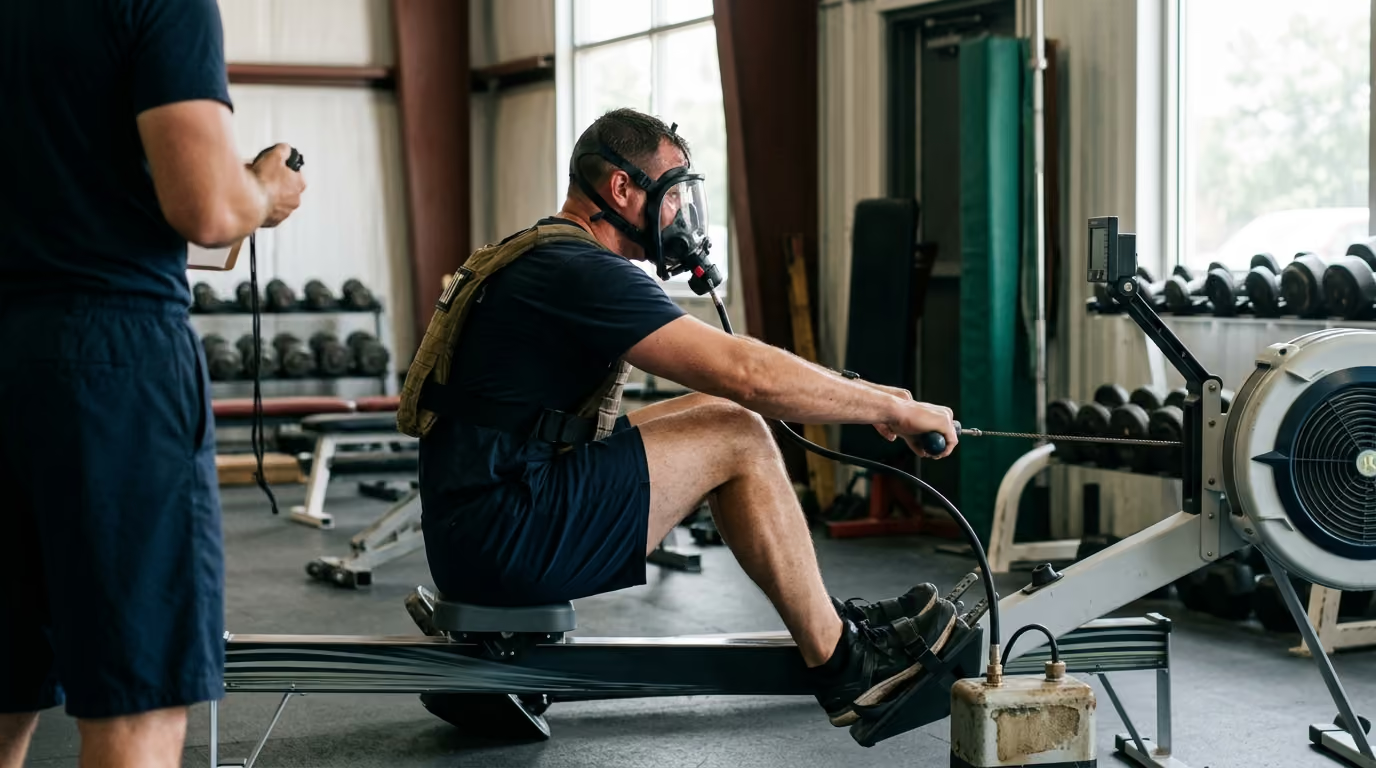

Five interacting operational demands drive firefighter exhaustion and require specific aerobic conditioning alongside evidence-based air management protocols on the fireground.





You are three flights up a commercial stairwell in full structural gear. Your boots feel heavy, but your legs are not the primary reason you are slowing down. Your mask pulls tight against your face with every rapid inhalation, your chest feels banded by your harness straps, and heat is trapped inside your turnout coat. Your air consumption is climbing faster than expected, and you feel starved for air despite being in solid cardiovascular shape.
This scenario illustrates a fundamental reality of emergency response. Fire and rescue operations do not simply demand generic fitness performed in heavy clothing. Emergency work layers substantial breathing resistance, restricted chest mechanics, uncompensable heat stress, and sensory deprivation on top of heavy physical workloads.
The plain-language answer to managing this demand is straightforward. First responders must build high baseline aerobic power and whole-body muscular strength using unrestricted, standard training methods. Technical air management, apparatus familiarity, and tactical pacing must be practiced under structured supervision. Respiratory hazards such as smoke, toxic gas, and extreme uncompensable heat must always be treated as occupational threats to mitigate rather than physical stressors to train through.
The respiratory load experienced during emergency operations involves more than the metabolic cost of moving your muscles. It encompasses the total physical burden placed on the breathing system during work. This burden includes the gas exchange required to deliver oxygen and clear carbon dioxide, the mechanical resistance of the breathing apparatus, and the physical restriction of chest expansion caused by turnout gear and harnesses.
Research demonstrates that wearing a self-contained breathing apparatus (SCBA) creates significant internal breathing resistance. Laboratory testing shows that breathing through a standard positive-pressure SCBA regulator elevates expiratory mouth pressure and increases the elastic and resistive work of breathing. This added internal work accelerates the fatigue of the diaphragm and intercostal muscles. When respiratory muscles fatigue, they pull blood flow and oxygen away from the legs and arms through a reflex known as the respiratory muscle metaboreflex. This physiological response causes operational exhaustion long before the cardiovascular system reaches its absolute theoretical limit.
Controlled exercise studies show that wearing a complete SCBA reduces maximal oxygen uptake (VO2max) by approximately 14.9 percent. When researchers isolated the regulator and facepiece without the weight of the cylinder or backplate, maximal oxygen uptake still dropped by roughly 13.1 percent. Carrying the cylinder and harness while breathing unrestricted room air produced only a 4.8 percent reduction. These findings indicate that the airflow resistance of the regulator and mask interface is a primary driver of reduced exercise capacity, often exceeding the penalty imposed by the physical weight of the cylinder alone.
The scientific evidence on respiratory load in emergency response can be graded across distinct domains:
To program training effectively, emergency personnel must understand how occupational stressors interact during operations. Fireground strain is not a single physiological variable. It is a combination of five distinct, overlapping loads that deplete operational reserves.
Metabolic load represents the raw energy and oxygen cost of performing external physical work. This includes advancing charged hose lines, forcing entry through reinforced doors, carrying heavy hydraulic tools, climbing ladders, and dragging casualties. These tasks require rapid energy production through both aerobic and anaerobic pathways.
Respiratory load refers to the internal effort required to move air through the regulator, valves, and facepiece. It also includes the energy needed to expand the lungs against the physical resistance of tightly cinched harness straps, heavy structural coats, and awkward working postures.
Thermal load is created when the body cannot dissipate metabolic heat. Structural protective clothing acts as an impermeable thermal barrier. In warm environments or during sustained exertion, sweat cannot evaporate effectively. Core body temperature climbs steadily, producing uncompensable heat stress that drives up heart rate and ventilatory drive independently of the physical task.
Mechanical load encompasses the external weight of personal protective equipment (PPE), tools, and structural boots. It also includes restricted joint mobility at the shoulders, hips, and ankles. Moving while wearing stiff, multi-layered clothing increases the energy cost of walking, crawling, and climbing, turning simple movements into metabolically expensive tasks.
Operating in zero-visibility environments while managing low-air alarms, radio traffic, structural integrity assessments, and crew accountability imposes significant psychological stress. Acute stress activates the sympathetic nervous system, causing sudden spikes in breathing rate and tidal volume. This rapid, shallow breathing increases air consumption and accelerates operational fatigue.
A responder's working capability can be conceptualized as an operational reserve model:
$$\text{Operational Reserve} = \text{Physical Capacity} - (\text{Task Demand} + \text{Equipment Constraints} + \text{Thermal Strain} + \text{Cognitive Cost})$$
When an individual possesses high baseline physical capability, they retain a wider safety margin. However, if equipment constraints and thermal strain are exceptionally high, even an elite aerobic base can be quickly overwhelmed. Training must be designed to expand raw physical capacity while teaching the body to operate efficiently under external constraints.
In standard exercise physiology, cardiovascular fitness is commonly reported as relative VO2max, expressed in milliliters of oxygen consumed per kilogram of body weight per minute (mL/kg/min). Relative VO2max allows fair comparisons between individuals of different body sizes in bodyweight-supported activities such as distance running or cycling uphill.
Occupational emergency tasks, however, do not scale to an individual's body weight. A 50-foot section of charged 1.75-inch hose, a 16-foot roof ladder, a set of hydraulic cutters, and an unconscious adult patient have fixed weights. The equipment does not become lighter for a smaller responder. For this reason, absolute VO2max, measured in liters of oxygen per minute (L/min), is often a superior predictor of fireground task completion.
A 2025 systematic review and meta-analysis examining physical performance in structural firefighting found pooled correlation coefficients of -0.64 for relative VO2max and -0.75 for absolute VO2max in relation to occupational test completion times. The stronger correlation for absolute aerobic capacity demonstrates that the total volume of oxygen your cardiovascular system can process per minute dictates your ability to move heavy, fixed external loads over time.
This distinction has clear practical implications for body composition and training programming:
Developing robust operational capability requires building absolute work capacity through compound resistance training and broad cardiovascular conditioning. Responders should focus on becoming strong, durable, and aerobically capable engines capable of moving heavy external loads efficiently. You can find detailed programming approaches for this balance within our guide to duty fitness training systems.
Structural firefighting gear is designed to protect wearers from thermal radiation, convective heat, and direct flame impingement. The exact physical properties that keep extreme external heat out also prevent internal body heat from escaping. When metabolic heat production outpaces heat dissipation, the body enters a state of uncompensable heat stress.
Research conducted by the Centers for Disease Control and Prevention (CDC) evaluated firefighters performing simulated fireground work at 40 degrees Celsius (104 degrees Fahrenheit). The protocol compared task-based circuit work, including hose advances, ladder raises, search crawls, and pike-pole pulling, against continuous weighted treadmill walking of identical duration and perceived exertion.
The findings demonstrated that simulated fireground tasks produced substantially higher physiological strain than steady-state treadmill work:
These physiological shifts directly impact breathing mechanics and air consumption. As core temperature climbs, the central nervous system increases respiratory drive to assist with heat dissipation, a response known as thermal hyperpnea. This increased breathing frequency is largely ineffective for cooling when wearing an SCBA facepiece, but it rapidly drains air from the cylinder.
Furthermore, a 12 percent reduction in plasma volume thickens the blood, reducing venous return to the heart. To maintain cardiac output, the heart must beat substantially faster, a phenomenon termed cardiovascular drift. As heart rate approaches maximal levels under heat strain, perceived exertion spikes, fine motor skills deteriorate, and air management becomes compromised.
Conditioning programs that rely exclusively on climate-controlled indoor cardio do not prepare the cardiovascular or respiratory systems for this operational reality. Conditioning must prepare responders for variable workloads, but thermal exposure must be dosed carefully to avoid cumulative heat illness.
A dangerous misconception in some emergency response cultures is the belief that inhaling smoke, working in contaminated air, or deliberately training without respiratory protection builds occupational toughness or conditions the lungs. This belief contradicts all established toxicological and physiological evidence.
Smoke generated during structural, vehicle, and wildland fires is a complex mixture of lethal gases, chemical vapors, and respirable particulate matter. Common constituents include carbon monoxide, hydrogen cyanide, phosgene, benzene, acrolein, formaldehyde, and polycyclic aromatic hydrocarbons. These compounds damage the human respiratory system through direct cellular toxicity, acute chemical irritation, and systemic asphyxiation.
Inhaling combustion byproducts causes immediate damage to the respiratory tract:
Research from the National Institute for Occupational Safety and Health (NIOSH) and the United States Department of Agriculture (USDA) Forest Service demonstrates that smoke exposure among wildland firefighters during prescribed burns and wildfire suppression frequently exceeds recommended occupational exposure limits. Longitudinal studies show accelerated annual declines in forced expiratory volume in one second (FEV1) and forced vital capacity (FVC) among personnel exposed to unmanaged smoke over multiple operational seasons.
Intentional exposure to smoke does not create positive physiological adaptations. It produces tissue destruction, inflammatory airway remodeling, and heightened long-term risks for occupational asthma, chronic obstructive pulmonary disease, and cardiovascular events.
Respiratory protection is a critical safety control. SCBA must be worn in all immediately dangerous to life or health (IDLH) atmospheres, during interior structural operations, and throughout overhaul phases where particulate concentrations and toxic gases remain elevated. When operating in extended wildland suppression environments where SCBA is impractical, exposure-reduction tactics, work rotations, and approved particulate filtration must be utilized. For broader insights into systemic operational demands, review our coverage of wildland firefighter operational fatigue.
Air management is an operational skill that links physiological conditioning, technical familiarity, and mental control. An SCBA cylinder contains a finite volume of compressed air. How quickly that air is consumed depends on external workload, body composition, psychological stress, and individual breathing mechanics.
Standard SCBA cylinder ratings (such as 30-minute, 45-minute, or 60-minute cylinders) are based on standardized, low-intensity breathing rates of 40 liters per minute under laboratory conditions. On an active fireground, a responder performing heavy manual labor under acute thermal stress often ventilates at rates between 80 and 120 liters per minute. Under these realistic conditions, a rated 30-minute cylinder may provide only 10 to 15 minutes of working air before the low-air alarm activates.
Research indicates that experienced firefighters develop specific ventilatory strategies to manage this constraint. In comparative exercise trials, experienced firefighters demonstrated stable tidal volumes when transitioning from unmasked breathing to SCBA regulator breathing. In contrast, untrained individuals significantly increased their tidal volume, hyperventilating against the regulator's resistance and experiencing acute air hunger.
To optimize air consumption and maintain physiological control, emergency personnel should understand the mechanisms of tactical breathing:
Deliberately holding your breath or pausing for extended periods between exhalations to save air is an outdated and hazardous technique. Skip-breathing causes carbon dioxide to accumulate rapidly in the blood (hypercapnia). Rising carbon dioxide levels trigger severe respiratory drive, causing sudden panic, dizziness, and subsequent hyperventilation that wastes more air than the technique saved.
During intense operational exertion, personnel should focus on rhythmic, controlled breathing with extended exhalations. Breathing in for a count of two and breathing out smoothly for a count of three or four helps ensure complete gas exchange, clears carbon dioxide from the dead space of the mask, and prevents dynamic lung hyperinflation.
National Fire Protection Association (NFPA) standards emphasize that low-air warning devices signal that the user has entered their emergency reserve air supply. The low-air alarm is an operational emergency trigger indicating that the team must already be exiting the hazard zone. It is never an acceptable pacing marker to begin cleaning up tools or concluding work.
Air consumption rates vary widely among crew members based on physical size, muscular efficiency, and task assignments. Responders must understand their individual air consumption rates under realistic working conditions and integrate regular pressure checks into crew communications.
Conditioning for emergency work requires a structured, progressive approach that develops physical capacity without accumulating unnecessary physiological damage. Training should follow a clear general-to-specific progression, building a broad athletic base before layering on equipment-specific constraints.
The foundation of respiratory fitness is built through unrestricted, whole-body conditioning. Training without masks or heavy turnout gear allows the cardiovascular and muscular systems to achieve optimal training adaptations without premature interruption from regulator resistance or heat illness.
When planning workouts around demanding shift rotations, refer to our framework on programming training around irregular shift schedules.
Once general physical fitness is established, introduce external load constraints in a temperature-controlled environment.
Incorporate functional movement patterns that mimic emergency operational demands, focusing on explosive output, multi-directional movement, and short recovery periods.
Training in full structural gear and breathing on air should be reserved for structured, supervised skill training and air management drills rather than daily physical conditioning.
For guidance on balancing daily operational readiness with physical conditioning volume, review our guide to minimum effective dose training strategies.
Optimizing respiratory capability requires avoiding common training errors and recognizing specific individual and environmental edge cases.
Personnel with undiagnosed or mild airway hyperreactivity may experience sudden, severe bronchospasm when inhaling dry, compressed air from an SCBA cylinder or exercising in cold environments. Any unexplained wheezing, persistent chest tightness, or prolonged post-drill coughing requires comprehensive pulmonary evaluation.
Lighter and shorter personnel often exhibit high relative aerobic capacity (mL/kg/min) but lower absolute power output (L/min). When managing fixed heavy loads like high-rise hose packs or unconscious victims, these individuals work at a higher percentage of their absolute physiological maximum. Training must prioritize absolute strength development and efficient load leverage.
Following acute respiratory infections, including influenza or viral pneumonia, airway tissues remain inflamed and hypersensitive for several weeks. Returning directly to interior firefighting or intense SCBA drills can trigger severe coughing spasms and acute shortness of breath. Return-to-duty progressions must be gradual, ensuring full resolution of pulmonary symptoms before entering hazardous atmospheres.
Occupational tasks require fixed absolute outputs regardless of gender. Research demonstrates that when female personnel achieve the necessary absolute strength and aerobic power benchmarks, their physiological responses, thermoregulation, and task completion times in full PPE align closely with male counterparts. Physical preparation should focus on the objective physical demands of the job rather than modified standards.
Respiratory symptoms encountered during or after duty should never be dismissed as simple lack of conditioning. Because emergency personnel face regular exposures to chemical irritants, thermal stress, and heavy particulate loads, respiratory changes require careful medical oversight.
You should consult a licensed occupational health physician, pulmonologist, or medical provider if you experience any of the following symptoms:
Comprehensive occupational medical exams should include baseline and annual spirometry testing (FEV1, FVC, and FEV1/FVC ratio), quantitative mask fit testing, and resting cardiovascular evaluations. Understanding your baseline lung function ensures that subtle occupational declines are caught early, allowing for timely medical interventions before irreversible airway damage occurs. Further analysis on managing systemic duty stress can be found in our evaluation of readiness and individual willpower.
Operational readiness on the fireground depends on a delicate physiological balance. Your cardiovascular capacity, muscular strength, air management discipline, and thermal tolerance must operate together within an environment that constantly seeks to restrict your breathing and elevate your core temperature.
True duty capability is not built through reckless, uncontrolled training or intentional toxic exposures. It is developed by systematically building high absolute aerobic fitness, cultivating whole-body strength, mastering your equipment under controlled conditions, and strictly protecting your lungs from occupational hazards at every stage of your career.
Review this guide when designing seasonal conditioning programs, updating department air management training protocols, recovering from an acute respiratory illness, or transitioning from structural response into extended wildland suppression seasons.
Protecting your breathing mechanics and managing respiratory load ensures you remain fully capable on the fireground today while safeguarding your health, performance, and physical independence for the decades of life that follow your service.
Stay connected for research-led guidance on duty fitness, shift-work sleep, injury recovery, stress, nutrition and career longevity. Practical ideas for first responders who want to stay capable on the job, recover well and protect their health for the long run.



Read practical guidance on first responder fitness, recovery, sleep, nutrition and resilience for demanding work and a long, active career.
read the blog



