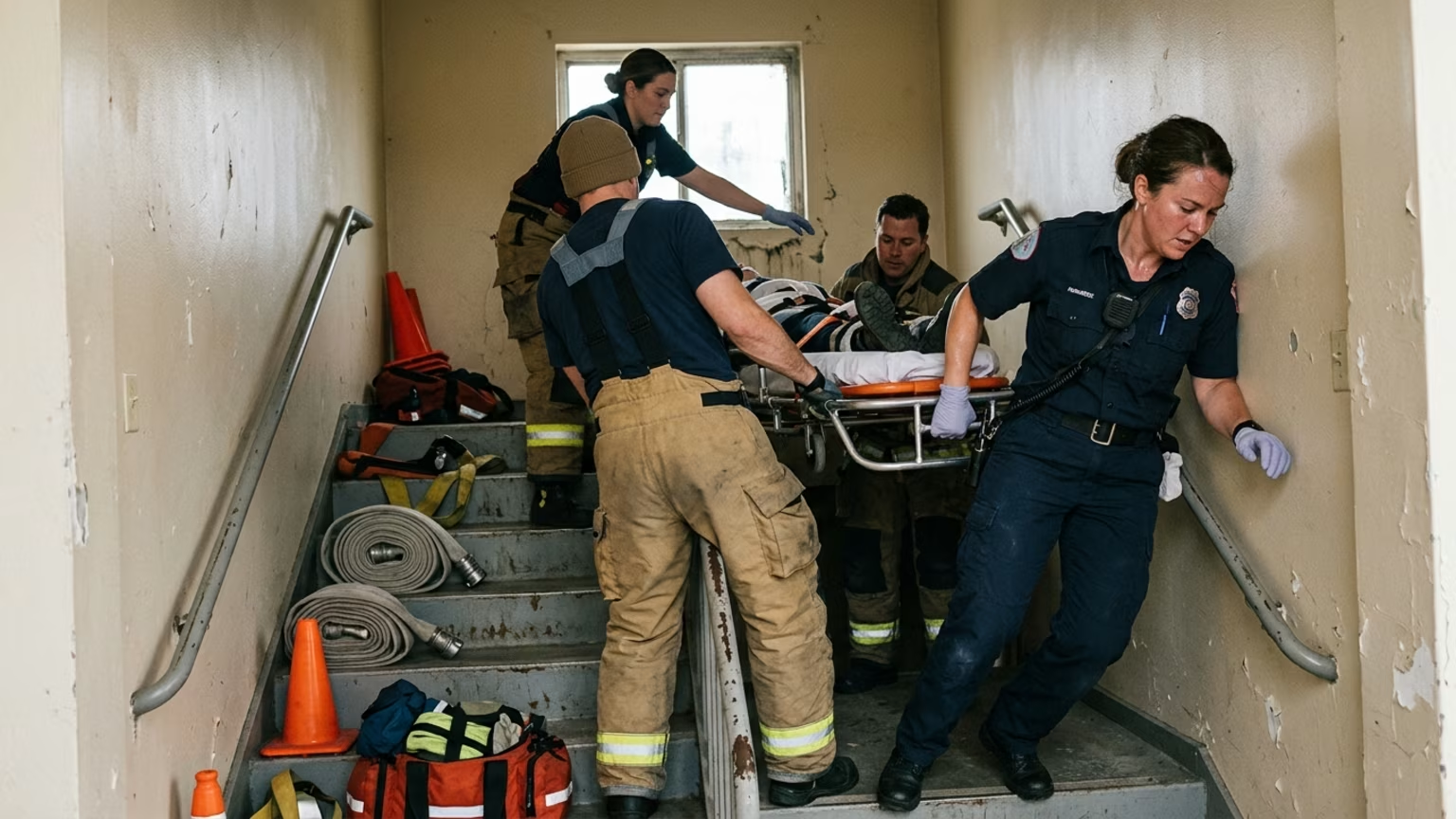

Exercise Ultimate Caduceus 2026 highlights the physical toll of large-scale patient movement, validating multi-component training and lifting devices for EMS.





On September 10, 2026, U.S. Transportation Command led Exercise Ultimate Caduceus 2026 to test the global movement of injured service members. The event required approximately 400 military and civilian personnel to manage the reception, triage, tracking and transport of patients across four regional sites.
The exercise tested the entire patient-movement process from arrival to definitive care. Footage published on September 20, 2026, demonstrated a massive coordination effort across multiple responding agencies. Participating organizations included U.S. Northern Command, U.S. Strategic Command, Air Force aeromedical evacuation crews and Critical Care Air Transport Teams. Army Reserve Medical Command, the Defense Health Agency, the Department of Veterans Affairs and the Department of Health and Human Services also took part.
Regional health-care and emergency-response partners worked alongside these federal entities to complete the mission. Operations spanned Alpena in Michigan and Boise in Idaho. The exercise also utilized Scott Air Force Base in Illinois and Fort Campbell in Kentucky. The scenario forced crews to handle staging, tracking and transport under rigorous field conditions.
A core component of the test was managing complex coordination with receiving care facilities. This scale of movement highlights the immense physical load placed on medical and transport personnel. A primary challenge in emergency medicine is the continuous manual labor required to move injured individuals. Repeated patient transfers create significant mechanical wear on the personnel executing the mission.
The Centers for Disease Control and Prevention and the National Institute for Occupational Safety and Health outline this specific risk clearly. CDC/NIOSH identifies patient handling as the single greatest work-related musculoskeletal-disorder risk factor for health-care workers. Manual lifting, moving and repositioning of patients directly causes acute and chronic physical wear. First responders and emergency medical professionals face these mechanical loads on almost every operational shift.
Translating military exercise observations to civilian emergency medical work requires understanding this profound physical toll. Addressing the accumulated physical demands and injury risk of patient transport is essential for career longevity. Medical professionals cannot simply power through continuous heavy lifting without experiencing structural degradation over time. Organizations must acknowledge the physiological limits of their frontline personnel.
More than 30 Soldiers from the Aurora, Colorado-based 7450th Medical Operational Readiness Unit served as a patient insertion team. An Army Reserve account stated this team supported patient tracking and ground movement throughout the operation. Their specific responsibilities included loading and off-loading patients to and from heavy transport aircraft. Crews moved patients onto C-130J Super Hercules aircraft, UH-60L Black Hawks and C-12 Hurons.
The exercise also utilized commercial aviation and Civil Reserve Air Fleet platforms to transport casualties. One image documented Army Reserve personnel moving a litter-bound mannequin loaded with biomedical equipment. They performed a simulated handoff to Air Force aeromedical evacuation crews at Scott Air Force Base. Maneuvering patients and heavy medical gear on flight lines requires significant functional strength and stability.
The operational demands of loading transport vehicles replicate the irregular lifting angles seen in civilian emergency responses. Paramedics and medical personnel regularly lift awkward loads from severely compromised positions. The physical strain accumulates rapidly over a long shift, especially when fatigue sets in. Building a comprehensive physical capacities profile helps personnel handle these specific movement demands effectively.
Emergency workers need deep structural resilience to manage repetitive lifting safely under operational stress. A tired responder lacks the basic motor control necessary to execute a heavy patient transfer perfectly. Relying entirely on flawless lifting mechanics during a grueling 24-hour shift is an unrealistic expectation. Agencies must provide better systemic support to mitigate these fatigue-related movement risks.
The physical demands observed during Ultimate Caduceus 2026 validate the need for structured operational fitness protocols. Moving patients safely requires targeted, multi-component interventions rather than basic wellness advice. A PEDro evidence summary reported moderate evidence supporting exercise interventions to manage these occupational risks. The summary also found moderate evidence for multi-component patient-handling interventions in the field.
This finding confirms that general fitness alone is not sufficient to protect emergency medical workers. Structured training must complement administrative controls, specialized equipment and strict operational guidelines. Crews need access to targeted physical conditioning to handle the mechanical stress of patient transfers. They must balance baseline strength with specific job capacity to remain resilient against injury.
When emergency professionals face severe sleep disruption from rotating shifts, their baseline physical recovery suffers. Unpredictable calls compound the problem by interrupting essential nutrition, hydration and rest periods. Fatigue severely limits lifting capacity and increases the likelihood of a critical movement error. Organizations need to pair structured conditioning resources with practical fatigue management protocols.
Implementing comprehensive handling protocols directly changes how emergency services manage shift preparation and recovery. Departments must match physical readiness standards with specific patient-handling equipment. CDC/NIOSH notes that safe patient handling and mobility programs should include accessible assistive lifting devices. Providing these mechanical tools is only the first required step in a broader risk reduction strategy.
Workers require ongoing, realistic training in the proper use of these specific assistive devices. Organizational promotion of assistive technology is critical for widespread adoption across a department. CDC/NIOSH states that using this technology can reduce workers' injury and strain risk over time. Protocols must shift from assigning individual blame to enforcing systemic equipment usage and institutional support.
Historically, many emergency departments relied entirely on teaching correct manual lifting mechanics to prevent injuries. The flawed assumption was that proper posture could neutralize the extreme weight of an adult patient. This perspective placed the entire burden of injury prevention on the individual responder's technique. The available evidence strongly challenges this outdated approach to occupational health and physical safety.
The PEDro evidence summary reported that training alone had no effect on musculoskeletal health in the reviewed evidence. Teaching a responder how to lift does not change the physical reality of a heavy, awkward load. An uncooperative or unconscious patient creates unpredictable force vectors that perfect form simply cannot fix. Relying on technique as a primary defense ignores the harsh mechanics of actual emergency transport.
This realization overturns decades of generic safety briefings in the emergency medical and responder field. Agencies can no longer claim that back injuries stem solely from poor lifting form or individual negligence. They must recognize that manual patient handling itself is an inherent and severe occupational hazard. CDC/NIOSH makes clear that manual patient handling can cause injury despite best efforts and training.
A comprehensive approach requires physical equipment, systemic policy adjustments and realistic operational support. Emergency services must abandon the idea that physical toughness can override basic human biomechanics. True career longevity demands a shift away from outdated physical assumptions. Protecting personnel means accepting the limits of the human body under heavy, repetitive load.
Emergency services must translate these findings into actionable daily routines for their frontline personnel. The immediate priority is integrating assistive lifting devices into every possible patient transport scenario routinely. Crews should check their specialized lifting equipment at the exact start of every operational shift. Supervisors must confirm that all mechanical aids are present, fully charged and functional before deployment.
Routine equipment checks prevent dangerous manual lifting situations later in the active operational period. Personnel should adjust their own physical conditioning to support the specific demands of patient transfer. This means prioritizing grip strength, core stability and endurance under sustained, heavy load. Multi-component exercise programs offer a highly reliable framework for building this required occupational resilience.
Responders need to target the exact muscle groups heavily recruited during litter carries and equipment loading. Maintaining physical capability requires consistent, job-specific training rather than generic fitness workouts. Leaders should actively encourage the use of mechanical lifting aids during routine and complex calls. Operational briefs should highlight equipment locations and preferred lifting strategies before emergency crews deploy.
Reducing the long-standing stigma around using mechanical assistance is a necessary operational cultural shift. Every prevented manual lift actively extends the career longevity of a dedicated frontline medical worker. Crews also need structured recovery practices to manage the fatigue associated with extended transport operations. High-volume transport exercises demand focused, deliberate attention on hydration, nutrition and required rest intervals.
Responders should practice systematic symptom monitoring to catch minor muscular strains before they escalate. Identifying physical warning signs early allows personnel to adjust their activity and seek appropriate clinical care. Proactive recovery reliably protects the body from the cumulative toll of irregular shift work. Combining physical training, assistive equipment and active recovery creates a sustainable working model.
Future developments in large-scale movement drills will directly shape local emergency response protocols. Evaluators will need to analyze how exercises like Ultimate Caduceus 2026 influence agency equipment procurement. The integration of advanced assistive lifting devices into active field operations remains a critical area to watch. Tracking how military and civilian agencies adapt to these physical loads will continuously guide future policy.
The adoption of multi-component physical training programs within emergency departments also requires careful, ongoing observation. Researchers need to study how targeted exercise interventions actively improve career longevity over extended timeframes. Observational data regarding specific fatigue management and injury rates will provide a clearer picture of operational health. Organizations must continue aggressively seeking evidence-based methods to physically support their frontline personnel.
As interagency coordination steadily improves, medical professionals will face increasingly complex patient transport scenarios. Maintaining physical readiness will remain a strict, central requirement for safely executing these physically demanding missions. Operational health policies must rapidly evolve to reflect the exact mechanical realities of patient movement. Staying updated on occupational safety research provides the single best defense against career-ending physical injuries.
Implementing structured patient-handling protocols points toward measurable improvements in career longevity when Rescuris provides the evidence-led operational framework. The accumulated physical toll from continuous manual lifting frequently complicates planning for physical capability and an active life after retirement or leaving service. Rescuris delivers the practical guidance necessary to protect physical readiness and navigate these occupational demands.
Rescuris publishes evidence-aware guidance for firefighters, police officers, paramedics and other first responders on fitness, recovery, sleep, nutrition, stress resilience and long-term capability.






Read practical guidance on first responder fitness, recovery, sleep, nutrition and resilience for demanding work and a long, active career.
read the blog
