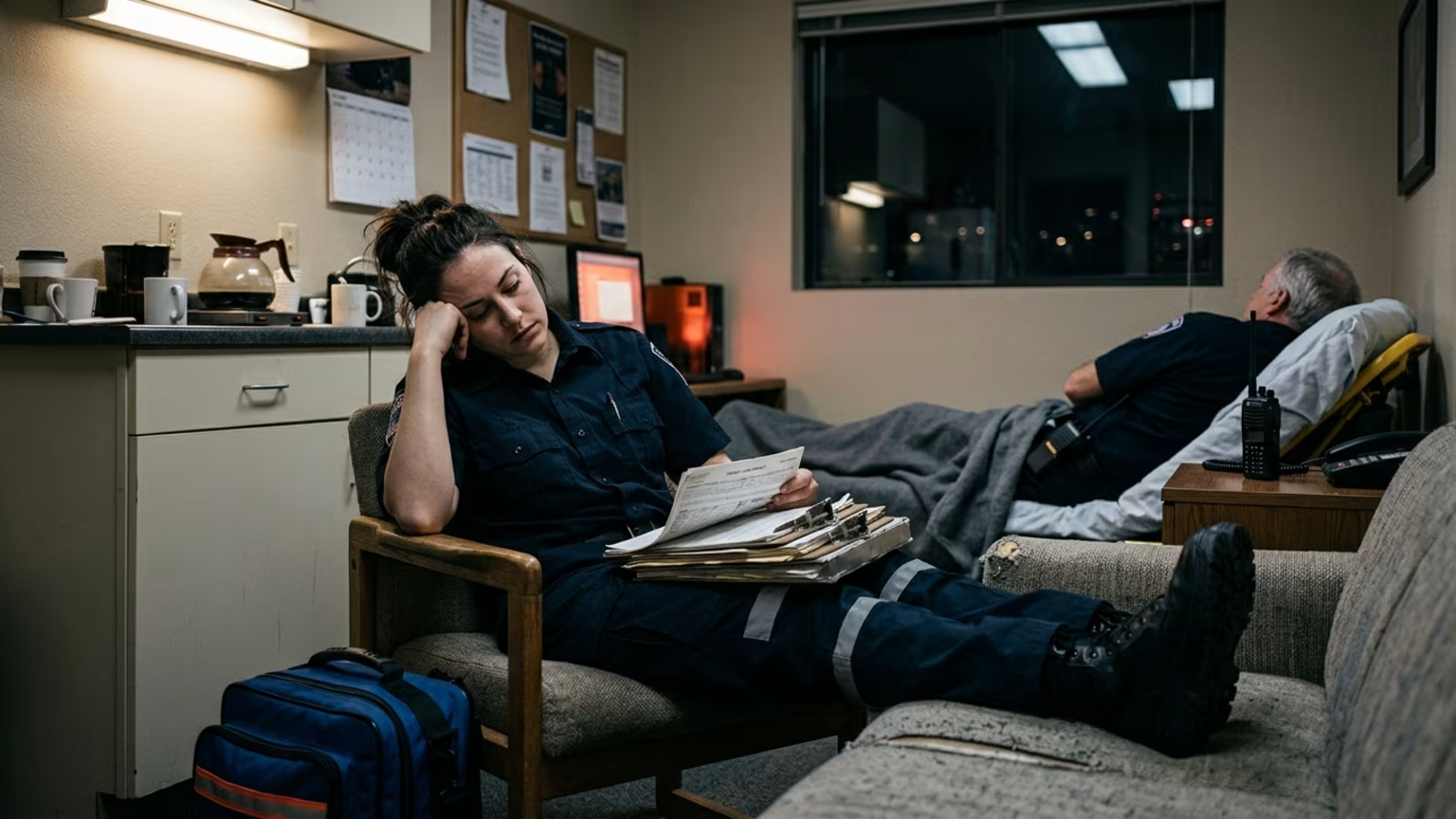

Washington officials are considering a paid EMT post to relieve volunteer fatigue during overnight hours. Learn how targeted staffing impacts shift recovery.





In September 2026, Washington city officials in Iowa discussed a proposal for a paid overnight EMT position. This plan attempts to strengthen emergency coverage when volunteer responders are sleeping or working extended shifts.
The Washington Fire Department traditionally relies on volunteers to manage emergencies around the clock for the community. Chief Brendan DeLong stated that overnight staffing has become increasingly difficult recently. Volunteers face competing work and sleep demands that significantly reduce their overall availability. The proposed position would create an overnight paid on-call EMT role to improve response reliability across the district, targeting the hours when volunteer response has historically been lowest.
According to KCII Radio, the department reports that approximately 30 percent of its total medical calls are handled by only one responder. A significant portion of those single-responder calls occur between 10 p.m. and 6 a.m. This specific overnight window represents a critical operational vulnerability for the entire emergency response system. The city council workshop held at 5:30 p.m. at Washington City Hall evaluated this exact tension between coverage and capability.
The estimated annual cost for the position is $75,000, with city officials expecting the necessary funding to come from the local EMS tax. If the plan receives final approval, the program is scheduled to take effect November 1. It acts as a targeted staffing intervention rather than a complete overhaul of the existing volunteer system. The proposal places a paid responder into the overnight coverage gap to stabilize response times.
This intervention reduces the need to depend entirely on volunteers to wake up and leave home late at night. It also relieves pressure on personnel responding after completing extended daytime work shifts at other jobs. The available public report does not specify the exact hours for the proposed overnight post. It also omits details regarding the minimum qualifications, compensation structure or supervision model for the new role.
This proposal directly validates current fatigue management protocols that prioritize continuous sleep opportunity for operational readiness. The proposed 10 p.m. to 6 a.m. coverage window overlaps heavily with the normal sleep period for most active volunteers. Relying on personnel who are actively resting creates an obvious vulnerability in community emergency coverage. When sleep is repeatedly interrupted, cognitive readiness and physical capability naturally decline over time.
A related firefighter sleep study reported by Firehouse provides useful sector context regarding continuous sleep opportunity. The Roswell Fire Department examined a specific schedule change between June 2024 and early 2026. They transitioned from a 24/48 schedule with an 8 a.m. start to a 48/96 schedule with an 11 a.m. start. This adjustment focused on protecting the critical sleep window immediately before a physical work tour.
The Roswell project measured sleep using wrist-worn trackers, daily surveys and regular follow-up health evaluations. Reported average tracker-measured sleep increased from 6.7 to 7.0 hours per night across the study group. Self-reported sleep also increased by 41 minutes per night during the detailed evaluation period. Sleep the night before firefighters commuted to work increased from 6.1 to 7.0 hours.
The department noted that high fatigue scores fell from 40 percent to 10 percent after the shift change. The share of personnel meeting the poor sleep quality measure fell from 67 percent to 36 percent. These specific recovery and readiness metrics show why evaluating sleep opportunity is crucial for operational planning. Modifying a schedule can yield measurable improvements in daily physical capability and long-term career longevity.
However, the Firehouse report cautioned that the schedule tested in Roswell may not suit every emergency agency. It might fail in departments with heavy overnight call volume or frequent mandatory operational overtime. The Roswell study had a modest sample, lower than hoped actigraphy completion and focused on a single department. These variables mean that Washington’s proposed EMT post requires its own careful operational review before expanding.
The Washington proposal challenges the assumption that coverage gaps are simply a matter of individual volunteer willpower. The traditional model often expects exhausted personnel to absorb every overnight gap through personal physical sacrifice. This approach ignores the biological limits of human sleep cycles and necessary physical recovery windows. Chronic fatigue cannot be solved by simply asking tired volunteers to try harder during the middle of the night.
Framing sleep as an individual weakness fails to address systemic response reliability or operational safety. The proposal recognizes that coverage reliability is heavily affected by the structure of the response system itself. When approximately 30 percent of medical calls involve a single responder, the system requires a deep structural adjustment. This view treats fatigue as a logistical problem rather than a personal failing among dedicated emergency crews.
This shift in perspective mirrors discussions seen in recent public safety hearings regarding extended shifts and mandatory overtime. A paid overnight post acknowledges that volunteers have competing work, family and sleep demands. It removes the expectation that personnel should consistently sacrifice their own long-term health for daily system operations. Building a resilient response network means planning around actual human physiological constraints instead of ignoring them.
Emergency services evaluating similar fatigue challenges should implement specific measurement adjustments before changing their daily operations. Agencies must track the right baseline measures before rolling out a new structural staffing intervention. Washington should document overnight call volume and the frequency of single-responder incidents beforehand. Tracking time to first responder and time to additional responder is equally critical for an objective evaluation.
Operational leadership should strictly separate response reliability from response speed when analyzing initial pilot results. A dedicated overnight post might improve reliability without guaranteeing a noticeably faster ambulance transport. Agencies need to measure whether a qualified responder was available and if the intervention changed dispatch to arrival time. This separation clarifies exactly what a new staffing layer actually achieves for the local community.
Departments must also measure the ongoing volunteer burden to ensure the intervention actually works as intended. A dedicated overnight responder could relieve immediate pressure on the existing volunteer pool during late hours. However, leadership should still monitor overnight call-outs among the remaining volunteer workforce continuously to spot new trends. Agencies must track sleep disruption after calls and verify whether volunteers stay available for later daytime shifts.
Finally, departments should adopt a structured pilot and review model for any new operational scheduling protocols. The Roswell department used a methodical format to change operations, measure results, listen to feedback and adjust. They relied on active sleep tracking, daily surveys and rigorous operational review to evaluate their specific adjustments. Agencies facing acute stress and extended shifts can apply this same evaluation principle to their own targeted operational interventions.
The immediate action in Washington remains a city council workshop rather than a confirmed final operational decision. The November 1 start date depends entirely on whether officials approve the plan and secure the necessary EMS tax funding. Analysts should watch how the department defines the exact schedule, station location and minimum qualifications for the overnight post. These specific operating details will determine if the position provides true overnight coverage or just an extra administrative layer.
Future monitoring should focus on whether the paid position actually reduces cumulative volunteer fatigue across the entire department. Adding one person does not automatically guarantee complete overnight response capacity for every major critical incident. A single responder may simply be the first person on scene while heavier transport resources remain delayed. Ongoing analysis must verify if this targeted staffing purchase successfully addresses the root operational tension without creating new logistical vulnerabilities.
Furthermore, the long-term impact on overall community readiness will require consistent tracking over multiple seasons. The initial data showing a high proportion of single-responder calls between 10 p.m. and 6 a.m. provides a baseline. Subsequent reviews must confirm whether the $75,000 investment genuinely decreases the frequency of those isolated responses. Tracking these metrics will separate a temporary operational patch from a sustainable shift-work recovery solution.
Managing nutrition, hydration and energy when meal timing is inconsistent complicates overnight coverage operations for dedicated emergency personnel. Balancing these physiological needs during unpredictable night shifts directly impacts long-term duty readiness, and Rescuris turns credible evidence into practical guidance built around these highly demanding irregular work schedules. Explore Resources
Rescuris publishes evidence-aware guidance for firefighters, police officers, paramedics and other first responders on fitness, recovery, sleep, nutrition, stress resilience and long-term capability.






Read practical guidance on first responder fitness, recovery, sleep, nutrition and resilience for demanding work and a long, active career.
read the blog
