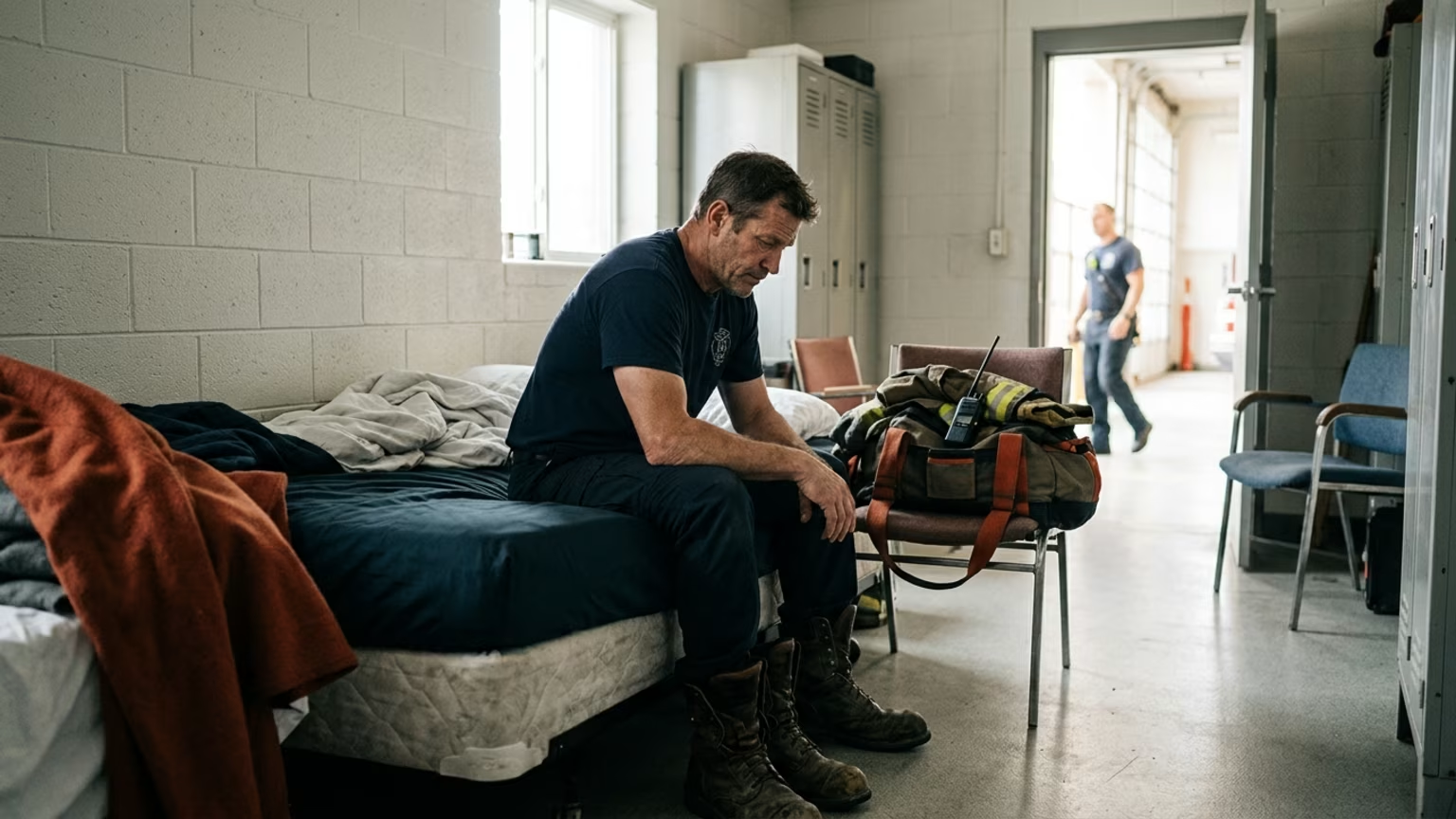

A 2026 Zurich study links better sleep to higher resilience and self-reported job performance. See how first responders can apply these operational findings.





On September 23, Zurich announced its Global People Resilience Study 2026, detailing a positive association between personal resilience, daily sleep habits and self-reported job performance.
The extensive research project was developed with Oxford Research & Development Partners and surveyed 11,175 working-age adults across 16 countries. This massive global sample covered people aged 18 to 69 with an average age of 38. The participant pool was evenly split, comprising 49 percent women and 51 percent men. Zurich’s study materials identify Professor Jan-Emmanuel De Neve, director of the University of Oxford’s Wellbeing Research Centre, as a collaborator in developing the research framework.
The primary finding focused on self-reported capability in the workplace. According to the study, workers in the highest resilience group reported good or excellent job performance at twice the rate of those in the lowest resilience group. Specifically, 88 percent of the highest-resilience group reported top performance, compared with 44 percent of the lowest-resilience group. This data represents a comparison in reported performance rather than an independently measured test of workplace output.
To measure these outcomes, the researchers utilized Zurich’s Personal Resilience Index. This specific index assesses resilience through beliefs, capabilities and behaviors. It considers factors across five distinct domains: psychological, physical, social, financial and digital. Zurich states that the framework was informed by more than 130 academic papers.
A significant secondary finding from the study connects daily rest to these broad capability scores. Zurich reports a clear association between better sleep and higher resilience scores across every measured life domain. The company describes sleep as highly relevant to workforce preparedness and general adaptability. However, this finding does not establish that improved sleep directly causes higher resilience or perfect job performance.
Applying broad workforce data to shift-based operations requires careful context and practical translation. The Zurich survey focuses on general workers across various occupations and job levels. The published study description does not identify a first-responder-specific sample, nor does it report separate findings for firefighters, police, paramedics or EMTs. The results therefore offer valuable context rather than direct evidence about emergency-service readiness.
Despite the lack of an emergency-services subgroup, the findings remain highly relevant to the physical realities of first responder work. Emergency professionals routinely manage irregular schedules, mandatory overtime and interrupted sleep patterns. When a global study links baseline sleep to higher resilience across multiple life domains, it validates the need to prioritize physical recovery. First responders cannot always control their sleep environments, making proactive rest strategies essential for long-term health.
Balancing strength, endurance and physical capability across a demanding career requires more than standard gym sessions. Shift-work sleep disruption directly impacts how the body manages stress, processes nutrition and recovers from accumulated physical wear. Treating sleep as a core component of operational readiness helps emergency professionals sustain their capabilities over years of duty. Agencies and individuals can use this framework to view rest as a measurable asset rather than a passive activity.
Understanding the connection between rest and readiness is critical for maintaining focus during unpredictable emergency calls. Sleep disruption directly affects how quickly personnel can process information and make complex decisions in the field. When fatigue accumulates over a series of long shifts, the margin for operational error naturally decreases. Prioritizing consistent rest helps mitigate the fatigue that often accompanies shift work and irregular sleep schedules.
Applying this research also helps separate useful stress-management guidance from unhelpful motivational slogans. Resilience is framed by Zurich as a capability that can develop over time rather than a fixed personality trait. This shifts the focus from an innate physical toughness to a measurable set of daily behaviors and routines. For personnel working demanding jobs, this approach normalizes the effort required to maintain high performance without relying on macho mentalities.
The Zurich study challenges the outdated assumption that resilience relies strictly on a singular measure of mental toughness. By breaking readiness down into psychological, physical, social, financial and digital domains, the Personal Resilience Index dramatically broadens the definition of workplace capability. This holistic view moves away from treating operational stress as a burden that personnel must simply absorb in silence. Instead, readiness appears as a flexible skill set that organizations and individuals can actively support through targeted strategies.
This multi-domain framework also challenges the idea that operational capability is solely dictated by physical fitness. By including social and financial factors, the index acknowledges that outside stress directly impacts on-duty performance. For first responders, this means that off-duty stability plays a major role in managing the demands of the job. A narrow focus on physical conditioning ignores the broader life domains that actually sustain a long and healthy career.
The findings also challenge the assumption that financial compensation is the primary driver of workplace capability. Zurich reports that resilience was 2.5 times more predictive of reported job performance than income in its analysis. While financial stability remains crucial, this highlights that a well-supported workforce may function more effectively than one relying solely on financial incentives. For emergency services, this suggests that investing in comprehensive recovery programs yields significant operational dividends.
Finally, the study challenges the pervasive cultural notion that sleep is a luxury or a sign of weakness. The clear association between better sleepers and higher resilience scores across all domains validates the operational need for protected recovery time. This challenges generic advice that prioritizes short-term output while ignoring long-term physical wear. True readiness requires a sustainable approach to physical recovery that respects basic physiological needs.
Based on these findings, emergency professionals can make immediate adjustments to their daily routines and shift preparations. The first step is to evaluate current rest habits and identify areas where sleep consistency can be improved. Because the study links better sleep to higher resilience across all domains, protecting baseline rest is a clear priority. This might involve optimizing the sleep environment for daytime rest or establishing strict boundaries around off-duty communication.
Individuals should also look beyond physical training when assessing their overall readiness for demanding duty. The five domains of the Zurich index provide a practical checklist for identifying potential stressors outside of work. If financial or social pressures are mounting, addressing those areas may improve overall capability just as effectively as a new exercise program. This broad approach helps prevent physical burnout and supports an active life long after leaving the service.
For agencies, the study provides a compelling reason to examine whether current scheduling practices are compatible with adequate rest. Departments can evaluate if mandatory overtime policies and shift rotations respect the recovery timelines required for high-risk work. Providing structured support across multiple life domains can help build a more adaptable and capable workforce. This requires moving beyond generic wellness advice to implement policies that respect the actual physical toll of emergency response.
When meal timing is inconsistent and shifts are unpredictable, establishing a clear recovery protocol becomes vital. First responders can focus on managing days off and recovery sleep to optimize their available downtime. Consistent nutrition and hydration strategies also play a major role in how the body processes fatigue. Aligning these basic physiological needs with the realities of the job directly supports long-term physical capability.
It is also critical to approach resilience with a realistic understanding of what the evidence actually supports. The defensible practical takeaway is to treat sleep and recovery as relevant to readiness without making absolute medical guarantees. Improving sleep will not magically resolve all workplace challenges or eliminate the inherent stress of emergency calls. However, prioritizing rest does provide the physical and mental foundation needed to manage those challenges effectively.
First responders managing the demands of irregular duty schedules should approach resilience as a continuous daily process. Implementing reliable off-duty routines helps separate useful stress-management strategies from mental-health stigma. By focusing on the structural components of recovery, emergency professionals can maintain their capability without sacrificing their long-term health. Understanding these connections helps personnel navigate the complexities of shift work with practical and evidence-led strategies.
Personnel should evaluate their daily routines through the lens of practical stress resilience to find what works best. Building a personal recovery system that accounts for the psychological, physical and social domains creates a robust defense against shift-work fatigue. Tracking basic metrics like energy levels, mood and physical recovery can help identify which adjustments are providing the most benefit.
As research into workplace resilience continues, several key areas require ongoing analysis and follow-up studies. Future research should prioritize evaluating specific emergency-service cohorts to determine how irregular shifts affect these multi-domain resilience metrics. Tracking outcomes specifically for firefighters, police officers and paramedics would provide far more actionable data for operational planning. This would help clarify whether the performance relationships observed in standard workforces hold true in high-stress environments.
It is also necessary to track whether future studies can establish a direct causal link between sleep interventions and objective job performance. The current Zurich findings describe self-reported associations rather than proving that improved rest directly causes better workplace output. Long-term studies utilizing independent performance metrics and controlled sleep protocols would significantly strengthen the evidence base. Until then, the connection remains a strong association that warrants serious operational consideration.
Organizations should also monitor how broad indices like the Personal Resilience Index are adapted for specific occupational hazards. Observing how these frameworks evolve will help agencies refine their own internal support structures over time. Tracking these developments helps maintain recovery strategies that remain aligned with credible, field-tested evidence.
Finally, future studies should investigate how shift-work sleep disruption specifically impacts the financial and digital domains of resilience. Understanding these nuanced interactions will help agencies design more comprehensive support programs for their personnel. Continuous evaluation of these factors will keep first responder performance standards grounded in operational reality rather than generic corporate theory.
Ignoring the reality that physical recovery directly influences workforce resilience leaves shift-working personnel vulnerable to long-term fatigue. When recovering from accumulated physical wear without losing duty readiness becomes a daily struggle, Rescuris delivers practical, evidence-led guidance built around the irregular schedules of emergency response. We translate complex physiological research into clear recovery routines that support both immediate operational capability and long-term health.
Rescuris publishes evidence-aware guidance for firefighters, police officers, paramedics and other first responders on fitness, recovery, sleep, nutrition, stress resilience and long-term capability.



Read practical guidance on first responder fitness, recovery, sleep, nutrition and resilience for demanding work and a long, active career.
read the blog
