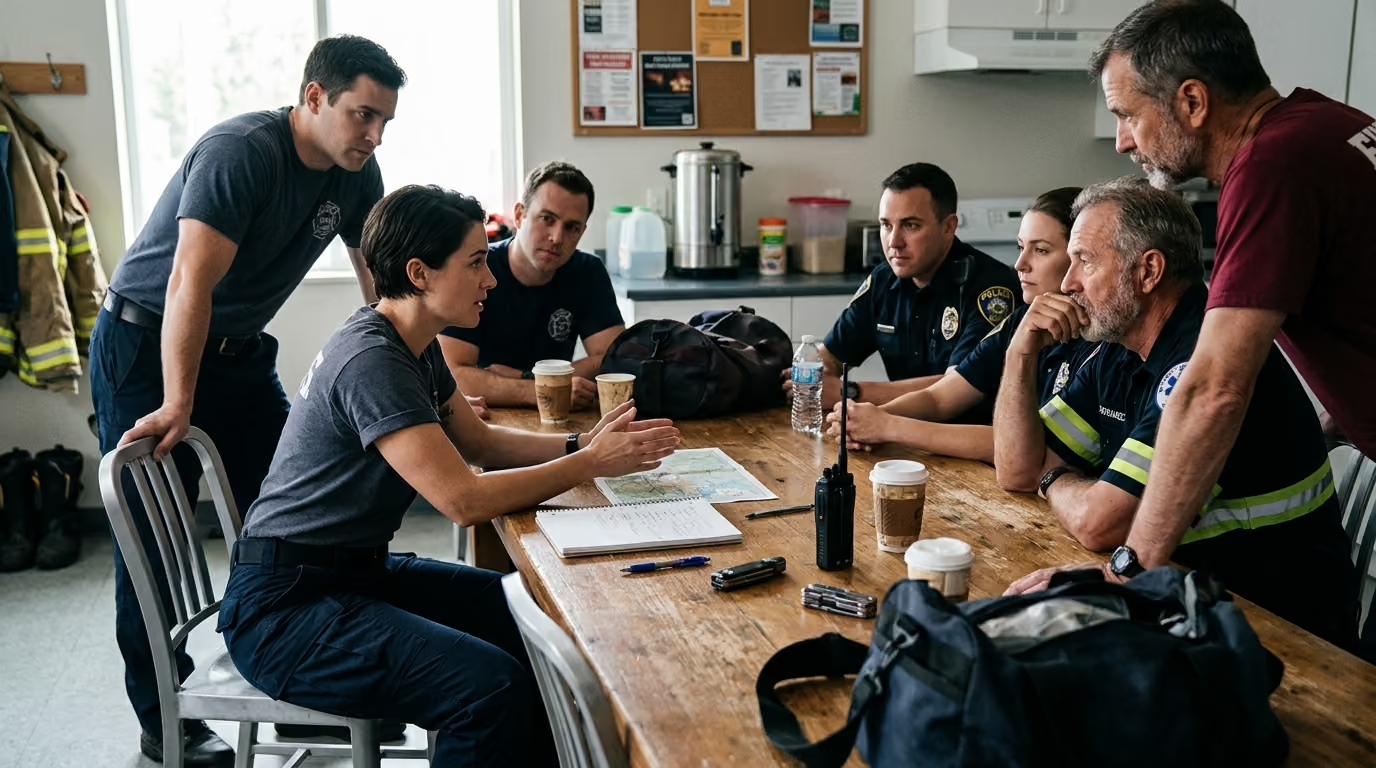

Workplace emergencies leave frontline teams emotionally drained, making structured post-incident reviews essential for identifying latent system flaws and safeguarding mental health.





Many operational teams assume that holding a post-incident debrief automatically improves performance and builds resilience. In reality, poorly conducted reviews often do the exact opposite. When a debrief degenerates into finger-pointing or hindsight judgment, it reinforces defensive habits, discourages candid reporting, and increases psychological distress among personnel.
Learning from difficult outcomes requires a deliberate operational design. A high-quality after-action review (AAR) separates individual accountability, systems analysis, emotional support, and actionable process improvement into distinct components. By analyzing why events made sense to personnel in the moment, organizations can identify latent system vulnerabilities while protecting the cognitive readiness and mental health of their workforce.
An after-action review is a structured, facilitated discussion held after an operation, incident, error, or near miss. It compares intended actions with actual outcomes, diagnoses why differences occurred, and determines what must be sustained or corrected.
The traditional four-question framework asks what the team set out to do, what actually happened, why there was a difference, and what should be done next time. A complete review structure addresses four distinct functions:
When organizations merge these functions into an unstructured conversation, learning fails. Keeping them clear enables teams to maintain high standards while protecting psychological safety.
Research confirms that structured post-incident reviews can produce substantial performance gains, but their success depends heavily on execution. A meta-analysis of 61 studies covering 915 teams and 3,499 individuals reported an overall effect size of d = 0.79 across diverse training and performance criteria. The analysis found that reviews were significantly more effective when aligned with clear learning objectives and when supported by objective media, such as video, audio recordings, or operational logs.
Structure plays a distinct role depending on the operational environment. The meta-analysis indicated that highly structured reviews produced better outcomes in military environments, whereas healthcare settings demonstrated comparable effectiveness between highly structured and moderately structured formats. Debriefs are not universally beneficial. Task complexity, participant characteristics, facilitation quality, and the prevailing organizational culture dictate whether a review improves capability or causes disengagement.
Safety culture also benefits from regular operational reviews. Research on review frequency indicates that teams conducting regular AARs report stronger shared safety norms. Discussing deviations and weak signals becomes a routine marker of professional competence rather than an admission of failure.
The evidence surrounding psychological safety highlights its role as the foundation for organizational learning. Research by Amy Edmondson across 51 work teams demonstrated that psychological safety is directly associated with team learning behavior. In that research, learning behavior mediated the relationship between psychological safety and team performance. When team members believe that interpersonal risk-taking is safe, they report near misses, seek assistance, and identify operational hazards before catastrophic failures occur.
Conversely, adverse events take a heavy psychological toll on front-line personnel. In healthcare and emergency operations, professionals involved in unexpected negative outcomes are often described as second victims. Systematic reviews show that prevalence estimates for second victim distress range from 10.4% to 43.3% across general healthcare cohorts, with intensive-care estimates reaching 58% for lifetime prevalence.
Documented symptoms among affected personnel include intrusive memories in 81% of cases, anxiety in 76%, self-directed anger in 75%, regret or remorse in 72%, and sleep disruption in 35%. When post-incident reviews treat systemic failures as individual moral failings, they exacerbate this distress, drive burnout, and degrade future performance.
Blame focuses on identifying a culprit to carry the negative emotional weight of a failure. Accountability focuses on understanding obligations, authority, operational decisions, and constructive follow-through.
Blame-based questioning asks who made a mistake and why that person was careless. Accountability-based questioning asks what the person was attempting to accomplish, what information was accessible, and what options appeared reasonable under operational pressure. Blame assumes an outcome was obvious in advance. Accountability respects the reality that decisions unfold under uncertainty, time pressure, and incomplete situational awareness.
A practical just-culture framework categorizes operational behavior into three distinct classes:
Human error involves an unintended slip, lapse, or cognitive mistake during normal duty. Examples include misreading an ambiguous display, forgetting a minor step during a complex medical sequence, or selecting the wrong equipment setting during an unexpected distraction.
The appropriate operational response is consolidation, peer support, and system redesign. Disciplining an individual for an inadvertent cognitive lapse does not prevent future errors. It merely ensures that other team members will hide similar mistakes.
At-risk behavior occurs when a person makes a choice that increases operational risk, often because the risk is unrecognized or believed to be justified. Common examples include bypassing a cumbersome safety checklist to meet response deadlines or creating informal workarounds for poorly designed equipment.
The appropriate response is coaching, workflow redesign, and removing the incentives that made the workaround attractive. Leaders must understand why the shortcut seemed necessary during daily work before issuing administrative corrections.
Reckless behavior involves a conscious, intentional disregard of a substantial, unjustifiable risk. Examples include operating safety-critical equipment while knowingly impaired, deliberately falsifying duty records, or intentionally disabling vital life-safety mechanisms.
The appropriate operational response is formal administrative investigation, proportionate disciplinary action, and potential reassignment or removal from safety-sensitive duties.
A just culture applies these behavioral categories uniformly. If an organization excuses reckless choices by senior personnel while punishing junior personnel for honest human errors, psychological safety collapses.
Complex operational failures rarely stem from a single root cause. Disasters typically emerge from subtle interactions between equipment, workflow design, workload, organizational priorities, and environmental stressors.
Front-line personnel often adapt dynamically to compensate for flawed equipment or unrealistic policies. When an incident occurs, organizations frequently make the mistake of blaming the operator rather than examining the conditions that invited the error.
A thorough systems analysis investigates several operational dimensions:
World Health Organization guidance on incident analysis emphasizes that investigating underlying systems is far more effective than reminding workers to be vigilant. Systems that depend entirely on unbroken human vigilance will eventually fail. Resilient organizations implement structural safeguards that catch errors before they cause irreversible harm.
When an operation results in injury, property loss, or a tragic outcome, the personnel involved experience substantial emotional weight. The emotional impact extends beyond those who made primary tactical decisions. Dispatchers, observers, trainees, and supervisors often experience profound guilt and distress.
Second victim symptoms can severely impair operational capability. Acute stress frequently manifests as persistent rumination, loss of professional confidence, hypervigilance, and insomnia. If left unaddressed, this burden contributes to chronic stress, clinical depression, substance misuse, and early career departure.
Protecting mental health during an AAR requires clear boundaries between operational review and emotional support:
Group reviews should focus primarily on operational facts, shared timelines, and system improvements. Forcing individuals to publicly express trauma or emotional pain in front of colleagues can cause secondary harm. Operational participation should be structured, while personal emotional support remains voluntary and confidential.
Personnel cannot speak openly about their psychological struggles if they fear their words will be used in disciplinary or legal proceedings. Peer support teams and employee assistance resources must operate independently from internal affairs or formal investigative bodies.
Organizations should provide access to trained peer support personnel who understand operational realities. Programs such as the RISE model developed at Johns Hopkins demonstrate the value of structured peer networks in mitigating the negative impacts of critical incidents.
Facilitators must maintain a calm, professional tone during reviews. If a participant exhibits severe distress, the facilitator should pause the discussion, offer a private break, and provide direct access to support resources.
First responder environments introduce unique physical and physiological variables that complicate post-incident learning. Shift work, circadian disruption, physical exertion, and environmental extremes degrade cognitive processing and emotional regulation.
Firefighters, police officers, paramedics, and dispatchers frequently manage high-consequence incidents while enduring acute sleep deficits. Research on shift work highlights how chronic circadian disruption impairs working memory, situational assessment, and emotional stability. You can read more about foundational fatigue mitigation in the CDC report on shift work baselines.
When an adverse event occurs at the end of a demanding night shift, personnel are physiologically ill-equipped for immediate cognitive analysis. Blood pressure remains elevated, stress hormones circulate, and cognitive resources are depleted. Conducting an extensive review while crews are severely sleep-deprived yields low-quality insights and increases defensiveness.
Practical field adaptations for emergency services include:
Immediately after an incident, conduct a brief three-minute operational check. Confirm immediate safety, document urgent mechanical or perishable facts, ensure everyone is accounted for, and verify that basic physiological needs are met. For rapid stress stabilization during shifts, techniques like a structured between-call reset strategy help crews clear acute tension.
Schedule the formal, in-depth AAR after crews have obtained rest and recovery. Allowing 24 to 48 hours to elapse permits physiological stabilization, reduces acute emotional arousal, and allows participants to process their actions objectively.
Emergency incidents often involve multi-agency operations where communication protocols differ. Fire, police, and EMS personnel may interpret identical incidents through different tactical frameworks. Cross-functional reviews must establish common terminology and examine inter-agency dispatch, radio channel saturation, and command handoffs.
Addressing these operational realities allows agencies to support career longevity for operational personnel without compromising tactical standards.
A consistent structure prevents post-incident discussions from wandering into unstructured complaining or aggressive interrogation. The classic four-question model provides a reliable operational template.
The facilitator begins by stating the purpose of the review. The objective is learning and tactical improvement, not assigning personal blame. Ground rules must require professional candor, active listening, and mutual respect.
The facilitator asks:
The team builds a shared, chronological timeline of the event. Participants describe what they observed, heard, and executed at each phase. Objective media, including radio recordings, dispatch time stamps, and camera logs, should be referenced to eliminate reliance on faulty memory.
Questions to guide this phase include:
Compare the intended operational plan with the actual execution. The goal is to uncover the underlying reasons for tactical deviations and unexpected outcomes.
The facilitator explores:
The final phase translates findings into concrete operational adjustments. A balanced review identifies successful tactical maneuvers alongside errors.
Key questions include:
Corrective actions generated from an AAR must be robust enough to prevent recurrence. Organizations often fall into the trap of selecting low-effort administrative fixes that do not eliminate underlying risks.
Evaluating proposed solutions against the hierarchy of controls helps teams implement meaningful changes:
Every corrective action should specify a designated owner, a realistic completion date, necessary equipment resources, and an objective measure of success. The organization must schedule a follow-up review to confirm that the changes resolved the problem without creating new operational risks.
Organizations often undermine the utility of their reviews by repeating common structural errors. Identifying these tendencies helps facilitators maintain focus and credibility.
When an error occurs, management often defaults to retraining the involved worker. If an ambiguous user interface or extreme workload caused the error, retraining will not prevent the next person from making the identical mistake. Training should address genuine knowledge deficiencies, not systemic design flaws.
Hindsight bias occurs when evaluators judge past decisions knowing the final outcome. From a retrospective viewpoint, the chain of events appears obvious. Facilitators must evaluate choices based on the incomplete, ambiguous information available to the operator in real time.
Outcome bias judges the quality of a decision entirely by its result. A reckless tactical choice that happens to succeed due to luck is still dangerous. Conversely, a sound tactical decision executed correctly that results in a poor outcome due to unpredictable environmental factors should not be punished.
When an operation narrowly avoids disaster without injury or damage, teams often celebrate and move on. Near misses represent lucky recoveries from compromised safety margins. Analyzing near misses provides valuable learning opportunities without the burden of severe harm.
Conducting an exhaustive, multi-day investigation for minor operational variations exhausts personnel and creates administrative fatigue. Match the scale of the review to the severity and learning potential of the event. Routine operations require brief, five-minute discussions, whereas major incidents demand structured analysis.
While learning and psychological safety are critical, organizations must maintain firm operational and legal boundaries. An informal after-action review is not suitable for every circumstance.
Formal administrative investigations, rather than standard peer AARs, are required when:
In such circumstances, administrative leadership, legal counsel, and formal investigative bodies must take precedence. Participants must be informed of the nature of the inquiry. Attempting to conduct an informal learning debrief that doubles as a disciplinary interrogation destroys trust across the agency.
Operational readiness must also be protected. If a review reveals that an individual is experiencing severe acute stress, cognitive fatigue, or physical exhaustion, supervisors must assess duty fitness. No personnel should be returned to safety-critical duties, vehicle operation, or tactical response while impaired by acute distress or exhaustion.
Building a culture that balances safety and performance is essential for managing stress resilience and mental performance across emergency organizations.
An after-action review is an operational performance tool, not a clinical therapy session. Facilitators and supervisors must recognize the limits of peer-level support and identify signs indicating that professional mental health care is warranted.
Warning signs that warrant professional clinical evaluation include:
Supervisors should provide clear, confidential pathways to licensed mental health clinicians who specialize in occupational trauma and emergency service populations. Connecting personnel to specialized care ensures that operational stress does not develop into chronic impairment. Further insights into foundational stress management can be explored in our stress and mental performance resources.
Conducting rigorous, blame-free post-incident reviews transforms difficult operational outcomes into enduring institutional capability while protecting the health and readiness of personnel over a long career.
Stay connected for research-led guidance on duty fitness, shift-work sleep, injury recovery, stress, nutrition and career longevity. Practical ideas for first responders who want to stay capable on the job, recover well and protect their health for the long run.



Read practical guidance on first responder fitness, recovery, sleep, nutrition and resilience for demanding work and a long, active career.
read the blog



