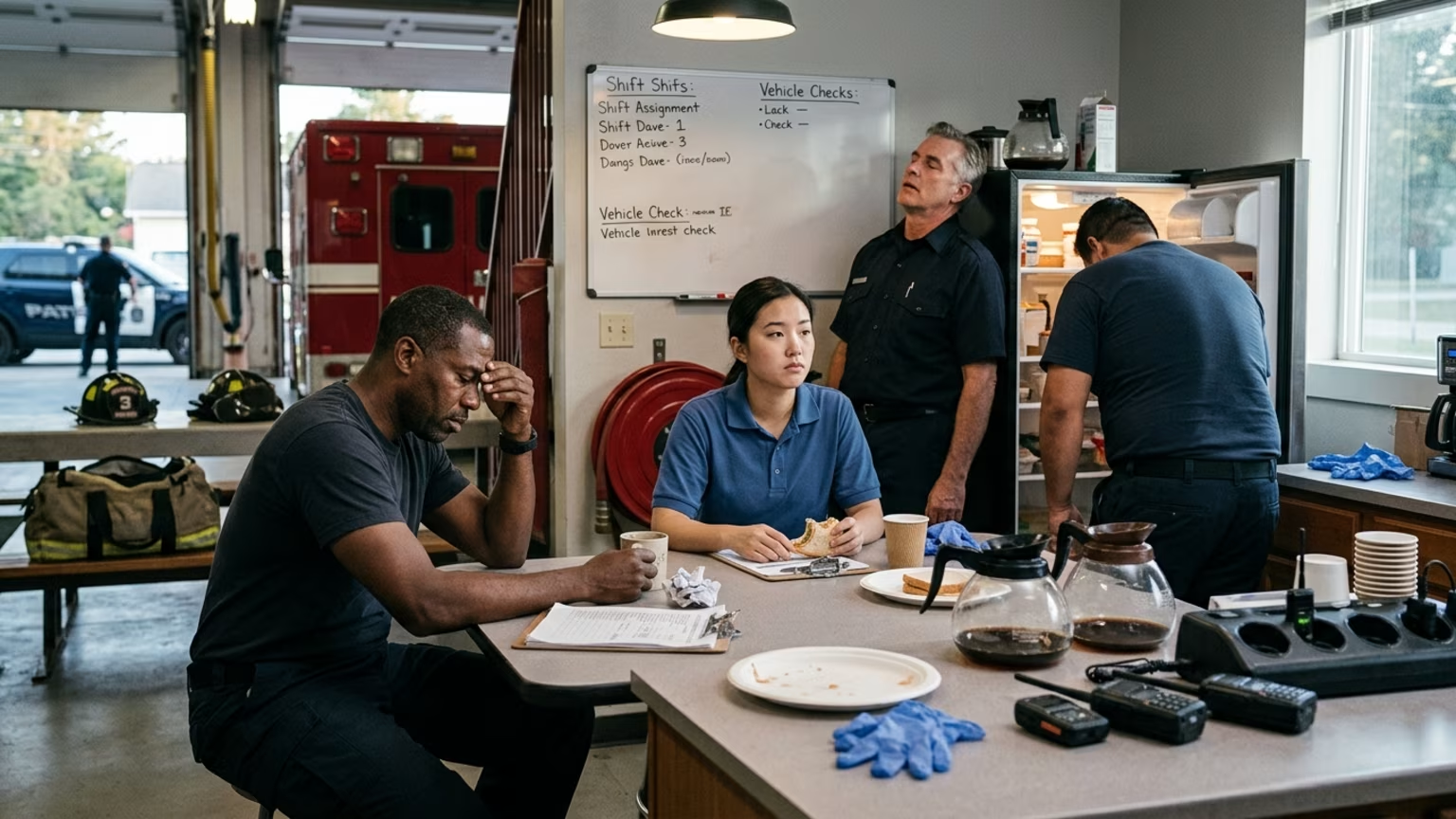

Learn how sleep loss and shift work degrade situational awareness for first responders. Explore practical habits to protect attention, manage cognitive strain and maintain focus on duty.





Attention under pressure is the capacity to process changing information while resisting the pull of immediate distractions. It is the mental mechanism that allows an individual to notice competing signals, interpret incomplete data and update decisions. This concept differs entirely from basic reaction time or raw physical speed. It relies heavily on cognitive flexibility to prevent a single salient threat from crowding out other critical details.
The practical problem on shift is rarely just a subjective feeling of being tired. Fatigue degrades the stability of attention over time and makes cognitive performance highly unpredictable. This instability increases the likelihood of dangerous lapses when an emergency medical professional or firefighter must monitor an active scene. Emergency service work frequently combines long shifts, heavy physical exertion and highly disrupted sleep.
These severe operational demands rapidly reduce a responder's physiological reserve. When that physical reserve drops, personnel become significantly less capable of switching between complex tasks. They also lose the ability to recognize that an initial assumption no longer fits the unfolding incident. Understanding how 24-hour rotations and shorter shifts drive circadian strain is practically required to defend against this specific decline.
First responders rely on higher-order control to manage survival and operational readiness. A person might still feel highly capable of reacting quickly while actually losing the ability to update a working interpretation. Recognizing this invisible shift is a critical component of modern fatigue management.
When individual attention falters under pressure, the entire operational unit assumes greater risk. Crew members must compensate for delayed reactions and missed communications. This compensatory effort drains the remaining cognitive resources of the team. Building systemic safeguards prevents this cascading failure across the department.
Research summarized in the Israel Medical Association Journal points to specific ways that compounded strain breaks down mental performance. Sleep restriction, heat stress and physical exertion interact directly to degrade executive function. The primary biological and psychological mechanisms involved include the following areas:
Recognizing cognitive strain requires looking closely at behavioral changes rather than just physical exhaustion. The scientific evidence provides a clear framework for observing three familiar attention failures on duty.
Tunnel vision occurs when attention becomes too narrowly captured by the most obvious danger or task. The brain drops peripheral information to conserve processing power for one specific problem. The available evidence supports significant concern about reduced cognitive flexibility under compounded strain, though it does not establish a universal first-responder tunnel-vision percentage.
First responders operating with reduced physiological reserve frequently report losing track of radio traffic. Their cognitive processing narrows entirely on a single patient intervention or a specific fireground task. This narrowing blocks out critical updates about structural stability or changing scene safety. Addressing this requires active external interruption rather than just hoping the responder notices.
Distractibility is another strong indicator of severely reduced capacity. Fatigue-related vigilance lapses make attention highly inconsistent across a shift. This deficit becomes particularly obvious during prolonged or monotonous periods of an assignment. Personnel might miss subtle changes in patient status or scene safety simply because their focus naturally drifts.
Premature fixation involves profound difficulty revising an initial interpretation. Impaired inhibition makes it hard to accept new facts that directly contradict an early assumption. These specific deficits indicate that attentional resources are depleted by the operating environment, and they represent performance risks rather than character flaws.
Personnel suffering from premature fixation often stick to their original dispatch information despite clear visual evidence to the contrary. They might treat a medical call as a simple fall even when scene indicators suggest a different mechanism of injury. Breaking this fixation requires immense cognitive effort when sleep deprivation has degraded executive function. Team communication remains the most reliable tool to counter this specific risk.
Addressing these cognitive risks requires practical interventions before a shift even begins. Preparation starts with protecting sleep opportunities and viewing rest as an operational requirement. Scheduling experts quoted by the International Academies of Emergency Dispatch argue that a sleep-friendly schedule must be judged by whether personnel can actually obtain protected sleep. A sleep block only works when it is genuinely protected from routine interruption.
Schedule design plays a massive role in establishing baseline cognitive readiness for emergency crews. A Firehouse-reported evaluation found that mean tracked sleep rose from 6.7 to 7.0 hours per night after a 48/96 schedule change. This result came from one specific department evaluation using wrist-worn sleep trackers. It is an observed association rather than definitive proof that a 48/96 schedule improves alertness universally.
Self-monitoring habits can also help personnel systematically assess their readiness before duty. Responders should evaluate how much sleep they obtained and whether they face unusual difficulty concentrating. This acts as a basic self-monitoring check rather than a medical diagnostic tool. Identifying likely attention traps early prompts extra caution during complex calls, especially when determining whether to push, modify or recover regarding physical training.
On scene, crews can use a deliberate pause when operational conditions suddenly change. Taking a short moment to ask what has changed helps counter the risks of reduced inhibition and premature fixation. Shared verbalization of important observations acts as another highly practical safeguard. Speaking aloud helps a crew notice when one person has become dangerously fixed on an early interpretation.
When operational conditions permit, taking brief recovery periods offers measurable cognitive benefits. In a clinical simulation study of residents, the nap-opportunity group scored 14.8 points higher, a 7.4 percent improvement in that study's scoring system. The resident simulation also reported better nontechnical-skill scores, including leadership and resource utilization, after a nap opportunity. Integrating quick grounding techniques between calls also helps crews manage the immediate transition between demanding tasks.
Physical training can also support on-scene performance when approached systematically. A systematic review found that occupation-specific firefighter training programs were associated with better performance in simulated tasks, while calling for stronger comparisons between protocols. Better baseline physical fitness reduces the overall physiological tax of heavy gear and exertion. This preserves executive control for higher-order decision making.
Departments must view fatigue management through a broader organizational lens to protect long-term attention. Researchers quoted in a report on Estonian and Latvian rescue workers argue that rest and physical training should be built into work design rather than left solely to individual firefighters. Relying purely on individual resilience is an incomplete strategy for career longevity.
Education regarding fatigue remains a highly active area of occupational study. A systematic review has examined fatigue-training interventions in EMS and other shift workers, but the available evidence does not justify presenting one universal protocol. Agencies must build educational frameworks that reflect the real constraints of their unique dispatch environments.
After an incident, a short transition period can effectively reset attention for the next call. Crews should hydrate, lower their body temperature and formally hand over any remaining information. Protecting post-shift sleep is especially critical following intense heat exposure, heavy exertion or a high-stress call. These combined factors aggressively compound the negative effects of sleep restriction on higher-order cognitive control.
Organizational support for recovery dictates how well personnel process complex shifts. Departments that normalize short recovery periods between calls see better sustained performance across a full tour. Training officers should integrate these recovery expectations directly into their standard operating guidelines. This approach shifts the burden of cognitive readiness from the individual back to the agency.
Crews should also record attention-related near misses without shame during their routine debriefs. Noting a missed detail or an avoidable distraction effectively turns individual strain into organizational learning. If sleep disturbances or persistent concentration problems continue long after a shift, personnel should immediately seek occupational-health support.
How often does your current operational routine force you to rely on sheer willpower instead of protected recovery blocks to maintain focus on complex scenes?
Protecting stable attention and situational awareness during unpredictable emergency conditions requires targeted recovery systems rather than sheer willpower. Resolving the cognitive strain described here helps emergency personnel maintain true duty readiness, and Rescuris translates this evidence into practical guidance, including understanding testosterone and hormone claims without assuming testing or treatment is right for everyone.
Rescuris publishes evidence-aware guidance for firefighters, police officers, paramedics and other first responders on fitness, recovery, sleep, nutrition, stress resilience and long-term capability.






Read practical guidance on first responder fitness, recovery, sleep, nutrition and resilience for demanding work and a long, active career.
read the blog
