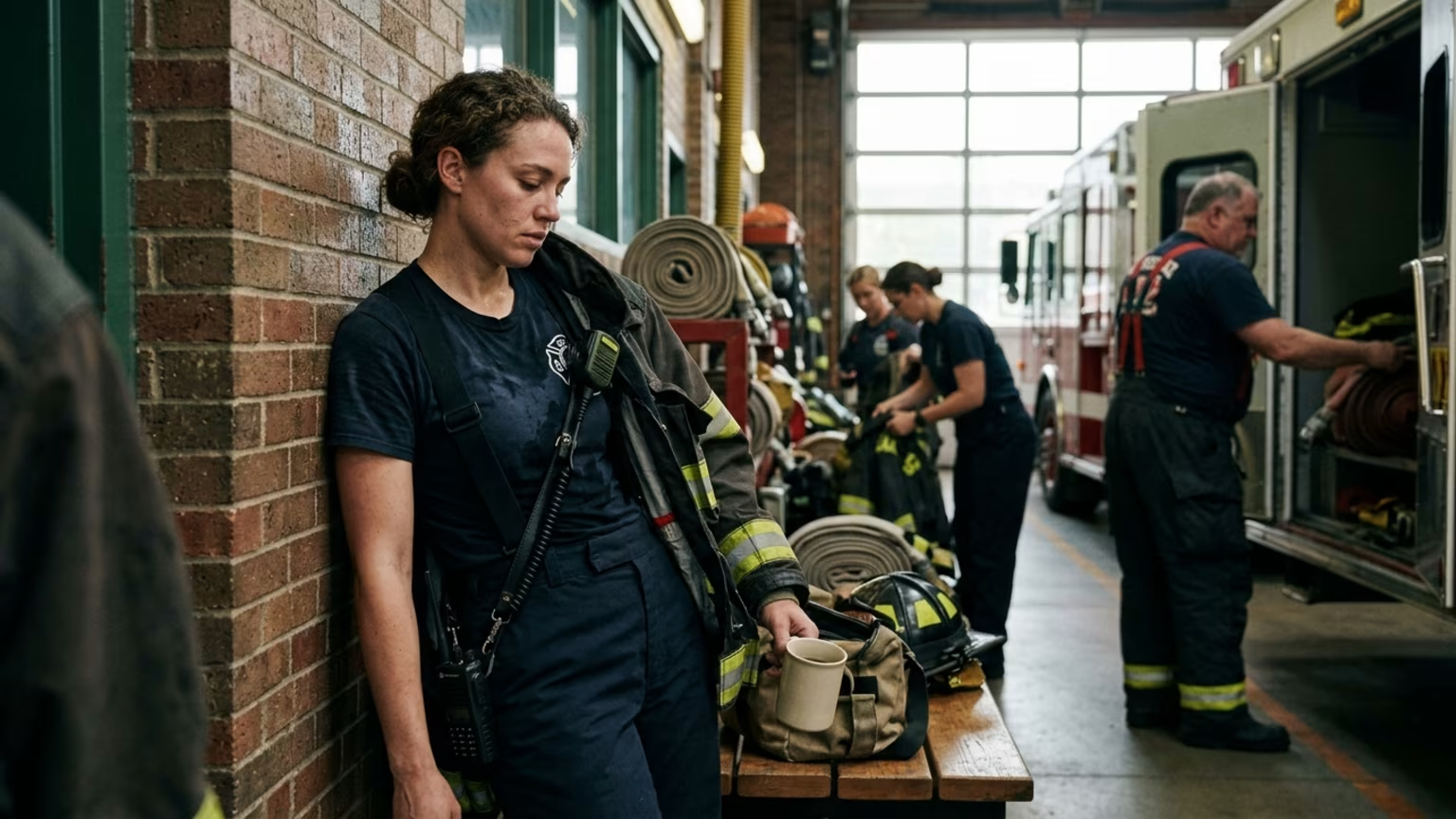

Build a duty-fitness profile that translates emergency tasks into trainable physical qualities for firefighters, police, and EMS professionals.





Duty fitness is the practice of matching physical training directly to the specific demands of emergency response. It replaces generic workout routines with an evidence-informed occupational-fitness framework. This approach breaks down common emergency tasks into trainable physical qualities like aerobic capacity, maximal strength, and grip endurance. Instead of focusing on arbitrary gym benchmarks, a duty-fitness profile maps out the exact loads and durations a responder faces on shift.
It builds a conditioning plan around the actual physical work required by the job. Training for the job means recognizing that emergency work does not happen in a controlled environment. A proper framework translates the chaotic reality of the street into a structured physical preparation plan.
Translating occupational tasks into physical capacities directly influences survival, readiness, and fatigue management on shift. Emergency calls require heavy physical exertion with incomplete recovery, disrupted sleep, and heavy equipment loads. A structured fitness profile prepares a firefighter, police officer, or paramedic to handle these extreme demands without accumulating severe fatigue. When physical training mimics the pacing and constraints of actual calls, responders can perform their duties safely and recover faster.
The Candidate Physical Ability Test (CPAT) provides a clear model for this operational readiness in the fire service. The CPAT is a timed, sequential test completed in 10 minutes and 20 seconds while wearing a 50-pound vest, with an additional 25 pounds added during the stair climb. Preparing for this specific sequence builds the precise physical resilience needed for extended fireground scenes. The CPAT’s stair climb requires three minutes at 60 steps per minute, while carrying the simulated protective load.
Law enforcement and medical roles demand different but equally critical readiness profiles. Police officers must maintain long periods of low-intensity readiness interspersed with sudden bursts of acceleration, pushing, pulling, and control. Emergency medical personnel constantly navigate unpredictable environments, from bending and crouching in cramped vehicles to lifting heavy equipment. A targeted fitness profile allows all emergency personnel to handle these distinct occupational loads while minimizing fatigue. Learning How to Build a Sleep Plan supports this physical preparation by optimizing recovery between demanding shifts.
Connecting daily job tasks to physical conditioning relies on several primary biological mechanisms:
When physical conditioning does not match occupational demands, responders quickly accumulate severe fatigue and physical wear. The National Institute for Occupational Safety and Health warns that manually handling and lifting patients can cause work-related musculoskeletal disorders. Physical symptoms of duty-fitness deficits often present as chronic lower back stiffness, persistent shoulder pain, or delayed joint recovery after shift. Mental fatigue also compounds when a responder lacks the specific physical conditioning required to perform routine job tasks comfortably.
Relying solely on gym strength without analyzing specific job tasks leaves personnel vulnerable to occupational injury. In the summary of an updated review, patient-handling training alone and cognitive-behavioral training alone did not improve musculoskeletal health, indicating that organizational and engineering controls matter. A stronger paramedic may have more physical reserve for heavy lifts, but personal strength cannot replace powered stretchers, lifting aids, or safe patient-handling procedures. When physical deficits exist, personnel often rely on poor biomechanics to compensate for missing positional control.
The long-term effects of mismatched physical capacity can shorten careers and permanently degrade mobility. The National Registry of Emergency Medical Technicians has also announced the LIFE Study, a long-term research effort examining occupational exposures, injuries, and stress among firefighters and EMS clinicians. Recognizing physical deficits early helps emergency personnel adjust their training before temporary aches become career-ending injuries. Building targeted Duty Fitness routines directly addresses these underlying physiological gaps.
Readers can build a highly relevant training program by auditing their specific job demands before selecting exercises. The first baseline strategy is systematically listing the actual tasks performed over the last several shift cycles. A firefighter might list stair climbing with equipment, dragging dry hose, and conducting crawling searches. An EMS professional might list stretcher loading, carrying technical medical bags, and pushing patients down narrow hallways. Reviewing recent calls and physical-ability tests establishes a clear foundation for a realistic conditioning plan.
The next strategy involves describing the specific task variables rather than simply naming traditional gym movements. Responders must identify the external load, the required distance, and the working position for each duty task. They must also note the direction of movement, the environmental constraints, and the realistic recovery time available. The equipment-carry event involves removing two saws from a shelf, carrying them 75 feet out and back, and re-racking them. Breaking this specific task down reveals a clear need for sustained grip endurance, loaded locomotion, and high shoulder stability.
After mapping out the tasks, personnel must assign the primary limiting physical quality for each movement. If breathing and heart rate fail first during a long assignment, the training priority must be aerobic capacity. If the hands fail while carrying heavy rescue tools, the priority immediately shifts to grip endurance. If the torso twists or collapses during a heavy patient drag, trunk control becomes the primary focus. This decision framework matches specific conditioning methods to actual operational limitations rather than chasing arbitrary fitness numbers.
Selecting the simplest valid assessment helps responders measure their baseline progress safely. Field-based submaximal tests or simple timed carries provide highly useful feedback without requiring extreme exertion. The goal of testing is to identify whether grip, bracing, or positional control fails before the task is complete. A maximum lift is not automatically the best occupational test, particularly for people returning from injury, older responders, or those with medical restrictions.
Prioritizing these identified gaps allows responders to structure a sustainable weekly schedule. The highest-priority qualities are usually those attached to frequent, highly consequential tasks where the responder has a clear physical limitation. A generic duty-fitness week might include two aerobic sessions focused on sustainable output and one strength session built around squatting, hinging, and carrying patterns. Personnel can then add one power session using low-volume jumps, pushes, or short accelerations. Implementing a structured Shift-Work Training Decision Tree helps personnel decide when to push hard and when to prioritize recovery.
Finally, the exact training schedule must adapt to the unpredictable realities of emergency service work. The evidence does not justify one universal number of weekly sessions or a single set of occupational benchmarks for every department. Personnel must adjust their training volume after night shifts, extended calls, illness, or poor sleep rather than forcing maximal work on every shift cycle. Preserving physical capacity requires balancing intense preparation with adequate rest, proper nutrition, and intelligent fatigue management.
Review your most physically demanding call from the past month of duty. Did your current physical training program actually prepare you for the exact loads, awkward positions, and minimal recovery windows required by that specific incident?
Translating actual emergency-service tasks into a structured physical program requires careful planning, but building these occupational profiles becomes much simpler when Rescuris provides the research foundation. Generic fitness advice that assumes a predictable nine-to-five schedule fails first responders, and our evidence-led guidance helps emergency personnel maintain true duty readiness.
Rescuris publishes evidence-aware guidance for firefighters, police officers, paramedics and other first responders on fitness, recovery, sleep, nutrition, stress resilience and long-term capability.






Read practical guidance on first responder fitness, recovery, sleep, nutrition and resilience for demanding work and a long, active career.
read the blog
