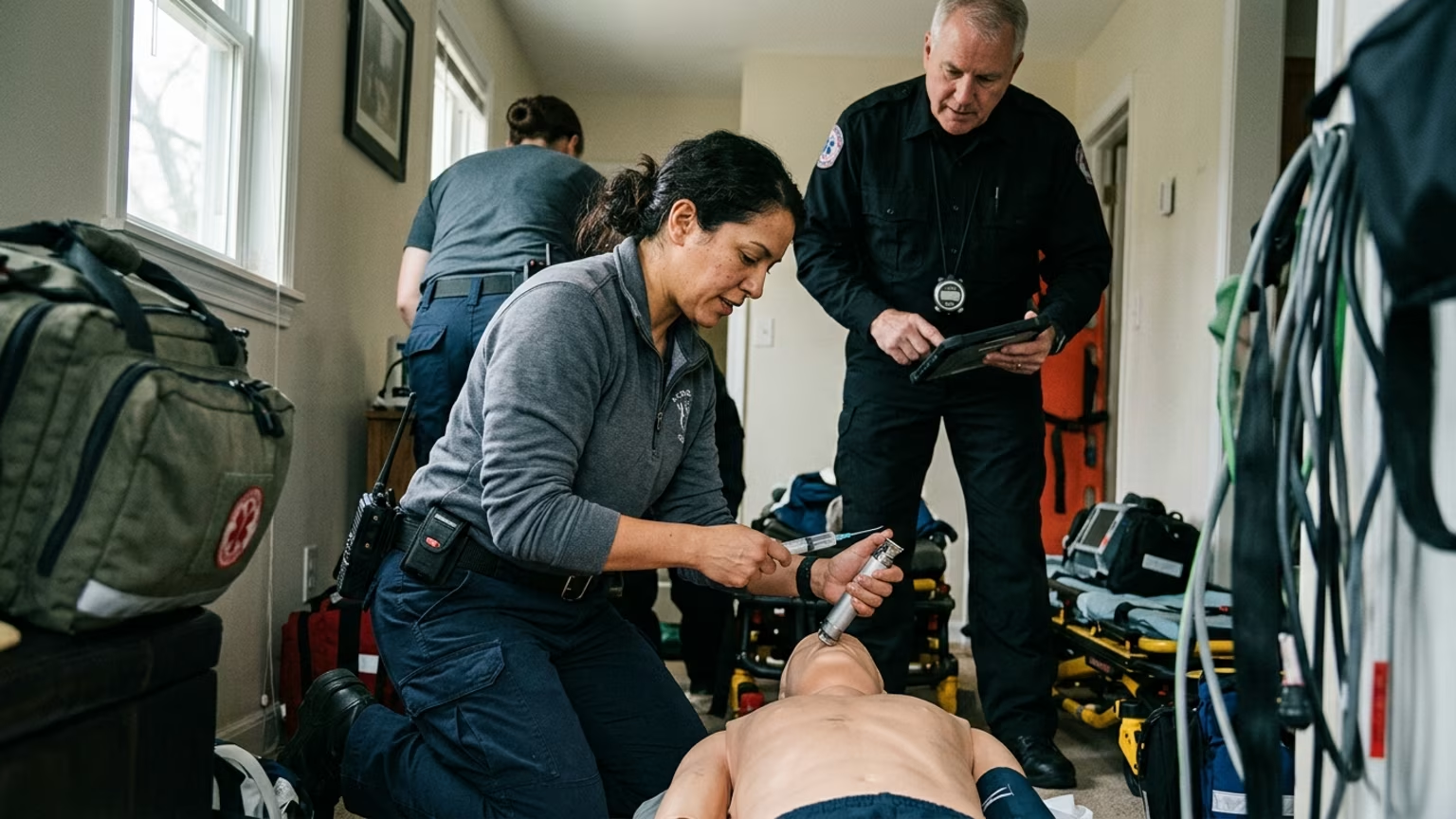

EMS World examines how graduated stress exposure in training helps first responders recover usable cognition, shifting away from maximally chaotic scenarios.





On September 25, 2026, EMS World published a feature examining how emergency medical educators can use graduated stress exposure to teach operational resilience. The article argues for deliberately dosing stress in training scenarios to strengthen cognitive performance rather than simply measuring a provider's failure point.
EMS World frames resilience not as emotional invulnerability or stoicism, but as the practical ability to recover usable cognition during chaotic events. The publication challenges the traditional notion that simply imposing maximum stress on a learner automatically builds operational readiness. Instead, the focus shifts to designing stress exposure that improves engagement while protecting the learner's ability to process new information. The article warns that pushing stress beyond a specific threshold often impairs learning entirely.
When learners face unmanageable chaos too early in their development, the pressure consumes their available working memory. This cognitive overload frequently leads to freezing, blind guessing or simply waiting for rescue from a senior instructor. The human brain cannot form complex clinical reasoning skills when it is entirely occupied with basic survival or panic responses. Therefore, training environments must challenge emergency personnel while leaving them with enough mental capacity to absorb feedback and recognize their own cognitive limitations.
To support this framework, the feature references a 2025 study comparing different simulation models in emergency education. According to EMS World, stress exposure adjusted to a learner’s real-time response produced better results than a fixed, rigid progression. The adaptive approach reportedly scored higher on several measured metrics related to stress management and learner engagement. This reinforces the idea that rigid training schedules often fail to accommodate the varying stress baselines of individual responders.
While the publication does not provide the study’s full methodological details or numerical findings, the core educational principle remains clear. The delicate balance of adaptive pressure prevents the counterproductive effects of overwhelming a provider before they have solidified their clinical foundations. Emergency departments must move away from the idea that stress itself is the lesson. Instead, controlled stress is simply the environment in which critical clinical lessons are tested.
This approach validates a significant shift away from making training scenarios maximally chaotic from the very first minute. For emergency-service professionals, maintaining focus under demanding conditions requires building deep automaticity and accurate pattern recognition first. Instructors must establish a clean skill sequence and allow personnel to practice slowly with the correct equipment. Once the physical mechanics of a medical procedure require less active attention, educators can begin to introduce friction into the environment.
EMS World recommends adding one realistic complication at a time to keep the pressure manageable and productive. These variables might include unexpected background noise, strict operational time limits or sudden equipment failure during a critical intervention. By pacing these challenges, agencies help personnel build practical stress reset skills that apply directly to unpredictable field environments. If a learner cannot process feedback or begins to shut down, the instructor should pause the scenario or adjust the challenge level downward.
Instructors might also introduce complex social variables to test a provider's situational awareness and communication bandwidth. This could involve managing a highly distressed family member, navigating an incomplete patient handoff or directing a second patient who needs immediate attention. These variables force the responder to prioritize incoming information without losing control of their primary clinical task. Managing these overlapping demands is a core component of daily emergency work.
Building automaticity is only half of the operational equation for a successful emergency response. The other half involves teaching learners to notice when a familiar pattern no longer fits the reality of the scene. When a standard protocol fails to resolve an issue, responders must know how to change their plans and recover into an organized process. Graduated stress exposure provides a safe framework to practice this exact cognitive pivot without the severe consequences of a real-world error.
Historically, some emergency-service training relied on the assumption that throwing recruits into overwhelming situations would naturally forge mental toughness. This aggressive mentality assumed that high attrition rates were a reliable measure of occupational readiness and clinical competence. EMS World's feature directly counters this narrative, noting that resilience is a learned cognitive skill rather than an innate personality trait. Imposing massive amounts of stress without a structured progression does not inoculate personnel against the realities of chaotic shifts.
Overwhelming a responder early in their development severely limits their capacity to learn and retain complex medical information. It prevents them from forming the necessary clinical reasoning skills required for a long, healthy career in emergency services. The graduated approach respects the biological realities of how humans process acute stress, adrenaline and cognitive load. It focuses on recovering an organized thought process when a familiar pattern suddenly fails, rather than simply demanding that personnel suppress their physiological reactions.
This shift moves the industry away from a culture of suffering and toward a model of sustainable cognitive performance. It acknowledges that true operational readiness comes from competence and adaptability, not merely the ability to endure punishment. By abandoning the outdated metaphor of simply surviving the deep end, agencies can produce providers who actually think clearly under fire.
Agencies can immediately adjust how they design simulation training and conduct operational debriefs based on these foundational principles. Rather than building drills designed to guarantee failure, training officers should treat pressure as a precise, adjustable dial. Instructors should establish the baseline clinical skill, verify that the responder can execute it smoothly and then turn the dial up by adding just one external variable. This allows the responder to isolate the new stressor and adapt their communication or clinical approach accordingly.
The debriefing process also requires a fundamental structural adjustment to expand the value of these graduated scenarios. EMS World advises against focusing solely on the clinical endpoint or whether the final multiple-choice answer was correct. Instructors and peers should debrief the specific environmental cues the learner noticed and how they structured their internal decision-making process. Teams should discuss exactly when their initial plan stopped fitting the reality of the scene and how they managed that critical transition.
Identifying how a provider recognized that shift and recovered their focus builds highly adaptable medical personnel. By integrating these targeted debriefing strategies, agencies can help their personnel process the mental load of emergency work more effectively. Debriefing becomes an active tool for cognitive recovery rather than a punitive review of minor clinical mistakes. This approach helps verify that the lessons learned in simulation translate directly to better stress management on the street.
While graduated stress exposure offers a logical framework for immediate training, its long-term impact on career longevity requires ongoing study. The EMS World feature serves as an excellent practical rationale for educators, but it does not supply the full clinical data needed to guarantee specific field outcomes. The claim that stress beyond a certain threshold impairs learning is presented conceptually, and future prehospital research will need to clarify how broadly this finding applies across different responder populations.
Departments considering the approach should view it as a highly defensible training strategy rather than an absolute cure for occupational trauma. The available information from the EMS World Expo session does not identify the specific presenter or provide exhaustive clinical parameters. Therefore, training coordinators must adapt the core principles of graduated exposure to fit the specific operational needs of their own agencies. Treating this method as an evolving framework rather than a finished blueprint allows departments to remain flexible as new evidence emerges.
Monitoring how structured load management for first responders interacts with career-long health metrics will be essential for protecting the next generation of emergency personnel. The ongoing challenge will be aligning short-term performance training with long-term physiological realities. Agencies must continue to refine their educational models as new data emerges on how cumulative stress affects the human nervous system. Building true operational resilience requires a commitment to continuous learning and a willingness to adapt traditional training methodologies to match modern scientific understanding.
Recovering usable cognition during chaotic emergency responses requires structured preparation, and Rescuris translates complex physiological evidence into actionable training protocols. Conflicting advice that prioritises short-term performance while ignoring long-term health frequently complicates how agencies schedule their simulations, so we provide the practical framework to help personnel maintain mental readiness across a demanding career.
Rescuris publishes evidence-aware guidance for firefighters, police officers, paramedics and other first responders on fitness, recovery, sleep, nutrition, stress resilience and long-term capability.






Read practical guidance on first responder fitness, recovery, sleep, nutrition and resilience for demanding work and a long, active career.
read the blog
