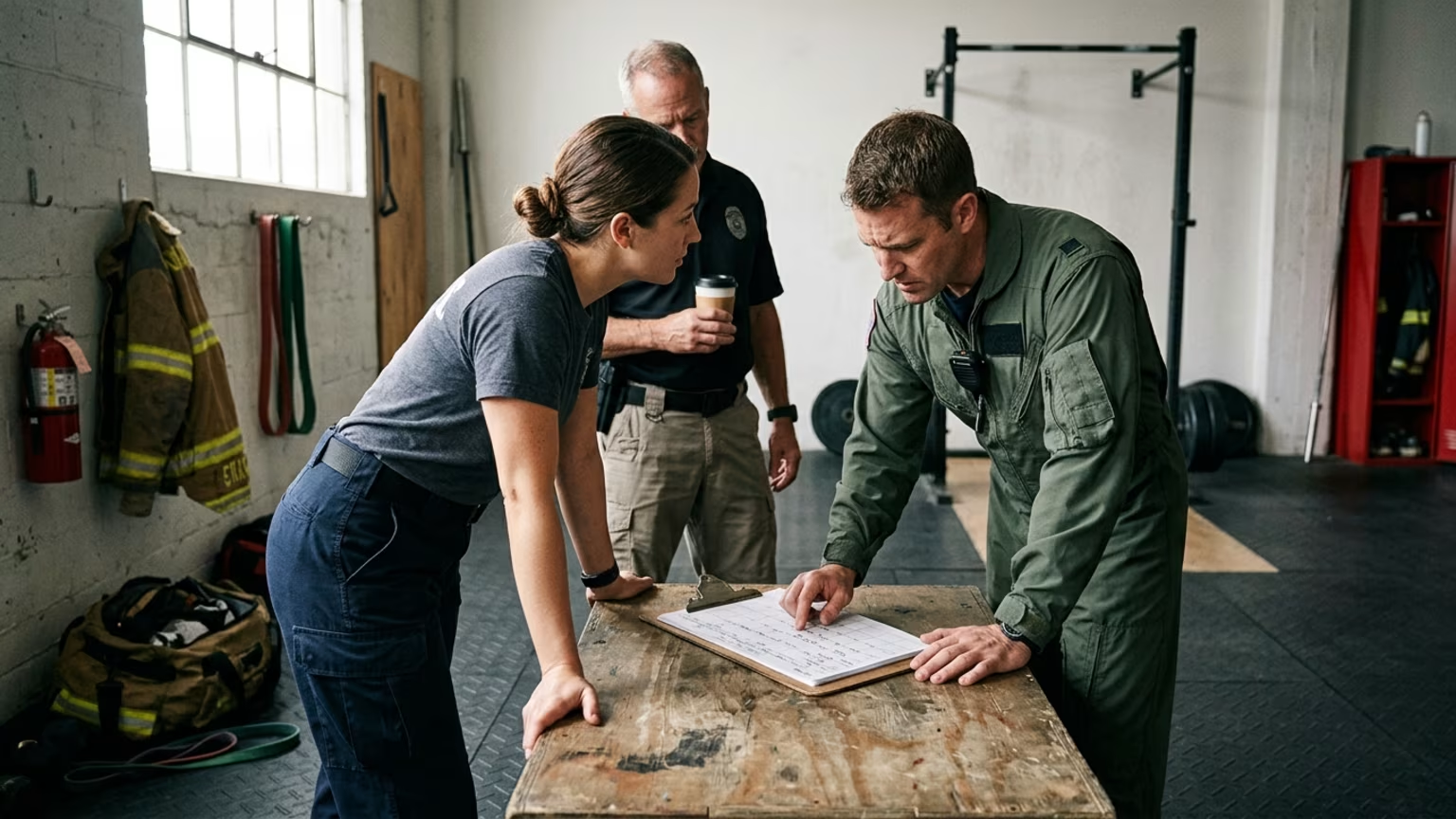

A new coaching response details how shift-working police officers can adapt base fitness routines and interval sessions for long-term tactical preparation.





On October 5, 2026, Mountain Tactical Institute published a coaching response detailing how a shift-working police officer can balance immediate patrol readiness with long-term tactical selection goals. Founder Rob Shaul answered a submission from a general-duties New South Wales officer who operates on a rotating schedule of two day shifts, two night shifts, and three to four days off. The publication outlines specific strategies for managing limited workout windows before a specialized assessment. This coaching guidance provides a practical look at adapting structured routines to the realities of unpredictable emergency service schedules.
The primary coaching takeaway emphasizes establishing a broad base of general-duty fitness well before transitioning to pipeline-specific preparation. For an officer targeting an operational support group or SWAT pipeline 12 to 24 months in the future, Shaul recommended programs like the Mountain Tactical Institute Spirits Packet or Law Enforcement Patrol and Detective Sessions. These programs function as foundational conditioning rather than immediate selection test preparation. The approach prioritizes developing a well-rounded physical base that supports the daily rigors of general law enforcement duties.
A September 2026 Mountain Tactical Institute update describes its specialized law enforcement sessions as a focused blend of concurrent training. This methodology targets multiple physical attributes simultaneously within the same training cycle. This approach targets strength and work capacity alongside endurance, chassis integrity and tactical agility. By combining these elements, the programming aims to cover the varied requirements of field work without overemphasizing any single physical trait. The provider states that its base programming is designed to address 90 percent of an officer's mission-direct physical demands. However, the publication does not offer independent outcome data to validate that specific coverage estimate.
The suggested foundational plans utilize focused workout windows to accommodate full-time operational duties. The provider prescribes these routines five days per week, with each individual session lasting exactly 45 minutes. The structure is specifically designed for completion before a shift begins or during a mid-shift lunch break. This design acknowledges that active law enforcement professionals rarely have the luxury of extended gym visits. By applying concurrent training principles, the programming aims to build necessary physical qualities efficiently. The Spirits plans operate on seven-week cycles, while the patrol sessions run in four-to-five-week cycles that update monthly.
This provider guidance directly translates into how shift workers manage their highly restricted training days. The inquiring officer reported only having time to train during the brief gap between the end of day shifts and the beginning of night shifts. When a professional can only manage three or four training days in a single week, rigid weekly workout calendars inevitably break down. The coaching response advises against the common practice of skipping scheduled sessions just to catch up with a rigid calendar week.
Instead, athletes are instructed to follow the sessions in sequential order and simply extend the timeline of the program as needed. This operational adjustment respects the reality of accumulating fatigue from difficult rotating schedules. By maintaining the intended order of the workouts, the officer preserves the structural progression of the routine. This method allows for necessary physical recovery time without sacrificing the systematic development required for long-term capability planning.
This sequential tracking prevents the common trap of cramming missed workouts into a single, exhausting off-duty day. The cyclical nature of the provider plans adapts directly to the officer's availability rather than dictating an impossible standard. This flexibility is a critical component when balancing the physical demands of active police work alongside necessary sleep recovery. The approach treats physical readiness as a continuous, adaptable process rather than a strict, unforgiving weekly checklist. For personnel navigating the transition from days to nights, having permission to simply slide the calendar forward removes unnecessary psychological pressure.
Traditional fitness programming frequently assumes a predictable Monday-through-Sunday routine, which directly conflicts with rotating emergency service schedules. The coaching advice challenges the expectation that a five-day training plan must be completed within a single calendar week. By permitting the officer to extend the program timeline, the guidance acknowledges that shift workers operate on occupational cycles rather than standard civilian weekends. This shift in perspective prioritizes consistent workout progression over strict schedule adherence.
Many training protocols fail because they treat missed days as performance failures rather than predictable operational realities. The flexibility to extend a four-week block into a five-week reality provides a sustainable pathway for personnel managing unpredictable holdovers and court appearances. Adapting the program length in this manner helps professionals avoid the dangerous cycle of under-recovering and overtraining. The strategy reinforces the idea that structured programming should serve the operational athlete's reality.
For days when a full 45-minute session is impossible, the coaching response offers immediate, actionable conditioning alternatives. Shaul recommends implementing brief, high-intensity intervals lasting only five to 15 minutes. The specific suggestion involves basic burpees or simple prone-to-sprint drills to maintain work capacity during heavily constrained workdays. This strategy provides a highly accessible way to preserve job-specific physical capability when extended gym access is completely unavailable.
The suggested starting point for these micro-sessions is 30 seconds of active work followed immediately by 30 seconds of rest. As the officer adapts to the physical stimulus, the intervals progress toward 40 seconds of continuous work and only 20 seconds of rest. This structured progression offers a clear, measurable path for increasing intensity without adding total time to the workout. First responders can use this exact work-to-rest ratio as a fallback option when unexpected shift requirements compress their scheduled off-duty hours.
The provider also weighs in on supplementary activities for officers preparing for specialized tactical roles. Shaul notes that Brazilian Jiu-Jitsu serves as a highly useful addition for law enforcement personnel, pointing athletes who train two or three times weekly toward a tactical grappling series. However, he specifically advised this officer to prioritize running over swimming for general conditioning preparation. This recommendation stems from the coach's specific view that running translates more directly to the officer's stated operational goals. Professionals should note that this is case-specific guidance rather than a universal ruling against aquatic training for all emergency personnel.
As tactical selection processes evolve, emergency service professionals must continuously monitor their own specific agency requirements. The coaching response focuses heavily on building general physical preparedness, but it does not specify the exact testing parameters for the officer's future operational support group pipeline. A secondary 2026 industry guide confirms that special weapons and tactics fitness requirements vary significantly from one department to another. First responders must verify their own local standards before committing entirely to any single generalized preparation program.
The same 2026 secondary guide highlights the National Tactical Officers Association recommended physical fitness qualification as a common reference point. The assessment tests running and loaded movement alongside burpees, loaded squats and pull-ups. While provider programs offer structured pathways to build basic physical capability, independent validation of these specific protocols remains limited. First responders planning for specialized assignments should use these foundational programs as a starting point while tailoring their ultimate preparation to the demands of their target organization. Future evaluations within the industry should compare provider claims of base fitness coverage against independent outcome data.
Adapting structured workouts to fit between day and night shifts is essential for maintaining operational preparedness over time. Recovering from accumulated physical wear without losing duty readiness demands practical strategies rather than generic advice, and Rescuris evaluates available training methods to provide that clarity. By translating performance concepts into accessible formats, the publication helps first responders navigate their physical requirements safely. Explore Resources
Rescuris publishes evidence-aware guidance for firefighters, police officers, paramedics and other first responders on fitness, recovery, sleep, nutrition, stress resilience and long-term capability.






Read practical guidance on first responder fitness, recovery, sleep, nutrition and resilience for demanding work and a long, active career.
read the blog
