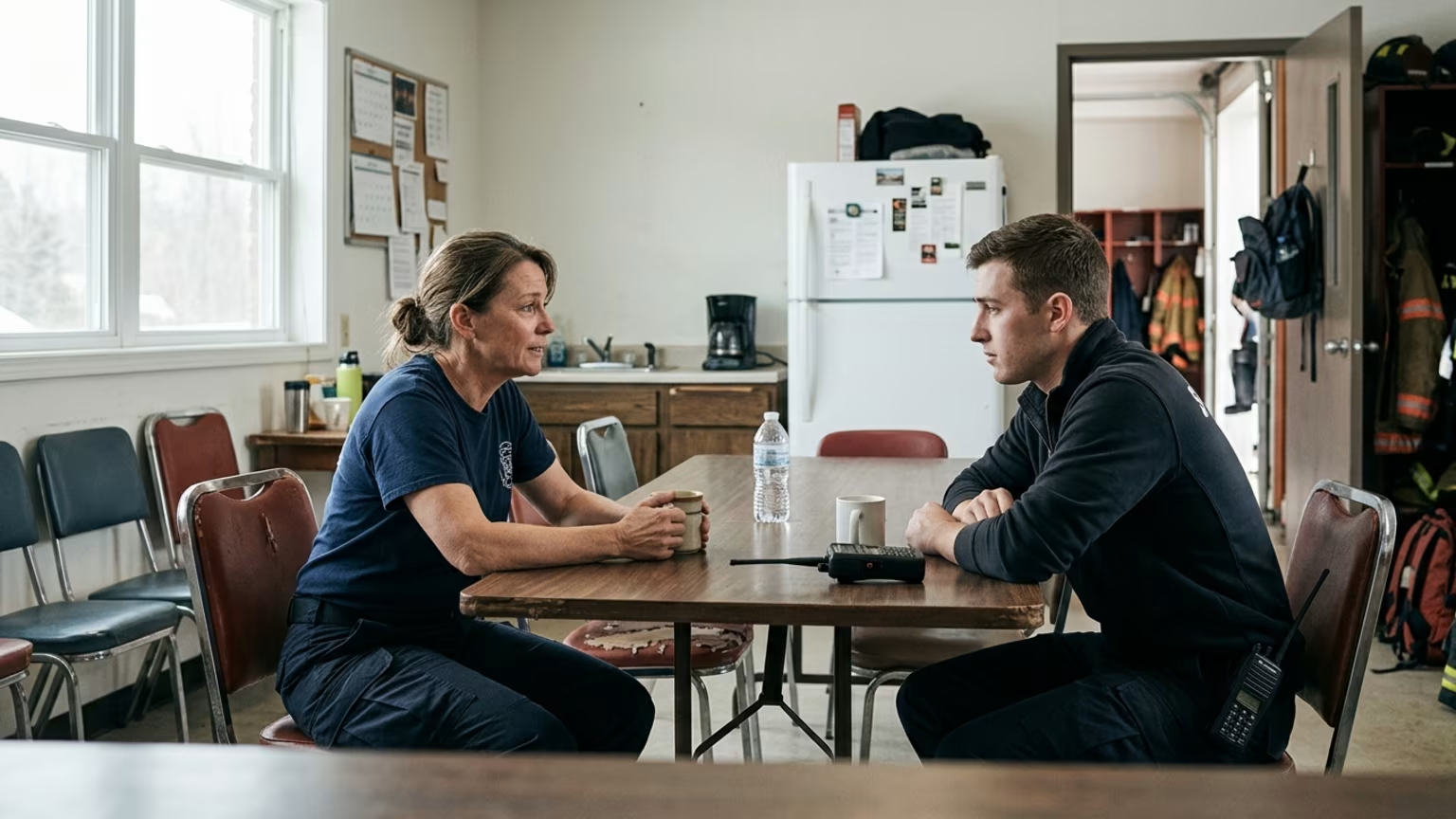

Lexipol’s 2026 State of Readiness survey connects strong wellness support to improved retention in public safety, highlighting operational capability gaps.





On September 14, 2026, Lexipol released its 2026 State of Readiness in Public Safety survey, highlighting a distinct association between organizational wellness programs and personnel stability. The survey collected 915 responses from professionals across law enforcement, fire, EMS and corrections to assess operational challenges. With 74% of respondents holding command- or chief-level roles, the findings provide a clear leadership perspective on workforce management.
The survey reveals a substantial gap between perceived readiness for routine operations and preparedness for fast-changing conditions. While 78% of respondents indicated their agencies were prepared for typical calls, confidence dropped sharply for other scenarios. Only 38% said their agencies were prepared for legal or regulatory changes. Furthermore, just 22% of respondents reported their agencies were prepared for major operational disruptions.
The survey's central finding connects these readiness gaps directly to personnel support and staffing stability. Lexipol reports that 48% of respondents rated their agency's wellness support as strong or comprehensive. Conversely, 22% rated their wellness support as limited or very poor. This disparity in support corresponds closely with reported retention success.
Among respondents working at agencies with strong or comprehensive wellness support, 44% rated their agency's ability to retain personnel as very or extremely effective. That figure fell to 10% among respondents at agencies with low wellness support. This shows that the reported proportion of effective retention in the stronger-wellness group is 4.4 times the proportion in the low-wellness group. The difference between these two groups is exactly 34 percentage points.
Staffing remains one of the clearest readiness concerns across the sector. According to the survey, only 17% of agencies were rated very or extremely prepared for staffing shortages. Forty percent of respondents said recruitment was more difficult than it was two years earlier. Respondents identified staffing shortages, at 65%, and recruitment challenges, at 39%, as the leading workforce factors limiting readiness.
The survey also found that leadership development and training outcomes received mixed evaluations. Only 19% of respondents rated their agency very or extremely effective at developing future leaders. Training effectiveness followed a similar pattern. Forty-five percent of respondents rated their agency's training as very or extremely effective, while 34% said training effectiveness was not consistently measured.
These findings validate the need to treat physical maintenance and psychological health as core operational requirements. Lexipol characterizes burnout as a risk that degrades multiple capabilities. The company notes it can negatively affect judgment, communication, staffing, retention and community trust. When agencies view recovery as a basic capability requirement rather than an optional benefit, they build a more resilient workforce.
Understanding these overlapping pressures requires agencies to evaluate how targeted occupational training programs boost operational safety without adding to crew fatigue. A separate 2026 officer-health survey from Endeavor Business Intelligence adds context to this priority. That survey reported that 99% of respondents considered mental health very or extremely important. In fact, 81% of those respondents said mental health was more important than physical health when forced to choose between the two.
Translating wellness into practice requires addressing logistical barriers. In the Lexipol survey, 83% of respondents cited time and scheduling as the leading training barrier. Budget constraints followed at 57%. A wellness program that cannot be accessed during shifts or recovery periods has limited practical value for frontline personnel.
The Lexipol release challenges the assumption that wellness programs automatically cause better retention regardless of their execution. The survey shows a descriptive association, but it does not prove that wellness programs directly caused the retention difference. Additionally, the term "wellness support" remains broad in this context. The release does not specify whether respondents were evaluating fitness facilities, sleep resources, peer support or a combination of elements.
Program quality and execution likely matter more than mere program existence. Available program data often measures participant satisfaction or basic competency rather than objective reductions in distress or direct improvements in workforce retention. This distinction is critical for agencies building support frameworks. Leaders must verify that programs do not just exist on paper, but actively deliver measurable improvements in daily occupational health.
Furthermore, the Lexipol survey measures perceptions rather than independently audited staffing records. It reports what respondents said about preparedness and retention effectiveness, but it does not provide actual turnover data or sick leave numbers. Because 74% of respondents held command- or chief-level roles, the results heavily reflect leadership views. Agencies must recognize that leadership perceptions may differ from the daily experiences of frontline paramedics, police officers and firefighters.
It is also critical to understand the source of these findings. Lexipol describes itself as a provider of public-safety policy, training, wellness and reporting solutions. The company states that more than 12,000 agencies and municipalities nationwide rely on its platform. Because Lexipol conducted and published the survey, the findings represent proprietary survey results rather than an independently validated estimate of the entire public-safety workforce.
Agencies and personnel can make immediate adjustments based on these readiness findings. A practical agency review should examine whether personnel have reliable access to fitness and duty-capability resources. These resources must accommodate different ages, abilities and specific job demands. Fitness facilities must be available to night-shift staff and rotating crews. Personnel should not have to choose between occupational training and their own physical recovery windows.
Departments should also prioritize recovery support after high-intensity calls, prolonged incidents and mandatory overtime. Lexipol's commentary recommends treating sustainable scheduling as an organizational responsibility rather than relying solely on individual coping strategies. Personnel must understand how their agencies structure time-off practices. They can then advocate for schedules that make true recovery possible rather than merely recommending rest.
Agencies must also prioritize outcome tracking that distinguishes basic program participation from meaningful results. This tracking includes measuring access rates, utilization and employee-reported usefulness. It should also monitor sick leave, injuries and the specific overtime burden on personnel. Departments must verify they are actively monitoring whether these resources improve daily operational capabilities.
Psychological support systems require clear structures to function effectively. Lexipol explicitly argues that peer-support programs are more credible when they include trained supporters, protected time and clear confidentiality protections. Supervisors need guidance on recognizing early signs of fatigue, withdrawal, irritability or performance changes. Providing access to confidential clinical support that personnel trust is essential for long-term health.
Individual first responders should evaluate how they utilize their agency's current offerings. If an employee assistance number is difficult to access, personnel should document these barriers. Building proper nutrition habits is a daily practice, and knowing how to choose better convenience options on shift requires practical organizational support. Personnel must also prioritize their own sleep education, recognizing how disrupted circadian rhythms impact health.
Moving forward, the sector must track how wellness programs directly affect injury rates and actual turnover. The Lexipol survey connects readiness with leadership and organizational systems. Agencies with more-prepared leaders reported stronger training effectiveness, retention, wellness support, policy quality and data use. Future studies should evaluate whether agencies adapt their scheduling practices to address these training barriers.
It is also necessary to evaluate how agencies handle emerging incident types. Only 8% of survey respondents said they were extremely confident in their agency's ability to respond to evolving challenges. As departments face new risks, assessing why irregular duty shifts undermine safety will become even more vital for long-term planning. Identifying the specific components of wellness programs that deliver the highest operational returns will guide future policy adjustments.
Lexipol notes that while 58% of respondents viewed their agency's readiness as stronger than two years earlier, sentiment remains heavily divided. Forty-nine percent of respondents remain concerned about the current state of public safety. Meanwhile, 44% are somewhat or very optimistic about the next two to three years. Tracking these divided perspectives against audited staffing metrics will clarify whether current retention strategies are genuinely effective.
Researchers should also evaluate these wellness metrics within specific public safety disciplines. Police, fire, EMS and corrections agencies possess distinct staffing models, shift patterns and credentialing requirements. The Lexipol release combines these groups into a single sample, but individual disciplines face different retention mechanics. A single cross-sector percentage should not be applied identically to every distinct emergency service profession.
Evaluating cross-discipline readiness surveys to secure better wellness funding is a crucial leadership task, and structuring those resources for daily physical maintenance is where our work begins. When facing the complex task of balancing strength, endurance, mobility and body composition across a demanding career, Rescuris delivers practical physical maintenance protocols built for irregular shifts.
Rescuris publishes evidence-aware guidance for firefighters, police officers, paramedics and other first responders on fitness, recovery, sleep, nutrition, stress resilience and long-term capability.






Read practical guidance on first responder fitness, recovery, sleep, nutrition and resilience for demanding work and a long, active career.
read the blog
