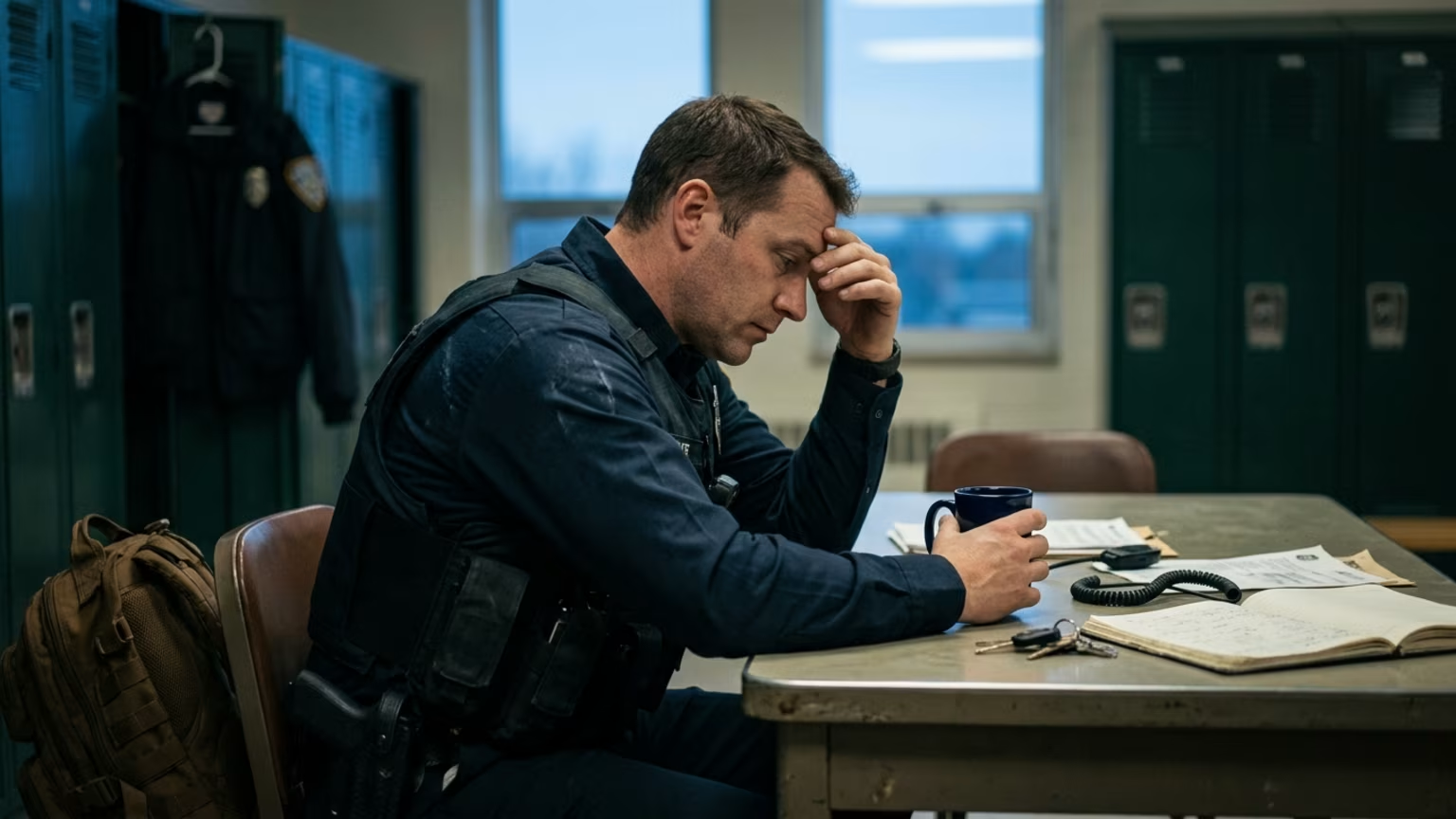

WBRC's Suicide Awareness Month report highlights the operational barrier to help-seeking among law-enforcement officers and the need for structural wellness support.





If you or someone you know is in immediate danger, call 911. For confidential crisis support, call or text 988, press 1 for the Veterans Crisis Line, or text 838255.
On September 26, 2026, WBRC broadcast a report focusing on law-enforcement leaders in Shelby County, Alabama, urging officers to speak up and seek help during Suicide Awareness Month. The coverage highlighted the distinct psychological risks associated with emergency service and the institutional barriers that prevent personnel from utilizing available support.
According to the broadcast, the CDC links the higher risk officers face directly to the unpredictable and critical events they encounter on the job. WBRC quoted Calera Police Chief David Hyche stating that law-enforcement personnel are 54% more likely to die by suicide than the general population. This severe vulnerability exists alongside the reality that officers are generally less likely to seek help when they need it. The unique physical and psychological demands of policing create a difficult operational environment.
The scope of this occupational hazard remains difficult to quantify accurately. The WBRC report noted that public-safety wellness researchers estimate more than 150 officer suicides are reported nationwide each year. However, the news outlet cautioned that the actual number may be much higher because of widespread underreporting. This underreporting often stems from concerns about career progression, fitness-for-duty evaluations, and the lingering stigma surrounding mental-health challenges.
Understanding these numbers requires acknowledging the compounding effects of shift work, interrupted sleep, and the physiological burden of constant hypervigilance. Irregular schedules and rotating shifts routinely fragment the recovery windows required after demanding tours of duty. When officers experience chronic sleep disruption, their ability to process high-stress incidents can degrade over time. These incidents happen to professionals who are often already managing accumulated physical wear and fatigue.
Recognizing the intersection of physical exhaustion and psychological strain is critical for assessing the mental-health risks of high-stress law enforcement training. The transition from acute operational stress to off-duty domestic life is notoriously difficult to navigate. When officers alternate between high-stakes decision-making and routine civilian activities, their nervous systems rarely have time to reset completely. This continuous cycle of activation and sudden withdrawal contributes heavily to the emotional exhaustion noted by occupational researchers.
Because this pattern is inherent to the job, wellness strategies must address it directly rather than treating it as an anomaly.
The new reporting indicates that traditional assumptions about mental toughness often complicate necessary help-seeking behavior. Shelby County Drug Enforcement Task Force Commander Lt. Clayton Smith described a significant perceived barrier among personnel. He explained that officers may find it difficult to ask for help because they see themselves as the people expected to help others. This rigid identity creates an operational liability when professionals attempt to ignore their own mounting fatigue.
Acknowledging this friction is a necessary step in developing functional support systems. To counter these entrenched cultural habits, departments are building formalized pathways for support. In Calera, WBRC reported that officers have access to peer-support teams consisting of colleagues who are explicitly trained to speak with struggling personnel. The department also actively works with local clergy and a police foundation that supports staff facing personal or family hardships.
These local frameworks validate the concept that proactive infrastructure is more effective than waiting for a crisis. Developing clear, accessible resources removes the burden of navigating a complex medical system during periods of high stress. Other jurisdictions are implementing similar models to build resilience from the beginning of an officer's career. A separate news report by KSNT focused on the Topeka Police Department and its approach to mental health.
KSNT reported that Topeka uses a police peer-support team and teaches mental-health and resiliency classes directly in the police academy. Establishing these concepts early helps normalize the idea that managing psychological stress is a standard part of career maintenance. However, the Topeka report also offered a sobering reminder of the stakes, noting that two Topeka officers died by suicide over the preceding 25 years. These initiatives reflect a growing understanding that psychological recovery requires the same structured planning as physical conditioning.
Just as departments establish protocols for tactical readiness, they must also provide systematic support for operational stress. The reliance on peer teams leverages the existing trust between colleagues who understand the unique constraints of the job. When officers know their peers are trained to assist them without judgment, the initial barrier to speaking up decreases significantly.
The traditional culture of emergency services long dictated that professionals should manage their stress privately without showing any visible strain. The WBRC coverage actively challenges this outdated framework by featuring leaders who advocate for transparency. Chief Hyche stated clearly that asking for help is not a weakness. He added that seeking support can directly benefit an officer, their immediate family, and their surrounding community.
This perspective reframes help-seeking as a responsible action that maintains duty readiness rather than a failure of resilience. For decades, many officers believed that discussing their fatigue or anxiety would lead to disciplinary action or mandatory leave. This fear drove many coping behaviors and substance risk in first responders, as personnel sought unofficial ways to manage their occupational load. Visible leadership disrupts the narrative that successful officers never experience mental friction.
WBRC noted that advocates see peer resources and leaders' willingness to speak openly about their struggles as vital to narrowing the gap between officers who need help and those who seek it. Treating psychological fitness as entirely separate from physical health is another assumption that is rapidly losing ground. The physical load of wearing heavy protective equipment, working long hours, and eating irregularly takes a measurable toll on the nervous system. When departments treat mental wellness as a distinct, isolated issue, they miss the broader context of physiological burnout.
For example, sleep loss and injury risk in shift-working first responders are heavily correlated with an inability to manage acute stress. Addressing sleep loss, nutritional deficits, and physical recovery actively supports a more resilient psychological baseline. Practical guidance must address the complete reality of the demanding work environment. This cultural shift also impacts how professionals prepare for retirement and life after service.
When personnel spend decades suppressing their emotional responses to occupational trauma, the transition away from active duty can trigger significant psychological distress. Addressing these challenges while still in uniform helps officers build a stronger foundation for their eventual departure from the force. By treating mental resilience as a career-spanning requirement, departments can help officers maintain their health long after they turn in their badges.
Based on this reporting, active and retired first responders should organize their support options before a critical need arises. A practical takeaway is to proactively learn what confidential support is available through your department, peer network, and community providers. Departments must distribute updated information regarding how personnel can access these tools without triggering a formal fitness-for-duty review. Having this information readily available eliminates a major logistical hurdle during periods of high stress.
Familiarizing yourself with national and local crisis lines is a critical operational adjustment. WBRC identifies calling or texting 988 as a reliable, 24/7 option for people who are struggling. In the Topeka coverage, a police behavioral-health unit representative described 988 as a specific way to connect with crisis support. The representative explained that 988 is useful when someone wants to speak with a social worker or advocate rather than directly contact emergency services.
Additionally, the Topeka report mentions 211 as a viable resource for gathering local social-service information. While the availability of specific services through 211 varies by region, it remains a useful starting point for non-emergency support. Departments should verify exactly how these lines operate in their specific jurisdictions and communicate those details to their crews. Taking the time to map out these resources transforms a vague awareness of mental-health support into a concrete, executable plan.
Leaders and wellness coordinators must also adjust how they communicate during daily shift briefings and academy training. Integrating discussions about fatigue and stress resilience into routine operational planning normalizes the topic. When supervisors regularly remind their teams about the availability of peer support, the stigma surrounding these programs naturally diminishes. A culture of readiness requires acknowledging that a long, healthy career demands deliberate, ongoing maintenance.
While the current reporting highlights important local models, the industry must rigorously track the long-term effectiveness of these interventions. The WBRC and Topeka reports point to practical methods like peer support, academy training, and connection to crisis resources. However, the supplied coverage does not establish verifiable data showing that any single model independently reduces suicide rates. Future occupational research must analyze whether these specific programs lead to measurable improvements in workforce retention and wellness.
Evaluating the limits of peer-led interventions is another critical area for continuing analysis. Peer support provides a vital first step, but it does not replace the need for licensed professional care. Departments must track how smoothly peer teams can transition struggling officers to clinical psychologists or specialized trauma therapists. Researchers should focus on identifying which structural barriers still prevent personnel from moving beyond initial peer conversations into sustained treatment.
Establishing a clear, frictionless pipeline from peer support to professional medical care remains an ongoing operational challenge. Finally, the issue of underreporting demands focused attention from public-safety wellness researchers. If the estimate of more than 150 officer suicides annually is significantly lower than reality, departments are building protocols based on incomplete data. As the conversation around first-responder mental health continues to evolve, accurate data will remain the foundation for designing safer career pathways.
Recovering from accumulated physical wear without losing duty readiness requires sustainable protocols that respect the realities of emergency work. The pressure to maintain peak operational capability often discourages officers from acknowledging fatigue, but Rescuris helps first responders build structured recovery systems. We translate clinical evidence into actionable physiological guidance that directly supports career longevity and safe shift performance. Explore Resources
Rescuris publishes evidence-aware guidance for firefighters, police officers, paramedics and other first responders on fitness, recovery, sleep, nutrition, stress resilience and long-term capability.






Read practical guidance on first responder fitness, recovery, sleep, nutrition and resilience for demanding work and a long, active career.
read the blog
