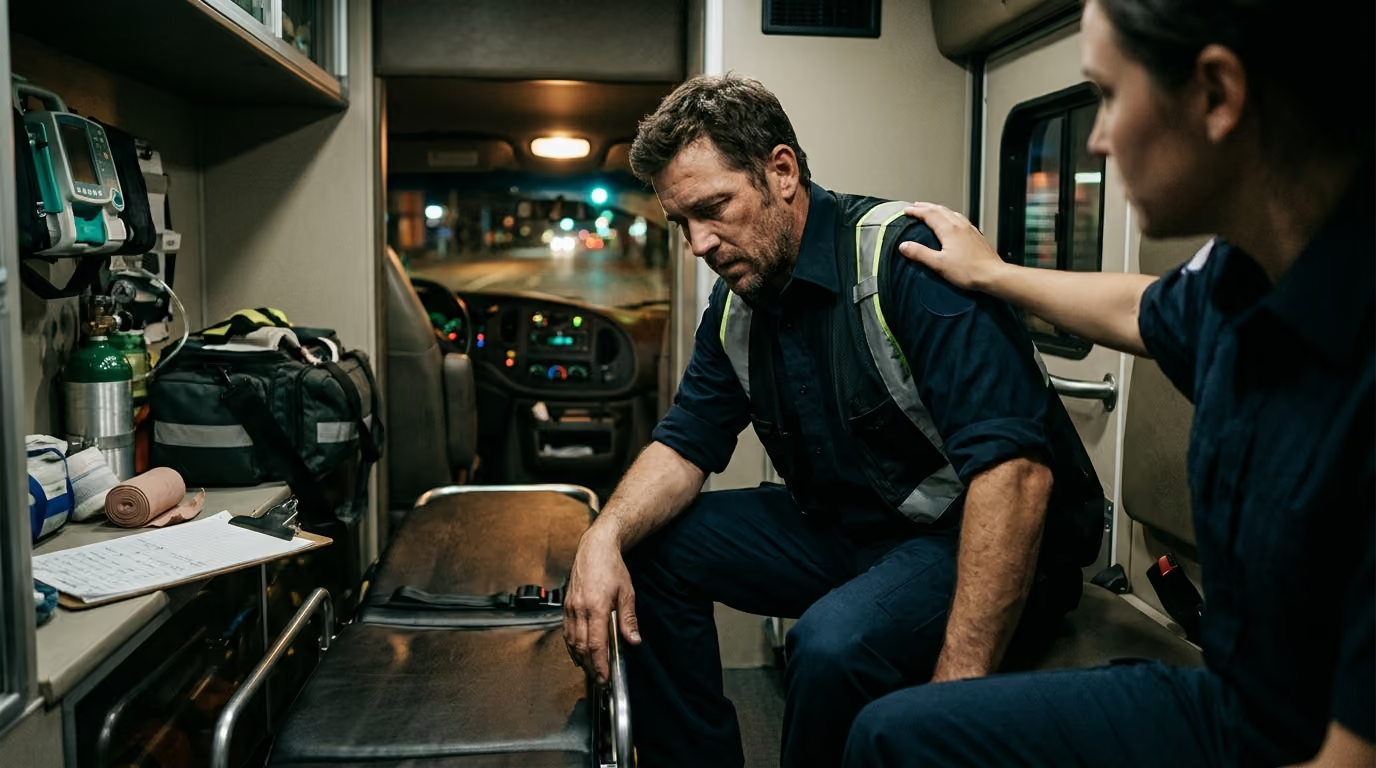

First responders facing chronic sleep restriction experience degraded movement mechanics, slower cognitive processing, and substantially higher rates of on-duty injuries.





A veteran paramedic steps out of the ambulance cab at 04:30 on the third consecutive night tour. It is a run identical to hundreds before it, yet as their boot hits the curb, their lead foot slips on wet pavement. The resulting knee sprain removes them from duty for six weeks. Later, the incident report attributes the injury to slick terrain. What the report misses is that the responder had accumulated twelve hours of sleep debt, was operating at the lowest point of their circadian rhythm, and experienced a brief lapse in postural coordination.
Sleep loss changes how the human nervous system senses, stabilizes, and moves. For firefighters, police officers, paramedics, and emergency dispatchers, fatigue is not just a personal discomfort. It is an operational hazard that directly alters the odds of musculoskeletal injuries, acute trauma, vehicle crashes, and delayed tissue repair.
Fatigue-related injury is a systems problem rather than an individual failure of discipline. Risk develops at the intersection of sleep length, sleep quality, circadian alignment, shift duration, consecutive night duties, mandatory overtime, physical gear loads, and environmental heat. Understanding these interactions allows first responders and emergency agencies to build practical controls that protect physical longevity.
The short answer is clear. Sleep loss significantly increases the risk of physical injury across all emergency services. When responders do not get adequate rest, reaction times slow, balance deteriorates, decision-making narrows, and pain sensitivity rises. These physical and cognitive deficits turn standard operational hazards into serious injury events.
To understand why this happens, it is necessary to separate related concepts that are often blurred together:
The primary operational model is straightforward: sleep loss drains physical and cognitive reserves, circadian misalignment reduces performance during biologically vulnerable windows, and duty demands expose those underlying deficits. When heavy equipment, rapid responses, uneven terrain, and unpredictable physical loads are added to that equation, injury risk climbs rapidly.
The body regulates wakefulness and sleep through a two-process model. Process S represents homeostatic sleep pressure. The longer an individual stays awake, the higher this pressure climbs as adenosine and other metabolic byproducts accumulate in the brain. Process C represents the circadian alerting drive, governed by the suprachiasmatic nucleus. It delivers an alerting signal across the biological day and drops that signal during the biological night.
When emergency personnel work night shifts or extended tours, they face a severe physiological conflict. Homeostatic sleep pressure is at its peak after hours of continuous wakefulness, while the circadian alerting drive reaches its lowest point between 02:00 and 06:00. This combination impairs neuromuscular control, even if the responder feels subjectively adjusted to the routine.
Research into sleep restriction demonstrates that human perception of fatigue is unreliable. In controlled studies, individuals restricted to three hours of sleep per night showed progressive declines in psychomotor vigilance and steady increases in reaction-time lapses over seven days. Those restricted to five hours also experienced increased lapses, but their subjective sense of sleepiness stabilized at a lower level. Responders frequently believe they have adapted to acute sleep deficits, while objective tests reveal impaired coordination and slower reflexes.
Neuromuscular coordination relies on continuous sensory feedback and rapid motor corrections. Sleep deprivation causes psychomotor vigilance to become erratic. Rather than being constantly slow, a fatigued responder experiences brief lapses in attention lasting from hundreds of milliseconds to several seconds.
During these micro-lapses, the brain fails to process incoming environmental signals. In emergency operations, a fraction of a second determines whether a responder catches their balance on a staircase, avoids an erratic driver during a roadside incident, or counters a shifting patient on a stair chair. The average performance may look acceptable, but intermittent lapses create severe vulnerability during sudden, high-speed events.
Balance is an active neuromuscular process. It requires integration among the visual system, the vestibular apparatus in the inner ear, and proprioceptive sensors in joints and muscles. Prolonged wakefulness and night work disrupt this sensory integration, leading to increased postural sway and delayed stabilizing contractions.
When postural stability degrades, routine tasks become hazardous:
Fatigued muscles show altered recruitment patterns. Instead of firing stabilizing core musculature before initiating a heavy lift, tired systems rely on compensatory movement strategies. This shift places excessive shear stress on the lumbar spine and increases the likelihood of acute disc herniations, ligament sprains, and muscle tears.
The occupational data linking sleep disruption to physical injury in public safety is consistent and robust. The body of evidence encompasses large-scale epidemiologic reviews, objective laboratory testing, and industry-specific workforce surveys.
Sleep disorders are widespread across the emergency services sector. A comprehensive meta-analysis of first responders established the following pooled prevalence rates:
These figures confirm that sleep pathology is an occupational norm rather than an occasional problem. When nearly a third of a workforce suffers from underlying sleep apnea or clinical insomnia, baseline physical resilience is compromised before a shift even starts.
Disrupted sleep patterns are especially prominent in rotating shift structures. In studies evaluating South Korean municipal firefighters, poor sleep quality was reported by 38.5% of non-shift personnel, but rose to 51.6% among those assigned to rotating shifts. Managing these underlying conditions is essential for long-term health, as detailed in our guide to building a structured shift sleep plan.
Epidemiological evaluations by the Working Time Society demonstrate that shift workers face an almost two-fold increased risk of work-related injury compared to traditional daytime workers. This risk is not distributed evenly across the schedule. It spikes sharply during night assignments, extended working hours, and following rapid turnarounds.
Occupational data confirms that workdays immediately following night shifts carry an injury odds ratio of 1.33 (95% confidence interval of 1.17 to 1.52). In the fire service, sleep debt interacts heavily with individual physical characteristics. Public safety research indicates that career firefighters with higher body mass index who are sleep-deprived are twice as likely to sustain an on-duty injury compared to well-rested peers.
In emergency medical services, a systematic review found that work shifts extending beyond 12 hours were associated with a 98% increase in the risk of being involved in a safety incident leading to injury. The evidence confirms that long duty cycles combined with nighttime wakefulness create an environment where injury rates increase substantially.
Sleep loss alters how the central nervous system processes pain signals. When sleep is cut short, descending pain-inhibition pathways in the brainstem become less effective, while spinal cord excitability increases. This neurological shift lowers the physical threshold required to register discomfort.
Experimental studies show that a single night of total sleep deprivation significantly decreases mechanical, cold, and pressure pain thresholds. In individuals experiencing acute muscle soreness from training or heavy duty calls, sleep deprivation amplifies reported pain intensity.
This biological mechanism creates a destructive cycle:
Emergency personnel must understand the difference between pain intensity and structural tissue damage. Pain sensitivity refers to how readily the nervous system triggers an alarm in response to a stimulus. Tissue damage refers to actual structural tears, disc herniations, or fractures.
Experiencing greater joint or muscle pain following a chaotic 24-hour shift does not necessarily mean an old injury has mechanically worsened. The central nervous system is simply operating in a sensitized, hyper-reactive state.
Conversely, relying on stimulants or adrenaline surges to suppress pain does not indicate that soft tissue is healed. A sleep-deprived responder who masks their symptoms may inadvertently place heavy mechanical loads on vulnerable structures.
The relationship between sleep and physical recovery is nuanced. Experimental models show that acute sleep loss alters anabolic hormone release and increases inflammatory markers like interleukin-6 and tumor necrosis factor-alpha. Yet, acute laboratory tests demonstrate that strength recovery after muscle-damaging exercise is not always delayed over a 48-hour window in young, fit populations.
Circadian biology plays an essential role in tissue repair. Soft-tissue healing, collagen deposition, and immune cell recruitment follow a strict circadian rhythm.
Fibroblasts, the primary cells responsible for repairing connective tissue, synchronize their migration and remodeling activity to the biological clock. When sleep-wake cycles and light exposure are repeatedly fractured, systemic circadian disruption impairs immune cell timing. This desynchronization can result in sustained low-grade inflammation and slower resolution of chronic soft-tissue strains.
Fatigue is a dynamic operational state rather than a static trait. Injury vulnerability fluctuates hour by hour, influenced by continuous wakefulness, call frequency, and thermal demands.
Injury risk reaches its highest level when multiple operational stressors combine:
Understanding how schedules interact with biology is essential for managing workforce health, as outlined in our analysis of circadian strain across shift lengths.
Physical injury during emergency operations rarely stems from a single physical slip. It is frequently preceded by subtle breakdowns in cognitive processing and risk assessment.
Persistent occupational fatigue narrows attentional bandwidth. Fatigued responders are more likely to:
When cognitive fatigue sets in, the brain prioritizes immediate energy conservation over rigorous safety protocols. This behavioral change makes operational cross-checking and crew communication vital safeguards against injury.
The risk of injury does not end when a responder clocks out. The drive home after a night tour or an extended overtime holdover represents one of the most dangerous periods of the entire duty cycle.
National safety agencies like the National Response Team recognize that post-shift driving is an integral part of occupational safety. Extended wakefulness degrades driving skills in ways that mirror blood alcohol intoxication. A responder who has been awake for 20 to 24 hours exhibits tracking errors, delayed braking reaction times, and poor lane positioning comparable to or exceeding legal impairment thresholds.
Relying on informal wakefulness strategies often gives responders a false sense of security:
Physical training maintains duty capability, but exercising while sleep-deprived requires careful adjustments. Training through severe fatigue using high-complexity movements increases injury rates without providing meaningful physical adaptations.
When a responder has experienced significant sleep loss or worked through the night, certain training modalities should be modified:
Strength and conditioning programs for first responders must incorporate autoregulation. Responders should adjust volume, load, and exercise selection based on their current physiological readiness. To implement this effectively, review our guide to training autoregulation and readiness.
For practical methods to preserve capability during busy shift cycles, explore low fatigue maintenance training.
Rapidly transitioning between night shifts and off-duty daytime routines causes significant circadian strain, often called social jet lag. Attempting to immediately snap back to a normal family schedule without a transition strategy results in prolonged sleep debt and heightened off-duty injury risks.
Responders coming off a final night tour should use a structured recovery method rather than forcing themselves to stay awake all day:
Mitigating fatigue-induced injury requires both individual awareness and organizational policies. Departments that treat fatigue management strictly as an individual responsibility experience higher worker compensation claims, more lost-time injuries, and lower operational effectiveness.
Responders should seek evaluation from a board-certified sleep physician, occupational medicine provider, or licensed mental health professional when experiencing any of the following symptoms:
Medical evaluations for conditions like obstructive sleep apnea are safe and highly effective. Modern continuous positive airway pressure (CPAP) therapy, positional devices, and dental appliances can restore sleep architecture. Addressing these conditions helps lower cardiovascular risks, improves daytime alertness, and directly reduces musculoskeletal injury risk on duty.
Agencies should establish non-punitive fatigue reporting mechanisms. If an officer, firefighter, or paramedic faces disciplinary action, reduced pay, or administrative penalties for reporting extreme fatigue or requesting transit support, reporting will cease.
Departments must treat severe fatigue with the same clinical care as an acute physical injury or hazardous material exposure. Clear policies should outline when a responder can step back from high-consequence duties, such as heavy vehicle operation or complex tactical entries, to protect both the crew and the public.
Use these operational checklists to manage injury risk across the shift cycle:
Review this guide whenever you change shift rotations, enter extended wildfire or storm operational periods, increase overtime hours, or notice lingering musculoskeletal pain that coincides with poor sleep.
Protecting sleep duration and quality is a foundational operational control that sustains neuromuscular coordination, sharpens reaction times, and prevents career-ending injuries.
Stay connected for research-led guidance on duty fitness, shift-work sleep, injury recovery, stress, nutrition and career longevity. Practical ideas for first responders who want to stay capable on the job, recover well and protect their health for the long run.



Read practical guidance on first responder fitness, recovery, sleep, nutrition and resilience for demanding work and a long, active career.
read the blog



