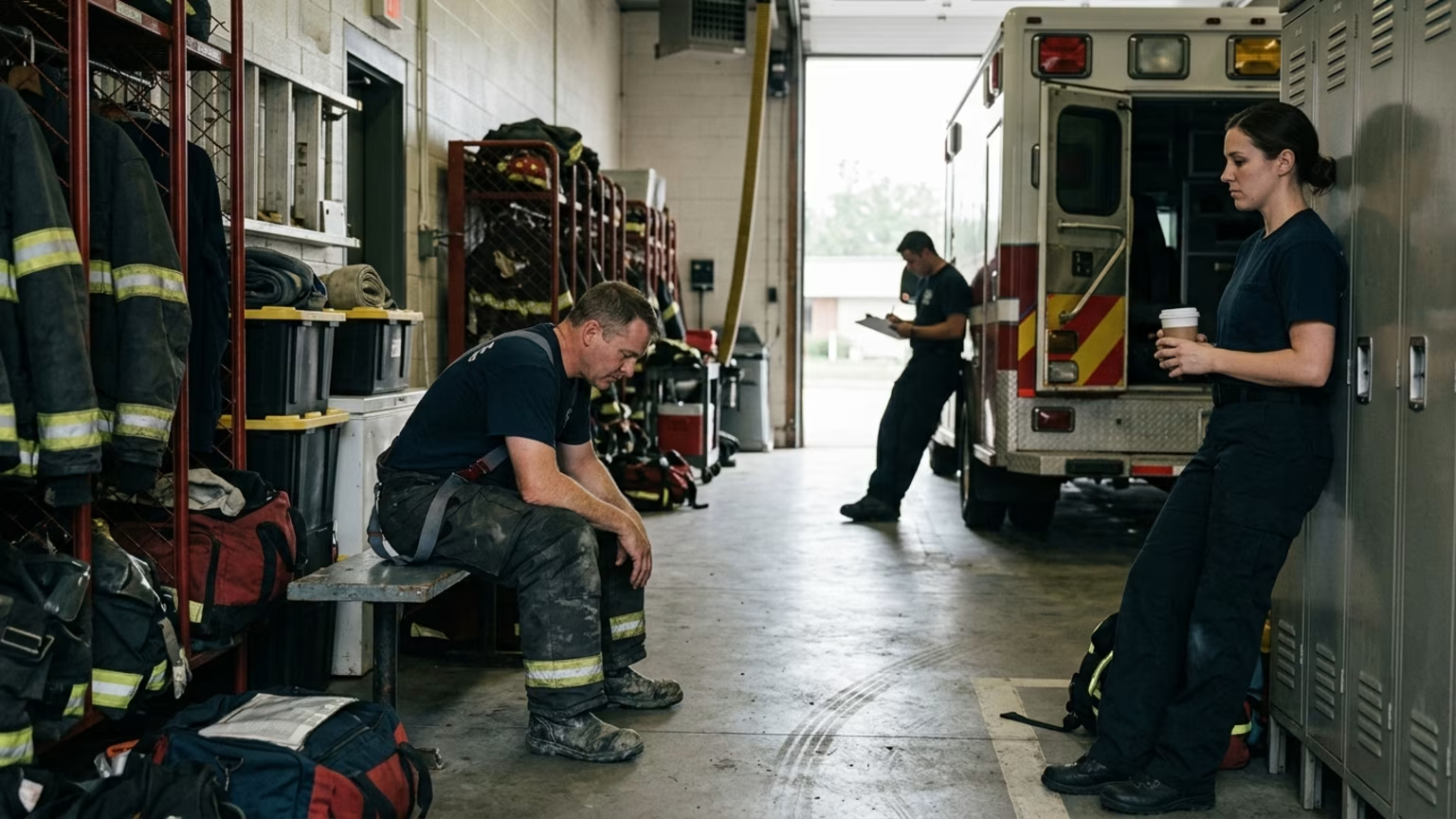

A University at Buffalo conference highlights the psychological toll of consecutive traumatic calls on police, validating the need for structured peer support.





On September 11 and 12, 2026, the University at Buffalo hosted a national conference where participants examined the psychological toll of clustered critical calls on police officers. The event brought together more than 100 participants. Attendees represented fields including law enforcement, health care, social work and community advocacy.
The primary finding discussed at the gathering highlighted the severe operational reality of responding to consecutive traumatic events. Buffalo Police Department Officer Hector Coco described a rapid sequence of incidents that left no natural space for emotional processing. During one demanding shift, Coco and his partner treated a one-week-old baby who was choking. They then went immediately to a scene where a 13-year-old had been shot, and next responded to a flipped car.
This clustered sequence perfectly illustrates how the unpredictability of emergency response limits critical recovery windows. Coco stated that the rapid succession of these severe events left no time to mentally process even one incident before the next call began. He told the conference that a police officer sees over 700 traumatic events in a year. Coco contrasted that staggering figure with his estimate that most people experience about five traumatic events in their entire lives.
The gathering, titled Rise, Respond and Rebuild, was hosted by the Jacobs School of Medicine and Biomedical Sciences. The report describes the event as the university's second time hosting the conference. Its reach expanded nationally this year, drawing wider attention to the specific challenges responders face. The original impetus for the event was a 2023 conversation between medical school leaders at the University at Buffalo and Michigan State University.
Both campuses had recently been affected by gun violence, which sparked a broader dialogue about community resilience and survivor support. Coco's account provided attendees with a clear look at the personal burden responders carry. He noted the difficulty of maintaining a professional exterior during chaotic emergencies. He admitted there are scenes where he wants to cry, but he knows he must hold it together for the public.
This firsthand account directly validates the need to treat clustered calls as a distinct hazard that alters standard fatigue protocols. Moving rapidly between chaotic scenes prevents the nervous system from returning to a baseline state. When emergency personnel cannot pause, the physiological stress from one incident carries directly into the physical demands of the next. This compounding effect means that standard operational breaks are often insufficient, and agencies must recognize how back-to-back incidents increase the total load on active duty personnel.
To better understand this cumulative toll, researchers at Edith Cowan University recently examined serving law enforcement personnel. A 2026 study led by the university surveyed 1,278 serving Western Australian police officers. This group represented nearly 20 percent of that regional police workforce. The university's summary reported that 38.3 percent of the respondents showed PTSD symptoms. Researchers linked these clinical symptoms directly to frequent trauma exposure on duty.
While these findings represent one specific police workforce, they highlight the heavy physical and psychological wear associated with continuous crisis response. Acknowledging this reality requires a practical approach to managing repeated high-intensity calls on duty. It is not enough to measure physical exertion alone when the mental load of consecutive events spikes heart rates and stress hormones. First responders need structured physical maintenance routines that account for these intense physiological shifts.
The Edith Cowan University study also provides valuable insight into how officers actually manage this continuous occupational exposure. Participants identified their spouses and colleagues as their main sources of personal support. In sharp contrast, superior officers were rated as the least supportive resource available to the respondents. A researcher involved in the study noted that peer support appeared to make a meaningful difference for the surveyed officers.
This finding supports prioritizing lateral, trained peer capacity over traditional administrative check-ins following a difficult shift. Because responders naturally lean on their colleagues, informal discussions in the apparatus or at the station hold significant weight. Acknowledging these natural peer dynamics helps agencies build support systems that actually align with responder behavior. Recognizing the limits of hierarchical support is essential for maintaining a healthy and capable workforce over a demanding career.
Recognizing the impact of consecutive traumatic calls often leads well-meaning agencies to implement immediate, mandatory interventions. Older operational models frequently relied on forced psychological debriefings right after a critical incident. The underlying assumption was that making a responder talk immediately would clear the mental slate and prevent long-term injury. However, current evidence does not support this forced approach as a reliable protective measure.
A review summarizing Cochrane evidence evaluated the effectiveness of single-session individual psychological debriefing. The review found no evidence that this specific intervention reduced PTSD, depression or general psychological morbidity compared with no intervention. More concerningly, the review raised the possibility that forced single-session debriefings could increase distress in some cases. Treating a rapid, mandatory debriefing as a guaranteed preventative ignores the complexity of trauma processing.
Moving away from these outdated mandates allows organizations to adopt more supportive and voluntary recovery practices. Responders need access to ongoing professional resources rather than a single forced conversation following a bad shift. Recognizing that every professional processes clustered calls differently eliminates the pressure to have an immediate reaction. Shifting from mandatory debriefs to sustained, accessible support respects the individual recovery timelines of active personnel.
Translating this evidence into daily operations requires practical adjustments that respect the unpredictable nature of emergency shifts. First responders cannot control dispatch volume, but they can adapt their approach to pacing between heavy incidents. Acknowledging that clustered calls severely compress recovery time is the first actionable step toward better fatigue management. Personnel should actively look for small windows to regulate physical tension before the next tone drops.
One actionable adjustment is creating clear boundaries after clearing a highly stressful scene. If a true break is impossible, personnel can focus on brief physical grounding techniques in the vehicle. Even minor actions like controlling respiration help physically reset the body before arriving at the next location. Using grounding skills between calls can mitigate the compounding adrenaline of a busy night. Small physical resets keep the nervous system from remaining continuously elevated throughout a long tour.
First responders should also consider tracking their overall shift load and stress across multiple weeks. Having objective data on fatigue levels helps officers make informed decisions about their off-duty recovery. This awareness allows responders to adjust their physical training intensity following heavily clustered shifts. Pushing through an intense workout immediately after a traumatic, sleep-deprived sequence often compromises long-term physical readiness. Adjusting workouts to prioritize mobility and recovery on these days is a vital operational adjustment.
Since the Edith Cowan University study shows officers heavily rely on colleagues, reinforcing these networks is critical. Officers should identify trusted peers for voluntary conversations after a challenging sequence of calls. It is helpful to normalize checking in with partners without forcing a clinical discussion. Departments can support this reality by establishing trained peer-support capacity that operates outside the formal disciplinary structure.
If distress persists or becomes difficult to manage, peer support must serve as a bridge to professional care. Trained peers are a valuable connection point, but they are not a substitute for clinical assessment. Recognizing the boundary between peer connection and necessary medical intervention protects both the individual and the supporting colleague.
As conferences like the one hosted by the University at Buffalo expand, the discussion around responder toll will evolve. Future developments will likely focus on bridging the gap between anecdotal accounts and validated operational protocols. Agencies will need to monitor emerging implementation research regarding peer-support training effectiveness across different departments. It is critical to track whether these programs actually improve long-term capability and clinical outcomes over a career.
The first responder community must also watch how leadership structures adapt to feedback about supervisory support. The Western Australian data indicating that superiors are often seen as unsupportive points to a necessary shift in management training. Following how different agencies attempt to improve frontline supervision will offer valuable lessons for the broader profession. Watching these leadership adjustments will help determine the most effective ways to support personnel on the ground.
Ultimately, observing how agencies balance mandatory service delivery with realistic recovery intervals will shape future duty standards. The push for evidence-based violence prevention in communities must be matched by evidence-based recovery strategies for the responders involved. Monitoring the development of these organizational policies will provide clear indicators of how the industry is maturing. Providing personnel with the time and support to process severe calls remains a central challenge to track.
Providing trained peer support after a rapid sequence of traumatic calls is a necessary operational step, and translating those support structures into lifelong physical readiness is our primary focus. When addressing the core challenge of separating useful stress-resilience guidance from motivational slogans or mental-health stigma, Rescuris formulates practical, evidence-based protocols. We equip first responders to navigate cumulative shift trauma while protecting their long-term health.
Rescuris publishes evidence-aware guidance for firefighters, police officers, paramedics and other first responders on fitness, recovery, sleep, nutrition, stress resilience and long-term capability.






Read practical guidance on first responder fitness, recovery, sleep, nutrition and resilience for demanding work and a long, active career.
read the blog
