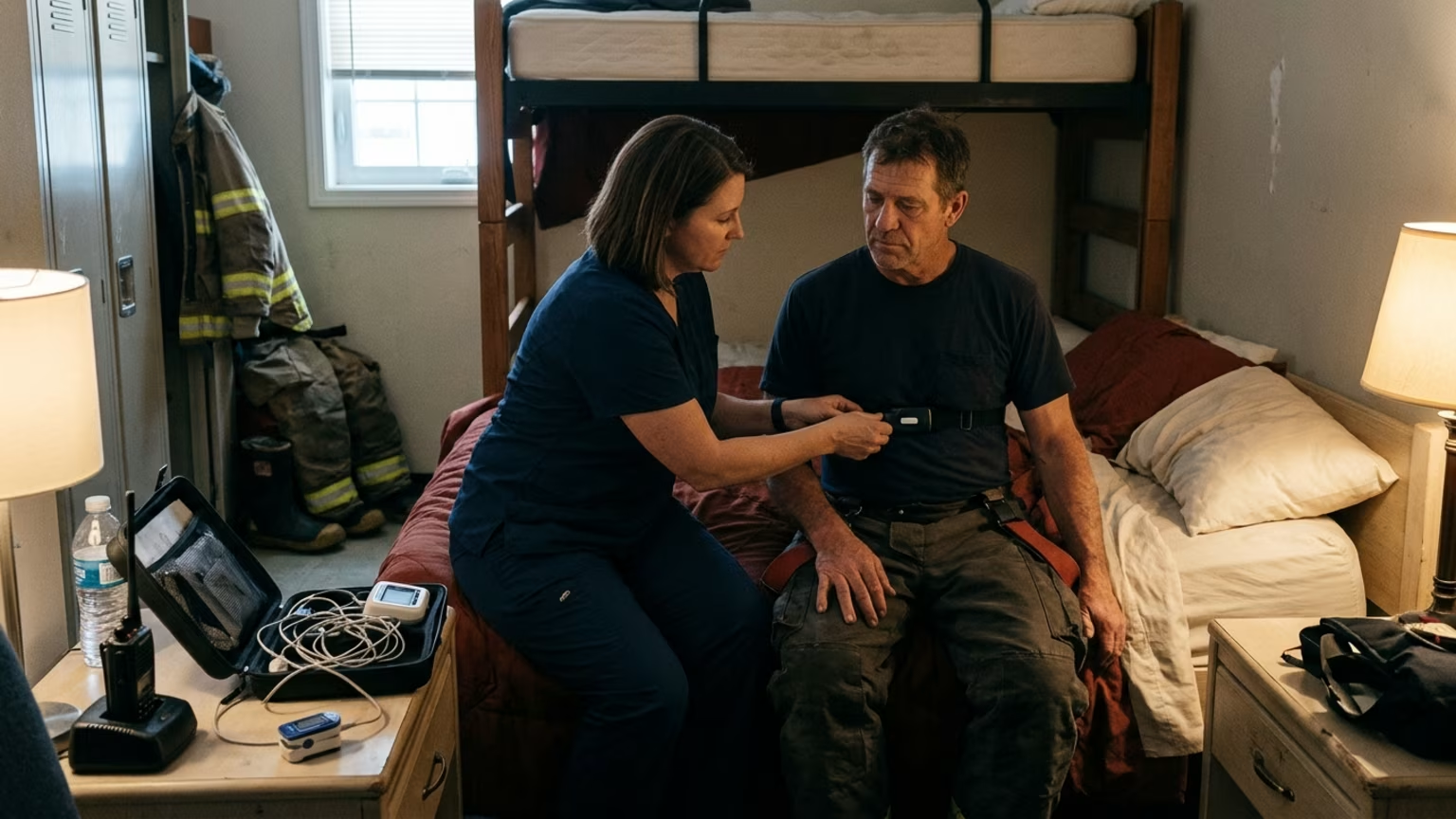

A Sleep study examines cardiovascular mortality in OSA. See the risk factors, CPAP findings and limits for first-responder health discussions.





On October 28, 2026, Sleep published a retrospective study of cardiovascular mortality among adults referred for obstructive sleep apnea (OSA) testing. The paper, “Risk Factors for Cardiovascular Mortality in Patients With Obstructive Sleep Apnea,” examined which patient characteristics were associated with deaths over follow-up.
For first responders, the relevant issue is broader than whether fatigue affects the next shift. The findings put sleep care alongside established cardiovascular risks in a longer-term health discussion.
According to the Sleep paper, researchers followed 4,368 adults referred for diagnostic polysomnography at a tertiary sleep center. Follow-up extended to 20 years, with a median of 8.6 years. The researchers recorded 335 cardiovascular deaths.
The study reported several causes among those deaths:
These percentages describe the cardiovascular deaths recorded in the cohort, not the likelihood of developing those conditions among everyone who underwent testing.
In adjusted analyses, the authors identified age and male sex as independent predictors. Active smoking, hypertension and atrial fibrillation were also predictors. So were prior myocardial infarction and diabetes.
Reported hazard ratios included 1.73 for hypertension, 2.16 for atrial fibrillation and 1.37 for diabetes. “Independent” here means that a factor remained associated with the outcome after adjustment for other measured variables. It does not mean that the factor acts in isolation in a person's health.
The authors interpreted conventional cardiometabolic factors as the predominant drivers of cardiovascular mortality in this cohort. They recommended prevention focused on coexisting conditions.
The treatment finding needs both parts of the published account. According to the abstract, good CPAP response was associated with lower cardiovascular mortality among patients with an apnea-hypopnea index of at least 15 events per hour. The reported hazard ratio was 0.72, with a 95% confidence interval from 0.55 to 0.96.
However, the journal's advance-articles summary reported that neither good nor poor CPAP response showed a detectable cardiovascular mortality benefit in the full cohort over the median follow-up. A favorable association within one subgroup and no detectable benefit across the full cohort are different findings. Reporting only one would leave out material context.
The abstract also reported that nocturnal desaturation, meaning nighttime oxygen drops, did not remain statistically significant after multivariable adjustment. That result does not establish that oxygen drops are harmless. It means this measure did not retain statistical significance once the analysis accounted for other variables.
The focal paper did not report first-responder or shift-work subgroup results. It did not examine duty-related fatigue or test whether screening or treatment changed responder performance, injury risk or cardiovascular outcomes. Its participants were adults referred to a tertiary sleep center, so the findings should not automatically be generalized to all people with OSA.
The retrospective design identifies associations, not proof that a listed factor caused a death or that changing it would produce a particular reduction in risk. The available article page also does not provide detailed limitations or cohort recruitment dates. Those gaps leave questions about how the cohort was assembled and how fully the reported patterns would apply elsewhere.
Separate occupational evidence provides context without turning this into a responder study. A JEMS article reports that a study of nearly 7,000 career firefighters found 37% screened positive for a sleep disorder, most often unrecognized OSA. A positive screen is not a diagnosis, and that figure is not an OSA prevalence estimate for all firefighters.
For someone working irregular duty, the practical distinction is between acknowledging schedule demands and assuming they explain every persistent symptom. This paper supports taking OSA and cardiovascular risk factors seriously as separate health issues when sleep problems warrant clinical discussion. It does not require choosing between a work-related explanation and a medical conversation.
The distinction matters when considering sleep apnea within emergency-service health, where work demands and personal health concerns both need room in the discussion.
The journal's advance-articles summary framed the results as challenging a CPAP-centric approach to cardiovascular risk management in OSA. That is a challenge to a way of organizing care, not evidence that one therapy lacks all clinical value.
The assumption worth questioning is that a sleep-apnea treatment response can stand in for the whole cardiovascular picture. In the authors' analysis, conditions such as hypertension and atrial fibrillation remained relevant predictors. A discussion centered only on sleep-test measures would miss the emphasis of the authors' conclusions.
This is also where performance advice can become too narrow for emergency-service readers. Advice judged only by whether someone feels more ready for the next shift is answering a different question from a study tracking cardiovascular deaths over years. The two outcomes should not be treated as interchangeable.
The authors' recommendation therefore points toward attention to coexisting conditions alongside sleep care. It does not call for replacing one with the other.
The evidence supports a discussion with a qualified clinician rather than a self-directed change in care. For responders with persistent sleep problems or fatigue, useful discussion points include:
The useful separation is between explaining a symptom and reviewing health risk. A responder can bring a demanding schedule into a clinical conversation without assuming that the schedule settles the question. Equally, being tired after difficult duty is not, by itself, a diagnosis of OSA. The study gives no basis for turning fatigue alone into a cardiovascular risk category.
These are topics for clinical review, not a new responder screening checklist. The study does not prescribe an occupational testing schedule or a department policy.
For anyone already using CPAP, this paper is not a reason to stop or change it. Personal decisions about evaluation or treatment belong with a qualified clinician who can consider the person's history and current care.
Taking the work schedule seriously does not mean letting it answer every health question. A parallel discussion of recovery opportunities within a duty roster can keep the operational issue visible without replacing clinical care.
The Sleep researchers also identified six patient profiles, or phenotypes, with cardiovascular mortality ranging from 2.9% to 14.4%. Their proposed use for these profiles is to help identify people who warrant closer cardiovascular surveillance.
The study also reported a random survival forest model with a C-index of 0.80. That is a model-performance figure, not an individual's probability of cardiovascular death. The distinction to keep in view is between identifying higher-risk profiles and demonstrating that using those profiles improves care. The latter would need evidence about decisions and outcomes, not only separation between groups.
The next useful questions are practical. Would those patient profiles help clinicians decide who needs closer cardiovascular follow-up? Do they add information that changes care beyond the established conditions highlighted in this analysis? How would similar assessment perform in a population with documented shift schedules and occupational demands?
A separate 2026 study in Sleep examines prediction of cardiovascular outcomes using ECGs from overnight polysomnography and sleep-stage data. It is a distinct study, not an additional finding from this OSA mortality cohort. Its existence makes risk prediction a relevant area to follow without settling the questions raised here.
For now, the paper's most grounded contribution is its attention to the whole cardiovascular picture in people assessed for OSA. For responders, the lasting question is not simply whether sleep care helps the next shift. It is how sleep concerns and established health risks are addressed together over a longer working life.
Cardiovascular mortality is an outcome measured over years, and Rescuris places sleep evidence in the broader context of recovery and career longevity. For emergency-service professionals sorting advice that favors immediate performance, its coverage helps keep long-term health in view alongside the demands of duty.
Rescuris publishes evidence-aware guidance for firefighters, police officers, paramedics and other first responders on fitness, recovery, sleep, nutrition, stress resilience and long-term capability.




Read practical guidance on first responder fitness, recovery, sleep, nutrition and resilience for demanding work and a long, active career.
read the blog
