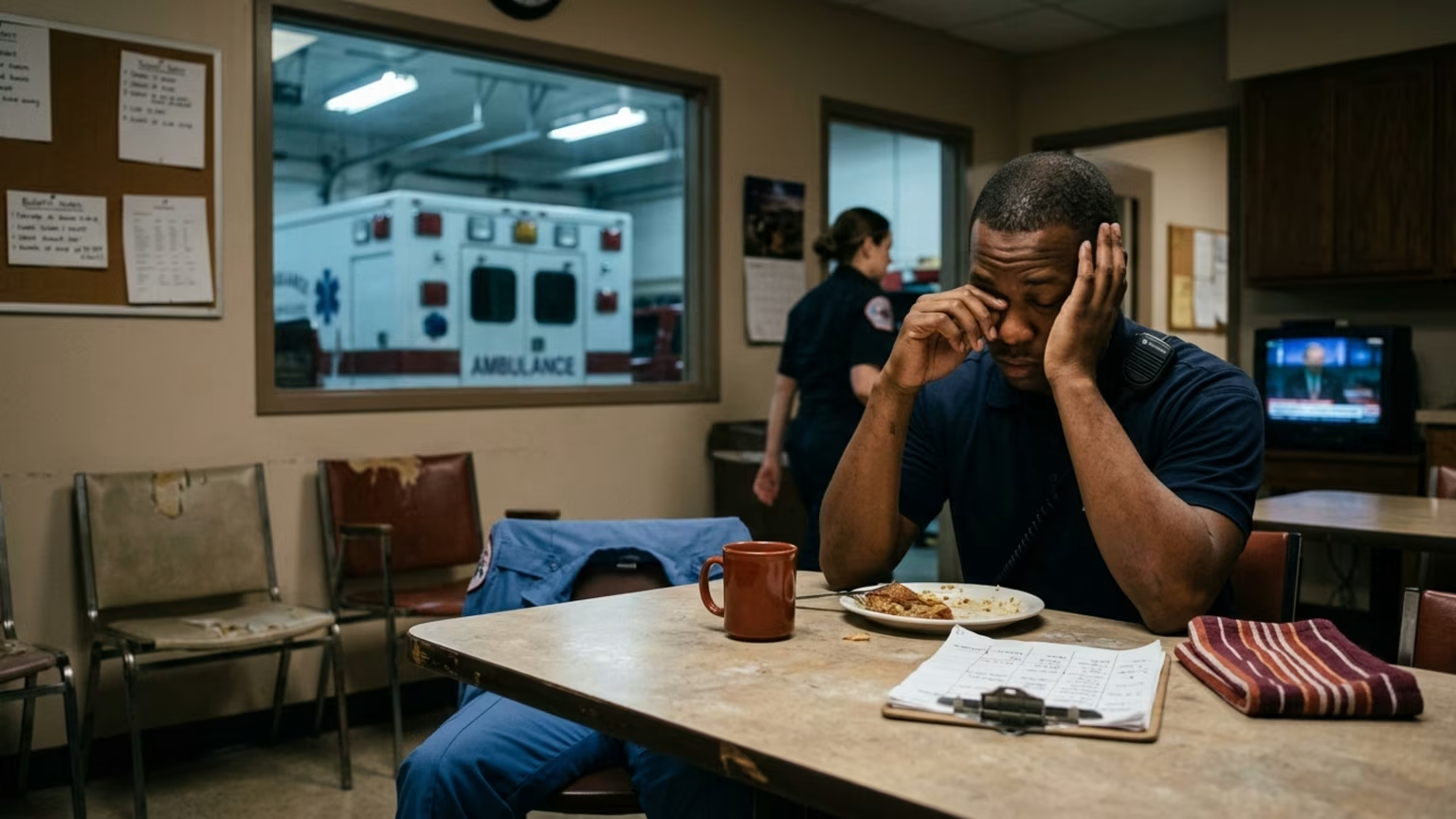

Evaluate first responder shift schedules for actual sleep opportunity. Compare the physiological impacts of rotating rosters and extended-duty duty models.





Choosing between a rotating shift schedule and an extended-duty roster requires evaluating how each operational pattern impacts circadian timing, sleep opportunity and physical recovery.
Rotating shifts keep units staffed continuously but place substantial stress on biological timing and physiological recovery. Forward rotation moves personnel from day shifts to evening shifts and then to night shifts in a progressive pattern. A police-schedule review recommends forward rotation over backward rotation while advising agencies to avoid quick schedule changes. However, this recommendation should be treated as guidance rather than universal proof for all emergency settings.
During the biological night, core body temperature drops and cognitive alertness naturally declines. Personnel forced to perform critical tasks during these early-morning hours often experience delayed reaction times. A forward rotation allows the body to gradually delay its sleep phase to meet these nighttime operational demands. This gradual shift is generally easier to tolerate than forcing an earlier sleep onset during a backward rotation.
Backward rotation creates particularly short recovery windows because personnel must shift their sleep periods earlier rather than later. Moving from a night shift to an evening shift and then to a day shift forces the body into an unnatural circadian adjustment. Guidance summarized by HealthWorkNY identifies backward rotation and night work as schedule features that can increase fatigue risk. It also lists shifts longer than 12 hours and quick return times as significant operational hazards.
Rapid rotation strategies attempt to limit the total consecutive days spent on night duty. This approach can restrict the time available for circadian adaptation. While the police-schedule review advises avoiding quick changes, evidence regarding rotation direction is not absolute. A controlled study summarized by Smarter Supplement Reviews found no significant difference in sleep measures between clockwise and counterclockwise rapidly rotating schedules.
That specific study evaluated air-traffic controllers and should not be taken as direct proof for first responders. Because that comparison was not conducted in emergency personnel, rotation direction might not be the only relevant variable. Agencies must still assess their rosters for early starts, short turnarounds and the total number of consecutive night shifts. Implementing proper sleep plans for rotating night rosters can mitigate some strain, but it cannot fix an inherently flawed schedule.
Fixed night schedules often provide greater predictability for planning family activities and personal time. This predictability does not eliminate the biological difficulty of attempting to sleep during the day while remaining alert overnight. A police study cited by Law Enforcement Today reported that poor sleep quality was 70 percent higher among night-shift officers than among day-shift officers. The same study found poor sleep quality was 49 percent higher among afternoon-shift officers.
Extended-duty schedules consolidate working hours into fewer reporting days but create a stark difference between scheduled rest and actual sleep. A longitudinal evaluation of the Roswell Fire Department examined a transition from a 24-hour on and 48-hour off schedule to a 48-hour on and 96-hour off schedule. The department previously started shifts at 8:00 a.m. but moved the start time to 11:00 a.m. for the new roster. The study ran from June 2024 through early 2026.
Researchers utilized wrist-worn trackers alongside paired medical evaluations and daily surveys. These surveys measured sleep, fatigue, mood and depression among the workforce. The 48/96 schedule produced measurable improvements in several physiological markers for this specific department. Measured average sleep increased from 6.7 to 7.0 hours per night under the new roster.
Sleep at home also rose from 6.9 to 7.2 hours. Furthermore, sleep on the final night before reporting for duty increased from 6.1 to 7.0 hours. This suggests that the later start time and reduced commuting demands materially improved sleep opportunity before the tour. The Roswell study reported a 41-minute increase in self-reported nightly sleep across the department.
Personnel also experienced a 60 percent reduction in monthly commuting time. This equaled approximately seven hours of saved commute time per month. These changes corresponded with significant health improvements within the surveyed group. Rates of poor sleep quality fell from 67 percent to 36 percent, while high fatigue scores dropped from 40 percent to 10 percent.
Additional health and family metrics showed favorable trends following the schedule adjustment in Roswell. Positive depression screenings declined from 12 percent to zero during the evaluation period. A survey of 32 spouses or partners found that 90 percent reported overall satisfaction with the schedule change. Within that group, 84 percent believed their partner's mental health improved and 78 percent reported greater help at home.
More than 70 percent stated the firefighter was more present when off duty. Other emergency professions also utilize extended-duty models to balance coverage and recovery. The IAED Journal describes a 24-hour dispatch model built around designated five-hour to six-hour sleep blocks during the tour. Some dispatchers on these schedules perceived more time at home and better work-life balance.
While the 48/96 schedule improved many metrics, some health screenings presented mixed results that require careful interpretation. The Roswell study reported that positive PTSD screens and high-risk sleep-apnea screens improved without reaching statistical significance. Additionally, aerobic-fitness results declined during the evaluation period, possibly because of differences in physical testing protocols. These mixed outcomes reinforce the fact that a schedule change alone cannot resolve every occupational health risk.
Determining whether to implement a rotating schedule or an extended-duty roster requires an honest assessment of station workloads. The first critical question is how much sleep a worker can realistically obtain before, during and after the shift. A schedule that operates effectively in a low-volume environment may fail completely in a busy urban unit. This operational context dictates which shift design will best support physiological recovery over a long career.
Extended-duty schedules like the 48/96 model rely on protected rest periods during the tour to remain sustainable. The Roswell article explicitly cautioned that a 48-hour shift may not function well in stations with high overnight call volume. Long transports, mandatory overtime and staffing instability can quickly consume the anticipated recovery benefit of a longer schedule. If an agency cannot protect nighttime sleep blocks, a 24-hour or 48-hour roster will rapidly accumulate severe sleep debt.
A 24-hour roster may offer protected on-duty sleep in a quiet station with adequate staffing levels. However, repeated calls, alarms and emergency transports quickly turn nominal sleep time into highly fragmented rest. High call volumes create a massive sleep deficit that personnel must carry into their days off. If a station regularly experiences these interruptions, shorter shift lengths might be the only way to protect physiological recovery.
Rotating shifts may be necessary when call volumes prevent any reliable sleep on duty. In these high-demand systems, moving to shorter shifts allows personnel to recover away from the station. When rotation is required, agencies should assess the roster for early starts, short turnarounds and consecutive night shifts. Protecting physical recovery when shift conditions alter sleep depends entirely on maximizing the off-duty rest intervals between these demanding blocks.
Commute burden also plays a major role in deciding which schedule is appropriate for a specific workforce. The Roswell findings demonstrated that an early start time restricted commute-night sleep to just 6.1 hours before the change. Agencies with personnel driving long distances might favor extended-duty schedules to reduce total commuting days. Reducing the number of required commutes can add hours of potential sleep time back into a responder's monthly schedule.
Individual tolerance factors will ultimately influence how any specific worker experiences a roster. Age, existing sleep disorders, caregiving responsibilities and chronotype all alter the biological impact of a schedule. A younger worker might manage rapid rotation well, while an older responder might find the constant circadian shifts unbearable. Understanding how irregular shift work alters basic sleep architecture is critical before committing to a permanent night schedule.
Evaluating a shift schedule purely by its label is a common operational error that ignores actual sleep metrics. Assuming that 24 hours on duty guarantees a specific recovery outcome completely misses the reality of interrupted rest. A designated sleep period means nothing if alarms, transports or mandatory overtime prevent personnel from actually sleeping. Departments must measure actual sleep, commute time and interrupted rest rather than relying on the nominal schedule design.
Failing to account for transition days is another frequent mistake when assessing family disruption and work-life balance. A schedule might advertise four consecutive days off, but the first off-duty day is often consumed by sleep recovery. The Roswell partner survey noted generally favorable family perceptions but specifically identified transition-day family time as a lingering concern. Mastering recovery sleep protocols on transition days is necessary because looking only at total days off hides the biological reality of post-shift exhaustion.
Predictable rosters are often mistakenly viewed as biologically harmless simply because they are consistent. Fixed night shifts allow for steady scheduling, but they force responders to fight their natural circadian rhythms every single night. The body expects sleep during the early morning hours, making alertness highly fragile during the biological night. Even with perfect predictability, sleeping during daylight hours remains physiologically challenging for most emergency professionals.
Overlooking the fatigue risks of backward rotation can easily compromise unit safety and personal health. Moving from a night shift to a day shift creates a severe physiological crunch that limits rest opportunities. Personnel are forced to shorten their sleep windows to prepare for earlier report times. Agencies that fail to identify these high-risk patterns often struggle with chronic fatigue across their workforce.
Implementing sweeping schedule changes without collecting objective baseline data is a recipe for operational failure. Departments should pilot any schedule modifications and collect objective sleep data before committing to a permanent roster change. Gathering subjective family feedback and reassessing fatigue markers after implementation prevents agencies from adopting unworkable shift patterns. Assuming that one specific roster fits every station or service line is a fundamental planning mistake.
Schedule design, call demand and staffing levels matter far more than the schedule label itself. A schedule cannot be evaluated responsibly without knowing how much sleep workers actually obtain on duty. Evaluating a roster requires looking at how often rest is interrupted and how much usable family time remains. The most sustainable schedule aligns realistic operational demands with human recovery limits while accounting for local commute burdens.
Evaluating shift rosters for actual sleep opportunity is the first step in occupational recovery, but assessing the subsequent biological changes requires a careful long-term approach. Understanding testosterone and hormone claims without assuming testing or treatment is right for everyone is critical for aging responders dealing with severe schedule disruption. Rescuris provides the evidence-based framework to address these physiological challenges responsibly without medical overreach or tactical clichés.
Rescuris publishes evidence-aware guidance for firefighters, police officers, paramedics and other first responders on fitness, recovery, sleep, nutrition, stress resilience and long-term capability.






Read practical guidance on first responder fitness, recovery, sleep, nutrition and resilience for demanding work and a long, active career.
read the blog
