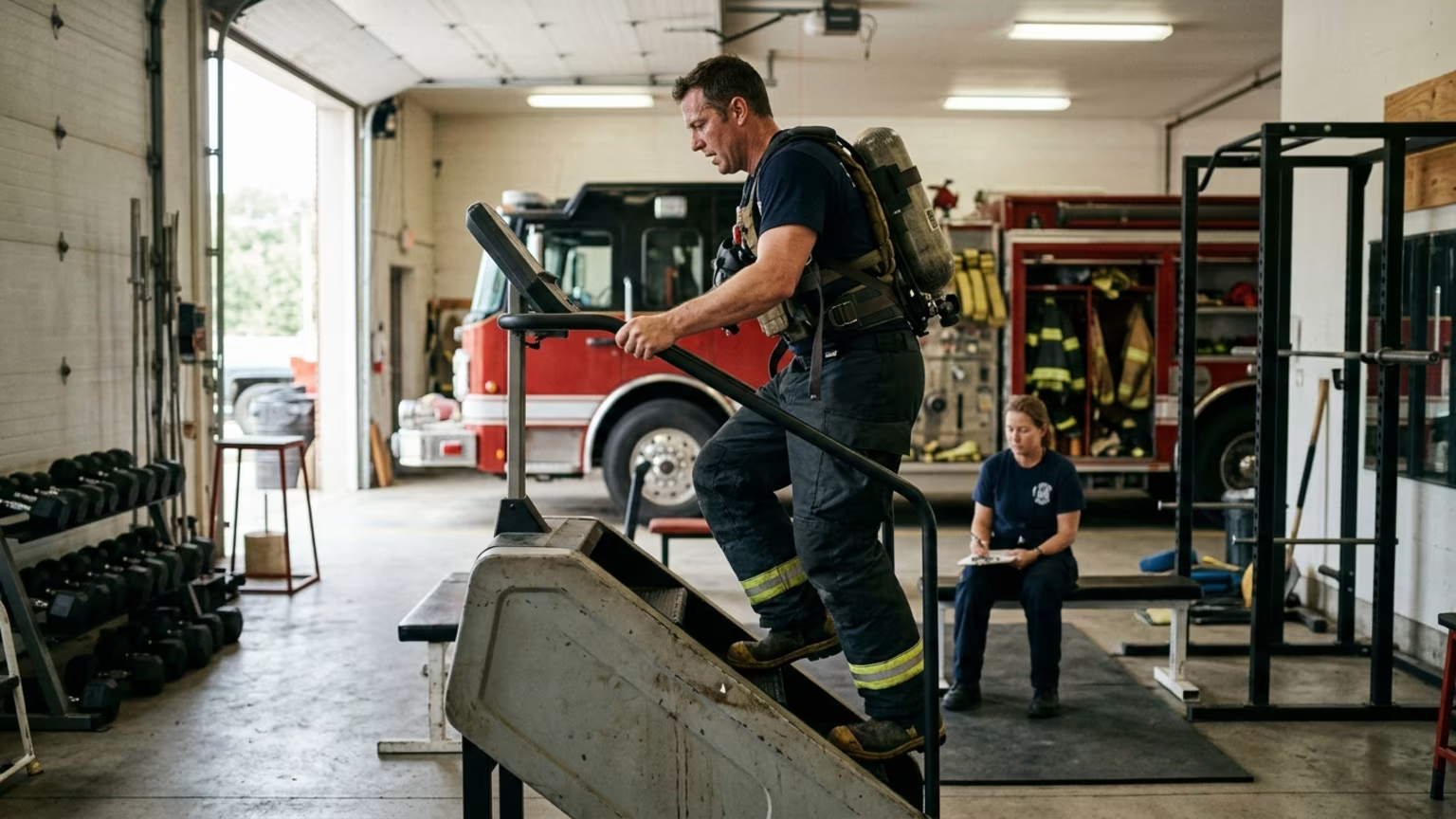

A recent donation of strength equipment to the San Bernardino County Fire Department highlights the role of station training in cardiovascular readiness.





On September 9, 2026, personnel from the San Bernardino County Fire Department collected 23 pieces of strength-training equipment donated by Planet Fitness in Hesperia. The early morning collection near Super Target on Main Street provides crews with station-based training access to support operational readiness.
Cardiovascular events remain a critical occupational threat for emergency personnel. The article covering the equipment donation reported that the U.S. Fire Administration and Planet Fitness identified cardiac arrest as the number-one killer in the fire service. They reported 48 firefighter deaths from cardiovascular events in 2025. Addressing this specific vulnerability requires reliable access to physical conditioning tools.
The donation package expanded the department's training capabilities significantly. The equipment included rowers and Smith machine towers along with leg-press and shoulder-press machines. It also provided three racks of dumbbells and adjustable flat benches. This gives crews consistent access to resistance and conditioning tools in their actual work environment. Station-based access matters because training must fit around unpredictable shift schedules and operational readiness requirements.
Medical experts recognize the systemic health benefits of consistent resistance exercise. Dr. Beth Frates is a clinical assistant professor of physical medicine and rehabilitation at Harvard Medical School. She told the Daily Press that strength training can improve health problems associated with heart-disease risk. Frates cited findings from a long-term analysis to illustrate these benefits. That analysis associated regular strength training with a 32% lower risk of high blood pressure and a 29% lower risk of metabolic syndrome.
Station-based strength equipment directly supports modern occupational conditioning protocols for tactical athletes. Planet Fitness framed the equipment donation around specific operational realities rather than generic physical appearance. The company stated the equipment is intended to help prepare personnel for the heat, weight and unpredictability of emergency incidents. They also noted that firefighters sometimes train while wearing their actual duty equipment to build specialized endurance.
Recent clinical research reinforces the value of moving toward highly specific occupational training. A 2026 systematic review found that structured, occupation-specific firefighter training programs were associated with measurable improvements in simulated fireground performance. The review documented faster task completion times and better execution during victim rescue, hose advancement and ladder operations. These findings validate the operational shift toward targeted strength and fitness protocols for emergency workers.
The link between gym access and duty capability is evident during complex emergency scenarios. Training interventions that replicate physical strains prepare the nervous system for unpredictable environments. When crews train with adjustable benches and heavy dumbbells, they build the mechanical resilience necessary for dragging hoses through tight spaces.
Carrying heavy equipment while wearing thermal protection places extraordinary stress on the body. Access to leg-press and shoulder-press machines allows firefighters to safely simulate lifting heavy loads under fatigue. That foundational strength directly translates to climbing ladders while carrying tools and managing heavy debris. Equipment donations provide the necessary physical infrastructure for these targeted occupational training systems.
Firefighting environments introduce extreme physiological variables that traditional gyms rarely replicate. Structural fires expose personnel to extreme ambient temperatures while heavy turnout gear severely restricts the body's natural cooling mechanisms. This rapid increase in core body temperature accelerates cardiovascular fatigue during critical emergency interventions.
Station-based fitness equipment allows crews to condition their bodies for these precise environmental stressors. Performing resistance exercises while wearing restricted gear safely simulates the heat retention experienced during actual fireground operations. This controlled exposure helps responders build the necessary heat tolerance and physical resilience before they face uncontrolled emergency conditions.
Furthermore, the unpredictability of emergency calls demands a high level of physical adaptability. Responders cannot always perform a perfect warmup before rushing to a complex victim rescue or heavy lifting scenario. Utilizing free weights during shifts keeps muscles engaged and prepared for sudden explosive movements. Maintaining this readiness mitigates injury risk when crews transition rapidly from a resting state to maximum physical exertion.
Providing exercise equipment is only one component of a comprehensive cardiovascular safety strategy. The American Heart Association and American College of Cardiology released new tactical-athlete cardiovascular guidance on September 3, 2026. This framework establishes updated protocols for evaluating cardiovascular risk and fitness for duty in high-stress occupations. The AHA and ACC describe cardiovascular disease as the leading medical cause of duty-related deaths among tactical athletes.
The guidance reflects a critical shift away from treating fitness-for-duty as a simple generic testing standard. Instead, it recommends individualized cardiovascular-risk assessments that carefully consider the specific occupational demands of the role. Fitness-for-duty decisions must account for individual health risks while also considering potential impacts on team members and public safety. This layered approach guarantees that medical evaluations reflect actual operational hazards.
Environmental factors play a massive role in tactical-athlete safety and must inform all medical assessments. The AHA/ACC guidance specifically identifies heat and dehydration as vital considerations for cardiovascular screening. Medical professionals must also consider altitude and access to emergency medical care. Preparticipation screening for emergency personnel should include a thorough medical history and a physical examination. Furthermore, ECG use should be considered according to age, cardiovascular strain and mission-critical responsibilities.
Departments must actively organize new equipment into balanced and sustainable station programs. Crews should utilize rowers and resistance machines to practice movements that directly support job demands. Personnel must avoid treating random equipment use as a complete conditioning program. A comprehensive approach requires pairing resistance work with consistent aerobic-capacity training to handle heavy respiratory loads.
Adopting standardized fitness tracking helps departments evaluate the effectiveness of their station equipment. High-throughput monitoring allows supervisors to track cardiorespiratory baselines without disrupting operational readiness. A separate 2026 review identified the 20-meter shuttle run as a practical and valid option for department-wide testing. Regular assessments help personnel understand their current capabilities and adjust their conditioning routines accordingly.
However, leaders must apply field-based test results with appropriate caution and clinical context. The 2026 review on field testing warned that practical assessments carry inherent limitations regarding measurement accuracy. Field-test estimates can misclassify individuals who score very close to established fitness cut points. Departments should require confirmatory testing before making any final employment-related decisions based on these standard metrics.
Access to exercise equipment and field testing must integrate with robust medical safety systems. The AHA/ACC guidance strongly emphasizes that cardiovascular screening alone cannot prevent every sudden cardiac arrest. Departments must implement actionable emergency plans for every station facility. Rapid access to automated external defibrillators is a non-negotiable requirement for protecting tactical athletes.
Finally, departments must establish clear boundaries regarding medical clearance and exercise programming. Firefighters with abnormal screening results, known cardiovascular disease or active symptoms must consult qualified occupational-health professionals. Supervisors should verify that breathing and respiratory load demands are managed appropriately for individuals returning to duty after an injury or illness.
As the tactical-athlete landscape evolves, researchers must address remaining gaps in occupational conditioning data. The 2026 systematic review on firefighter performance cautioned that future research still needs to clarify optimal training duration. Finding the right volume of exercise is difficult when personnel manage unpredictable shift patterns and sudden emergency deployments. We must carefully evaluate how progressive overload models function in environments governed by constant interruptions.
Understanding the impact of concurrent job demands remains a crucial priority for long-term health. Heavy physical training can occasionally compound the physiological stress caused by sleep disruption and environmental heat exposure. The systematic review identified concurrent job demands and baseline fitness as essential factors requiring further clinical study. Implementing new exercise equipment safely requires balancing rigorous physical effort with adequate recovery protocols between active calls.
The integration of new medical screening frameworks will also require ongoing observation. As departments adopt the recent AHA/ACC guidance, we will track how individualized cardiovascular risk assessments perform in the field. Balancing the need for advanced screening methods like ECGs against logistical constraints will challenge many municipal fire departments. First responder performance programs must ultimately harmonize equipment access, medical oversight and sensible recovery planning.
Integrating donated station equipment into an established cardiovascular screening program is a necessary administrative step, and organizing those resources into realistic daily routines is where our work begins. When facing the challenge of separating useful stress-resilience guidance from motivational slogans or mental-health stigma, Rescuris formulates clear recovery frameworks. We help first responders sustain physical capability without ignoring long-term health.
Rescuris publishes evidence-aware guidance for firefighters, police officers, paramedics and other first responders on fitness, recovery, sleep, nutrition, stress resilience and long-term capability.






Read practical guidance on first responder fitness, recovery, sleep, nutrition and resilience for demanding work and a long, active career.
read the blog
