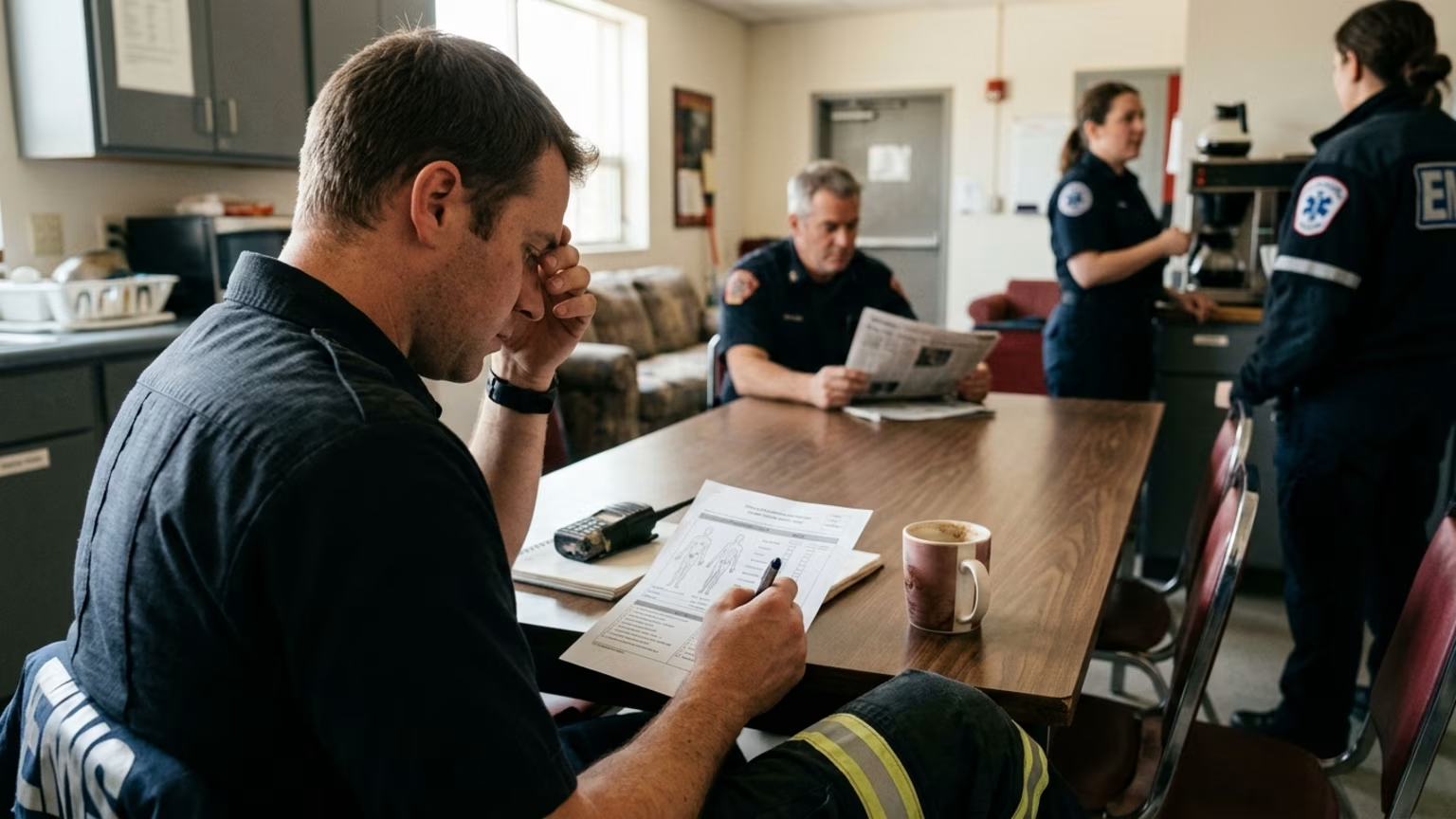

UC Davis researchers have launched the WE-CAIR program, a $14.05 million initiative studying how psychosocial stress modifies the health impacts of wildfire smoke.





In September 2026, researchers at UC Davis launched a multidisciplinary initiative to investigate how psychosocial stress modifies the health impacts of wildfire smoke. The WE-CAIR program received a five-year grant from the National Institutes of Health to examine human health over both the short and long term. Backed by the National Heart, Lung, and Blood Institute, the initiative treats smoke exposure as a multi-system health issue. The public announcement signals an important shift toward understanding how environmental hazards interact with psychological strain.
The program brings together 22 investigators from across UC Davis and collaborators from the UC San Diego School of Medicine. The grant is identified as P01 HL179398, with a total award of $14,050,840. Direct costs account for $8,993,941 of the total funding provided for the five-year research period. Angela Haczku serves as the director of the UC Davis Lung Center and program director of WE-CAIR.
Haczku stated that the research aims to explain individual susceptibility and identify biomarkers that could support improved prevention. The WE-CAIR initiative contains four primary research projects designed to examine distinct biological pathways. Project 1 focuses on group 2 innate lymphoid cells. UC Davis researchers previously found these cells can produce the inflammatory cytokines IL-13 and IL-17 when triggered by wildfire smoke.
Project 2 studies the aryl hydrocarbon receptor to understand its role in wildfire-smoke-related cardiovascular inflammation. Project 3 investigates whether the epigenetic regulator TET1 may help protect against airway and cardiovascular inflammation. Project 4 examines how psychosocial stress and social vulnerability influence the health effects of wildfire smoke exposure. This structure connects the composition of wildfire smoke through immune-system and epigenetic responses to the effects observed in patients.
UC Davis reports that extreme wildfire smoke exposure has increased 27-fold over the past decade. While acute exacerbations of cardiovascular disease are well documented, the long-term health effects remain poorly understood. This knowledge gap is particularly critical for emergency personnel working extended operations in hazardous environments. Combining epigenetic research with clinical exposure simulators will help isolate how these factors interact over time.
The overall objective of WE-CAIR is to identify actionable targets for medical intervention and policy updates. By connecting atmospheric science with molecular biology, the 22 investigators hope to define the exact mechanisms of injury. Integrating data from mouse exposure simulators with human clinical studies provides a comprehensive view of disease progression. This systems-level integration ensures that the findings will eventually translate from the laboratory directly to patient care.
For wildland firefighters and emergency personnel, smoke exposure rarely occurs as an isolated inhalation event. First responders repeatedly encounter heavy smoke while managing long shifts, irregular sleep and high heat. The UC Davis program recognizes this complex exposure environment by integrating psychosocial stress into its biological evaluation. This approach validates the practical reality that occupational stress loads directly compound the physiological damage of particulate inhalation.
A 2025 field study cited in recent reporting illustrates the severe strain placed on working responders. The study found that wildland firefighters averaged 13.8-hour shifts on fire-fighting days. During these operational periods, crews averaged approximately 6.7 hours of sleep. Researchers noted that poorer sleep and longer shifts were associated with reduced cognitive function among the studied firefighters.
The Environmental Protection Agency has also reported that even a few hours of wildfire-smoke exposure can reduce adult attention. These cognitive impacts demand serious attention from departments tracking operational fatigue and sleep deprivation during the 2026 wildfire season. Evaluating these intersecting environmental risks is essential for maintaining safety during high-consequence decision making. Cognitive impairment on the fireground presents an immediate threat to both individual survival and crew coordination.
Recent reporting on a Barrow Neurological Institute study further connects smoke inhalation to neurological strain. The laboratory research showed that wildfire-smoke particles activated brain-support cells known as astrocytes. These activated astrocytes then triggered inflammatory responses with the potential to damage neurons. While this does not prove exact exposure thresholds for firefighters, it highlights how particulate matter creates multi-system inflammation.
The British Columbia Centre for Disease Control has reinforced this broader view of particulate hazards. The agency reported that growing evidence links long-term wildfire-smoke exposure with severe chronic conditions. Specifically, fine particulate matter known as PM2.5 is associated with dementia, ischemic stroke, heart failure and cancer. Modifying first responder conditioning programs must account for this systemic stress to ensure adequate recovery between deployments.
Older occupational health protocols often treated smoke inhalation strictly as a localized airway injury. This view prioritized acute respiratory clearance while largely ignoring systemic inflammation and epigenetic changes. The WE-CAIR program challenges this limited scope by investigating how environmental hazards combine with social vulnerability. A responder passing a baseline fitness test may still carry a significant burden of cellular-level inflammation.
Protective equipment standards also vary drastically between different types of emergency response disciplines. The National Institute of Standards and Technology has published work examining mitigation strategies for wildfire smoke exposure. However, this research focuses on wildland-urban-interface residential environments rather than active operational firegrounds. Wildland firefighters commonly work in heavy smoke without the comprehensive respiratory protection used during interior structural firefighting.
Estimating long-term occupational risk remains difficult when protective measures and exposure levels fluctuate wildly. A 2019 exposure-modeling study attempted to quantify these risks based on career length. The model estimated that cumulative smoke exposure could increase a wildland firefighter’s risk of death from lung cancer by 8 percent to 43 percent. The same study estimated an increased risk of cardiovascular disease mortality ranging from 16 percent to 30 percent.
While clinical endpoints from the UC Davis program remain in development, crews must adjust current risk-management practices. Operational leaders should treat sleep opportunity and post-incident recovery as vital performance metrics. Tracking cumulative exposure over a season helps supervisors identify when a responder is approaching a critical fatigue threshold. This tracking must document unusually long shifts, poor sleep, high-heat assignments and repeated heavy smoke exposure.
Implementing practical active post-incident transition strategies allows crews to clear residual tension after demanding assignments. A 2026 scoping review reported that several forms of wildfire exposure were consistently associated with adverse mental-health outcomes. These exposures included direct contact with danger, seeing flames or smoke, and participating in evacuations. The review highlighted neuroinflammation, prolonged fight-or-flight activation, and sleep disruption as potential pathways for these adverse outcomes.
The psychological toll of these prolonged disaster deployments requires careful monitoring by both individuals and supervisors. The scoping review reported insomnia prevalence ranging from 13.5 percent among Fort McMurray evacuees to 63.0 percent among Greek fire victims. Recognizing changes in mood, anxiety, or concentration is essential for maintaining unit cohesion. Responders should openly discuss these signals with qualified mental-health clinicians rather than ignoring persistent symptoms.
Retired personnel must take proactive steps to document their full occupational history with medical providers. Clinicians need a detailed record of cumulative fire seasons to properly assess ongoing respiratory health. Secondary reporting on disaster-related trauma states that PTSD is three times more common among firefighters than in the general population. Furthermore, approximately one in ten emergency responders may develop long-lasting PTSD after facing a natural disaster.
The WE-CAIR program represents a critical step forward in tracking environmental and psychological variables simultaneously. As Project 4 progresses, the sector will gain clearer data on how social vulnerability influences biological health. Departments should monitor this initiative for newly identified biomarkers that could inform better occupational screening. Until specific clinical tools emerge, maintaining rigorous documentation of shift lengths and smoke intensity remains the best defense.
Researchers will also continue investigating the temporary physiological changes observed during active fire seasons. A 2025 study of 39 wildland firefighters found temporary reductions in kidney function during one midseason fire incident. The research also noted changes in kidney-injury biomarkers among the affected crew members. Future studies are necessary to establish whether repeated seasonal exposures ultimately cause permanent renal damage.
Understanding how environmental exposures impact hormonal health will remain a central concern for the emergency response community. The UC Davis effort to map the chain from smoke composition to patient outcomes provides a template for future research. While associations between smoke and chronic disease exist, responders must remember that these factors do not automatically guarantee illness. Adapting shift policies based on emerging evidence will help protect long-term capability without generating unnecessary clinical panic.
Ongoing evaluation of multi-system damage requires a collaborative approach between academics and field operators. While the Barrow Neurological Institute research raises concerns about neuron damage, translating these findings to human field conditions takes time. First responders must balance these long-term risks against the immediate tactical requirements of their profession. Relying on objective data rather than generalized health anxiety ensures that emergency personnel can sustain their careers safely.
Unit supervisors and crew leaders constantly battle sleep disruption from nights, rotating shifts, overtime and unpredictable calls. Establishing a structured approach to biological and psychological recovery is critical for maintaining readiness during heavy fire seasons, and Rescuris provides the framework to implement these changes. By applying evidence-based protocols to daily routines, emergency personnel can protect their long-term cognitive and physical health without sacrificing operational capability. Explore Resources
Rescuris publishes evidence-aware guidance for firefighters, police officers, paramedics and other first responders on fitness, recovery, sleep, nutrition, stress resilience and long-term capability.






Read practical guidance on first responder fitness, recovery, sleep, nutrition and resilience for demanding work and a long, active career.
read the blog
