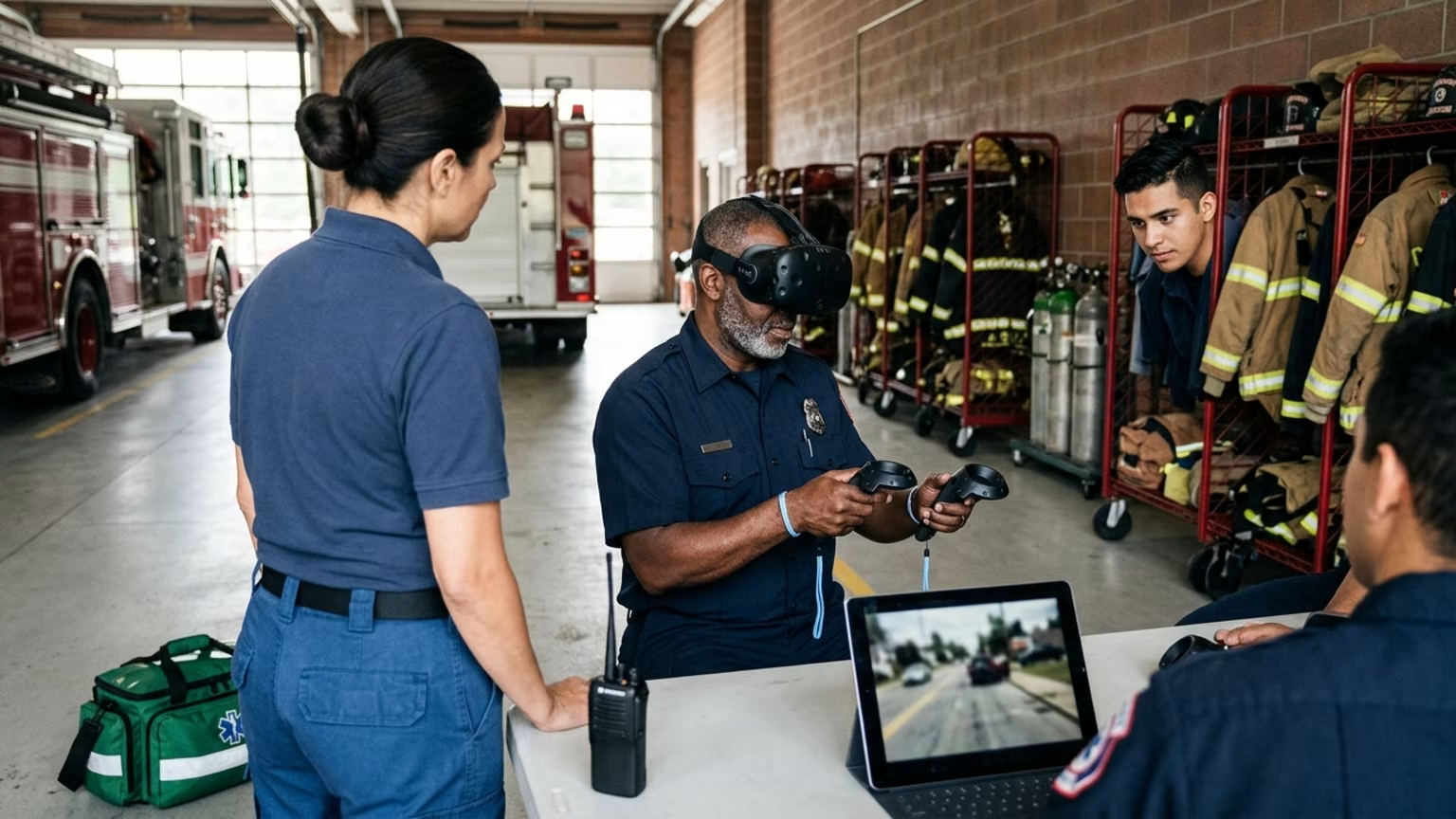

JEMS reports on VRSim's newly released VRNA Advanced EMS module. The simulation helps first responders rehearse clinical protocols under simulated pressure.





On October 1, 2026, JEMS reported that VRSim expanded its emergency-services lineup with a newly released VRNA Advanced EMS training module. The program targets paramedics, AEMTs and first responders.
The primary takeaway from the announcement centers on combining clinical procedures with human-factor stress. The VRNA Advanced EMS module places trainees in complex decision-making roles. Users must assess patients, direct teams and execute advanced life-support protocols while managing rapidly changing emergency scenes. This requires participants to balance technical medical knowledge with situational awareness.
Scenarios cover pediatric and adult emergencies, including stroke responses, seizure protocols and cases involving an altered level of consciousness. JEMS presents the advanced module as a distinct addition to the original VRNA EMS offering. The basic version focuses primarily on foundational skills and basic life support practice. The newly released module adds advanced care requirements and more complex clinical decisions.
JEMS reports that the AI-driven simulation intentionally adds social friction to the clinical requirements. Trainees face disruptive or curious bystanders and anxious family members who interfere with the scene. The system forces trainees to navigate these social dynamics while handling changing patient presentations. This environment requires users to practice their medical skills and communication abilities simultaneously.
The system introduces variable difficulty levels to test resilience, with scene factors and symptoms changing rapidly between runs. This unpredictability prevents users from memorizing a single correct pathway. It forces a more dynamic application of operational protocols. Practicing these scenarios helps emergency crews prepare for the chaotic reality of fieldwork.
To track performance, an integrated online portal records accuracy, timing and clinical outcomes. Instructors and agency coordinators can use this data for post-scenario debriefing sessions. However, the published coverage does not provide independent results from that portal. The available article simply lists the metrics the software intends to track.
VRSim CEO Matthew Wallace stated the program is intended to keep providers confident amid burnout and high-stakes pressure. This represents the corporate rationale for developing the software rather than independent evidence of reduced burnout. The goal of keeping personnel on the job is important. However, achieving that goal requires sustained operational support alongside new training tools.
This announcement highlights a shift in how agencies approach cognitive load. Emergency shifts rarely present a clinical problem in a quiet vacuum. Personnel must process medical protocols while managing environmental noise. The ability to control a chaotic scene directly influences patient care quality.
First responders face significant mental fatigue from repeated exposure to unpredictable environments. High-stakes pressure can degrade decision-making capacity over a long career. Integrating AI-driven scene variation into training provides a controlled environment for mental skills practice. Finding ways to build confidence under pressure requires practical methods for managing acute stress.
The reported features of the VRNA system highlight situational awareness alongside medical intervention. Trainees must process shifting symptoms while directing other team members. This reflects the realistic teamwork demands of emergency medical services. Rehearsing these steps repeatedly helps emergency crews standardize their communication during high-stress events.
Building resilience involves regular exposure to the specific stressors that personnel face on duty. Programs that simulate these stressors offer a structured method for maintaining operational readiness. It acts as a form of graduated stress exposure adapted for virtual platforms. Allowing providers to make mistakes safely builds competence over time.
Managing cognitive load directly impacts physical fatigue during a shift. Processing complex medical protocols while ignoring external disruptions requires intense mental effort. This cognitive strain often compounds the physical exhaustion of emergency work. Practicing these scenarios in virtual reality helps build mental automaticity for complex procedures.
When clinical protocols become automatic, personnel expend less mental energy on scene management. This efficiency supports long-term capability and operational endurance. First responders who use less cognitive energy on routine decisions handle late-shift stress more effectively. Reducing that mental strain improves overall shift resilience.
This technology challenges the assumption that virtual simulation can act as a substitute for hands-on clinical hours. Some commercial technology narratives suggest that digital modules can replace real-world experience, but the perspective shared in the JEMS article contradicts that view. Christopher DeRosa, an EMT and fire fighter, described immersive tools as a scaffold for access. He noted they provide realism and repetition.
DeRosa specifically warned that these programs are not shortcuts to competency or replacements for physical clinical experience. A virtual simulation can replicate the cognitive stress of a changing patient presentation, but it cannot duplicate the tactile feedback of an actual emergency. Viewing the VRNA system as an enhancement clarifies its operational value. It allows for repeated cognitive rehearsal before personnel apply those skills physically.
A 2026 review in the Journal of Computer Assisted Learning offers relevant context for these assumptions. The review evaluated VR and AR safety training programs across multiple disciplines and identified limited long-term retention data as a significant evidence gap. The researchers also noted an overreliance on student-heavy samples in current studies. They found infrequent assessment of real-world results beyond immediate learning outcomes.
This review highlights why agencies must view immersive training cautiously. Virtual tools offer engaging ways to practice scene management, but they lack robust evidence connecting virtual success to long-term operational performance. Agencies should not assume that high scores in a simulator guarantee flawless field execution. The training must remain integrated with traditional evaluation methods.
Agencies considering this type of training must implement clear evaluation criteria before starting a trial. Training coordinators should ask vendors specifically which scenarios are included to understand the exact scope of the medical protocols available. The technology offers a sophisticated rehearsal format for clinical decisions. JEMS characterizes the offering as affordable but provides no price or comparative cost data.
Administrators must also clarify how the software measures success. JEMS states that the VRNA portal tracks accuracy and clinical outcomes. Agencies should ask how the platform defines those clinical outcomes mathematically. Instructors need to know exactly how the system calculates timing during a scenario.
Post-scenario debriefing must become the central focus of the training cycle. The 2026 Frontiers in Medicine review stressed that simulation effects depend heavily on debriefing methods. Instructors should not rely solely on the automated metrics provided by the portal. They must guide trainees through a detailed analysis of their decision-making process.
Agencies should also clearly define how simulation performance affects training progression. Virtual scenarios should serve as a diagnostic tool rather than a definitive test of competence. If a trainee struggles with family management during a stroke response, instructors can provide targeted coaching. Addressing these gaps early helps prevent the operational frustration that contributes to burnout.
Another adjustment involves separating learner confidence from demonstrated operational skill. Trainees often feel more prepared immediately after completing a virtual scenario, but measuring whether that feeling translates to better patient care requires distinct field evaluations. Agencies should track later retention of the rehearsed medical protocols. They must also observe whether team communication improves during actual emergency responses.
First responders can also use the concept of virtual rehearsal individually. Visualizing complex scenarios between calls helps maintain cognitive readiness. Personnel can mentally review stroke responses or seizure protocols before arriving on scene. This mental practice aligns with physical readiness strategies like balancing structured physical training around demanding rotations.
The true test of immersive EMS training will depend on long-term outcome data. Current coverage focuses on the release of the module and its intended goals. Neither the JEMS article nor the VRSim launch announcement reports a clinical trial. They do not provide a comparison group or a measured change in burnout rates.
A 2026 review in Frontiers in Medicine evaluated simulation-based education broadly and reported benefits across various learning and process outcomes. However, the authors noted that effects and durability depend heavily on design quality and debriefing methods. This broader research does not confirm that the VRNA AEMS module produces those same outcomes. Agencies should monitor industry publications for independent validation of this specific tool.
Future studies need to evaluate how virtual training impacts career longevity and retention. The goal of keeping providers on the job amid burnout requires measurable proof. Researchers should investigate whether personnel who use virtual stress-inoculation report lower rates of mental fatigue. Tracking field performance data alongside portal metrics will clarify the true operational return on investment.
Until independent clinical outcomes are available, immersive simulation remains a promising rehearsal method. It offers a structured way to practice communication under pressure and provides safe exposure to complex patient presentations. However, it requires rigorous oversight to confirm it translates to operational competence. Emergency agencies must balance technological innovation with proven clinical experience.
Evaluating new simulation tools points toward measurable improvements in baseline cognitive readiness. Managing nutrition, hydration and energy when meal timing is inconsistent remains a crucial factor in sustaining that mental focus during chaotic scenarios. Rescuris provides the evidence-led guidance necessary to help emergency professionals maintain operational capability without sacrificing long-term health.
Rescuris publishes evidence-aware guidance for firefighters, police officers, paramedics and other first responders on fitness, recovery, sleep, nutrition, stress resilience and long-term capability.






Read practical guidance on first responder fitness, recovery, sleep, nutrition and resilience for demanding work and a long, active career.
read the blog
