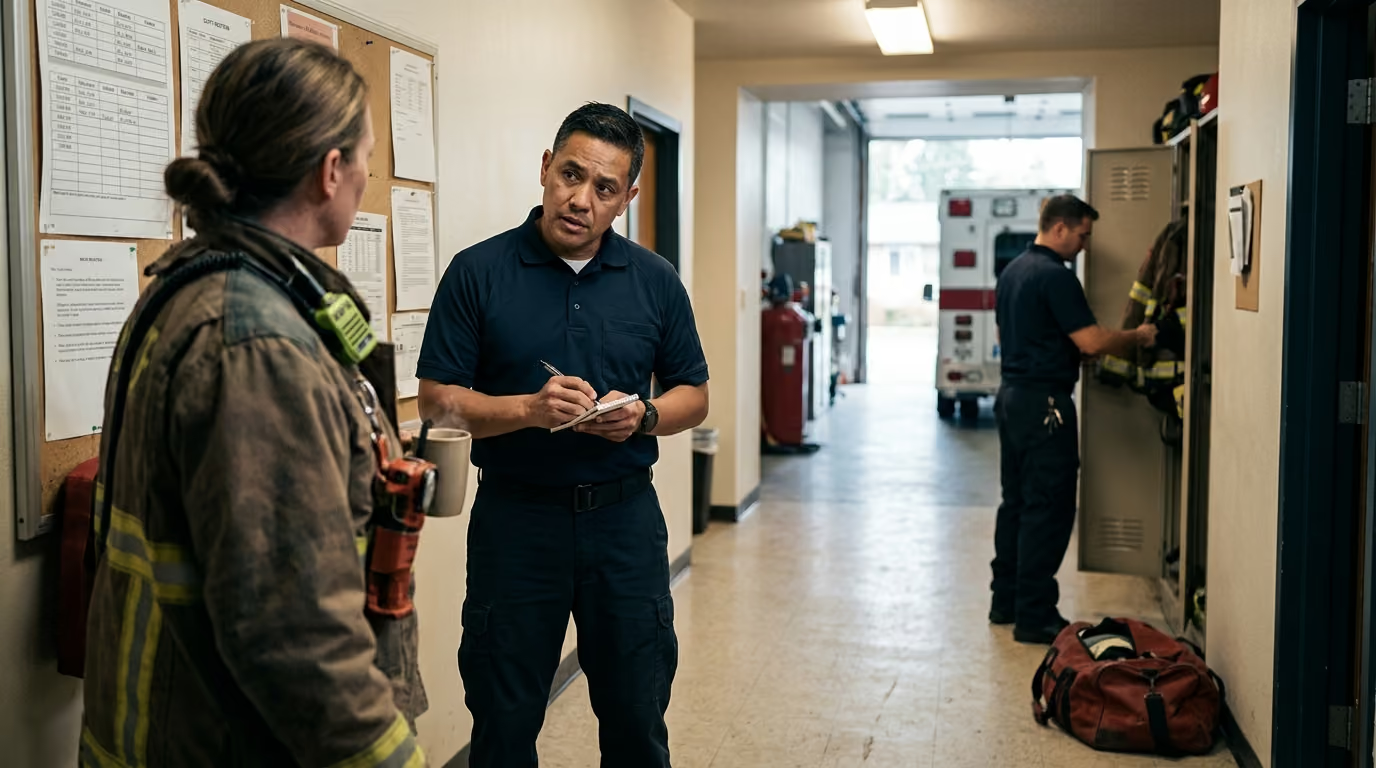

Three structured verification steps and disciplined radio habits enable emergency crews to overcome severe cognitive load and maintain seamless inter-agency team coordination.





High-stakes communication is an operational control system designed to transfer critical information, maintain shared situational awareness, and verify task execution under severe stress. It is not a generic soft skill, a collection of conversational tips, or an exercise in tactical jargon. In emergency services, verbal transmission serves as a direct safeguard against operational failure. When voice traffic breaks down, tactical coordination collapses, hazard identification fails, and the risk of injury rises. This guide provides an in-depth, research-backed blueprint for communication during high-stress operations, detailing closed-loop protocols, assertive advocacy, disciplined listening, cognitive load management, and inter-agency coordination.
In high-stress incidents, effective communication requires three clear actions. First, direct every transmission to a specific individual. Second, require explicit confirmation of understanding rather than passive silence. Third, report task completion immediately. When responders replace ambiguous broadcasting with structured, closed-loop interactions, operational errors decrease and team situational awareness remains intact.
Scientific research across emergency medicine, aviation, trauma resuscitation, and disaster response treats team communication as a core technical competency. The evidence indicates that unguided, spontaneous speech degrades rapidly when heart rates spike, cognitive demands surge, and environmental noise intrudes.
Observational data from interdisciplinary trauma teams highlights a stark gap between general talking and verifiable operational communication. In one trauma study, teams averaged roughly 20 communication outputs per event, yet they completed only 2.8 closed-loop interactions per event. Responders frequently transmit instructions without verifying whether the receiver heard, understood, or acted upon the message. The same research demonstrated that general, one-time trauma training did not increase closed-loop communication frequency. Crews that completed two or more structured courses used closed-loop protocols at more than three times the baseline rate. Structured, repeated habituation is necessary to override natural speech habits during crises.
Simulation studies in emergency healthcare environments reinforce these findings. When teams utilize directed closed-loop communication, verified task completion increases, and the rate of dropped operational requests drops significantly. When requests lack a specific name or explicit action, tasks are frequently forgotten or duplicated. In high-tempo environments, dropped requests create cascading operational delays.
Studies on geographically dispersed emergency teams, such as dispatchers and field paramedics, demonstrate that coordinating mechanisms directly drive team performance. A shared operational model among distributed responders improves situational awareness and overall team effectiveness. When personnel understand the overarching plan, they anticipate operational needs instead of waiting for commands.
Research on collective allostatic load confirms that communication breakdown acts as both a cause and a symptom of mental exhaustion. Studies examining physiological markers such as heart-rate variability show that high cognitive load reduces working memory. Under severe strain, responders drop confirmations, skip verbal read-backs, and make unwarranted assumptions. This lack of verbal confirmation forces colleagues to guess the status of the scene, driving up collective stress and accelerating operational failure.
To understand why communication fails on scene, responders must understand cognitive load. Working memory has a finite processing capacity. During routine conditions, a responder can take in environmental cues, process dispatch audio, monitor team movements, and formulate complex sentences simultaneously.
When an incident escalates, environmental stressors multiply. Extreme heat, flashing lights, siren noise, physical exertion, and immediate threats consume working memory. The physiological stress response shifts neurological resources away from language processing and toward immediate physical survival. Responders experience auditory exclusion, tunnel vision, and reduced information retention.
Under high cognitive demand, communication fails in predictable patterns:
These failures create a self-reinforcing cycle. When an officer sends an order and receives silence, they must expend mental energy wondering if the crew is safe, if the radio failed, or if the task is underway. This uncertainty increases the officer's cognitive burden. Managing speech discipline acts as a direct physical and mental buffer. Responders can use targeted practices like a quick grounding technique between calls to clear working memory, stabilize heart rate, and restore verbal focus before key transmissions.
Closed-loop communication is an operational protocol originally refined in military aviation, spaceflight, and trauma surgery. It replaces casual conversation with a reliable, three-step loop. The system verifies that information moves from the sender to the receiver without distortion, and that the requested action reaches completion.
The sender initiates the loop by addressing a specific person or unit. The message contains three components: the recipient's call sign, a clear action verb, and the specific target or location.
> Vague approach: "We need water on the second floor."
> Operational standard: "Engine 2 from Command, advance a 1.75-inch attack line to the second-floor hallway."
The receiver does not rely on generic acknowledgments like "Copy" or "Ten-four." While short codes acknowledge signal reception, they do not prove that the content was understood. The receiver repeats the core operational directive.
> Deficient response: "Copy that, Chief."
> Operational standard: "Engine 2 advancing a 1.75-inch attack line to the second-floor hallway."
If the transmission is garbled, contradictory, or incomplete, the receiver immediately seeks clarification rather than guessing.
> Clarification standard: "Command from Engine 2, confirm: second-floor hallway or the attic access stairwell?"
The sender confirms that the receiver's paraphrase matches the operational intent. Once confirmed, the receiver executes the task and provides a completion report when finished.
> Verification: "Command, affirmative."
> Completion Report: "Command from Engine 2, attack line is in position on the second floor; water is flowing."
A callout is a one-way announcement designed to broadcast an immediate hazard, situational milestone, or critical change to the entire team. Callouts make hazards visible across the scene. A closed loop assigns responsibility and confirms execution.
Emergency services rely on clear chains of command. When field conditions deteriorate, rigid operational hierarchy can prevent junior personnel from speaking up about critical safety threats. Responders may stay silent due to fear of reprimand, lack of confidence, or the assumption that senior officers know better.
In professional Crew Resource Management, assertiveness is defined as stating an operational concern clearly, respectfully, and persistently to protect personnel and mission success. It is not aggressive, argumentative, or insubordinate. It provides commanders with verified field data that might otherwise remain unseen.
The National Fallen Firefighters Foundation outlines a five-step sequence that provides a repeatable structure for stressed personnel:
> Operational Example:
> "Chief Miller, I have an urgent safety concern. The structural supports on the east wall are bowing, and mortar is crumbling around the header. I recommend we pull the exterior crew back twenty feet and set up an exclusion zone. Do you agree?"
This structured format removes personal judgment. It presents real-world observations and requests an operational decision.
When a critical safety hazard persists and an initial recommendation goes unacknowledged, responders use a two-challenge operational pattern.
> Challenge 1: "Captain, water supply pressure has dropped below operating levels. I recommend backing the interior line out to the doorway."
> Officer Response: "We just need two more minutes."
> Challenge 2: "Captain, we have lost pressure entirely at the nozzle and fire is rolling across the ceiling. We must withdraw immediately to avoid crew entrapment. Do you copy?"
Listening in emergency operations is a disciplined, active behavior rather than a passive pause between speaking turns. When cognitive load is high, undisciplined listening results in hearing only what one expects to hear. Responders filter out surprising or conflicting reports, creating dangerous blind spots.
A shared mental model exists when all crew members share a compatible understanding of six operational realities:
Disciplined listening requires differentiating between raw sensory observations, subjective inferences, and tactical recommendations. Confusing an inference with an observation leads to inaccurate decision-making.
When personnel present inferences as verified facts, incoming teams misjudge the scene. Responders must state what they actually observe before offering interpretations.
Clear communication requires disciplined restraint. Transmitting excessive background details ties up radio channels and overwhelms the working memory of receivers. Disciplined radio protocols adhere to the following priority hierarchy:
Responders should construct transmissions using a structured thought process: determine the core operational need, identify the specific recipient, state the required action, and release the push-to-talk button.
Large-scale critical incidents require police, fire, emergency medical services, public works, and dispatch centers to coordinate simultaneously. Inter-agency communication failures are a common vulnerability in major incident reviews. These breakdowns stem from divergent terminology, incompatible radio systems, and conflicting organizational priorities.
Ten-codes, numeric signals, and agency-specific slang create dangerous ambiguity during multi-agency operations. A code that means "officer needs immediate assistance" in one jurisdiction may mean "traffic stop" or "routine break" in another.
Under the National Incident Management System guidelines, all multi-agency communications must use plain language. Tactical directives must use direct terms that leave no room for interpretation across agency boundaries:
Dispatchers are the initial link in situational awareness. Because dispatchers and field crews are geographically separated, neither can see the other's physical environment. Dispatchers cannot see the smoke conditions or suspect movements, and field crews cannot see incoming caller updates on the computer-aided dispatch screen.
Field units must maintain strict closed-loop communication with dispatch, repeating addresses, unit identifiers, and hazardous updates. When dispatch transmits a dynamic update, the field unit must verify the key details rather than clicking the microphone.
> Dispatch: "Engine 1, updated information on the structure fire: caller reports two occupants trapped on the second-floor balcony."
> Field Unit: "Engine 1 copies, second-floor balcony, two occupants trapped. We are two minutes out."
When different agencies issue conflicting directives on scene, responders should avoid arguing over personal authority. Instead, address the conflict through unified command roles.
> Deficient response: "You cannot park there; fire owns this sector."
> Operational standard: "We have two conflicting assignments for this roadway. Fire needs this corridor clear for an incoming ladder truck, while Law Enforcement has designated it as an inner perimeter. Let us contact Unified Command to set the access priority."
This approach replaces personal friction with a structured focus on operational safety and role clarity.
To prevent communication breakdowns during complex operations, emergency teams use standardized communication templates. Standard templates reduce cognitive strain by providing a consistent structure for formatting complex data under stress.
For dynamic tactical shifts, the ORAC model organizes high-consequence updates into four clean steps:
> Model in practice:
> "Command to Division 2: (Observation) Fire has compromised the ceiling joists above your position. (Risk) Structural collapse is imminent. (Action) Evacuate all personnel to the exterior stairwell immediately. (Confirmation) Division 2, report when all members are accounted for at the landing."
Patient handoffs between field paramedics and emergency department staff, or tactical handoffs between arriving shift commanders, carry significant risk of information loss. Standardized handoff sequences keep critical details intact:
Using this disciplined sequence keeps transfers concise, structured, and focused on essential operational facts.
The physical demands of emergency response directly impact speech clarity, emotional control, and tactical performance. When responders operate under prolonged sleep disruption, extreme environmental heat, heavy physical gear, and chronic stress, interpersonal communication is among the first operational capabilities to fail.
Physical exhaustion narrows attention. A responder carrying heavy equipment while working at their physical limit experiences an elevated heart rate and rapid breathing. Under these conditions, the brain conserves energy by cutting out extra verbal steps. Personnel become short-tempered, stop acknowledging radio traffic, and make assumptions about team actions. Over a long shift, unresolved fatigue degrades clear thinking and speech discipline.
Protecting clear operational communication requires recognizing physical limits. Responders working irregular rotations must understand how shift timing and sleep disruption affect performance. When physical readiness deteriorates, speech becomes clipped, irritable, and imprecise.
Maintaining physical readiness through sustainable readiness training supports mental performance during long incidents. When a responder is physically conditioned for their gear and environment, tasks require less relative cardiovascular effort. This physical reserve leaves more working memory available for processing radio traffic, assessing hazards, and maintaining voice discipline.
When teams understand how physical strain degrades speech, they can adjust their communication habits during tough operations. Leaders can use shorter orders, insist on clear read-backs, and spot signs of exhaustion in a crew member's voice before critical errors occur. Supporting career longevity requires treating communication as an operational discipline that relies directly on sleep, physical recovery, and workload management.
Communication habits cannot be built through classroom lectures alone. Research confirms that one-time training fails to establish habitual closed-loop communication during live operations. Agencies must integrate communication protocols directly into practical skills training, live fire evolutions, scenario-based policing drills, and high-fidelity medical simulations.
Agencies can build communication skills through a structured, multi-phase training progression:
During training evolutions, evaluators must evaluate communication discipline alongside tactical outcomes. A drill where the fire was extinguished or the suspect was secured should still be evaluated for communication performance:
After-action reviews often overlook communication failures or reduce them to individual blame. Productive debriefs analyze the systemic conditions that caused communication to fail. Teams should evaluate their communications using six structured questions:
Focusing on communication systems rather than individual fault encourages honest reporting of near misses and builds team-wide operational resilience.
Implementing structured communication protocols carries practical trade-offs. Standardizing speech patterns improves clarity, but misapplying these tools can create new operational risks.
Closed-loop communication requires three steps for every message. In fast-moving mass-casualty incidents or rapid tactical entries, attempting to close the loop on minor details can overwhelm radio channels. When airtime is limited, personnel must prioritize high-consequence transmissions for closed-loop confirmation, using brief callouts for general updates.
Closed-loop communication is designed to verify understanding, not enforce unquestioning obedience. If conditions change and make an order dangerous, a responder must not simply repeat the directive and execute it. The receiver must use assertive communication to inform the sender of the new hazard before taking action.
> Deficient response: "Engine 3 copies, entering the basement." (While observing the floor has already collapsed).
> Operational standard: "Command from Engine 3, cannot comply with interior basement entry. The main floor has collapsed into the basement. We are holding at the exterior doorway."
Communication breakdowns are not always caused by flawed training. Persistent miscommunication, emotional outbursts, extreme withdrawal, or intense conflict can point to deeper issues. Chronic cumulative stress, sleep debt, burnout, or unaddressed psychological trauma can degrade cognitive function and emotional regulation.
When communication problems are driven by chronic exhaustion or trauma, practice drills alone will not solve the issue. Agencies should provide clear paths to peer support, operational psychologists, or licensed mental health professionals without stigma. Identifying when communication breakdowns stem from chronic nervous system strain allows teams to intervene early, supporting long-term health and operational readiness.
If a sender issues a critical directive and stops responding to radio calls, the receiver must not assume the plan remains unchanged. The receiver should broadcast their current operational status to incident command or adjacent units, state their immediate tactical action, and request a status check on the original sender. Never proceed into high-consequence environments based on an unverified, incomplete transmission.
When communicating with distressed civilians, avoid using technical jargon, complex multi-step instructions, or an aggressive tone. Use short, concrete directives containing an action verb and a clear direction: "Walk toward my voice," or "Sit on this step." Look directly at the individual, verify their comprehension through physical movement or a simple confirmation, and provide one step at a time.
In environments with high ambient noise, such as industrial facilities, pump panels, or heavy structural fires, voice transmissions become distorted. Responders should place the microphone directly against their neck or voice port, shield the mic from wind and rushing water, pause briefly after pressing the push-to-talk button, and speak slowly at a steady volume. Keep messages under ten words, and repeat critical numerical coordinates, such as floor numbers and sector letters, twice.
If an initial assertive challenge is ignored and conditions pose an immediate threat to life, the responder must escalate using the two-challenge pattern. State the hazard, explain the direct risk to the crew, and propose an immediate alternative. If the officer still fails to acknowledge the life-safety threat, agency safety rules should authorize personnel to take immediate protective action and notify the safety officer or incident commander.
Disciplined communication is an essential operational tool that coordinates action, protects personnel, and preserves situational awareness on the scene. By practicing closed-loop protocols, using structured assertiveness, and maintaining speech discipline under stress, first responders protect both tactical capability and long-term crew safety across their careers.
Stay connected for research-led guidance on duty fitness, shift-work sleep, injury recovery, stress, nutrition and career longevity. Practical ideas for first responders who want to stay capable on the job, recover well and protect their health for the long run.



Read practical guidance on first responder fitness, recovery, sleep, nutrition and resilience for demanding work and a long, active career.
read the blog



