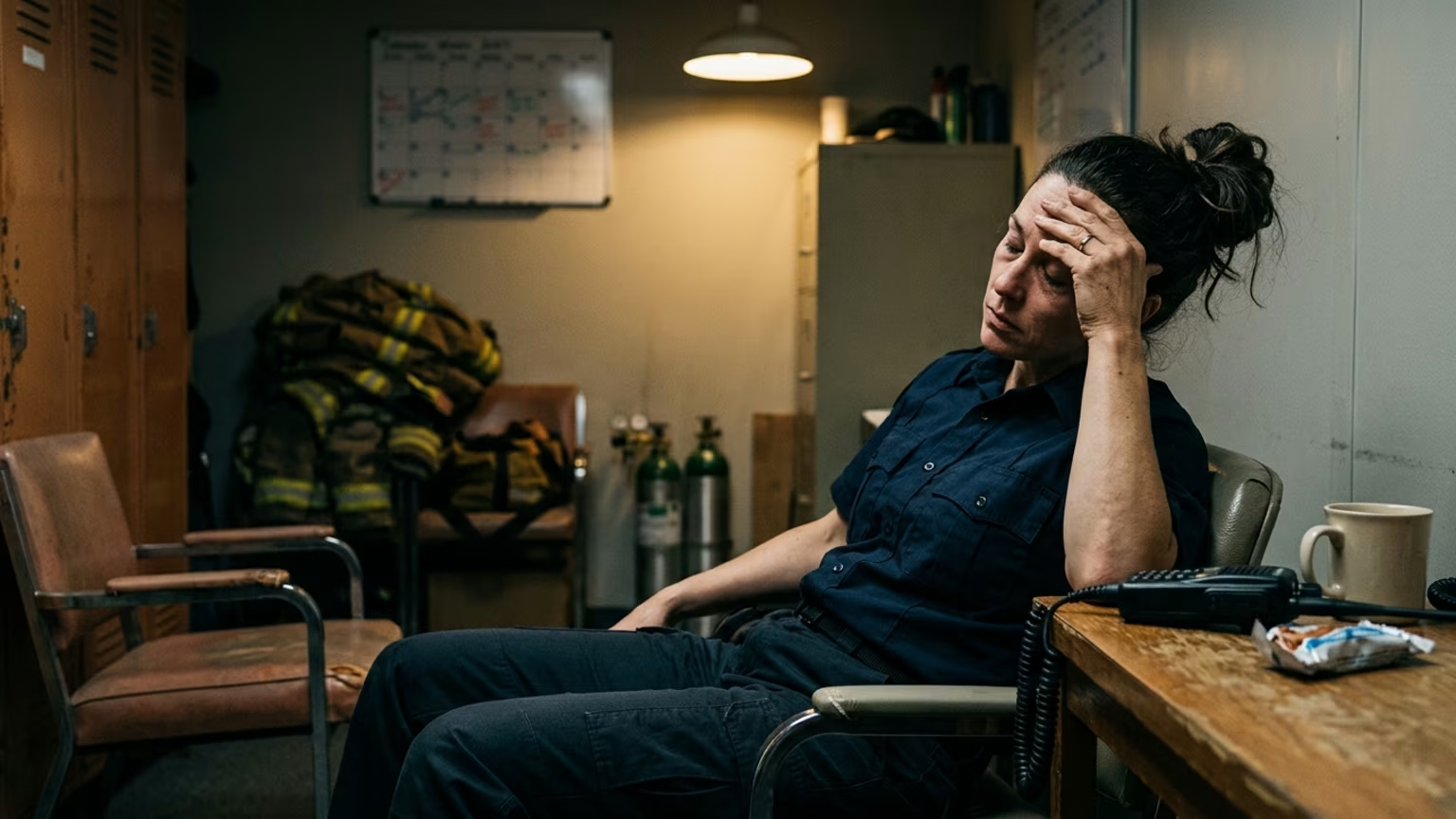

Shift-working first responders can use autoregulation, sleep data and perceived exertion to safely adjust training, prevent injury and sustain duty readiness.





Shift work creates a recovery deficit that separates emergency personnel from standard athletic populations. A responder might endure long tours, emergency call-outs, extreme heat and emotional stress before attempting a planned workout. Building a shift-specific sleep plan can help mitigate some of this damage, but the cumulative duty stress remains high. This reality makes traditional linear programming nearly impossible to maintain.
The Baltic firefighter study confirms that leaving recovery to individual willpower is a failing strategy. The study of more than 1,000 firefighters in Estonia and Latvia revealed stark physical consequences for shift workers. Researchers found that nearly 55% of the surveyed personnel were overweight or obese. Even more concerning, barely one in ten responders consistently felt well-rested.
More than half of those Baltic respondents also reported significant back pain. These statistics prompted researchers to recommend systemic changes rather than personal discipline alone. Researchers examining firefighters in Estonia and Latvia highlighted organizational solutions, including incorporating training and dedicated rest into the work shift. Leaving these critical elements entirely to individual firefighters often leads to burnout and injury.
Police officers face comparable, though structurally different, barriers to consistent recovery. Police officers commonly experience sleep disruption from shift work, overtime and court appearances. These pressures often compound with call-backs and rotating schedules. A day that looks like a day off on paper might involve significant residual stress.
This cumulative duty load means a seemingly poor recovery day reflects deep systemic fatigue. An officer handling a series of complex, high-stakes calls absorbs massive psychological load. This mental burden physically drains the body just as effectively as a heavy conditioning session. Recognizing this connection is the first step toward building a sustainable training routine.
These duty statistics directly translate into profound stress on the autonomic nervous system. When emergency personnel operate on insufficient sleep, their bodies compensate through increased physiological effort. A 2026 firefighter load-carriage study demonstrated how this fatigue alters movement and heart rate. The researchers observed that higher heart-rate reserve accompanied reduced cadence during prolonged loading.
The study also measured how the participants perceived this growing physical burden during their shifts. In the firefighter load-carriage study, RPE rose alongside physiological fatigue indicators. This supports its use alongside objective measures to determine readiness. The reported RPE rose from 2.7 ± 0.7 to 5.0 ± 0.7 in the compared conditions, confirming that subjective effort accurately reflects physical fatigue.
Wearable technology can provide valuable trend data when used in the proper operational context. However, a normal resting heart rate cannot cancel out the reality of severe physical sleepiness. Combining sleep metrics, perceived exertion, subjective mood and duty load provides the most accurate assessment. No single metric can replace the need for honest internal feedback.
When fatigue moves from acute tiredness to chronic impairment, the protocol must change. NIOSH-related guidance summarized in the search results says persistent insomnia, unintended sleep episodes or work-impairing sleepiness warrant clinical assessment rather than being dismissed as normal shift work. Dismissing severe, repeated sleep disruption as normal shift work ultimately threatens your career longevity and long-term health. Professionals must treat sleepiness as a critical safety factor.
Implementing these clinical insights directly improves daily operational safety. When crews ignore severe exhaustion, they compromise their situational awareness and reaction times. Protected recovery time helps restore the autonomic balance required for fast, accurate decision-making. True resilience comes from acknowledging biological limits, not from testing them continuously.
The 2026 longitudinal partnership between the Roswell, Georgia, Fire Department and Billings offers a practical case study. This project examined how an organizational schedule change influences both subjective and objective readiness. The study compared a 24/48 schedule beginning at 8:00 a.m. with a 48/96 schedule beginning at 11:00 a.m. By shifting the start time, the department aimed to improve overall personnel recovery.
The methodology of the Roswell project went far beyond simple departmental surveys. The study used wrist-worn sleep trackers and medical evaluations. It also employed daily surveys covering sleep, fatigue, mood and depression. This layered data collection prevented researchers from relying on a single, easily skewed metric.
The Roswell study explicitly collected daily data on fatigue, mood and depression alongside sleep measures. The results demonstrated measurable improvements in both sleep quantity and perceived rest. In this specific transition, the Roswell firefighters’ measured average sleep increased from 6.7 to 7.0 hours per night. Sleep on the night before a shift increased from 6.1 to 7.0 hours.
Additionally, self-reported total sleep rose by an average of 41 minutes per night. The subjective improvements in daily energy were equally significant for the department. Following the schedule change, the proportion reporting high fatigue fell from 40% to 10%. These findings confirm that organizational scheduling plays a massive role in baseline physiological readiness.
Organizational changes like the Roswell transition highlight the limits of individual willpower. A single responder cannot out-train a poorly designed shift rotation or chronic sleep deprivation. Departments that monitor fatigue actively provide a better framework for their personnel to succeed. This systemic approach validates the need for personal autoregulation when departmental changes lag behind.
Implementing autoregulation requires clear protocols that replace ego with objective decision-making. The first crucial step is to log duty load before you log gym load. Document overnight calls, prolonged incidents, extreme heat, overtime and commute disruption alongside your workout volume. This broader context helps explain why a familiar submaximal lift might feel unusually heavy today.
Before starting your session, run a short check of your subjective and objective signals. Record your sleep quality, perceived energy, mood, soreness and the planned session's anticipated difficulty. If these markers suggest fatigue, do not automatically cancel the workout. Instead, use a low-risk movement or submaximal set to test your coordination, breathing and perceived effort.
Apply a practical traffic-light framework to interpret these signals and guide your immediate training decisions. On a green day, your sleep is normal, your mood is stable and your warm-up feels crisp. You should keep hard training in the program when the evidence says you can absorb the work. Autoregulation does not mean avoiding difficult sessions when your body is fully prepared.
A yellow day occurs when one or more signals are mildly compromised, such as moderate soreness. On these days, you must train but modify the dose to protect your recovery. You can use a structured shift-work training decision tree to interpret these signals. This allows you to apply a minimum effective dose of training to maintain physical capability.
Changing one training variable is often the safest way to adapt a yellow-day workout. Reduce the weight, cut the total volume, move slower or stop farther from muscular failure. This controlled approach keeps you moving without pushing your nervous system into deep fatigue. You preserve technique and consistency without paying a heavy price tomorrow.
Periodic testing helps calibrate these daily decisions against a long-term fitness baseline. A fire-service review described the 20-metre shuttle run as a practical aerobic-fitness monitoring option. The review cautioned that estimates near cut-points can misclassify individuals. This test measures broad capacity, not your immediate daily readiness.
A red day requires immediate respect for severe physical or mental exhaustion. Symptoms like work-impairing sleepiness, illness, significant injury pain or extreme lethargy dictate full recovery. Pushing through a red day increases injury risk and delays your return to baseline readiness. You should preserve safety and use the time for light mobility, hydration and protected sleep.
True operational readiness requires treating sleep, fatigue and perceived exertion as critical data points rather than obstacles to be ignored.
Ignoring physiological readiness signals leads directly to chronic fatigue and physical breakdown, but replacing rigid programming with adaptable frameworks is exactly how Rescuris protects emergency professionals. Planning for physical capability and an active life after retirement or leaving service becomes attainable when responders apply our evidence-backed recovery systems. Explore Resources
Rescuris publishes evidence-aware guidance for firefighters, police officers, paramedics and other first responders on fitness, recovery, sleep, nutrition, stress resilience and long-term capability.






Read practical guidance on first responder fitness, recovery, sleep, nutrition and resilience for demanding work and a long, active career.
read the blog
