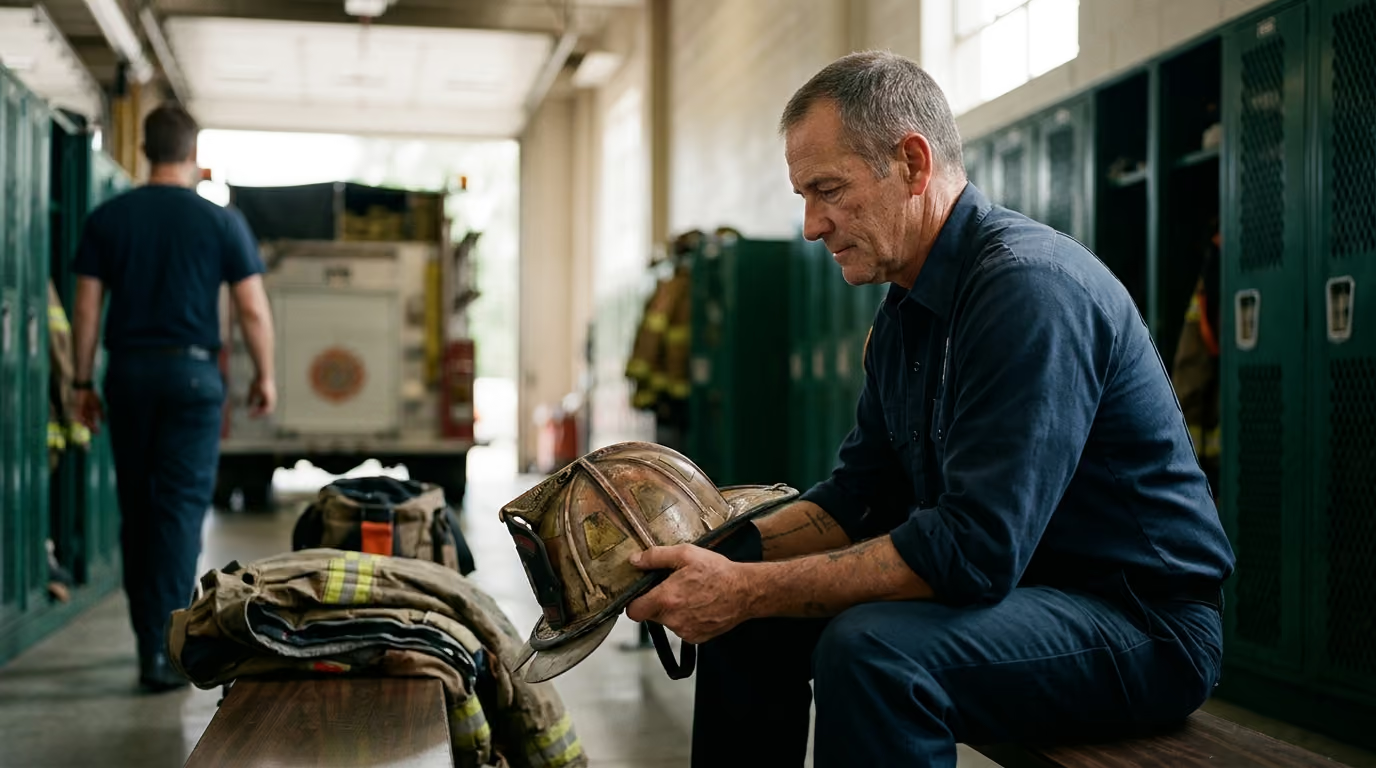

Four structured steps help retiring first responders capture operational experience, manage identity transitions, and share meaningful mentorship across their careers and communities.





If you are in immediate danger, call 911. For 24/7 support, call or text 988 and press 1 for the Veterans Crisis Line, or text 838255.
If you search for how to leave emergency service without losing your identity, you will find plenty of advice about pensions, healthcare benefits, and gym routines. You will find far less guidance on what to do with twenty or thirty years of hard-won judgment, specialized skills, and accumulated human experience. Many retirees wonder how to step away from the uniform without discarding the meaning of their career or remaining trapped in the past.
A post-service legacy is not defined by medals, rank, dramatic rescues, or career arrests. A durable legacy consists of the knowledge, ethical standards, relationships, and community benefits that continue after your operational role ends. Preserving that value does not require you to make emergency service your entire identity. It requires deliberate translation of your experience into forms that serve your family, your peers, and your community.
If you or someone you know is experiencing acute distress or thoughts of suicide, call or text 988 to reach the Suicide & Crisis Lifeline (press 1 for the Veterans Crisis Line), text 838255, or call 911 in an emergency. Professional behavioral health resources and peer support networks exist to help personnel navigate both career stress and post-service life.
Legacy represents the lasting effect of your life and work on other people, operational practices, institutions, and future generations. It is distinct from reputation. Reputation focuses on how colleagues or the public perceive you today. Legacy focuses on what continues to function, teach, or protect others long after you walk out of the station or precinct.
A meaningful legacy can take many shapes:
Meaning refers to the sense that your life is coherent, significant, and directed toward valued goals. Emergency response provides an immediate, external source of meaning through urgent calls, clear team roles, and public utility. When you leave the job, the environment no longer supplies an automatic daily mission.
Building a personal legacy allows you to reconstruct that purpose deliberately. You can review our career longevity and life after service resources to see how structured planning supports long-term purpose. Preserving your experience should never mean an obligation to stay permanently attached to emergency operations. Healthy legacy projects honor your past while giving you permission to develop a broader life.
Occupational identity describes the portion of your self-concept tied to your profession, organizational culture, uniform, and operational authority. In emergency services, this identity runs deep. First responders share physical risks, unusual working hours, dark humor, distinct terminology, and intense public accountability. When that career ends, you lose more than a paycheck. You lose a social circle, a predictable routine, and an environment where your competence was recognized without explanation.
Role residual occurs when you continue to identify with your former operational position after leaving active service. Role residual is normal and can preserve healthy pride, personal discipline, and enduring friendships. It becomes harmful when it keeps you from forming new interests, creates pressure to maintain an image of invulnerability, or dominates every personal interaction.
Researchers categorize the psychological shift out of uniform into three distinct stances:
The transition away from active duty often reveals unresolved physical and psychological wear. Evidence from the Centers for Disease Control and Prevention and the National Institute for Occupational Safety and Health demonstrates that public safety personnel face distinct behavioral health pressures from chronic stress, shift work, and traumatic exposures. NIOSH reports that law enforcement officers and firefighters face substantial suicide risks linked to occupational environments, while EMS professionals experience elevated suicide rates compared to the general population.
Separation from the job does not instantly erase accumulated stress. Research on retired personnel indicates that post-traumatic stress symptoms, depression, and anxiety can persist or become more prominent once the daily adrenaline of emergency calls stops. Programs addressing first responder behavioral health initiatives emphasize that transition planning must address mental health alongside financial security.
Retirement planning that focuses only on pensions and medical benefits fails to prepare responders for the psychological reality of separation. Maintaining purpose, managing role residual, and acknowledging mental health needs are fundamental components of career longevity.
To build a balanced legacy, you need an organizing model that prevents your past occupation from swallowing your present life. The Service, Self, and Society framework divides post-service contributions into three distinct areas.
The service domain covers what you learned and contributed within your professional field. This includes technical knowledge, crew safety standards, communication habits, and organizational memory.
Activities in this domain include:
The self domain focuses on your family, personal growth, and identity beyond the uniform. Emergency careers take a heavy toll on personal relationships, sleep, and domestic routines. This domain ensures your family understands the human being behind the badge or turnout gear.
Activities in this domain include:
The society domain translates your skills into broad civic benefit. Your abilities in logistical coordination, crisis de-escalation, public speaking, and team leadership are valuable across local civic life.
Activities in this domain include:
Balancing these three domains protects you from occupational fusion. When your post-service life includes personal reflection and community contribution, your self-worth no longer depends on whether active-duty crews remember your name.
Preserving experience requires a structured method. Without a clear process, attempts to share knowledge can turn into unstructured war stories or repetitive advice that alienates younger personnel. The Capture, Translate, Transmit, and Release model provides a systematic workflow for legacy projects.
The capture stage involves collecting raw material from your career without immediate judgment or editing. Gather physical artifacts, official records, training manuals, photographs, journal entries, commendations, and personal memories.
Focus on collecting:
Do not try to make the material polished during this stage. The goal is to build a private repository of memories and documents.
Raw operational experience is rarely useful on its own. Tactical specifics change as equipment, laws, and medical protocols evolve. The translate stage converts specific events into universal principles, questions, and safety frameworks.
To translate an experience, ask yourself:
This translation process strips away ego and graphic operational detail, leaving behind usable professional judgment.
The transmit stage delivers the translated lessons to your chosen audience using appropriate formats and clear boundaries. Different audiences require different methods of delivery.
Transmission formats include:
Always match the depth and tone of the material to the needs and emotional capacity of the recipient.
The release stage is the most difficult and necessary step in the process. Once you share your lessons, you must let go of control over how others apply them. Future generations will adapt your advice, discard what is outdated, and develop their own solutions to new problems.
Releasing your legacy means:
Legacy is a gift, not an administrative regulation. Once transmitted, your contribution belongs to the people who receive it.
There is no single correct way to build a legacy. Responders should select pathways that match their physical abilities, cognitive preferences, emotional readiness, and personal interests.
Mentorship allows you to transfer seasoned judgment directly to early-career or mid-career personnel. Effective post-service mentoring does not focus on telling dramatic war stories. It focuses on helping younger personnel develop independent reasoning, emotional durability, and sustainable operational habits.
Effective mentors focus on:
You can learn more about managing cumulative duty fatigue to help newer personnel balance training and rest. Avoid using mentoring sessions to complain about current administrative leadership or to demand that mentees copy your personal working style.
Family storytelling allows your spouse, children, and grandchildren to understand what your service meant without exposing them to graphic trauma. When first responders remain silent about their work, family members often fill in the blanks with imagined horror or assume emotional withdrawal was personal.
Use a structured format when sharing family stories:
Include stories of humor, station life, close friendships, and ordinary domestic routines. This ensures your descendants remember a complete person rather than an occupational stereotype.
Translating emergency experience into community prevention saves lives before 911 is ever dialed. Many retired responders find high satisfaction in shifting their focus from acute response to proactive public safety education.
Practical public education topics include:
Delivering public education through established civic or community groups provides structure and institutional backing without requiring operational deployment.
Writing forces clarity. It allows you to organize complex experiences into permanent, accessible resources for others. You do not need to write a commercial memoir to produce valuable written legacy material.
Valuable writing formats include:
Focus your writing on principles, systemic vulnerabilities, and decision-making under stress. Document what you got wrong and what you would do differently with modern training and perspective.
Oral history captures spoken accounts of departmental evolution, historic incidents, and workplace culture. These projects benefit significantly from including multiple perspectives, such as dispatchers, field crews, chief officers, and family members.
Essential guidelines for oral history projects:
Working with local historical societies, university libraries, or departmental historical committees ensures that audio files and transcripts are preserved in durable formats.
Your operational skills have wide value outside the emergency sector. Longitudinal studies on volunteering in older adults show that structured, values-aligned community engagement supports mental well-being, life satisfaction, and cognitive function. Research published in peer-reviewed journals demonstrates that regular volunteering correlates with lower depressive symptoms, reduced loneliness, and improved physical mobility in older populations.
Options for non-emergency civic contribution include:
Applying your skills in non-emergency settings reinforces your identity as an active, capable citizen whose value extends far beyond emergency response.
Legacy planning cannot assume that every responder leaves service voluntarily after a full, celebrated thirty-year career. Many separations occur abruptly under complex, painful circumstances that require specific adaptations.
Leaving the job due to physical injury, line-of-duty disability, organizational downsizing, or administrative conflict can produce intense grief, anger, and betrayal. Responders in this position often feel discarded by their agencies and alienated from active personnel.
If you faced an involuntary exit:
Your worth and the value of your career are not invalidated by an abrupt or unfair departure.
Some operational experiences involve profound trauma, systemic failure, or moral injury that should not be converted into casual stories or public educational material.
Managing sensitive material requires careful guardrails:
Preserving meaning does not require you to reopen wounds that compromise your present stability.
Many retired responders continue working as academy instructors, reserve officers, fire investigators, or union representatives. While this maintains professional connection, it carries the risk of prolonging occupational fusion and delaying healthy transition.
If you continue in a secondary operational role:
You can read our guide on career longevity strategies to learn more about maintaining long-term physical and mental balance.
Every legacy project must operate within strict legal, ethical, and clinical boundaries. Sharing operational experience carries responsibilities to the public you served, your former colleagues, and your own psychological health.
First responders routinely enter people's homes and lives during their most vulnerable, painful moments. Upholding public trust requires absolute protection of private citizen information in all written, spoken, and educational material.
Mandatory privacy rules include:
Ethical storytelling focuses on operational dynamics, human empathy, and decision-making, never on the private misfortunes of individual citizens.
Legacy work should support your personal integration, not re-expose you to debilitating occupational stress. Immersing yourself in past calls, reviewing fatal accident files, or recording hours of intense audio can trigger sleep disruption, irritability, or intrusive memories.
Maintain strict psychological guardrails:
Legacy projects should enrich your current life, not pull you backward into old stress responses.
To determine whether your legacy efforts are healthy and productive, evaluate your activities against objective personal, relational, and ethical standards.
Review your projects every few months using these questions:
If a project produces chronic frustration, isolation, marital strain, or emotional exhaustion, it has become an unhealthy obligation and should be paused or restructured.
Legacy work is a creative and personal practice, not a clinical treatment for post-traumatic stress, clinical depression, substance misuse, or severe anxiety.
Consider scheduling an evaluation with a licensed mental health professional if you notice:
Working with clinicians who understand first responder occupational culture ensures you process career experiences safely while building a healthy foundation for the future.
Preserving your experience does not require an immediate, massive commitment. You can begin building a balanced, sustainable legacy this week by taking small, deliberate steps.
True legacy is about sustainable capability and long-term health. By translating your experience into practical knowledge, you honor your years of service while ensuring your future remains purposeful, connected, and complete.
Stay connected for research-led guidance on duty fitness, shift-work sleep, injury recovery, stress, nutrition and career longevity. Practical ideas for first responders who want to stay capable on the job, recover well and protect their health for the long run.



Read practical guidance on first responder fitness, recovery, sleep, nutrition and resilience for demanding work and a long, active career.
read the blog



