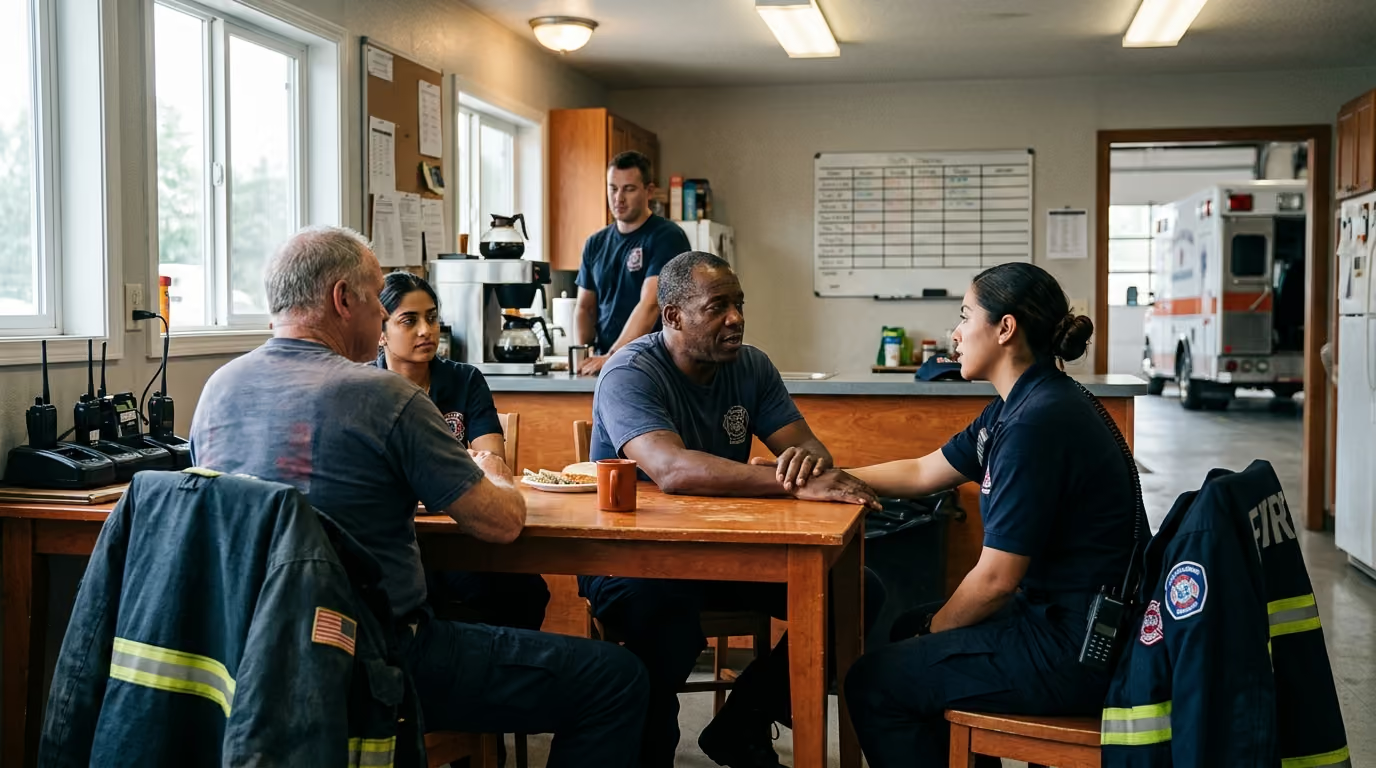

Debriefing with crew members after a critical frontline call requires clear boundaries and practical communication tools to ensure peer support remains safe and effective.





If you or a colleague are facing an immediate life-threatening emergency, call 911 or contact your local emergency dispatch immediately.
For confidential, 24/7 crisis support in the United States, call or text 988 to reach the Suicide & Crisis Lifeline. Military veterans and service members can press 1 or text 838255 to connect directly with the Veterans Crisis Line.
When safety concerns involve access to lethal means at home or in the station, work collaboratively with a trusted peer, family member, or licensed clinician to store equipment safely off-site or secure it in a locked location.
Peer support is a structured, relationship-based process where emergency personnel help colleagues process difficult calls, navigate cumulative stress, and access professional care when needed. It is not psychotherapy, clinical diagnosis, or an internal investigation.
A safe peer conversation requires five fundamental practices. First, establish rapport and listen without attempting to fix or judge the person. Second, explain confidentiality limits before sensitive details emerge. Third, ask directly about safety and suicidal thoughts whenever warning signs appear. Fourth, facilitate a warm referral to professional care instead of acting as the sole lifeline. Finally, maintain clear operational boundaries so the supporter remains grounded and effective.
Many emergency responders search for how to talk to a struggling crew member without making things worse, crossing professional boundaries, or triggering unwanted administrative consequences. This guide provides a definitive operational framework for holding safe, supportive, and legally sound conversations across fire, EMS, law enforcement, and dispatch environments.
Peer support functions as an operational bridge between everyday station culture and professional care. It builds on shared occupational language, mutual trust, and an understanding of frontline demands. Peer supporters are not clinicians. They do not diagnose conditions, prescribe medications, or conduct formal trauma processing.
Effective departmental wellness programs divide support into distinct operational tiers:
When peer support stays within its proper scope, it reduces isolation, helps responders process high-stress events, and speeds up access to medical or psychological services. Confusion occurs when a peer attempts to take on the role of a therapist, an investigator, or a supervisor. Maintaining strict role clarity protects both the person seeking help and the peer supporter.
Research into emergency responder mental health reveals significant occupational exposure to critical incident stress, sleep disruption, and chronic physical strain. Systematic reviews of public-safety personnel highlight elevated rates of post-traumatic stress, major depression, general anxiety, hazardous substance use, and sleep disturbances compared to civilian populations.
Data from the Substance Abuse and Mental Health Services Administration (SAMHSA) indicates that an estimated 30 percent of first responders develop behavioral health conditions, including depression and post-traumatic stress, compared to roughly 20 percent of the general public. Systematic review data synthesized by the Agency for Healthcare Research and Quality (AHRQ) identifies broad prevalence estimates across emergency services:
These statistics vary considerably based on branch of service, call volume, geographic location, years of service, and study design. For example, specific studies of emergency medical services personnel cited by SAMHSA report that up to 28 percent have experienced feelings that life was not worth living, with 10.4 percent reporting serious suicidal ideation. Exposure to suicide is also an occupational reality. Literature reviews indicate that between 31.5 percent and 95.0 percent of emergency professionals have responded to suicide calls during their careers.
The evidence base for organizational psychological interventions remains mixed. Systematic reviews demonstrate that mandatory, single-session critical incident stress debriefings do not reliably prevent post-traumatic stress disorder. In some instances, forced emotional processing immediately after a traumatic event can impede natural psychological recovery.
Current evidence supports multi-tiered systems that combine voluntary peer support, leadership engagement, confidential clinical pathways, and proactive education. Peer support programs are most effective when they do not claim to cure mental health disorders. Instead, their proven value lies in reducing stigma, offering early stabilization, and facilitating warm referrals to specialized clinical professionals.
Frontline emergency work creates unique physical, cognitive, and cultural barriers to emotional recovery. Standard wellness advice often assumes predictable nine-to-five schedules, low-stakes environments, and stable circadian rhythms. First responders operate under completely different operational realities.
Shift work, overnight shifts, and extended 24- or 48-hour rotations create chronic sleep debt. When crews operate under severe fatigue, emotional regulation and cognitive flexibility decline. The biological stress response remains constantly activated, making small interpersonal conflicts or distressing calls feel overwhelming. Navigating shift work and cumulative sleep debt is an essential baseline for psychological stability.
Emergency service cultures also cultivate an expectation of stoicism and control. Responders are trained to manage chaos, protect the public, and suppress their emotional responses on scene. While this emotional detachment is necessary during an active rescue or tactical operation, maintaining it indefinitely off duty leads to emotional isolation. Responders frequently fear that admitting distress will result in being pulled from duty, losing peer respect, or facing career penalties.
A peer supporter understands these realities because they share the same work environment. They know what it feels like to run back-to-back pediatric calls, manage physical exhaustion, and deal with organizational stress. This shared experience creates immediate credibility that outside clinicians often struggle to establish. Peer supporters can validate feelings without pathologizing normal human responses to abnormal events.
Building resilient organizations requires moving beyond individual toughness. When agencies integrate shared support systems and organizational resilience, seeking assistance becomes a standard operational decision rather than a sign of personal weakness.
Safe peer support conversations rely on structured, evidence-informed communication principles. Psychological First Aid models developed by the World Health Organization and disaster response agencies provide the operational foundation for peer interactions.
Psychological First Aid organizes supportive field interactions into three clear operational actions:
A peer conversation is a supportive dialogue between equals, not a clinical interview. Avoid opening conversations with clinical labels like "You seem depressed," "You have PTSD," or "You need therapy." Diagnostic language creates defensiveness and raises fears of career disruption.
Begin with grounded, observational statements:
Starting with genuine human contact builds trust. It gives the individual permission to share as much or as little as they feel comfortable discussing.
Traumatic calls and severe stress often strip individuals of their sense of agency and control. To counter this, peer supporters should offer choices wherever safety permits:
Autonomy must be respected, provided there is no imminent risk of harm to the person or others. If immediate danger exists, safety takes priority over personal preferences.
There is a critical difference between normalizing an emotional response and minimizing a person's pain. Normalizing reduces shame by framing reactions as natural human responses to extreme events. Minimizing dismisses distress and discourages honest disclosure.
Helpful normalization:
Harmful minimization:
A reliable guiding statement for any peer conversation is: "Your reaction is completely understandable, and it still deserves real support and attention."
To make peer conversations structured and repeatable under pressure, responders can use the seven-step CONNECT model.
Do not start an in-depth peer support conversation in front of an audience, in a busy dayroom, or while actively responding to an alarm. Sensitive conversations should never take place while someone is driving, armed, handling machinery, or managing emergency tasks unless an urgent safety intervention is required.
Select a neutral, private space where neither person feels trapped or observed. Confirm that both parties have the time to talk without immediate interruptions. Ask simple scene-setting questions:
Open the conversation by stating objective, observable behaviors rather than assumptions or diagnostic judgments. This approach keeps the person from feeling attacked and allows them to clarify what is happening.
Examples of observational openings include:
These observations ground the conversation in reality and show genuine care.
Use active listening skills to understand the individual's experience. Keep your focus on their narrative rather than jumping in with your own stories or solutions.
During this stage, listen for functional impairment. Pay attention to changes in sleep patterns, appetite, concentration, driving habits, alcohol consumption, social isolation, and irritability. You can also encourage brief grounding techniques between calls to help regulate breathing and lower acute nervous system arousal during the discussion.
Once the person has shared their story, clarify their immediate safety and emotional needs. A peer supporter must never shy away from direct questions regarding self-harm or suicide.
Research from the National Institute of Mental Health (NIMH) demonstrates that asking directly about suicide does not increase suicidal thoughts or cause someone to act. Asking directly provides relief, cuts through isolation, and opens the door for lifesaving intervention.
Ask clear, direct questions without hesitation:
If the person denies suicidal ideation, explore other immediate needs:
Collaboratively determine the next step based on the person's current level of distress and risk:
Never leave a referral as an open-ended suggestion. Do not say, "You should call someone sometime." Instead, offer to sit together while making the call, assist with navigation, and make the referral an active handoff.
Explain the exact boundaries of confidentiality before sensitive personal details are shared. Transparency builds trust and prevents misunderstandings later on.
A professional confidentiality script covers three elements:
Explaining these boundaries upfront demonstrates professionalism and respect for the responder's autonomy.
Follow-up provides accountability, prevents isolation, and ensures that support does not end when the conversation wraps up. Follow-up is not surveillance. It is a genuine demonstration of ongoing support.
Establish concrete next steps:
Closing the loop gives the responder a clear safety net and lets them know they are not alone.
Confidentiality is the cornerstone of effective peer support, but it is never absolute. Clear ethical and legal limits exist to protect life and safety. Misunderstanding these limits creates significant liability for peer teams and puts vulnerable responders at risk.
Within a structured peer support program, confidentiality guarantees that discussions are private and not shared with supervisors, administration, human resources, or colleagues. Notes should be kept to an absolute minimum, containing only basic logistical data like dates and referral types, with zero identifiable clinical or personal details.
Peer supporters must never promise total secrecy. Absolute secrecy is illegal and unethical when immediate danger is present. Peer supporters cannot keep secrets regarding:
When an escalation is legally or operationally required, the peer supporter should inform the individual directly whenever it is safe to do so. For example: "I care about your life too much to keep this secret. Because you have a plan and intend to end your life today, we need to get crisis professionals involved right now. I will stay with you while we contact them."
Legal protections for peer support confidentiality vary across states, provinces, and municipalities. Some jurisdictions grant statutory privilege to designated peer supporters, while others offer limited administrative protection under departmental policy. Agencies must consult qualified legal counsel and labor representatives to establish clear, written standard operating procedures for their peer teams.
Peer supporters do not diagnose mental health disorders, but they must recognize behavioral warning signs and know when to escalate care. Evaluating risk is about assessing immediate safety, functional capability, and access to means.
Pay close attention when an individual exhibits combinations of the following signs:
To guide decision-making, peer supporters can use a simple color-coded escalation framework:
A referral fails when a peer supporter simply hands someone a brochure or phone number and assumes the job is done. Fatigued and distressed responders rarely make cold calls to unfamiliar services. Stigma, logistical hurdles, and fear of the unknown often stop them from reaching out.
A warm handoff bridges this gap through active, guided connection.
Not all mental health clinicians understand the realities of emergency response work. Referring a firefighter, police officer, or paramedic to a provider who is shocked by graphic stories or unfamiliar with shift schedules can backfire.
When vetting clinicians for departmental referral lists, verify that they:
Connecting responders with culturally competent clinicians builds long-term confidence in departmental wellness systems.
Building a sustainable peer support program requires clear organizational architecture, clinical oversight, and strong protections against peer burnout. Without clear systems, well-intentioned peer teams often struggle or collapse.
Peer supporters should be selected based on their interpersonal reputation, emotional stability, discretion, and ability to hold firm boundaries. Personnel should never be assigned to peer teams simply because of rank, administrative convenience, or past personal trauma.
Core training curriculum must cover:
A peer support program must never operate in clinical isolation. Every trained peer team requires an assigned, licensed mental health clinician who acts as a clinical director or advisor.
This clinician provides regular, confidential case consultation, reviews complex or challenging interactions, and offers guidance on difficult referrals. The clinical advisor also monitors the peer team for signs of vicarious traumatization and compassion fatigue.
Peer supporters carry a heavy emotional load. Because they are trusted and accessible, colleagues often reach out to them during off-duty hours, leading to disrupted recovery time.
To protect peer supporters and promote long-term career longevity, programs must establish operational boundaries:
Taking care of the peer team ensures that the department's support system remains strong, reliable, and effective over the long haul.
Safe peer support conversations protect operational readiness, strengthen crew cohesion, and save careers and lives. Integrating structured communication, clear confidentiality rules, and warm referral pathways transforms good intentions into dependable, lifesaving peer support.
Use this checklist to apply these principles over the coming week:
Stay connected for research-led guidance on duty fitness, shift-work sleep, injury recovery, stress, nutrition and career longevity. Practical ideas for first responders who want to stay capable on the job, recover well and protect their health for the long run.



Read practical guidance on first responder fitness, recovery, sleep, nutrition and resilience for demanding work and a long, active career.
read the blog



