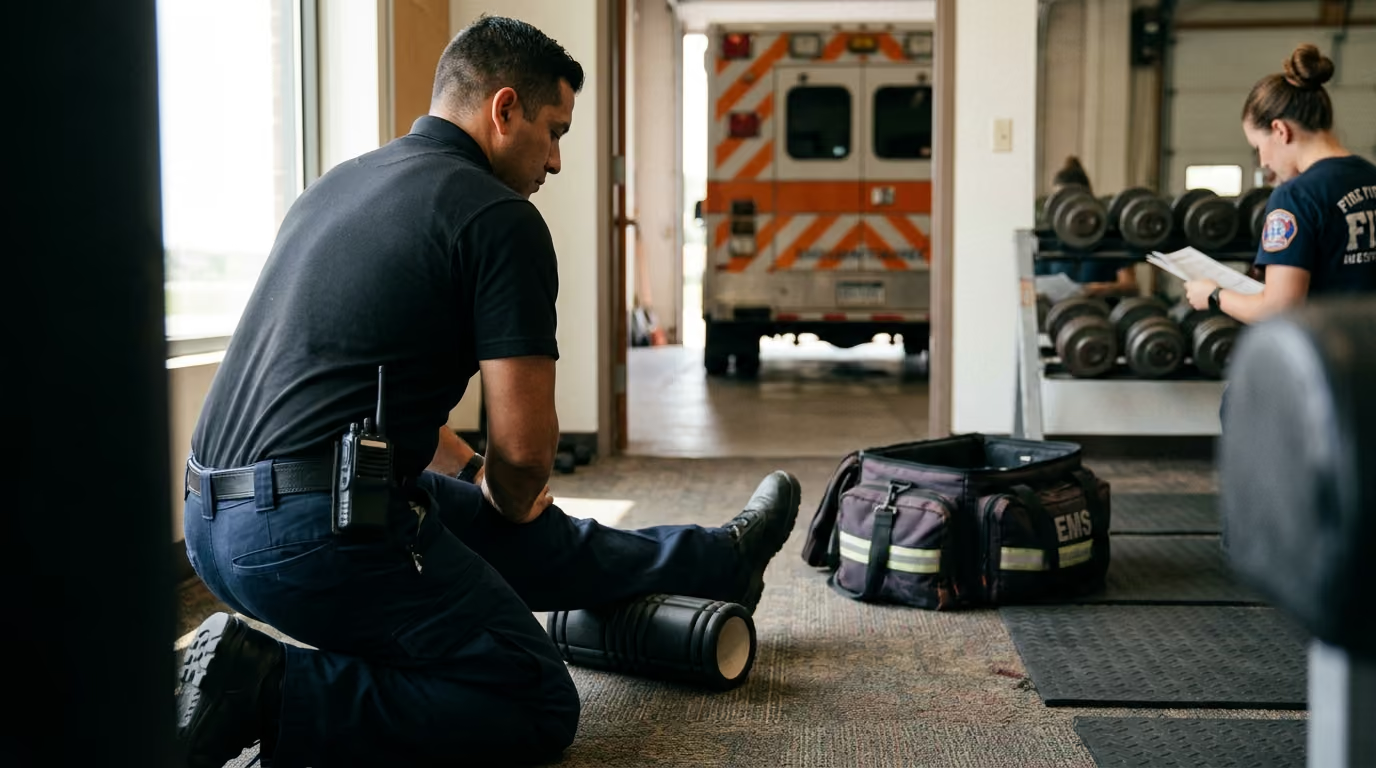

Returning to full duty after a severe musculoskeletal injury requires a four-stage framework that bridges basic medical clearance and demanding operational performance.





You have completed physical therapy, your physician signed the return-to-work slip, and your joint feels quiet during normal daily routines. Then your crew gets dispatched to a difficult residential extraction involving a bariatric patient on a narrow staircase. You find yourself bracing awkwardly, hesitating to load the limb, or feeling a familiar ache re-emerge twelve hours after the shift ends.
This gap between being cleared for work and possessing genuine operational durability is where most reinjuries take place.
Returning to full duty after a musculoskeletal injury requires far more than symptom relief or a standard clinical release. A safe return requires restoring absolute strength, matching tissue capacity to unpredictable emergency tasks, rebuilding movement confidence, and proving tolerance to repeated physical stress under fatigue. True reinjury prevention treats clearance as the midpoint of a continuum, continuing through structured job exposure, systematic self-monitoring, and dedicated physical maintenance across a career.
Occupational physical demands place extraordinary stress on the musculoskeletal systems of emergency personnel. Research shows that musculoskeletal disorders represent a major source of lost time, early retirement, and physical limitation across the emergency services. A comprehensive systematic review and meta-analysis estimated the overall prevalence of musculoskeletal disorders among firefighters at 46.39 percent. In that analysis, low back complaints were the most prevalent at 34.32 percent, followed by knee problems at 19.97 percent and shoulder issues at 18.68 percent.
Overexertion remains one of the primary mechanisms behind these conditions. Surveillance data demonstrate that lifting, carrying, pushing, and pulling external loads are leading causes of duty-related sprains and strains. These events frequently involve sudden, unpredictable forces, such as a struggling patient, a shifting hoseline, or unstable footing during dynamic operations.
Returning to work after an injury does not guarantee that a responder has regained full operational capacity. In a study examining first responders with musculoskeletal or mental health conditions, 89.6 percent returned
to work within the observation window, but only 67.2 percent returned to their unrestricted pre-absence duties. This gap highlights the frequency with which emergency workers return to modified assignments or resume full duty with residual physical deficits.
Evidence regarding general fitness testing presents another layer of complexity. Systematic reviews have found limited evidence directly connecting standard fitness test scores to reduced occupational injury risk. Aerobic fitness does demonstrate a moderate correlation with lower injury rates, yet isolated physical tests rarely capture the chaotic, multi-planar demands of field operations. Rehabilitation must target the absolute capacity and task-specific exposures required by actual field assignments.
Prognostic research confirms that successful recovery depends on both physical and psychological factors. Systematic reviews examining return-to-work outcomes demonstrate that recovery expectations, fear-avoidance beliefs, coping strategies, and structured work accommodations strongly influence long-term success. Addressing movement apprehension is just as critical as rebuilding joint stability and muscle mass.
Administrative clearance is binary, while physical capability exists on a continuum. Most occupational medical clearances confirm that acute tissue healing has taken place, baseline mobility is adequate, and resting pain has resolved. These criteria verify that an individual is safe to perform basic daily activities without causing immediate damage.
Emergency operations do not consist of basic daily activities. They require sudden maximal strength efforts, awkward joint postures, external equipment loads, and prolonged physical output under heat or cardiovascular fatigue. To structure a durable return, departments and individual responders should view recovery through four distinct milestones.
The primary objective during this initial phase is excluding serious structural pathology, managing inflammation, and restoring resting joint mechanics. Medical recovery is reached when acute tissue injury has stabilized and basic unloaded movement is tolerated. Passive interventions and gentle active range of motion dominate this phase, but they do not build capacity for operational tasks.
Functional recovery restores the underlying physical capacities that support normal movement patterns. This includes rebuilding local muscular endurance, joint mobility, single-leg balance, and baseline strength. Responders achieve functional recovery when they can execute symmetrical gym-based movements, such as unloaded squats, hinges, lunges, and presses, with good technique and zero symptom escalation.
This milestone bridges clinical exercise with occupational performance. Operational readiness demands that the responder can perform essential job functions while wearing protective equipment and handling awkward external loads. The responder must demonstrate competency during tasks such as dragging a weighted mannequin, carrying equipment up stairs, or working from awkward kneeling positions.
The final milestone reflects the reality of shift work. Performance resilience means a responder can complete multiple physically demanding calls or training evolutions across an entire tour without compensatory movement or delayed symptom flares. It incorporates cardiovascular fatigue, sleep debt, and repeated exposures, ensuring that the repaired tissue tolerates real-world duty cycles.
Emergency service work creates an unpredictable physical loading environment. A paramedic or police officer may spend four consecutive hours seated in a vehicle, only to immediately sprint, vault an obstacle, or perform a maximal floor-level lift. This transition from sedentary resting states to sudden explosive demands places exceptional stress on tendons, ligaments, and spinal structures.
Equipment weight significantly alters baseline biomechanics. Firefighters wear structural turnout gear and self-contained breathing apparatus weighing fifty pounds or more. Police officers carry duty belts and body armor that place continuous asymmetrical loads on the lumbar spine and pelvis. Adding external gear increases joint reaction forces, shifts the body's center of mass, and accelerates physical fatigue during routine tasks.
Environmental heat and cardiovascular strain further degrade motor control. During interior structural firefighting or extended tactical operations, core body temperatures elevate rapidly. As core temperature climbs and central nervous system fatigue accumulates, fine motor coordination and joint stabilization deteriorate. Movements that were performed with crisp mechanics during early morning hours can become uncoordinated and hazardous near the end of a shift.
Cumulative duty fatigue and interrupted sleep impair musculoskeletal recovery. Shift work disrupts circadian rhythms, blunts tissue repair, and reduces systemic tolerance to mechanical load. When a responder returns to work without fully developed work capacity, this background fatigue amplifies reinjury vulnerability. You can explore how shift timing interacts with physical capacity in our guide on training around shift work.
A systematic progression ensures that an injured responder does not advance to high-risk tasks before establishing foundational tissue tolerance. Jumping directly from light clinical exercise to unrestricted emergency duty creates an abrupt spike in workload that frequently triggers recurrence.
The opening stage identifies the precise tissue involved and addresses the factors that contributed to the breakdown. Complete immobilization is avoided whenever clinically safe. The objective is to maintain cardiovascular conditioning, protect the injured site from excessive strain, and introduce pain-free active movement.
Cross-education and training the uninjured limbs can preserve neural drive and reduce systemic deconditioning. Low-load isometric contractions are introduced early to maintain muscle activation and manage local tendon pain. General upper body or lower body conditioning continues using unaffected limbs and non-impact cardiovascular modalities.
Once resting symptoms stabilize and basic movement is restored, the focus shifts to building structural capacity. This stage develops multi-planar joint strength, local muscular endurance, single-leg stability, and trunk stiffness. Isolated exercises advance toward compound, closed-kinetic-chain movement patterns.
Training in this stage focuses on controlled tempos, progressive resistance, and symmetrical movement execution. Responders build baseline strength across the hinge, squat, lunge, push, pull, and carry patterns. Cardiovascular conditioning intensifies to re-establish aerobic capacity, which serves as the primary engine for recovering between repeated physical efforts on duty.
Stage 3 transitions the responder from standard athletic gym movements to the exact postures, forces, and tools required on duty. This process uses a structured exposure ladder that gradually increases task complexity.
The final stage evaluates how well the responder tolerates repeated physical work across simulated shifts or modified duty tours. Rather than assessing a single, isolated maximal test, Stage 4 evaluates work capacity over time.
The responder completes multiple job-specific circuits with realistic recovery intervals between bouts. Clinicians and strength coaches evaluate movement quality to confirm that mechanics do not degrade under fatigue. If the responder completes these exposures without next-day symptom flares or compensatory limping, unrestricted operational clearance can be finalized.
Rehabilitation should not be considered complete simply because a predetermined number of weeks have passed. Objective discharge criteria must evaluate impairment resolution, task performance, and biological recovery response.
Impairment criteria verify that the underlying joint and muscle structures have recovered adequate physiological capacity. These include:
For tendon-related conditions, resolving resting pain is insufficient. Tendon healing requires restoring local muscle strength, tendon stiffness, and the ability to absorb and release elastic energy without reactive thickening.
Task criteria confirm that the individual can execute physically demanding emergency scenarios safely. Essential task benchmarks include:
How a responder feels immediately after completing an exercise test provides only half the story. The biological response over the subsequent 24 hours indicates whether the applied load exceeded current tissue tolerance.
During progressive loading evolutions, pain during activity should remain mild to moderate, generally not exceeding a 5 out of 10 rating. Symptoms should return to baseline levels within a few hours and must completely resolve by the next morning. Next-day morning stiffness, persistent throbbing, altered gait, or joint warmth indicates that the training volume or intensity was too high and must be adjusted before the next exposure.
Limb symmetry testing is widely used in rehabilitation to evaluate readiness after lower or upper extremity injuries. The Limb Symmetry Index calculates performance by comparing the involved limb against the uninvolved limb using a simple formula:
$$\text{LSI} = \left( \frac{\text{Involved Limb Score}}{\text{Uninvolved Limb Score}} \right) \times 100$$
A score of 90 percent or higher is traditionally treated as a standard passing threshold in return-to-sport and return-to-work evaluations. Relying solely on this metric creates dangerous blind spots for emergency responders.
The uninjured limb frequently undergoes deconditioning while the responder is off duty or on restricted activity. If the healthy leg loses fifteen percent of its strength during a prolonged recovery window, the injured leg may easily achieve a 90 percent symmetry index while remaining substantially weaker than its pre-injury baseline. Research shows that symmetry indexes can overestimate functional recovery and fail to distinguish individuals who safely return from those who sustain secondary injuries.
A first responder whose legs are equally weak is symmetrical, but they remain an operational liability on the fireground or street. Symmetry must always be evaluated alongside absolute strength standards, body-mass-relative force production, rate of force development, and task-specific endurance. Symmetrical scores should be viewed as an entry-level clearance screen rather than a guarantee of operational resilience. You can read more about structured progression in our overview of duty fitness programming.
Physical tissue healing does not automatically restore psychological confidence. Following a traumatic joint dislocation or severe lumbar spasm, responders frequently develop protective movement patterns. They may subconsciously brace their spine, shift weight away from an injured knee, or avoid extending an arm during forceful actions.
Fear-avoidance beliefs occur when an individual views pain as a sign of ongoing tissue damage rather than a manageable sensation during rehabilitation. Responders who hold high fear-avoidance beliefs are more likely to experience prolonged disability and compensatory movement. Conversely, some responders exhibit excessive confidence, rushing through rehabilitation milestones and concealing symptoms to protect their standing within a crew or avoid the perceived stigma of modified duty.
Rebuilding psychological readiness requires systematic, graded exposure to feared positions. If a firefighter fears lumbar flexion during heavy lifts, rehabilitation must systematically reintroduce controlled spinal flexion under light loads, progressing toward dynamic, awkward carries. Successfully navigating these controlled exposures proves to the central nervous system that the tissue is capable of handling load, extinguishing fear-based protective mechanics before the responder encounters an emergency.
Different anatomical regions present distinct failure patterns under operational stress. Return-to-performance protocols must address the specific mechanics, common breakdown points, and exposure progressions unique to each area.
Lumbar spine injuries represent the single largest category of musculoskeletal lost time in emergency services. Back injuries rarely occur from pure, symmetrical lifting in ideal gym environments. They happen when a responder combines spinal flexion, lateral bending, axial rotation, and unexpected movement while handling a patient or heavy tool.
Rehabilitation must move past simple floor exercises and build dynamic, multi-planar trunk stiffness. Initial training establishes isometric trunk endurance across the anterior, posterior, and lateral musculature. The progression moves quickly to hip-hinge mechanics, loaded carries, and offset lifting where the center of mass changes dynamically.
Final clearance requires demonstrating tolerance to awkward floor transfers, bariatric stretcher maneuvers, and heavy carries while maintaining breathing control under cardiovascular strain.
The shoulder complex operates under extreme leverage during emergency operations. Firefighters repeatedly work with arms elevated overhead to pull ceiling or vent roofs, while paramedics manage awkward lateral reaches to secure equipment or assist patients in confined spaces.
Rehabilitation must develop rotator cuff endurance and scapular upward rotation under fatigue. Early stages focus on isolated cuff strength and closed-chain stability drills. Progressions introduce heavy pulling, overhead carries, and unilateral pushing from stable stances.
Operational testing must verify that the responder can control tools at full arm extension, manage sudden traction forces from charged hoselines, and endure repeated overhead work while wearing structural turnout gear.
Knee complaints among first responders frequently involve the patellofemoral joint, meniscus, or ligamentous structures. Operational breakdowns occur during rapid stair descents, awkward kneeling on hard surfaces, sudden direction changes on wet pavement, or slips on unstable debris.
Knee rehabilitation must prioritize unilateral deceleration capacity and eccentric quadriceps control. Programs advance from bilateral squats to deep step-downs, walking lunges, and single-leg landing drills.
Testing must assess the responder's ability to descend stairs under load, rise from prolonged kneeling postures without hand assistance, and execute sudden pivot maneuvers on slick surfaces while wearing duty footwear.
Lateral ankle sprains are among the most common acute field injuries. Responders frequently navigate broken ground, wet grass, curbs, and cluttered interior spaces in low-light conditions.
Rebuilding ankle stability requires restoring full closed-chain dorsiflexion, peroneal reactive strength, and calf complex endurance. Balance training must advance from barefoot clinic floors to wearing heavy duty boots on unstable, uneven surfaces.
Responders must demonstrate stable single-leg landings, rapid lateral cutting, and safe stair descents while carrying external gear before returning to active duty.
Tendon problems, including patellar, Achilles, and common extensor tendinopathies, demand a unique management approach. Tendons adapt to mechanical load slowly, and prolonged rest weakens their load-bearing capacity.
Rehabilitation follows a progressive loading model consisting of heavy isometric holds for pain reduction, followed by heavy slow resistance training to rebuild tendon stiffness. Energy storage drills and plyometrics are introduced only after base strength is established.
Responders must monitor next-morning stiffness and pain levels closely, ensuring that cumulative shift workloads do not provoke reactive tendon swelling. More detailed concepts on tissue recovery can be found in our resource on injury recovery frameworks.
Examining common failure patterns helps illustrate how gaps in rehabilitation lead to reinjury during field operations.
A paramedic completes eight weeks of therapy following a lumbar disc irritation. They are discharged after demonstrating a symmetrical 135-pound trap-bar deadlift in running shoes. On their third shift back, they assist in lifting a bariatric patient from a confined bathroom space while bent and rotated over a toilet, experiencing an immediate acute spasm.
A firefighter returns after a rotator cuff strain having achieved normal range of motion and good resistance-band strength in isolated testing. During an interior fire attack, they experience severe anterior shoulder pain and loss of control while using a pike pole to pull drywall overhead for five consecutive minutes.
An officer passes return-to-work testing after an ankle sprain with a 94 percent Limb Symmetry Index on single-leg hopping tests. However, because both limbs deconditioned during eight weeks of restricted duty, absolute calf strength and reactive stability remain forty percent below pre-injury levels. During a foot pursuit across an uneven lawn, the ankle rolls again.
An emergency medical technician with patellar tendinopathy rests for four weeks until knee pain drops to zero. They return to full duty and feel great during their first shift, but by the third consecutive 12-hour shift involving repeated stair climbs, severe knee stiffness and pain return.
A durable return to performance does not conclude when a responder works their first unrestricted shift. Musculoskeletal capacity begins to decline if dedicated physical loading is discontinued. A lifelong maintenance program serves as continuous operational risk management.
Responders should maintain two to three focused strength sessions per week, prioritizing compound movements, unilateral single-limb stability, and multi-planar core endurance. Cardiovascular training should preserve a solid aerobic base to ensure rapid recovery between emergency calls. Practical frameworks for organizing training around operational realities are detailed in our guide on minimum effective dose training for emergency personnel.
Individual self-monitoring ensures that subtle physical deficits are addressed before becoming full injuries. Responders can track their status using a simple three-tier traffic light system:
Departmental policies strongly shape long-term recovery outcomes. Agencies should provide transparent modified-duty programs, access to experienced occupational physical therapists, and clear reporting pathways that do not penalize responders for addressing minor symptoms early. Creating a culture where physical maintenance is supported protects career longevity and preserves department readiness across generations of responders. For additional context on sustainable service, review our resources on first responder career longevity.
Rehabilitation frameworks provide structured guidance, but they cannot replace individualized medical judgment. Every injury involves unique anatomical, physiological, and environmental factors that require customized management.
Responders must never train through sharp joint pain, sudden catching, dynamic instability, or progressive neurological deficits such as numbness, tingling, or radiating weakness. Forcing high-intensity loading onto an unhealed fracture, high-grade ligament tear, or acute tendon avulsion can turn a manageable condition into a career-ending injury.
Returning to emergency duty while impaired by pain medications, sleep-depriving pain, or uncorrected physical deficits endangers not only the individual responder but also their partner, their crew, and the public they serve. When in doubt, prioritize systematic capacity testing over arbitrary timeline pressures.
Self-management and progressive exercise are powerful tools, but certain signs demand comprehensive evaluation by a licensed healthcare professional, such as a sports physical therapist, orthopedic physician, or occupational medicine specialist.
Schedule a clinical evaluation if you experience:
A qualified clinician can establish an accurate diagnosis, rule out serious underlying pathology, provide objective strength measurements, and build a customized return-to-performance progression tailored to your specific operational role.
Revisit this reference whenever you are recovering from an acute physical setback, transitioning from modified duty back to the field, or planning an off-season training progression to address chronic movement restrictions.
True career longevity in emergency services is built on the daily discipline of maintaining physical capacity, respecting biological recovery, and ensuring that every return to the field is supported by proven operational performance.
Stay connected for research-led guidance on duty fitness, shift-work sleep, injury recovery, stress, nutrition and career longevity. Practical ideas for first responders who want to stay capable on the job, recover well and protect their health for the long run.



Read practical guidance on first responder fitness, recovery, sleep, nutrition and resilience for demanding work and a long, active career.
read the blog



