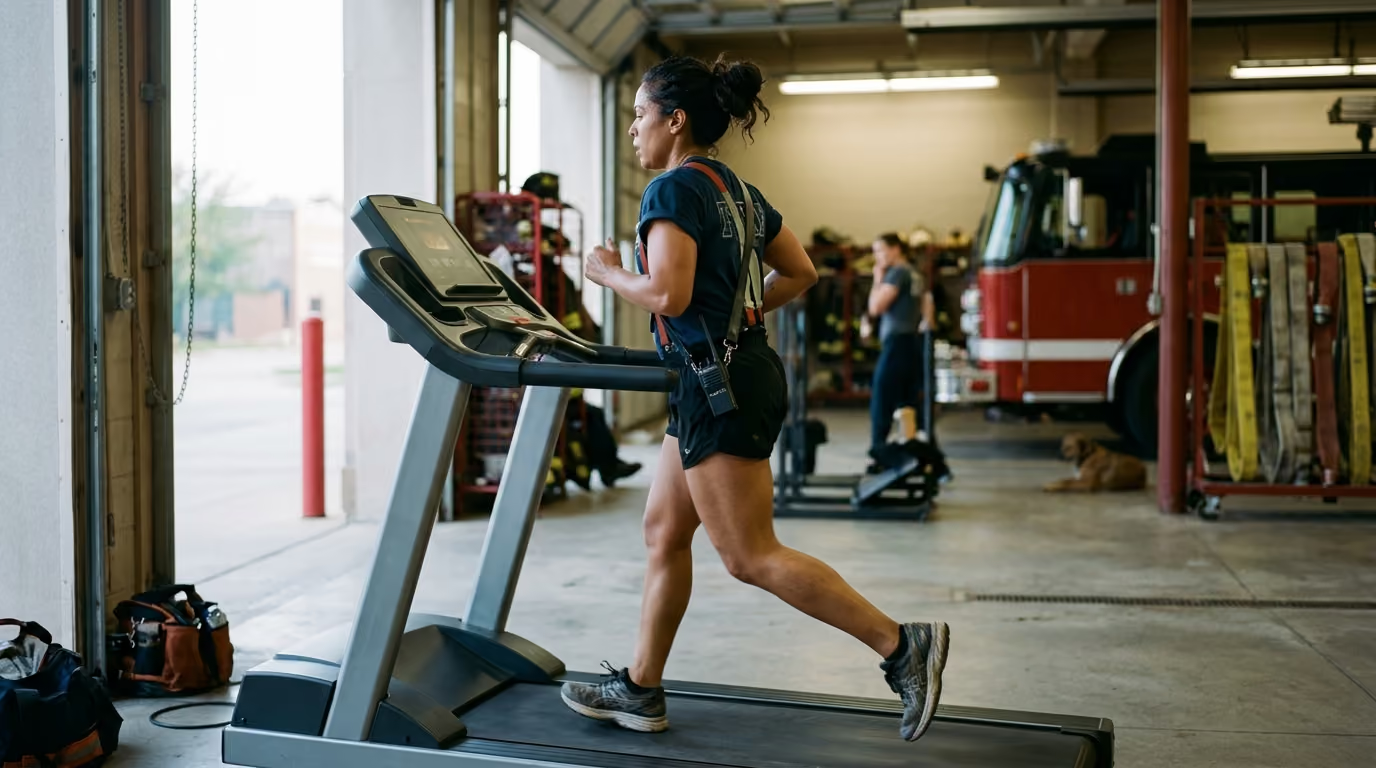

Three foundational running capacities allow first responders to develop tactical speed, expand their aerobic base, and withstand physical duty demands safely.





Most first responders do not need to log marathon mileage, yet avoiding running entirely leaves a critical operational gap. Running on duty is rarely a steady jog on a smooth track. It is an abrupt sprint across broken pavement, a rapid climb up a stairwell in full gear, or a high-intensity pursuit after hours of sitting in a patrol vehicle. Treating running as a specialized duty skill rather than a recreational lifestyle allows emergency personnel to build rapid acceleration, strong aerobic capacity, and resilient lower limbs without sacrificing strength or accumulating chronic fatigue.
Running capacity for emergency personnel serves a direct operational purpose. You need enough speed to reach a scene or close distance rapidly. You need enough aerobic fitness to sustain physical work after that initial exertion and recover quickly between calls. You also need sufficient tissue durability so your feet, shins, knees, and hips can tolerate sudden physical impacts without breaking down. A balanced approach pairs focused running exposures with structured strength training and adequate recovery, matching the physical demands of emergency service.
The relationship between physical fitness and occupational performance is well documented, but the direct connection between fitness scores and injury prevention requires a clear look at the research. Systematic reviews examining emergency responder fitness show that higher aerobic capacity generally correlates with lower occupational injury risk. However, evidence proving that high fitness test scores directly prevent on-duty injuries remains limited and population-specific.
In structural firefighting research, aerobic capacity demonstrates a clear association with physical capability and durability. Studies have shown that firefighters with estimated VO2max values below 43 milliliters per kilogram per minute were 2.2 times more likely to suffer musculoskeletal injuries compared to peers with higher aerobic fitness. In tactical recruit populations, low baseline aerobic fitness consistently predicts higher training attrition and injury. A systematic analysis of tactical trainees revealed that individuals in the slowest running categories experienced more than double the injury risk of their faster peers during initial qualification courses.
Cardiovascular fitness adaptations occur much faster than connective tissue adaptations. Your lungs and heart can adapt within weeks to sustain longer runs. Your bones, tendons, plantar fascia, and joints require months to build tolerance against repetitive ground impact. When a responder increases running volume too quickly because their cardiovascular system feels capable, connective tissues often fail under the unaccustomed mechanical stress.
Training load progression must account for both internal and external stressors. Long-standing fitness folklore often promotes a rigid rule that weekly running mileage should never increase by more than ten percent. Systematic reviews have found little scientific justification for this universal ten percent rule. Instead, recent running research indicates that the size of an individual running bout relative to your recent training history is far more critical. Single sessions that exceed recent exposures by large margins significantly increase the probability of bone and tendon overuse injuries.
Running as an emergency responder is fundamentally different from civilian road running because occupational conditions alter biomechanics and recovery capacity. Firefighters carry self-contained breathing apparatus and heavy protective turnouts that restrict heat dissipation and alter their center of gravity. Police officers carry duty belts or tactical vests that load the lumbar spine and restrict natural pelvic rotation during locomotion. Paramedics and emergency medical personnel frequently transition from prolonged sitting in an ambulance directly into explosive lifting and rapid movement.
Shift work and sleep disruption compound these biomechanical challenges. Research examining emergency first responder fatigue reveals that sleep restriction and disrupted circadian rhythms impair cognitive function, degrade tissue repair, and elevate musculoskeletal injury risk. When you attempt high-velocity sprint training or long running sessions after a broken night shift, your neuromuscular coordination is compromised. Reaction times slow down, motor unit recruitment becomes erratic, and the protective shock-absorbing qualities of your lower body decline.
Occupational boots alter foot mechanics significantly compared to engineered running shoes. Duty footwear features stiff outsoles, raised heels, elevated ankle collars, and substantial mass. Running in boots limits ankle dorsiflexion and dampens the natural elastic recoil of the Achilles tendon. If you must run in occupational footwear on duty, your physical training program must build strong calf complexes, mobile ankles, and resilient intrinsic foot muscles.
Environmental surfaces on duty are rarely forgiving. Responders navigate polished tile, oil-slicked asphalt, gravel, unpaved terrain, and wet stairwells. Training only on a flat, cushioned treadmill leaves you unprepared for the lateral stability demands and variable friction of real-world operational environments. Conditioning must prepare you for unpredictable surfaces while keeping your total training volume within manageable recovery limits. Implementing a structured approach to programming workouts around shift work protects your body against excessive fatigue while building practical readiness.
Many running programs enforce rigid technical models, insisting that every person must adopt an identical foot strike or body posture. Individual anatomy, limb lengths, prior injuries, and movement speeds naturally dictate different movement patterns. Effective running mechanics for first responders focus on force management, tissue protection, and mechanical efficiency rather than aesthetic perfection.
Overstriding is the most common mechanical error among non-runners. Overstriding occurs when the foot contacts the ground far ahead of the body's center of mass, usually with a straight knee and a rigid heel strike. This action creates a braking force that slows forward momentum while sending sharp impact forces directly into the tibia, knee, and hip. Landing with the foot closer to the body allows the knee and ankle to flex naturally, absorbing force through the muscular system rather than passive bone structures.
Cadence modification provides an effective tool to correct overstriding without overhauling your entire movement style. Systematic reviews on running biomechanics demonstrate that increasing your natural step rate by five to ten percent reduces vertical ground reaction forces, shortens stride length, and lowers knee joint loading. You do not need to target an arbitrary number such as 180 steps per minute. If your natural easy running cadence is 155 steps per minute, nudging that rate toward 165 steps per minute can substantially decrease tissue strain.
Upper body posture directly affects breathing efficiency and lower body mechanics. Responders should aim for a slight forward inclination that originates from the ankles rather than bending forward at the waist. Bending at the hips restricts hip extension and compresses the diaphragm, making high-intensity breathing difficult. Keep the chest proud, relax the shoulders, and maintain a compact, rhythmic arm swing that drives backward from the shoulder joint.
Operational running rarely resembles a steady-state track workout. Responders routinely start from awkward seated positions, sprint short distances, stop rapidly, and change direction around obstacles. True operational speed is the ability to accelerate violently, decelerate safely, and redirect momentum without losing balance or pulling a muscle.
Acceleration occurs during the first ten to twenty meters of a sprint. Effective acceleration requires a forward body lean, positive shin angles where the knees drive forward, and powerful horizontal force production into the ground. Initial steps are short and punchy, gradually lengthening as upright velocity increases. Training acceleration through short five-to-ten-meter sprints builds operational speed with far lower hamstring strain than all-out maximal velocity sprinting.
Deceleration is the foundation of change-of-direction capability and injury prevention. Stopping requires eccentric strength in the quadriceps and calves to absorb kinetic energy rapidly. When an untrained responder tries to stop abruptly from a dead sprint, excessive force is transferred to the anterior cruciate ligament and patellar tendon. Proper stopping mechanics involve lowering the center of mass, taking short braking steps, and maintaining a stable, wide base of support.
Directional changes should be introduced progressively. Start with wide-angle turns before attempting sharp 90-degree cuts or 180-degree pivot stops. Once straight-line acceleration and controlled deceleration are mastered, integrate lateral shuffles, crossover steps, and reactive directional drills. Practicing these patterns under low fatigue builds neuromuscular coordination that protects joint integrity when unpredictable emergencies occur.
Footwear selection for running should prioritize comfort, anatomical fit, and functional stability over marketing trends. Research examining footwear construction shows that midsole cushioning can attenuate impact forces and reduce loading rates, while midsole longitudinal stiffness can improve running economy. However, extreme shoe designs often create unintended consequences. Highly cushioned shoes with excessive stack heights can reduce ground feel and ankle stability on uneven surfaces.
Minimalist footwear with zero drop and thin soles can strengthen intrinsic foot muscles and improve running economy when introduced slowly. However, switching abruptly from standard duty boots or cushioned trainers to minimalist running shoes dramatically increases loading on the Achilles tendon and calf complex. If you choose to use low-drop footwear, transition over several months by using them first for walking and short warmup drills before attempting running intervals.
Running surfaces dictate the nature of the mechanical load applied to your body. Concrete is unforgiving and delivers high impact shocks, making it less suitable for high-volume cardiovascular conditioning. Asphalt roads offer a more predictable surface than concrete sidewalks but still deliver substantial impact. Synthetic running tracks provide an ideal balance of shock absorption, predictable traction, and measurable distances for interval work.
Natural surfaces such as grass fields and compacted dirt trails distribute mechanical stress across a wider variety of lower-limb tissues. Running on uneven ground requires continuous micro-adjustments from the stabilizing muscles around the ankle, knee, and hip. This natural variability prevents the repetitive localized loading that causes shin splints and stress fractures. Mix your running surfaces throughout the week, reserving firmer surfaces for high-velocity speed drills and softer surfaces for recovery volume.
A sustainable running program for emergency responders builds three overlapping physiological capacities: speed and acceleration, an aerobic base, and tissue durability. Designing workouts around these capacities prevents running from interfering with strength training or on-duty physical performance.
Speed work should focus on absolute movement quality and force production, not exhaustion. Perform speed sessions when you are fresh, ideally after a rest day or before heavy lifting.
Developing an aerobic base allows you to sustain moderate work output and recover rapidly between high-intensity operational tasks. Aerobic runs should be performed at a conversational pace where you can speak complete sentences without gasping.
Tissue durability requires direct strength training targeting the calves, shins, hamstrings, and hips. Incorporating these movements into your regular strength routine bolsters running performance and shields against overuse injuries. For responders balancing high workloads, utilizing the principles of minimum effective dose training ensures you build durability without creating deep systemic exhaustion.
Beginners must avoid doing too much too soon. The following progression gradually builds tissue tolerance while minimizing injury risk:
When running volume causes joint soreness, shin discomfort, or foot pain, you do not need to abandon cardiovascular conditioning. Low-impact cross-training modalities allow you to maintain and expand your aerobic engine without subjecting your lower limbs to repeated ground impact forces.
Systematic reviews comparing running and cycling show no significant differences in VO2max maintenance or aerobic performance when cycling replaces running over short to moderate intervention periods. If your shins or knees ache, swapping running sessions for cycling, rowing, or pool running preserves your operational conditioning while allowing irritated connective tissues to heal.
Sled pushes and heavy sled drags provide an exceptional training bridge between strength and sprinting. Pushing a loaded sled requires positive shin angles and powerful horizontal ground force application, closely mimicking the mechanics of acceleration. Because sled work eliminates the eccentric shock of foot strike, it builds leg power and cardiovascular conditioning with minimal soreness.
When returning to running after a period of low-impact substitution, follow a structured progression:
Operational culture often encourages working through physical discomfort, but ignoring mechanical pain leads to chronic overuse injuries that compromise duty capability. Differentiating between normal muscular fatigue and warning signs of structural tissue failure is an essential skill for career longevity.
Muscle soreness is typically diffuse, symmetrical across both legs, and softens as your body warms up during light movement. Warning signs of injury are usually focal, isolated to one side of the body, and escalate in intensity as running continues. Pain that forces you to alter your natural running stride or causes a noticeable limp indicates significant tissue irritation that will not improve with continued impact.
Bone stress injuries represent a serious risk for responders who suddenly increase running mileage. Point tenderness along the lower third of the tibia, sharp localized pain on the top of the foot, or deep aching pain in the hip or groin should never be run through. If you experience pinpoint bone pain that hurts during normal walking, stop running immediately and replace your conditioning with non-weight-bearing modalities.
Sleep deprivation directly accelerates overuse injuries and degrades tissue recovery. Scientific consensus reviews on athlete sleep demonstrate that chronic sleep loss impairs collagen synthesis, elevates systemic inflammation, and doubles the risk of musculoskeletal injury. Following difficult night shifts with minimal sleep, replace high-impact sprint or interval workouts with low-intensity movement, mobility drills, or dedicated recovery sleep. Reviewing targeted shift-specific sleep strategies can help optimize your recovery windows between irregular duty cycles.
Self-management and training modifications resolve many minor running aches, but certain symptoms require evaluation by a qualified medical professional. Seeking timely assessment from a licensed physical therapist, sports medicine physician, or orthopedic specialist prevents minor tissue strains from turning into career-altering injuries.
A licensed physical therapist specializing in tactical or athletic populations can evaluate running biomechanics, identify muscle strength deficits, and provide targeted rehabilitation protocols. If you experience persistent Achilles tendon morning stiffness, chronic plantar heel pain that is sharpest during your first steps out of bed, or recurring knee pain that persists despite reducing mileage, schedule a clinical evaluation.
Do not attempt to push through symptoms that compromise your balance, gait, or ability to operate safely on duty. Seeking professional guidance is not a sign of poor physical grit; it is an active investment in operational durability. Integrating sound medical care with structured injury recovery strategies allows emergency personnel to resolve underlying dysfunctions and return to full duty capacity quickly.
Developing a durable running capacity equips you to handle the unpredictable physical demands of emergency response while protecting your health for a long, capable career.
Stay connected for research-led guidance on duty fitness, shift-work sleep, injury recovery, stress, nutrition and career longevity. Practical ideas for first responders who want to stay capable on the job, recover well and protect their health for the long run.



Read practical guidance on first responder fitness, recovery, sleep, nutrition and resilience for demanding work and a long, active career.
read the blog



