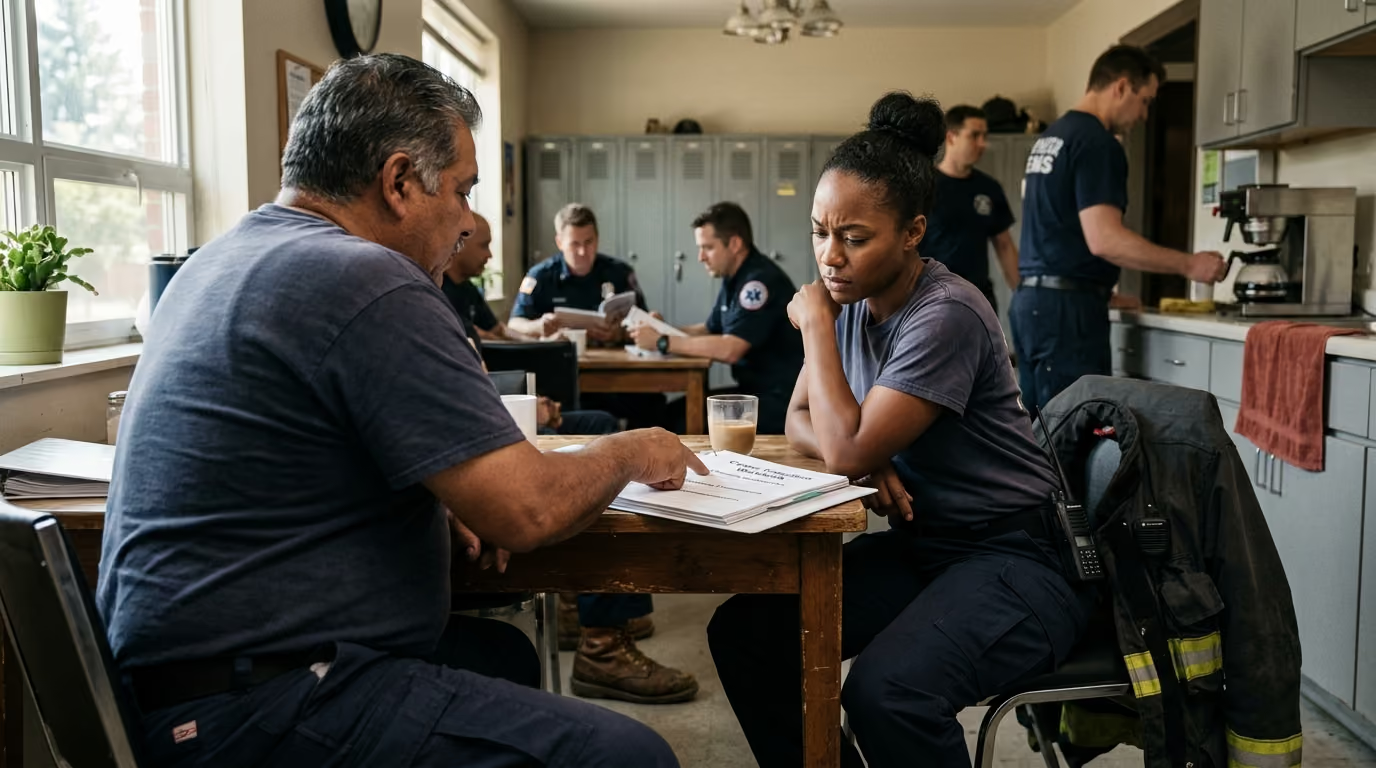

A successful post-service transition requires evaluating second-career pathways, physical longevity, compensation trade-offs, and transferable skills using a structured decision framework.





If you are in immediate danger, call 911. For 24/7 support, call or text 988 and press 1 for the Veterans Crisis Line, or text 838255.
You sit at the kitchen table with a cup of coffee, looking at an open job board. After twenty years of shift rotations, radio traffic, and emergency calls, standard corporate job titles look foreign. The skills that kept you and your crew safe do not appear in standard drop-down menus.
A second career is not just finding any job after leaving emergency services. It is the intentional design of work around your health, income needs, recovery, and daily schedule for the next ten to thirty years. Transitioning well requires translating your tactical capabilities into civilian roles, checking credential requirements, and confirming that your new job does not recreate the physical and mental strain you want to leave behind.
Leaving operational duty changes your daily routine, but it does not instantly erase years of accumulated occupational stress. Research shows that first responders experience higher baseline rates of mental health conditions than the general population. According to data from the Substance Abuse and Mental Health Services Administration, approximately 30% of first responders develop behavioral health conditions, compared to 20% of the general public.
Clinical reviews show that post-traumatic stress disorder affects emergency personnel at elevated rates across all disciplines. Estimated PTSD rates range between 6% and 32% for law enforcement officers, 9% and 22% for emergency medical personnel, and 17% and 32% for firefighters. Across broad responder populations, general PTSD prevalence estimates commonly fall between 10% and 23.2%. Among retired firefighters, research has identified PTSD and depression prevalence rates of 18% each, with heavy drinking estimated at 7%.
Occupational burnout is similarly widespread across emergency services. Research on emergency medical services personnel reveals burnout rates spanning 16% to 87.7%, with a median screening-positive rate of 37.2%. Surveys indicate that nearly 40% of EMS workers report active burnout symptoms during their operational careers.
The evidence is clear. Stepping away from active duty does not automatically restore baseline health. Without the structure, peer culture, and adrenaline of emergency response, unaddressed sleep debt, physical injuries, and psychological trauma can surface during a transition. Planning a second career requires evaluating how a new job supports long-term physical durability and psychological recovery.
Emergency service creates specific operational habits that both assist and complicate a civilian career transition. On duty, responders operate within clear command hierarchies, make rapid decisions with incomplete information, and manage acute crises. In civilian workplaces, decision-making is often slow, consensus-driven, and distributed across multiple departments.
The loss of operational identity represents a significant adjustment. For decades, your social circle, daily routine, and personal purpose were tied to the uniform. Moving into private business, education, or administration can feel understimulating at first. Responders often interpret a slower civilian pace as a lack of urgency or competence, which can create frustration if expectations are not managed.
Physical wear from years of irregular work also influences career suitability. Shift work, broken sleep, heavy gear, and repetitive physical strain alter baseline functional capacity. Many personnel transition while managing chronic joint pain, cardiovascular risk, or nervous system dysregulation. A structured approach to career longevity requires choosing a post-service path that respects your current physical boundaries rather than pushing through pain.
Circadian rhythm disruption also persists long after you work your final night tour. Years of rotating schedules alter metabolic health, hormone production, and sleep quality. Moving to a standard schedule offers long-term benefits, but the initial adjustment requires deliberate sleep hygiene and recovery planning. Establishing a shift-specific sleep plan during your final working months helps stabilize your circadian rhythm before you start a new role.
Evaluating a second career requires looking beyond initial salary numbers. A position that pays well but demands constant travel, weekend availability, and heavy physical labor can rapidly degrade your health. The SUSTAIN framework provides a structured method to score potential career paths across seven essential dimensions.
Evaluate the true daily time commitment of the role. Look for:
A job marketed as a standard daytime schedule may still include mandatory overtime or after-hours emergency coordination. Clarify these expectations before accepting an offer.
Identify which core capabilities the position requires. Relevant skills include:
Using familiar skills increases your professional value and job satisfaction. However, selecting a role that uses every operational skill may keep you tied to the exact stressors you want to leave.
Assess the type and volume of psychological demands in the position. Examine:
A safety manager deals with regulatory audits and production deadlines rather than trauma scenes. An emergency manager experiences low day-to-day physical danger but manages intense administrative pressure during major regional activations.
Examine the physical requirements of the daily work environment. Consider:
Select a path that accommodates existing orthopedic limitations and protects your mobility for retirement.
Calculate total compensation rather than comparing base salaries alone. Account for:
A lower base salary with comprehensive medical benefits and strong retirement matching often provides greater net value than high-paying contract work with zero benefits.
Review the health and security protections offered by the employer. Compare:
Federal law enforcement officers and firefighters covered under FERS receive a special retirement formula. They earn 1.7% of their high-three average salary for each of their first 20 years of service, followed by 1% for additional years. Qualifying federal retirees may also receive a special retirement supplement until age 62. State, county, and municipal pension structures vary widely, making direct plan verification essential.
Determine whether the role supports your life goals over the next ten to twenty years. Ask:
You can evaluate multiple career opportunities by assigning weights to each dimension based on your personal priorities. A standard weighting model allocates:
Score each target job from 1 to 5 on each dimension, multiply by the assigned weight, and compare total scores. Adjust the weights to reflect your circumstances. Someone with a secure pension can weight schedule and physical health higher, while an early-career leaver may prioritize income and benefits.
First responders transition into diverse industries, ranging from public administration to private enterprise and education. Each pathway presents distinct advantages, operational demands, and credential requirements.
Public sector roles offer strong cultural continuity, allowing you to use your operational background in an administrative capacity. Common roles include emergency management directors, fire marshals, code enforcement officers, public safety dispatch supervisors, and transportation security analysts.
Emergency management directors design disaster response procedures and coordinate interagency operations during crises. The Bureau of Labor Statistics reports a median annual wage of $93,330 for emergency management directors, with projected employment growth of 4% through 2035.
This pathway suits experienced officers, chiefs, and senior supervisors who want to continue public service while reducing direct physical exposure.
Corporate security, threat assessment, executive protection, loss prevention, and business resilience represent a rapidly expanding sector for former responders. Roles range from site security supervisors to global corporate risk managers.
This path is well suited for investigators, supervisors, tactical officers, and intelligence personnel who want higher compensation and understand corporate environments.
Occupational health and safety specialists identify workplace hazards, conduct accident investigations, enforce safety standards, and develop risk prevention programs across industries like construction, manufacturing, energy, and healthcare.
The Bureau of Labor Statistics reports a median annual wage of $90,150 for occupational health and safety specialists and $61,560 for safety technicians. The field is projected to grow by 19% through 2035, generating approximately 20,900 job openings annually.
This field fits firefighters, rescue technicians, and police supervisors who want to preserve their safety focus while transitioning into private industry.
Consulting allows former first responders to monetize specialized operational expertise. Practice areas include emergency response planning, incident command training, life safety assessments, expert witness testimony, after-action reviews, and grant writing.
Consulting works best for senior leaders, technical specialists, and investigators with strong professional networks, business discipline, and personal financial reserves.
Teaching positions allow experienced responders to pass on operational knowledge. Roles include academy instructors, EMS program coordinators, community college faculty, defensive tactics trainers, school safety specialists, and corporate trainers.
Postsecondary education administrators oversee instructional programs and faculty. The Bureau of Labor Statistics lists a median annual wage of $104,590 for postsecondary administrators, with positions typically requiring a master's degree.
Education provides an excellent path for field training officers, academy instructors, and senior personnel who enjoy mentoring and clear instructional delivery.
Former paramedics, EMTs, and rescue personnel often transition into broader healthcare systems. Options include hospital emergency management, patient safety coordination, clinical equipment education, emergency department operations, and occupational health nursing.
This area works well for EMS providers and fire medics who want to remain in healthcare while moving toward administrative, educational, or higher-credential clinical positions.
Nonprofit organizations, disaster relief agencies, victim advocacy groups, and veterans' service organizations value the leadership, logistics, and crisis management skills of former responders.
The Bureau of Labor Statistics reports a median annual wage of $80,390 for social and community service managers, with employment projected to grow by 7% through 2035.
This path is well suited for personnel who prioritize social impact, community development, and collaborative leadership over corporate earnings.
A successful career transition requires calculating true net compensation rather than focusing solely on gross pay. Moving from public service to the private sector changes your tax structure, benefit contributions, and out-of-pocket expenses.
Use this basic model to calculate the real economic value of a second career:
Net second career value equals your gross salary plus employer benefits, retirement contributions, and paid leave value, minus income taxes, commuting costs, credential fees, required equipment, personal insurance expenses, and any lost pension accrual.
Calculate this value across five, ten, and fifteen-year horizons. A job with a high starting wage that requires expensive out-of-pocket health coverage and lacks employer retirement contributions can yield less wealth over ten years than a modest salary with strong institutional benefits.
Returning to work after earning a public pension requires careful legal and financial review. Before accepting a new role, check:
Never base financial choices on casual locker-room advice. Pension laws, tax treatments, and reemployment restrictions are specific to your jurisdiction and plan tier.
A public safety pension provides financial stability, but it can also tempt personnel to accept stressful, unfulfilling second careers simply because they are available. Earning additional income should not come at the cost of your physical durability, sleep, or family stability.
Follow a structured financial planning sequence:
Distinguish between financial independence and readiness for daily retirement. Having enough money to leave active duty does not mean you are prepared for the loss of daily routine, social connection, and professional purpose. Planning structured activities, fitness routines, and community involvement is just as important as balancing your budget.
Transitioning into a sustainable second career is a multi-phase process that should begin twelve to twenty-four months before your separation date.
Assess your personal readiness before applying for open positions:
Taking time to stabilize prevents you from accepting an unsuitable job out of financial panic or restless habit.
Create four distinct written lists:
Your willingness to complete targeted training often determines how easily you move into higher-paying civilian roles.
Identify viable target roles across different categories:
Comparing options across multiple sectors prevents you from settling for the first available job posting.
Research your chosen industries thoroughly:
Direct research provides accurate data on salary ranges, daily duties, and corporate culture.
Prepare your professional portfolio for civilian hiring managers:
Test your chosen field on a small scale before making an irrevocable commitment:
Piloting a role reveals the daily realities of the job without risking your financial stability.
Reassess your second career at 30, 90, and 180 days after starting:
Your first job after leaving service does not have to be your permanent destination. Use it to gain private sector experience, expand your professional network, and refine your long-term plans.
These illustrative models show how different first responders apply structured transition planning to match their skills and physical needs with sustainable careers.
Profile: A veteran fire captain wants to remain connected to public safety and rescue operations but can no longer manage structural firefighting, heat stress, and heavy physical loads.
Target pathways: Municipal emergency management director, county fire marshal, life safety plan reviewer, or public safety communications manager.
Key trade-offs: Excellent skill transfer and mission alignment, but potential retention of municipal bureaucracy, council oversight, and emergency callouts.
Action step: Conduct informational interviews with three local emergency management directors to evaluate their weekly administrative tasks, grant management requirements, and disaster activation schedules.
Profile: A police lieutenant retires with a full twenty-five-year pension and health coverage but experiences loss of daily structure, camaraderie, and professional purpose.
Target pathways: Community college criminal justice instructor, part-time municipal background investigator, nonprofit foundation manager, or corporate ethics consultant.
Key trade-offs: High schedule freedom and low financial pressure, but requires active boundary setting to avoid overcommitting to unpaid or high-stress advisory tasks.
Action step: Establish a structured weekly calendar that incorporates regular physical training, family commitments, and structured hobbies before accepting part-time employment.
Profile: A seasoned flight paramedic with chronic lumbar spinal disc injuries can no longer safely lift patients, carry gear bags, or manage turbulent transport environments.
Target pathways: Hospital patient safety coordinator, clinical simulation center instructor, healthcare risk analyst, or medical equipment technical representative.
Key trade-offs: Protects musculoskeletal health and uses clinical knowledge, but requires adjusting to sedentary desk work, computer charting, and corporate meetings.
Action step: Work with a physical therapist to verify functional workplace capabilities, review formal job descriptions against physical restrictions, and check disability pension earnings rules before applying. Applying an autoregulation training guide helps monitor physical tolerance as you transition into new physical demands.
Profile: A former tactical team leader and investigator finds conventional office environments slow, unengaging, and frustrating.
Target pathways: Corporate crisis management specialist, disaster response logistics coordinator, specialized tactical instructor, or enterprise business continuity planner.
Key trade-offs: Provides engaging problem-solving and rapid operational coordination, but may sustain elevated adrenaline levels, hypervigilance, and irregular working hours.
Action step: Separate the need for challenging intellectual problem-solving from the habit of physical crisis exposure. Select positions that involve complex logistical planning rather than immediate field danger.
Profile: An early-career police officer or firefighter chooses to leave emergency services entirely to pursue technology, construction management, or healthcare.
Target pathways: Information technology cybersecurity analyst, commercial construction project manager, registered nurse, or commercial real estate appraiser.
Key trade-offs: Complete separation from operational trauma and shift work, balanced by the need to complete multi-year retraining, start at entry-level seniority, and absorb upfront tuition costs.
Action step: Complete a single introductory college course, technical boot camp, or trade workshop to test your aptitude and interest before committing significant financial resources to a degree program.
Transitioning out of uniform involves significant cultural, professional, and personal adjustments. Avoiding common mistakes helps protect your health and finances.
Civilian hiring managers rarely understand department ranks, unit designations, radio codes, or tactical terminology. Describing your background as "Engine 4 Captain" or "Shift Watch Commander" provides little clarity on your management capabilities.
Translate your experience into clear business outcomes on your resume:
Quantify your scope of work by highlighting team size, operating budgets, training hours, risk reduction metrics, and successful projects.
Personnel often assume that moving to an office job eliminates work-related stress. While desk positions remove acute physical danger, they introduce sedentary strain, screen fatigue, complex organizational politics, ambiguous authority, and rigid project deadlines.
Prolonged sitting can exacerbate existing musculoskeletal injuries and back pain. Moving successfully into an administrative role requires setting up an ergonomic workstation, taking regular movement breaks, and establishing clear boundaries around email and after-hours availability. Using a quick stress reset technique during demanding administrative workdays helps downregulate tension between meetings.
Leaving emergency response removes operational trauma exposure, but it does not automatically heal accumulated stress injuries. Without the daily focus and camaraderie of the station or precinct, unresolved symptoms of PTSD, depression, or anxiety can intensify.
Plan proactive mental health support during your career transition. Maintaining access to clinicians experienced with public safety culture, staying connected with trusted peers, and maintaining regular physical exercise provide stability as you build a new professional identity.
Earning professional certificates can strengthen your resume, but credentials alone do not guarantee a job offer. Enrolling in costly graduate programs or specialized certificate courses without verifying employer demand can drain your financial reserves.
Identify ten to fifteen active job postings in your local market before spending money on training. Note the exact degrees, licenses, and software proficiencies that employers request, and invest only in credentials that directly match those requirements.
Planning a second career requires realistic appraisals of your physical health, ongoing medical treatments, and disability plan rules.
If you are transitioning due to a line-of-duty injury or medical disability retirement, your return-to-work options are governed by strict legal and administrative policies. Many public retirement systems establish earnings caps, restrict employment in similar operational roles, or require annual medical evaluations to maintain disability benefits.
A RAND study on public safety occupational health notes that industrial disability retirement structures vary widely. Some public safety systems provide industrial disability benefits equal to 50% of final salary, while ordinary non-occupational disability benefits may provide 33.33% with specific vesting thresholds. These percentages represent specific plan rules rather than national standards, demonstrating why individual plan verification is critical.
Consult your pension administrator and an attorney specializing in public employee benefits before accepting paid employment while receiving disability payments. Performing work that contradicts your documented medical limitations can jeopardize your benefits and create financial liability.
Never push through severe pain, cognitive fatigue, or medication side effects to meet second-career demands. If a new position worsens chronic orthopedic injuries, causes dangerous daytime sleepiness, or triggers severe psychological distress, prioritize your medical stability. Tailor your work environment to your health rather than compromising your recovery for a job. If you are recovering from physical trauma, reviewing injury recovery frameworks can help you set realistic physical baselines before taking on new workplace duties.
A successful career transition often requires guidance from licensed professionals who specialize in public safety retirement, occupational health, and career development.
Reach out to a licensed psychologist, clinical social worker, or professional counselor familiar with first responder culture if you experience:
Early clinical support helps process accumulated trauma and provides practical tools for adapting to civilian life.
Work with a fee-only Certified Financial Planner (CFP) or certified public accountant who understands emergency service pensions. They can help you:
Career coaches with public safety transition experience can accelerate your progress by:
Review this framework whenever you reach key transition milestones: twelve months prior to planned retirement, after completing medical evaluations, when reviewing job offers, or at your 90-day post-hire review.
Building a sustainable second career is not about proving your capability in a new arena. It is about choosing work that protects your health, supports your family, and allows you to enjoy the longevity you earned through service.
Stay connected for research-led guidance on duty fitness, shift-work sleep, injury recovery, stress, nutrition and career longevity. Practical ideas for first responders who want to stay capable on the job, recover well and protect their health for the long run.



Read practical guidance on first responder fitness, recovery, sleep, nutrition and resilience for demanding work and a long, active career.
read the blog



