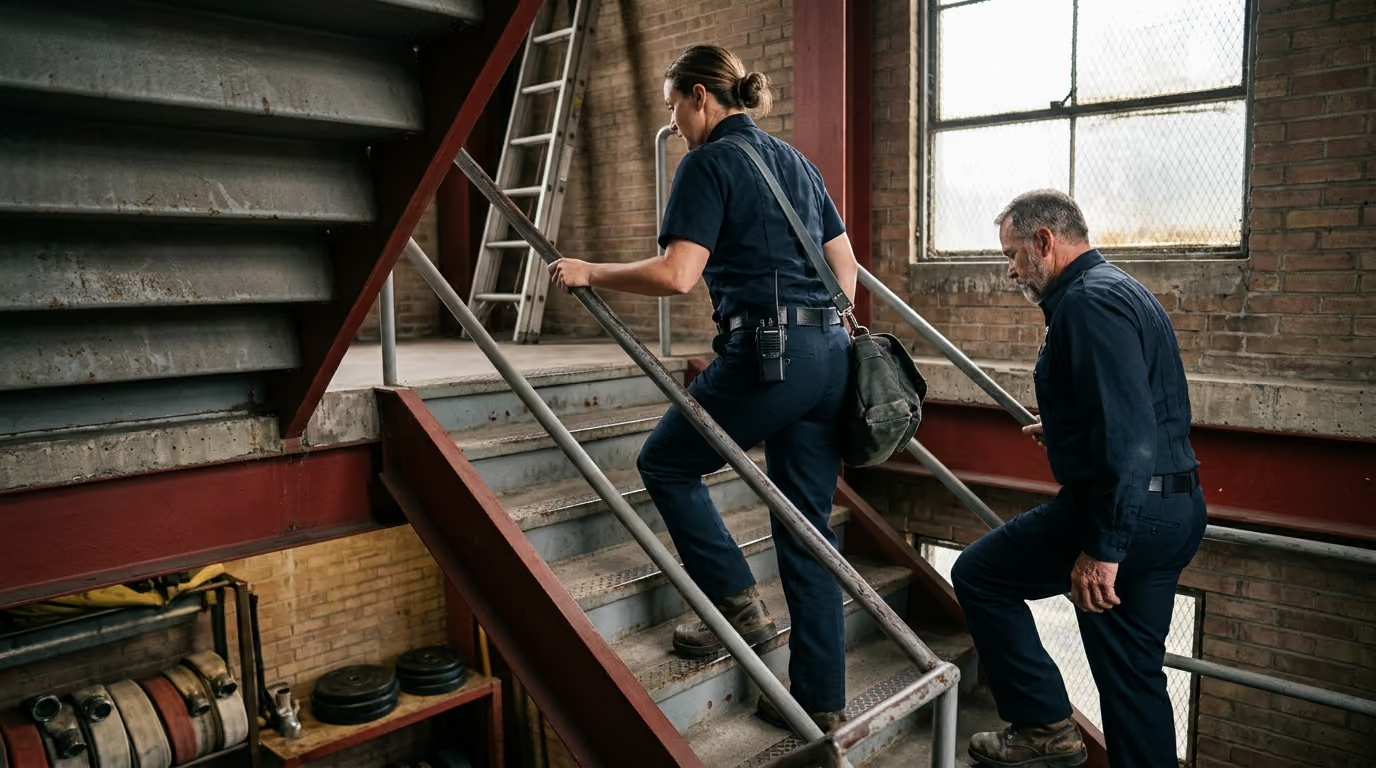

Carrying heavy rescue gear up flights of stairs requires specialized physical capacity that emergency professionals can build through targeted testing and graded conditioning models.





Many emergency responders search for ways to handle knee pain during stair descents, prevent breathlessness during high-rise ascents, or stop slipping on apparatus ladders. The answer is not simply doing more generic cardio or heavy back squats. Vertical capacity depends on a precise balance of aerobic power, single-leg concentric force, eccentric braking control, grip stability, and equipment adaptation.
Vertical access is a complex physical skill. Moving up and down stairs, climbing aerial ladders, and navigating confined vertical shafts require distinct muscular actions and movement strategies. When you add heavy turnout gear, breathing apparatus, reduced visibility, and unpredictable structural surfaces, standard gym conditioning often fails to prepare the body.
A practical way to understand vertical capability is through a clear formula. Capacity equals force multiplied by control, work tolerance, and task skill, minus fatigue and environmental penalties. If any single component breaks down, operational performance declines and injury risk rises.
This guide provides a comprehensive framework for building, testing, and maintaining vertical movement capacity across an emergency-services career.
Vertical access tasks across fire, rescue, and emergency medical operations fall into distinct physical categories. Each task creates unique biomechanical stress on the musculoskeletal system.
Stair climbing is primarily a continuous single-leg locomotor task. Ascent requires concentric force production from the hip extensors, quadriceps, and calf musculature to elevate body mass against gravity. Descent requires eccentric force production, where the quadriceps and calf muscles lengthen under load to absorb impact and control downward momentum. Carrying equipment or patients amplifies these demands significantly.
Ladder climbing introduces a constrained environment where hands and feet must coordinate with rigid rungs or rails. Unlike stairs, ladders offer fewer recovery options if a foot slips. Fall consequences from height are severe. Occupational Safety and Health Administration regulations require personnel to face the ladder and maintain continuous grasp, reinforcing three points of contact. Three-point contact means keeping two hands and one foot, or two feet and one hand, in firm contact with the structure during movement.
Access systems on apparatus and emergency vehicles present another distinct category. Steps, tailboards, and grab handles often feature non-standard spacing, narrow ledges, and slippery metal surfaces. Firefighters and paramedics frequently mount or dismount these systems while carrying heavy medical bags, hydraulic tools, or hose packs.
Transitions between levels represent the highest-risk moments during vertical movement. Stepping from an aerial ladder onto a pitched roof, moving through a scuttle hatch, or stepping off the bottom step of a vehicle involves asymmetric balance and rotational forces. These transitions demand high levels of pelvic stability and dynamic trunk control.
Confined-space vertical movement involves crawling, crouching, and squeezing through restricted openings. Research from the United States Fire Administration highlights that crawling in full protective gear creates extreme cardiorespiratory stress. The combination of restrictive clothing, awkward body angles, and trapped metabolic heat dramatically increases the risk of thermal strain and sudden cardiac events.
Stair navigation involves fundamentally different mechanical demands depending on the direction of travel. Treating ascent and descent as identical movements is a common training mistake.
Ascent requires positive mechanical work. The gluteus maximus, rectus femoris, vastus medialis, vastus lateralis, and soleus contract concentrically to raise the center of mass. Research on firefighter fitness shows that low cardiorespiratory capacity correlates directly with occupational injury. Personnel with estimated aerobic capacity below 43 milliliters per kilogram per minute demonstrate more than double the injury rate of peers with higher fitness levels. Aerobic power allows responders to sustain repeated ascents without progressive loss of muscle recruitment.
Descent requires negative mechanical work. As you step downward, the leading leg must absorb kinetic energy and control the rate of lowering. Research on knee joint kinetics indicates that stair descent generates significantly higher patellofemoral contact forces than stair ascent. The quadriceps and triceps surae must fire eccentrically to prevent rapid knee flexion or foot collapse.
When eccentric strength is insufficient, responders exhibit clear compensation patterns during descent. They slap their feet down heavily, pitch their upper bodies forward, or rely excessively on handrails. These compensations increase joint impact forces, elevate slip potential, and accelerate lower-limb fatigue.
Individuals with previous knee injuries or patellofemoral pain syndrome show distinct biomechanical alterations during stair descent. Clinical research demonstrates that people with knee pain experience irregular eccentric torque production and disrupted knee angular velocity during step-downs. Strengthening the eccentric capacity of the knee extensors and hip abductors is essential for protecting joint health over a long career.
Ladder climbing requires coordinated upper and lower limb mechanics within a strictly defined geometric plane. The interaction between human movement and ladder structure directly influences safety and physical strain.
Climbing style influences both speed and stability. Research conducted by the National Institute for Occupational Safety and Health examined firefighter movement on aerial ladders at a 52.5-degree angle. The investigation compared climbing while grasping the rungs versus sliding the hands along the side rails.
Rail climbing provided continuous hand contact, which significantly improved body-position control and reduced perturbation risks. However, rail climbing requires handrails designed to accommodate a secure grip while wearing structural firefighting gloves. When ladder rails are too wide or lack sufficient clearance, rung climbing becomes the only viable option.
Ladder rung spacing represents a critical engineering factor. Biomechanical research from NIOSH and the University of Michigan evaluated ladder models with 12-inch and 14-inch rung spacing across male and female firefighters. Reducing the rung spacing from 14 inches to 12 inches produced measurable operational improvements:
These findings demonstrate that climbing performance is not solely a matter of individual physical strength. Structural dimensions directly affect joint strain and fall risk. Understanding these mechanics helps responders choose safer hand placement and foot positioning strategies during ladder operations.
Slip recovery mechanics on ladders depend heavily on upper-body strength and rapid foot placement. In CDC and NIOSH perturbation studies, the ability to arrest a simulated ladder fall correlated strongly with measured grip strength and the speed of reestablishing foot contact. Moving hands one rung at a time during ascent and descent preserved better stability than reaching across multiple rungs. Deliberate hand movements reduce the likelihood of hand decoupling during a slip.
Wearing personal protective equipment fundamentally alters the biomechanics of vertical movement. Structural firefighting gear, wildland packs, and tactical body armor add passive mass while restricting joint mobility.
Motion capture research on firefighters reveals that wearing full protective gear shifts mechanical loading toward proximal joints. During stair climbing in gear, ankle joint torque decreases due to stiff boot construction, while knee and hip torques rise significantly. Trunk muscle activity increases across all movement phases to stabilize the posterior load of the self-contained breathing apparatus.
Carrying tools or hose bundles creates asymmetric loading. When a responder carries a heavy tool in one hand, the contralateral quadratus lumborum, obliques, and hip abductors must contract intensely to keep the pelvis level. This asymmetric torque alters foot strike patterns, increasing the likelihood of catching a boot heel on a stair edge or missing a ladder rung.
Thermal burden further degrades movement mechanics. Turnout gear traps metabolic heat, driving core body temperature upward during prolonged climbing. As core temperature rises, the central nervous system experiences fatigue, leading to degraded motor control, slower reaction times, and reduced grip endurance. Integrating fatigue management protocols into training helps personnel understand when heat strain begins compromising physical coordination.
Evaluating vertical capacity requires field-ready assessments that measure force, control, and endurance without requiring complex laboratory equipment. A comprehensive assessment battery should evaluate five distinct physical domains.
Aerobic capacity can be assessed using timed multi-flight stair climbs or validated step tests. Testers must track performance metrics alongside physiological indicators:
If a responder finishes a climb with fast times but stumbles on stair edges during the final flight, their usable aerobic capacity is insufficient for safe operational duty.
Concentric strength testing evaluates the ability to elevate mass repeatedly without spinal compensation:
The assessor should watch for excessive forward trunk lean, knee valgus collapse, or reliance on momentum from the trailing leg.
Eccentric control is best measured through slow, controlled lowering movements:
Assessors should note whether the knee tracks over the second toe or dives inward, whether the pelvis drops on the unsupported side, and whether the foot slaps the ground aggressively.
Grip strength directly predicts the ability to arrest a fall after a slip:
The final assessment tier evaluates movement quality while wearing operational equipment:
Scoring must reflect both task completion and mechanical efficiency. A passing score requires completing the movement without dangerous deviations in posture, foot placement, or grip security.
Building robust vertical capability requires a systematic training progression. Jumping directly into high-intensity stair climbing in full turnout gear frequently causes patellar tendinopathy, lower back strain, and excessive systemic fatigue. A structured five-stage model allows tissues to adapt safely.
This initial phase establishes movement quality, joint stability, and tendon tolerance. Training focuses on basic single-leg mechanics and trunk stability without external equipment loads.
Key exercises include:
Aerobic conditioning during this stage utilizes non-impact modalities such as rowers, assault bikes, or steep incline treadmill walking. This builds mitochondrial density while sparing knee joints from excessive repetitive impact. Personnel seeking structured guidance can review foundational duty fitness programming to balance these movements across their training week.
Stage 2 introduces repetitive stair climbing volume while continuing to build lower-limb strength. Responders practice deliberate foot placement on stairs and ladders in standard training attire.
Key training protocols include:
Coaches and peer fitness trainers should closely monitor knee tracking and pelvis alignment during this phase.
Stage 3 introduces occupational equipment in a controlled, progressive manner. Adding boots, gloves, and weighted vests alters joint mechanics and center of mass dynamics.
Key adaptations include:
This stage prepares connective tissues for the shifted joint torques caused by structural footwear and torso loading.
Stage 4 combines vertical movement with realistic emergency tasks. Responders wear full personal protective equipment, including turnout gear and breathing apparatus.
Workouts in this stage include:
These sessions require careful monitoring to ensure that movement mechanics do not deteriorate under combined cardiorespiratory and muscular fatigue. Integrating smart strategies for managing physical training around shift work ensures adequate recovery between high-load sessions.
The final stage prepares responders for the unpredictable chaos of real emergency environments. These evolutions introduce low visibility, thermal load, and task complexity under strict safety supervision.
Representative evolutions include:
Stage 5 evolutions should occur periodically rather than weekly. They serve as functional evaluations rather than everyday conditioning sessions.
Demanding vertical operations impose a dual recovery burden: acute cardiorespiratory and thermal fatigue combined with delayed musculoskeletal damage from heavy eccentric loading.
Immediately following a heavy climbing evolution or high-rise incident, crews must enter a structured rehabilitation sector:
Personnel experiencing severe breathlessness, lightheadedness, chest tightness, or cognitive confusion require immediate medical evaluation.
Eccentric muscle actions during stair descent and ladder stabilization cause micro-trauma within muscle fibers. This produces delayed-onset muscle soreness, localized swelling, and temporary reductions in peak muscle torque over the subsequent 24 to 72 hours.
During this window, responders are at heightened risk for secondary injury if exposed to maximal plyometric or heavy eccentric loads. Practical strategies to facilitate tissue remodeling include:
Understanding these biological timelines helps responders select appropriate injury recovery strategies rather than attempting to grind through severe muscle damage.
While vertical capacity is trainable, emergency services work presents genuine physical boundaries. Pushing through severe pain or ignoring movement compensation patterns dramatically increases catastrophic injury risks.
Certain physical presentations require immediate training modification or workload reduction:
Self-management has clear limits. Responders should seek evaluation from a qualified physical therapist, athletic trainer, or occupational physician under specific circumstances:
Addressing biomechanical deficits early protects both individual health and crew safety. Investing in sound movement patterns supports lifelong career longevity well beyond retirement from active service.
To translate this framework into practical habits this week, apply the following step-by-step checklist:
Developing vertical access capacity requires consistent, multi-faceted preparation. By balancing aerobic power, concentric strength, eccentric braking control, and equipment-specific skill, emergency responders can navigate demanding vertical environments safely and sustain operational readiness throughout their careers.
Stay connected for research-led guidance on duty fitness, shift-work sleep, injury recovery, stress, nutrition and career longevity. Practical ideas for first responders who want to stay capable on the job, recover well and protect their health for the long run.



Read practical guidance on first responder fitness, recovery, sleep, nutrition and resilience for demanding work and a long, active career.
read the blog



