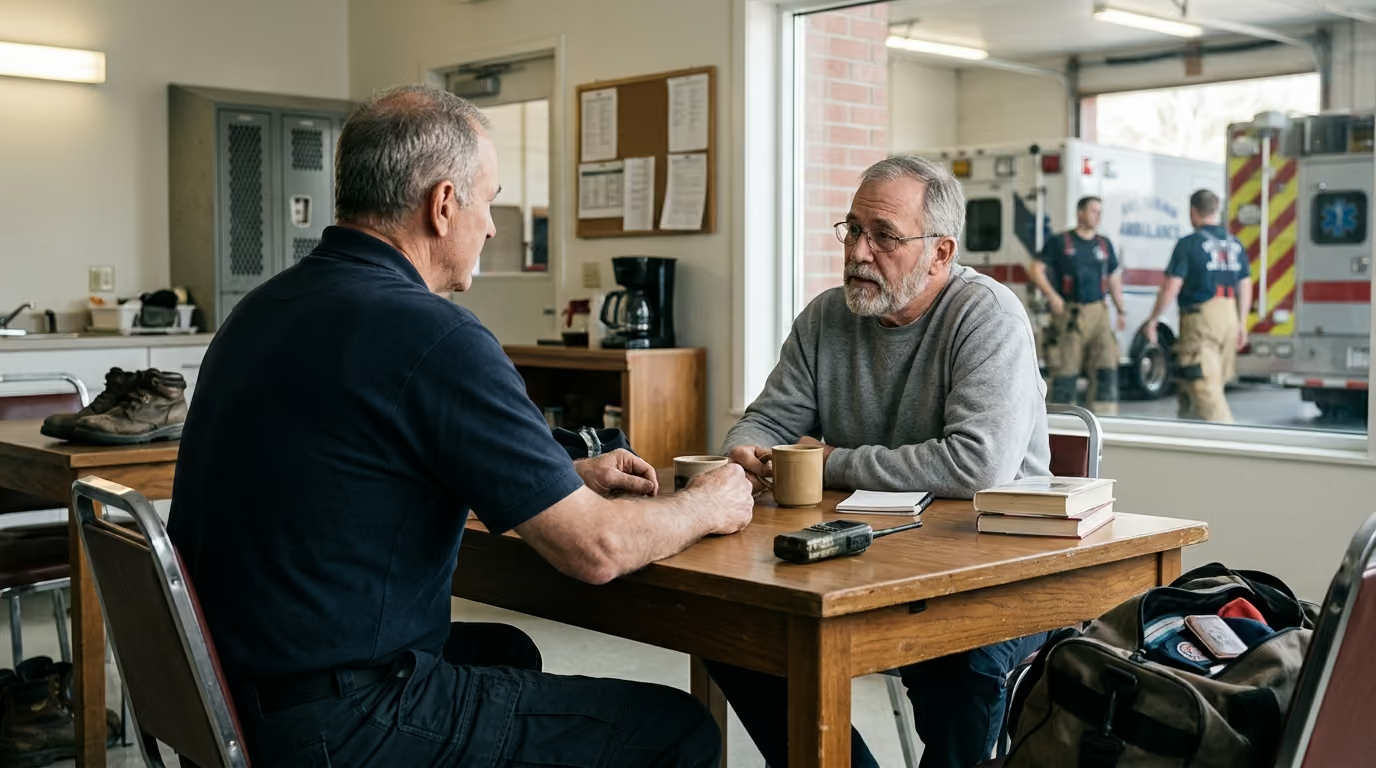

Four decision pillars and five engagement levels help retired first responders manage post-service relationships, protect their mental health, and maintain healthy community boundaries.





If you or a colleague are experiencing overwhelming distress or thoughts of self-harm, immediate support is available. Call 911 for immediate emergency response. Call or text 988 to reach the Suicide & Crisis Lifeline, and press 1 if you are a veteran or military service member. You can also text 838255 for confidential crisis support. If you are concerned about safety at home, work with a trusted peer, family member, or healthcare provider to safely store firearms and medications.
Retiring from emergency services often prompts a common question: should you cut ties with your old department, or stay deeply involved in the responder community?
The short answer is that healthy post-service connection is not an all-or-nothing choice. Research shows that maintaining social ties protects emotional health, but staying exposed to daily workplace conflict and acute incident chatter can stall your recovery and personal growth. The goal is to design intentional connection. You can keep the shared history, mutual support, and camaraderie while establishing firm boundaries against operational overload, unmanaged trauma exposure, and unpaid administrative stress.
Leaving policing, the fire service, emergency medical services, corrections, or dispatch is unlike retiring from a standard corporate job. Emergency response structures daily routines, shapes personal values, and dictates social circles for decades. When you hand in your badge, gear, or radio, you do not simply leave an employer. You step away from a tight social network and an all-consuming professional role.
Academic studies on emergency-service retirement show that losing a professional identity can significantly complicate the transition to civilian life. When your entire sense of self is tied to being the person who answers the call, retirement can feel like an abrupt loss of purpose. Researchers refer to this as identity foreclosure. This occurs when an occupational role becomes the only legitimate identity a person recognizes in themselves.
Healthy transition does not mean you must erase your service history. Instead, you can practice identity continuity. Identity continuity allows you to carry forward core values such as discipline, loyalty, courage, and service into new settings without needing an active badge to validate your worth.
This transition requires shifting your functional role within the responder network:
A sustainable retirement honors your career without letting the agency dominate your future. Developing interests and relationships outside emergency response gives you a stable foundation. You can find comprehensive perspectives on this shift in our library of resources on career longevity and life after service.
The scientific literature on emergency responders confirms that social support is a vital protective factor against psychological distress. However, the data also reveals that retirement carries distinct mental health vulnerabilities that require careful boundary management.
Data from the Substance Abuse and Mental Health Services Administration demonstrates that psychological distress and post-traumatic stress symptoms remain elevated when social support decreases. Following major critical incidents, responders with strong peer backing consistently show better coping mechanisms than isolated individuals. In fire service studies, approximately 20 percent of firefighters and paramedics meet the criteria for post-traumatic stress disorder at some stage in their careers. That is roughly three times the rate observed in the general population.
Retirement does not instantly wash away cumulative occupational stress. A systematic review examining former first responders found a pooled post-traumatic stress prevalence of roughly 15.4 percent across general-exposure studies. Police cohorts showed estimates near 22.4 percent, while firefighter samples showed roughly 15.5 percent. Large-scale Australian surveys of emergency personnel conducted by Beyond Blue found that 85 percent of retired personnel experienced deeply distressing work events during their careers, with nearly 23 percent reporting probable post-traumatic stress.
These findings show that leaving the job does not eliminate past exposures. A longitudinal study of retired firefighters from Nottingham Trent University revealed that maintaining social connectedness and developing multiple group memberships directly reduces depression and loneliness. Responders who belonged to diverse social groups, such as family networks, athletic groups, civic associations, and hobby circles, navigated identity transition far better than those who relied solely on their old department.
Social connection protects health, but uncontrolled operational exposure can trigger old stress patterns. Staying connected to former colleagues is valuable when it provides camaraderie, humor, validation, and shared memories. It becomes counterproductive when it pulls you back into graphic incident reviews, toxic organizational politics, or chronic hypervigilance.
Active-duty emergency work keeps the nervous system primed for immediate threat. Years of interrupted circadian rhythms, tone drops, radio traffic, and high-stakes decision-making condition the body to stay on high alert. When you retire, your nervous system finally has the opportunity to downshift and reset.
Remaining casually plugged into operational channels can interrupt this physiological recovery. Consider what happens when a retiree stays on active shift group chats or listens to scanner traffic late at night. Every dispatch notification, critical incident image, and workplace complaint sends micro-signals of stress to the brain. This exposure keeps baseline cortisol elevated and disrupts restorative sleep. Responders who struggle with sleep quality during this transition can review our guide on creating a structured sleep plan.
The difference between healthy connection and stressful exposure comes down to content and context:
Psychological First Aid principles emphasize that long-term recovery requires shielding individuals from unnecessary trauma reminders and distressing media. When you leave active duty, you gain the right to filter what enters your mind. Protecting your peace of mind is not disloyalty. It is an essential part of preserving your long-term health.
To decide whether a specific relationship, committee, or association role belongs in your retirement, you can evaluate it through four clear criteria: Connection, Cost, Control, and Choice.
Evaluate the emotional and practical return of the engagement. A constructive relationship provides:
If an interaction leaves you feeling grounded, respected, and energized, it serves a clear positive purpose.
Every ongoing commitment draws on limited personal resources. Honestly assess the toll on:
If staying involved leaves you irritable, exhausted, or mentally absent at home, the cost outweighs the benefit.
Healthy post-service connections allow you to set clear parameters around your time and attention. Ask yourself:
When you lack control over the frequency or intensity of interactions, you are at risk of being pulled back into operational stress.
You must be able to change your involvement without guilt or apology. A healthy relationship allows you to:
If your involvement is driven by guilt, obligation, or the belief that the organization will fail without you, step back and re-evaluate.
Post-service involvement exists on a wide spectrum. You do not have to choose between total separation and complete immersion. You can position yourself at any of five distinct levels based on your current health, goals, and lifestyle.
This level involves minimal direct interaction. You receive quarterly pension updates, read the annual association newsletter, or hold an inactive union card. It is ideal for retirees who want to keep track of structural benefits while establishing clear emotional distance from daily department life.
At this level, you maintain personal friendships without taking on any institutional obligations. You attend quarterly breakfasts with close friends, join annual alumni reunions, or participate in family-inclusive department picnics. Conversations focus on life updates, hobbies, family, and shared history rather than current administrative disputes.
This level allows you to share your expertise through formal, time-limited roles. Examples include teaching a recruit academy class, delivering a guest lecture on leadership, acting as an agency historian, or consulting on specialized training modules. The boundaries are clear: you arrive, deliver instruction, and return home without being drawn into daily operations.
This level involves active service in organized peer support teams, legislative committees, pension boards, or retiree welfare groups. Because this work involves confidential personal disclosures, policy debates, or legal matters, it requires formal training, clear supervision, and strong personal boundaries. It suits individuals who have processed their own career stress and have the emotional capacity for structured service.
This level includes serving as a reserve deputy, volunteer firefighter, contract disaster inspector, or specialized emergency management contractor. This tier carries significant operational exposure. It can reintroduce physical risks, irregular sleep patterns, command hierarchies, and acute incident stress. Anyone considering this level should evaluate their medical fitness, nervous system health, and family agreements before stepping back into operational duty.
Choosing a lower level of involvement does not indicate a lack of care or commitment. It simply reflects a realistic understanding of what you need to maintain balance in your post-service life.
Different responder organizations present unique boundary challenges. Applying targeted rules to each environment helps you stay connected without compromising your well-being.
Active agencies carry complex rank dynamics, administrative politics, and reminders of past critical incidents. Former command staff may still act like supervisors, while former subordinates may feel uncomfortable speaking candidly.
Practical boundaries:
Labor organizations provide vital retirement advocacy, pension monitoring, and healthcare protection. However, active labor fights can pull retirees into persistent anger and adversarial stress.
Practical boundaries:
National and regional associations offer opportunities to stay engaged with broader industry research, equipment advancements, and leadership development. They allow you to stay connected to the profession without being tied to the daily drama of a single agency.
Practical boundaries:
Informal relationships with your former shift or station crew are often the most rewarding connections, but they also carry the fewest built-in boundaries. Group chats can quickly fill up with cynical venting, unverified rumors, and graphic incident clips.
Practical boundaries:
Many retirees step into formal or informal mentoring and peer support roles. Experienced responders have deep credibility with active members, making them accessible guides during difficult times. However, supporting others requires strict structural boundaries to keep everyone safe.
The United States Department of Justice and the Office for Victims of Crime emphasize that peer support is a structured bridge to professional care, not an informal substitute for clinical therapy. If you act as a mentor or peer supporter, you must establish clear operating guidelines from the beginning. Learn more about how modern agencies approach these programs in our review of shared support systems across emergency response agencies.
Key standards for post-service peer supporters and mentors include:
Stepping into a supporting role requires recognizing your personal limits. If listening to a colleague's traumatic experience triggers your own unresolved memories or disrupts your sleep, connect that individual with another vetted team member and step back to focus on your recovery.
Managing boundaries is an active, ongoing process. You will occasionally need to adjust your level of involvement based on how you feel and what is happening in your personal life.
Your current boundaries are working well when:
You need to step back and tighten your boundaries when:
You must immediately pause your involvement and connect with qualified support if:
Special circumstances require extra caution. If you left the service through an involuntary medical retirement, an administrative dispute, or following a catastrophic line-of-duty incident, visiting the department can trigger intense grief and anger. In these situations, prioritize your physical rehabilitation and psychological recovery before attempting any formal institutional connection.
Setting healthy boundaries requires honest self-reflection. However, cumulative career stress, unresolved trauma, and the profound identity shift of retirement can sometimes overwhelm your normal coping strategies.
Professional evaluation from a licensed clinician who understands emergency response culture is strongly recommended when you experience:
Specialized clinicians use structured, evidence-based approaches to help you process career stress. Modalities such as Eye Movement Desensitization and Reprocessing, Cognitive Processing Therapy, and specialized somatic therapies allow you to resolve traumatic memories without having to relive them indefinitely. Seeking clinical care is a proactive step to protect your health, your family relationships, and the retirement you earned.
For daily stress regulation between activities or after challenging social encounters, practicing short grounding drills can be very effective. You can review our practical guide on stress reset techniques to help downshift your nervous system in real time.
Managing your relationship with the responder community is an active process of self-care. Use this practical checklist to review your boundaries and set up healthy habits this week:
Building a balanced, fulfilling retirement does not mean turning your back on the career or the colleagues who stood beside you. By establishing clear boundaries, protecting your personal recovery, and developing a broader life beyond the station house, you can honor your years of service while building lasting physical health and personal fulfillment.
Stay connected for research-led guidance on duty fitness, shift-work sleep, injury recovery, stress, nutrition and career longevity. Practical ideas for first responders who want to stay capable on the job, recover well and protect their health for the long run.



Read practical guidance on first responder fitness, recovery, sleep, nutrition and resilience for demanding work and a long, active career.
read the blog



