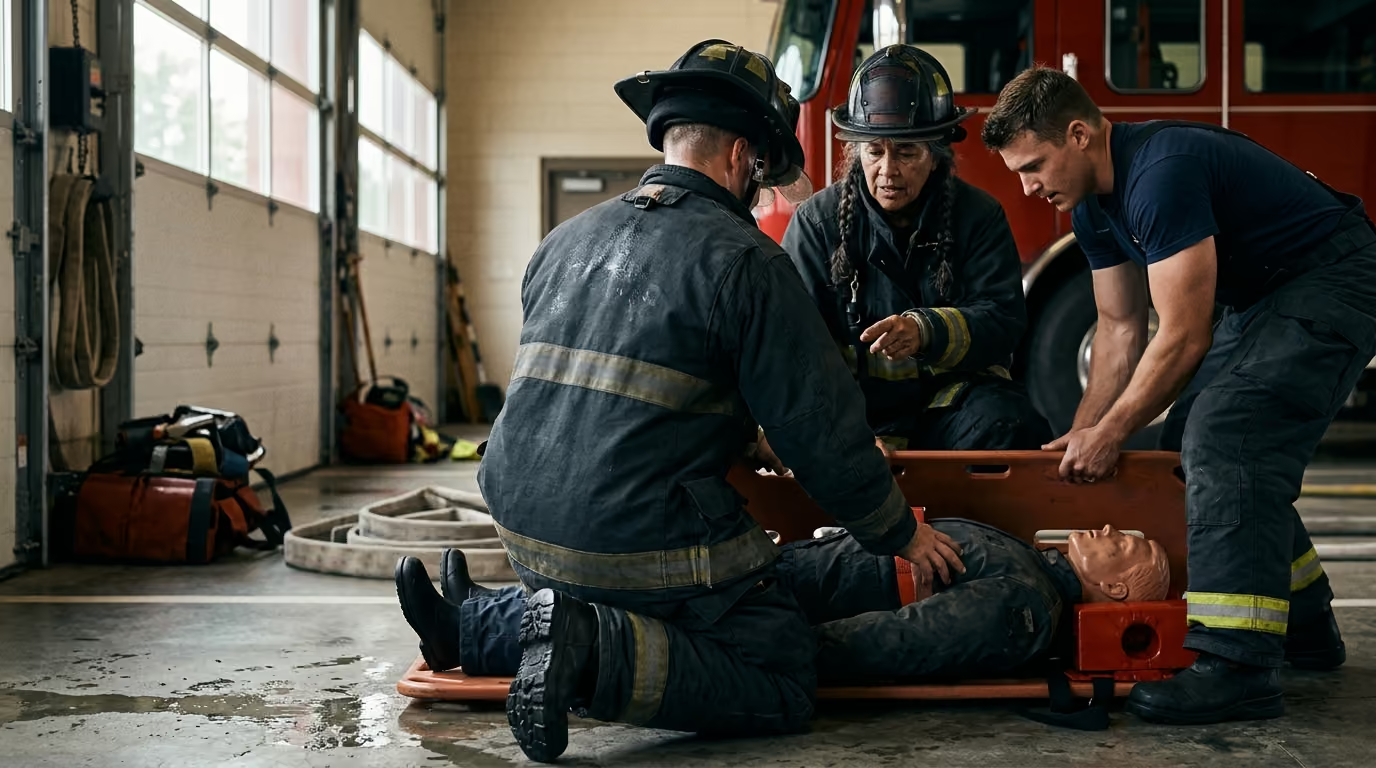

Protective gear weight seems like the main physical obstacle, but thermal strain and movement restrictions impose the greatest penalties on operational performance.





Conditioning exclusively in full turnout gear or tactical armor does not build elite operational resilience. It often degrades movement mechanics, accelerates thermal fatigue, and blunts physical adaptations before the target energy systems can adapt.
The primary goal of training in protective equipment is to build specific movement economy, manage thermal and respiratory strain, and eliminate wasteful compensatory mechanics. True operational capacity requires balancing unencumbered physical development with progressive, component-based equipment sessions that protect the nervous system and long-term joint health.
Operational readiness relies on a foundational formula:
Operational capacity equals raw physical capacity minus equipment cost minus environmental cost minus task inefficiency.
Protective equipment imposes an unavoidable physiological tax. Gear adds external dead weight, limits joint range of motion, elevates the work of breathing, and traps metabolic heat. When personnel attempt to solve this challenge through raw grit alone, they develop inefficient movement patterns such as lumbar twisting, breath holding, and overstriding. A structured, evidence-based approach prepares emergency personnel to maintain precision, cognitive focus, and work output under extreme physical burdens.
Protective ensembles save lives by shielding personnel from thermal extremes, toxic atmospheres, chemical hazards, and blunt impact. However, these systems create immediate physiological penalties that degrade physical performance. Understanding these burdens allows emergency professionals to program training that targets specific constraints rather than blindly accumulating fatigue.
The total weight of protective gear represents only a fraction of its true cost. The location of that mass relative to the body's center of mass dictates the mechanical and metabolic penalty.
Mass carried on the extremities increases the moment of inertia and demands far more energy than mass carried close to the spine. Stiff, heavy boots require substantial energy during the swing phase of every step. Equipment mounted far out on tactical vests, utility belts, or held in gloved hands multiplies torque across the hip, spine, and shoulder joints.
External load is the mechanical weight resting on the skeletal frame. Encapsulation is the thermal barrier created by multi-layer garments that prevents convective and evaporative cooling.
A responder can face severe physiological strain even under light mechanical loads if the protective ensemble restricts sweat evaporation. Sweating inside an impermeable barrier does not cool the body; it simply causes fluid and electrolyte loss. Training must separate load tolerance from thermal accumulation so that one stressor does not prematurely shut down adaptation to the other.
Protective clothing forces the body to expend more energy to perform a fixed amount of work. It simultaneously restricts the body from reaching its normal maximal aerobic ceiling.
Stiff fabrics resist joint articulation, forcing muscle groups to overcome garment stiffness with every stride or reach. Bulky gear alters normal gait kinematics, which increases stabilizing muscle activation. The result is a substantial increase in submaximal oxygen consumption combined with a reduced maximal work capacity.
Self-contained breathing apparatus (SCBA) and tight-fitting respirators impose resistance across both inhalation and exhalation phases. This increased work of breathing triggers early recruitment of accessory respiratory muscles, including the sternocleidomastoids, scalenes, and pectoralis minor.
Increased respiratory resistance can lead to rapid, shallow breathing patterns, early hyperventilation, and elevated sympathetic nervous system activation. This mechanical breathing strain creates a compounding loop where rising respiratory effort accelerates metabolic heat production, which further drives up ventilation demands and cardiovascular strain.
Peer-reviewed occupational physiology provides clear data regarding the exact physical decrements caused by protective gear. These findings highlight why standard gym fitness does not directly translate to encumbered readiness without deliberate preparation.
Research published in the Journal of Strength and Conditioning Research demonstrates the compounding degradation caused by individual protective components. A load-carrying condition alone produced a 38 percent drop in physical performance. Adding a respiratory protection device introduced an additional 4.6 percent decrement. When participants wore full protective equipment, total performance dropped by 44.5 percent.
These objective metrics show that unencumbered testing significantly overestimates actual work capacity on the fireground or tactical scene. General physical preparedness establishes the physiological ceiling, but equipment introduces severe performance degradation that requires targeted technical practice.
A systematic review examining firefighter protective equipment confirmed that encapsulating gear dramatically increases metabolic and cardiovascular stress. Wearing protective ensembles increases oxygen consumption during submaximal tasks by 22 to 33 percent compared to standard athletic attire. Simultaneously, the gear reduces measurable maximal oxygen uptake by 3 to 5 percent.
This metabolic compression means that a moderate physical task performed easily in station wear operates near threshold levels when performed in turnout gear. The cardiovascular system must work at elevated heart rates to supply working muscles while simultaneously directing blood flow toward the skin in an ineffective attempt at thermoregulation.
Operational reports and laboratory trials reveal that encapsulated heat stress often limits human performance before mechanical fatigue does. In controlled trials comparing exercise in 19 kilograms of firefighter gear across different ambient temperatures, peak heart rate reached approximately 180 beats per minute at 32 degrees Celsius, compared to 168 beats per minute at 22 degrees Celsius at the identical work rate.
Occupational health research demonstrates that wearing protective turnout gear with breathing apparatus imposes a thermal burden equivalent to adding 6 to 11 degrees Celsius to the ambient Wet Bulb Globe Temperature. Once an ensemble creates uncompensable heat stress where heat production exceeds environmental heat dissipation, adding extra layers does not produce a simple linear change in strain. The body has already lost the ability to balance its thermal budget.
Component-isolation research indicates that not all protective items impose equal physiological costs. In comparative trials evaluating the removal of specific equipment pieces during recovery, removing boots produced significant reductions in physiological strain markers, including heart rate, core temperature changes, skin temperature, and blood lactate accumulation.
Boots impose a disproportionate metabolic burden due to distal limb loading and ankle joint immobilization. Heavy, rigid footwear alters plantar feedback, reduces natural ankle rocker mechanics, and forces the hip flexors and knee extensors to work harder during movement. Addressing footwear ergonomics and practicing efficient lower-body mechanics yields substantial returns in energy conservation.
Biomechanical assessments show significant impairments in gait stability, stride cadence, base of support, and obstacle clearance regardless of the specific gear configuration worn. Heavy ensembles shift the total center of mass upward and outward, which delays corrective postural reflexes.
Compounding this stability loss, helmets and respirators restrict the lower peripheral visual field, preventing personnel from spotting trip hazards. Thick gloves remove fine tactile feedback, increasing the grip force required to hold simple tools. These factors demonstrate that trips, slips, and falls during operations stem from sensory and mechanical constraints rather than basic strength deficits.
Emergency personnel operate under unique organizational and environmental constraints that alter how equipment adaptations must be developed. Field training cannot mimic predictable athletic preparation due to the chaos of emergency response.
First responders do not control the timing of their physical output. A crew may step out of an air-conditioned apparatus into direct solar radiation or structure fire conditions after hours of low physical activity.
Under these conditions, cardiovascular strain escalates rapidly. Sweat generated during heavy labor remains trapped against the skin, saturating base layers and eliminating the cooling benefits of airflow. Integrating proper injury prevention and physical recovery strategies ensures personnel can dissipate accumulated heat before the next dispatch.
Emergency service schedules involve interrupted sleep, overnight dispatches, and prolonged physical exertion. Performing heavy equipment conditioning while in a state of acute sleep debt dramatically elevates perceived exertion and reduces core temperature tolerance.
Sleep deprivation impairs autonomic regulation, leading to elevated resting heart rates and blunted heart rate variability. When unmanaged, executing high-intensity loaded conditioning on shift compounds systemic inflammation and increases musculoskeletal injury risk. Using a clear shift work training decision framework helps crews determine whether to execute high-output equipment drills or prioritize restoration.
Unlike athletes who peak for scheduled events, first responders face unpredictable call volumes. A structural fire or prolonged rescue operation may demand hours of continuous work in full gear without warning.
This reality requires responders to maintain wide physiological reserves. Work capacity built in training must exceed average call demands so that emergency calls do not operate at the absolute limit of physical tolerance. Smart duty fitness programming focuses on expanding this buffer without running the worker into exhaustion during routine station shifts.
When protective equipment restricts normal joint articulation, the human body instinctively seeks alternative movement pathways to complete the task. These compensations get the job done in the short term, but they distribute mechanical stresses onto vulnerable spinal structures and passive connective tissues.
Bulky bunker pants and stiff boots restrict hip extension and ankle dorsiflexion. Responders frequently compensate by adopting a wide, waddling gait, overstriding, and striking heavily on their heels.
Overstriding increases braking forces through the knees and hips while decreasing dynamic stability on slick or uneven surfaces. Personnel must be coached to maintain a compact base of support, land with the foot underneath their center of mass, and rely on a higher cadence of short, deliberate steps rather than reaching with extended strides.
Protective vests and air packs alter spinal positioning, making standard hip hinge mechanics feel awkward. When lifting tools, charged hose lines, or simulated casualties, personnel often round their lumbar spines and initiate pulls with back extension rather than hip drive.
Adding rotational shear stress while lifting under load is a leading mechanism for disc and ligament tears. Responders must practice setting a neutral spine before initiating movement, positioning their feet closer to the object, and turning the entire body using small foot adjustments rather than twisting the torso under load.
The mass of an air pack or body armor places continuous downward pressure on the shoulder girdle. Responders commonly react by excessively shrugging their shoulders, keeping the upper trapezius and levator scapulae under chronic isometric tension.
This continuous elevation restricts upper thoracic movement, cramps neck mobility, and impairs efficient breathing mechanics. Personnel should actively practice depressing and retracting their scapulae, relaxing the neck, and allowing the structural harness of their gear to distribute load across the pelvis and thoracic cage.
Under heavy loads or difficult tasks, the natural human impulse is to execute a prolonged Valsalva maneuver by holding the breath against a closed glottis. While this creates momentary intra-abdominal pressure, continuous breath-holding under respiratory gear rapidly increases intrathoracic pressure, spikes blood pressure, and accelerates hypercapnia.
Breath-holding quickly causes panic, lightheadedness, and premature air consumption. Responders must learn rhythmic breathing patterns, coordinating exhalation with the exertion phase of lifts, drags, and climbs while maintaining stable abdominal bracing.
Movement breakdowns occur most frequently during positional transitions, such as moving from standing to kneeling, crawling to standing, or navigating tight obstacles. Encumbered workers often drop heavily onto their knees or use awkward single-leg lunges that torque the knee joint.
Training must explicitly teach controlled transition mechanics. Responders should practice stepping through transitions with stable three-point stances, using structural supports when available, and keeping loads centered during elevation changes.
Developing durable capacity for working in protective gear requires a structured, multi-component training plan. Developing strength, endurance, movement skill, and thermal tolerance together produces balanced operational capability.
An expansive aerobic base is the foundation of operational performance. A robust aerobic system supplies oxygen efficiently to working muscles, accelerates lactate clearance, and drives systemic recovery between intense bursts of work.
Aerobic capacity should primarily be built through unencumbered, low-impact modalities like cycling, rowing, incline walking, and swimming. Training without gear allows high cardiac output and mitochondrial development without accumulating joint wear or thermal stress. Responders should maintain two to three Zone 2 cardiovascular sessions weekly, keeping heart rates within 60 to 70 percent of maximum for 30 to 60 minutes.
Emergency operations rarely follow a steady pace. Work occurs in sharp, demanding bursts of dragging, breaching, lifting, and climbing, separated by brief pauses.
Conditioning must develop the ability to repeat high-output efforts without experiencing catastrophic drops in movement quality. Interval training should feature work-to-rest ratios mirroring operational profiles, such as 30 to 60 seconds of high-effort work followed by 60 to 90 seconds of active recovery. These sessions train the anaerobic pathways to clear metabolites and restore phosphocreatine reserves while under cardiovascular demand.
Muscular strength provides the physical reserve that makes heavy gear feel lighter. If an equipment ensemble weighs 25 kilograms, that weight represents a much lower percentage of maximal strength for an individual with a 150-kilogram deadlift than for an individual with an 80-kilogram deadlift.
Strength training should focus on multi-joint compound patterns:
Personnel must learn to move smoothly despite restricted peripheral vision, reduced auditory cues, and blunted tactile sensation. Movement drills should expose the body to asymmetrical stances, uneven surfaces, and varied center-of-mass shifts.
Incorporate ground-to-standing transitions, crawl patterns, stepping over hurdles, and working in half-kneeling positions into warm-ups and skill blocks. Responders should practice handling tools while wearing structural gloves to build manual dexterity and grip endurance without looking directly at their hands.
Thermal and gear tolerance must be built gradually. Never attempt to force heat adaptation through extreme, uncontrolled dehydration or dangerous overheating.
Conditioning with gear should be introduced progressively, starting with clean, breathable training vests before transitioning to actual protective garments in temperature-controlled environments. Heat tolerance develops through gradual exposure, allowing blood plasma volume to expand, sweat rates to optimize, and cardiovascular stability to adapt without dangerous internal temperatures.
A common coaching error is jumping straight from standard gym clothes into full-gear, maximum-effort circuits. This sudden transition causes form breakdown and hides the true source of physical failure. Using a four-stage progression introduces equipment stressors one at a time.
In this initial phase, the responder masters the fundamental movement patterns in standard athletic clothing. Focus entirely on pristine spinal alignment, deep hip hinge mechanics, steady breathing, and smooth footwork.
Introduce individual gear items one at a time to identify specific movement restrictions. This component-isolation method reveals how individual pieces alter mechanics before the full ensemble masks the root cause.
Combine all protective equipment into a unified setup, but conduct the training session within a cool, well-ventilated training area. This isolates the combined mechanical, balance, and respiratory constraints of the full system without the confounding danger of uncompensable heat stress.
Once movement technique and pacing are consistent in full gear, introduce realistic operational demands, variable environments, and task complexity.
Understanding the principles of balancing structured physical training and short readiness sessions allows departments to maintain this progressive integration without burning out crews on shift.
To implement these concepts, training should use practical, structured workout templates. These field-tested sessions build physical capacity, reinforce movement economy, and prioritize worker safety.
This workout builds posterior chain endurance, grip durability, and upright postural stability under load while keeping thermal strain low.
This workout trains lower-body power endurance, breathing control under respiratory resistance, and positional transitions.
This session develops sustainable pacing, reduces wasted movements, and helps responders avoid going out too hard early in an incident.
Heat management is not a soft comfort issue; it is a critical safety control. When internal temperatures rise uncontrollably, fine motor control deteriorates, cognitive decision-making fails, and cardiac risk increases dramatically.
Thermal stress behaves like training volume: it accumulates with time, work intensity, and environmental humidity. Conditioning programs must treat heat exposure with the same planning used for sets and reps.
A workout performed in 15-degree dry weather cannot be repeated with the same volume or density in 32-degree humid weather. In humid conditions, the air is saturated with water vapor, preventing sweat from evaporating. Work intervals must be shortened, rest periods lengthened, and cooling stations prepared in advance.
Rehabilitation guidelines established by the United States Fire Administration (USFA) and NFPA 1584 provide clear operational baselines that should be integrated directly into training sessions:
Active cooling gear, including ice vests and cold water forearm immersion troughs, provides real physiological support. However, research highlights their limitations.
A controlled study examining wildland firefighters demonstrated that while cooling vests lowered skin temperature, perceived exertion, and subjective thermal sensation, they did not significantly increase total exercise tolerance time. Cooling tools make personnel feel more comfortable, but they do not automatically reset internal physiological strain. Active cooling must support, rather than replace, scheduled work-rest rotations and exposure limits.
To sustain physical capability across an entire career, recovery must be managed across three distinct time frames:
Broad training guidelines cannot account for every operational scenario. Specific physiological and environmental edge cases require customized training adjustments to keep personnel safe.
In high-humidity environments, sweat runs off the skin without evaporating, draining body fluids without lowering internal temperatures.
When training in humid heat, remove encapsulating jackets during rest breaks immediately. Provide shaded recovery zones with active airflow, monitor body weight changes to verify fluid balance, and use electrolyte solutions rather than plain water for sessions lasting longer than 60 minutes.
Responders recovering from recent viral respiratory infections, or those with underlying airway reactivity, face elevated risks when working under respiratory resistance.
The added breathing work of an SCBA regulator can trigger bronchospasm, early respiratory fatigue, or panic. Individuals returning from respiratory illnesses should clear unencumbered cardiovascular assessments before wearing respiratory equipment under load.
Ill-fitting equipment introduces severe musculoskeletal strain. Oversized boots cause blisters and alter normal foot mechanics, leading to plantar fasciitis and shin splints.
Loose tactical vests or poorly adjusted SCBA harnesses cause the load to swing away from the body, multiplying shear forces on the lumbar spine. Ill-fitting helmets force the neck into constant extension, fatiguing the cervical spine. Equipment fit must be inspected regularly as an active injury-prevention measure.
Hydration requires balance. Drinking too little fluid leads to rapid dehydration, elevated core temperatures, and cardiovascular strain. Conversely, drinking excessive amounts of plain water during prolonged sweating can cause exercise-associated hyponatremia, a dangerous drop in blood sodium concentrations.
NIOSH recommends consuming cool, balanced electrolyte and carbohydrate beverages during intense physical labor lasting longer than 90 minutes. Personnel should aim for regular, small fluid intakes during rehabilitation rather than chugging large volumes of water at once.
Confined-space operations magnify every physical and mental constraint. Movement is restricted, visibility is minimal, and doffing gear is impossible while inside the hazard area.
Training for confined spaces must emphasize deliberate, slow-cadence movement and low-frequency breathing control. Rushing in a confined space spikes air consumption and triggers acute anxiety, accelerating physical exhaustion.
Working under heavy loads, encapsulating clothing, and respiratory resistance places unique demands on the human body. Personnel and instructors must know when symptoms indicate an underlying medical issue requiring professional healthcare evaluation.
Stop training immediately and refer the individual to an occupational physician or licensed healthcare provider if they experience any of the following signs:
Never allow an individual who experienced acute heat exhaustion, severe dehydration, or a musculoskeletal injury during equipment training to return to active duty without formal medical clearance.
Rushing a compromised responder back onto the truck puts the individual, their crew, and the public at risk. Rehabilitation must verify that movement mechanics, cardiorespiratory function, and thermal regulation have returned to baseline.
Training in protective equipment is an essential component of operational readiness, but it must be applied with purpose and precision. Grinding through full-gear workouts without attention to movement quality, thermal accumulation, and component mechanics produces broken responders rather than capable ones.
By building an expansive aerobic engine, developing compound strength, eliminating compensatory movement, and systematically managing thermal exposure, emergency personnel can perform safely in the most hostile environments.
True operational capability means moving with precision, keeping your cool under thermal strain, and protecting your body to ensure a long, healthy career.
Stay connected for research-led guidance on duty fitness, shift-work sleep, injury recovery, stress, nutrition and career longevity. Practical ideas for first responders who want to stay capable on the job, recover well and protect their health for the long run.



Read practical guidance on first responder fitness, recovery, sleep, nutrition and resilience for demanding work and a long, active career.
read the blog



