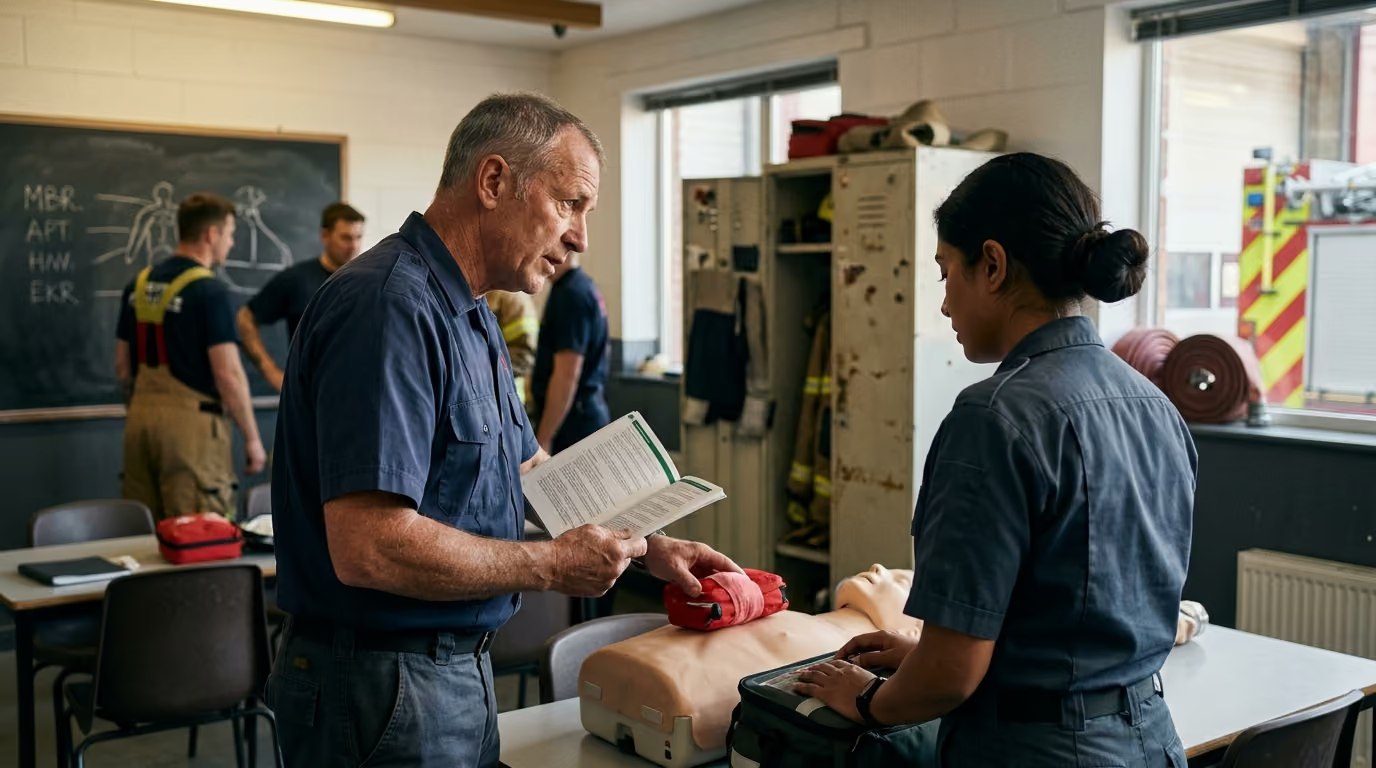

Stepping away from emergency service creates space for meaningful community work through a structured framework that protects health and prevents volunteer burnout.





If you are in immediate danger, call 911. For 24/7 support, call or text 988 and press 1 for the Veterans Crisis Line, or text 838255.
Volunteering after an emergency services career is not a direct continuation of operational duty under an unpaid title. It is a structured transition process designed to preserve purpose, social connection, and mental sharpness while protecting physical health, family life, and personal recovery.
Retirement from firefighting, law enforcement, emergency medical services, dispatch, or corrections involves a profound shift in routine, status, and daily community impact. Many retiring responders assume their choices are limited to either staying immersed in high-intensity operational roles or stepping away from service entirely.
A sustainable approach builds a balanced service portfolio. It allows retired personnel to apply their hard-earned skills, learn new disciplines, and support their communities without reproducing the chronic stress, irregular hours, and physical breakdown of their former careers.
A successful volunteer commitment in retirement should support your health and lifestyle rather than acting like an uncompensated full-time job. Research indicates that moderate service of roughly two hours per week provides significant physical and psychological benefits without accelerating burnout.
The ideal volunteer role aligns with your current personal values, respects your medical limitations, and establishes clear boundaries around time and emotional exposure. Service should remain entirely flexible, allowing you to pause or adjust your commitment whenever family, health, or recovery needs require it.
The relationship between volunteer service and long-term health is well documented across multiple disciplines. Large-scale umbrella reviews of volunteer literature indicate consistent benefits across physical, mental, and social health domains. These reviews identify lower mortality rates, improved physical functioning, reduced depressive symptoms, and higher overall life satisfaction as common outcomes among older adult volunteers.
The evidence base is primarily observational and longitudinal. It highlights that the positive effects of volunteering are strongly influenced by the age of the participant, their underlying motivations, and the structural design of the volunteer role.
Longitudinal research evaluating older adults indicates that volunteer volume follows a clear pattern of diminishing returns. Studies demonstrate that individuals volunteering at least 100 hours per year, which averages approximately two hours per week, experience lower risks of physical limitations and reduced mortality compared to non-volunteers. This level of participation is associated with higher physical activity, increased optimism, a stronger sense of purpose, and lower rates of loneliness.
However, the data reveals a curvilinear relationship. Volunteering beyond a moderate threshold does not produce linear health gains and can lead to role strain if it infringes upon rest and personal relationships.
Occupational health research focused on public safety personnel emphasizes that retirement requires deliberate planning. A scoping review of mental health across emergency careers shows that support systems must operate before and after retirement rather than stopping at the final shift. Transition data from public safety retirees confirms that voluntary or paid community work helps validate personal competence, mitigates the loss of station camaraderie, and improves quality-of-life scores.
At the same time, occupational studies on volunteer well-being reveal critical risk factors. Roles characterized by severe emotional demands, continuous exposure to crisis narratives, and high role ambiguity show strong associations with volunteer exhaustion, anxiety, and psychological burnout. Service is beneficial when it is structured and supportive, but it becomes harmful when it replicates the unregulated stress of an emergency career.
Leaving public safety is rarely just an administrative event. It represents the sudden departure from a distinct operational culture that provided identity, mission clarity, structured authority, and tight peer bonds.
Many first responders experience an acute identity void upon retirement. The desire to fill that void quickly can drive individuals toward volunteer positions that recreate the exact conditions that caused physical and emotional strain during their careers.
Operational habits often complicate the volunteer experience. Responders are trained to accept responsibility during crises, work through fatigue, and prioritize the mission above personal comfort.
When applied to unstructured volunteer environments, these traits can lead to severe overcommitment. Non-profit organizations and volunteer groups frequently lean on retired responders for leadership, incident management, and continuous staffing. Without firm boundaries, a retiree can quickly find themselves managing operational crises, resolving interpersonal conflicts, and sacrificing the autonomy retirement was intended to provide.
Emotional exposure is another critical consideration. Decades of responding to severe trauma, medical emergencies, domestic violence, and fatal accidents accumulate over a career.
Stepping into volunteer roles that involve regular contact with human suffering, such as crisis hotlines or disaster recovery, can reactivate stress responses. When planning your long-term wellness, review post-service career longevity strategies to understand how cumulative operational strain impacts your transition into civilian life.
Identity diversification is the most effective counterweight to these operational risks. Relying solely on the responder persona for self-worth limits personal growth and increases vulnerability to transition stress.
Sustainable volunteering allows retirees to view themselves as mentors, educators, conservationists, or community organizers. The operational past remains an asset, but it no longer serves as the sole definition of personal capability.
Developing a sustainable volunteer plan requires a structured, step-by-step decision framework. Rather than saying yes to the first organization that requests help, retirees should evaluate prospective roles through an objective screening process.
Before looking at available opportunities, define what you want this stage of service to accomplish. Clarifying your intent prevents you from accepting positions out of habit or social obligation.
Ask yourself these foundational questions:
Capacity is not static. It must be evaluated based on your typical week rather than your best, most energetic days. Review your limits across these specific categories:
Use a simple numerical scale from 0 (negligible) to 3 (high) to rate prospective volunteer roles across operational factors. Score each of the following elements:
A role that scores a 2 or 3 across several categories presents high operational intensity. It should not be accepted as a permanent commitment without an initial trial phase.
Avoid jumping directly into leadership, coordination, or high-volume operational shifts. Move through progressive stages to evaluate organizational fit and personal recovery:
Track how you feel during the 48 hours following a volunteer shift. A sustainable role should leave you feeling useful, neutral, or comfortably tired.
If a volunteer shift leads to persistent joint pain, sleep disruption, irritability with family members, or intrusive memories, the operational cost is too high. If you notice persistent sleep issues, explore our guide on managing shift work sleep debt to re-establish healthy circadian patterns in retirement.
Establish personal boundary markers before starting any role. These rules outline the exact conditions under which you will reduce your hours, take a formal leave, or resign:
Volunteer positions vary dramatically in structure, physical demand, and emotional load. Categorizing opportunities helps you select a role that matches your specific retirement objectives.
Many retirees want to maintain a connection to emergency response without returning to frontline shift work. Local emergency management agencies, historical preservation committees, and community response networks offer structured options.
The Community Emergency Response Team (CERT) program, coordinated through FEMA, represents a formalized pathway. CERT trains community members in basic disaster response skills, including fire safety, light search and rescue, team organization, and disaster medical operations.
While federal independent study courses provide introductory theory, local government agencies provide the required classroom and practical training. Prior career experience is an asset, but retirees must follow current local standard operating procedures and credentialing standards.
Beyond field response, emergency-related volunteering includes:
Supporting active-duty colleagues through peer networks can be deeply rewarding. Retired responders possess credibility, shared language, and an intuitive understanding of the occupational burden.
Peer support is not clinical therapy, formal crisis intervention, or open-ended casework. Federal guidance from the Substance Abuse and Mental Health Services Administration (SAMHSA) emphasizes that responder peer support must operate within structured parameters. Safe peer support programs require:
Without these safeguards, retired peer supporters risk secondary trauma, compassion fatigue, and the unrealistic burden of acting as an unofficial crisis line.
Working with youth allows retirees to pass on practical knowledge, instill civic values, and maintain active community engagement. Common outlets include junior firefighter programs, police explorer posts, search and rescue cadences, high school sports, and vocational training initiatives.
Effective youth leadership requires clear operational boundaries and institutional safeguarding policies:
Community safety initiatives allow retirees to leverage their technical expertise in low-stress, educational environments. These roles focus on proactive risk reduction rather than reactive emergency response.
Examples of prevention-focused community roles include:
These programs preserve the public service aspect of the job while completely eliminating night shifts, physical lifting hazards, and dynamic scene chaos.
Serving in social service settings provides broad community perspective. Organizations like food banks, community kitchens, housing coalitions, and elder support agencies rely heavily on reliable volunteer labor.
National service structures, such as AmeriCorps Senior Companion programs, demonstrate how structured civic assistance operates. Volunteers provide non-medical companionship, assist with grocery access, and provide transportation for medical visits.
These roles deliver high social connection, but retirees must evaluate the physical requirements of driving, lifting, and prolonged standing before committing.
Retirement offers an opportunity to step entirely outside the public safety ecosystem. Choosing a completely unrelated cause supports identity diversification and eliminates the risk of career-related stress triggers.
Rewarding non-operational volunteer paths include:
Engaging with completely new peer groups provides fresh perspectives, builds new social circles, and reinforces personal identity beyond the badge or uniform.
Transitioning from professional emergency services to volunteer work contains subtle pitfalls. Recognizing these common errors helps you maintain balance and protect your well-being.
Responders are accustomed to 40, 56, or 80-hour work weeks. Retiring personnel often try to fill every blank space on their calendar with volunteer commitments.
Research clearly shows that volunteer benefits peak at moderate levels of participation. Overcommitting recreates the chronic fatigue, calendar congestion, and personal neglect that retirement is designed to resolve.
Retired officers, fire officers, and senior paramedics possess extensive field judgment. However, entering a volunteer organization with the assumption that professional experience supersedes local policies causes friction.
Volunteer non-profits operate under different legal structures, risk management models, and cultural norms. Approach new organizations with humility, complete all required onboarding, and respect existing leadership frameworks.
Some retirees throw themselves into peer support or crisis volunteering to work through their own unresolved career trauma. While helping others can be meaningful, raw or untreated post-traumatic stress cannot be resolved by taking on other people's pain.
Engaging in emotionally demanding support work while vulnerable increases the risk of secondary traumatic stress. Prioritize your own psychological health and clinical care before attempting to support others through acute crises.
Retirees sometimes adopt an all-or-nothing mindset. Some force themselves into high-intensity response roles to prove their capability, while others cut off all contact with former colleagues and civic organizations.
Both extremes create problems. The healthiest transition involves deliberate experimentation, allowing you to stay connected to meaningful causes while filtering out destabilizing operational exposures.
Non-profit boards and community groups frequently recruit retired public safety leaders for executive, coordinator, or board positions. While flattering, stepping immediately into high-level governance recreates administrative friction, personnel management headaches, and liability concerns.
Serve as a frontline participant for at least six months before deciding whether you want to take on organizational governance.
Volunteering is not entirely free. Unreimbursed expenses can accumulate rapidly across long-term commitments.
Calculate the total financial impact of fuel, vehicle wear, uniform purchases, protective equipment, specialty tools, and continuing education certifications. Ensure the financial investment aligns comfortably with your retirement budget.
Every retirement transition involves unique physical, psychological, and personal variables. Structuring a sustainable service plan requires adjusting for specific personal constraints.
Retirees navigating musculoskeletal injuries, degenerative joint disease, respiratory conditions, or cardiovascular limitations must carefully screen volunteer physical demands. Field response, wildland conservation, or heavy warehouse work can exacerbate existing injuries.
Adapted service pathways allow injured personnel to contribute high-level value without physical strain:
When navigating daily physical limitations, focus on evaluating duty readiness and accumulated fatigue to ensure your physical baseline remains protected.
Retiring in the wake of a catastrophic line-of-duty death, major community disaster, or accumulated cumulative stress requires an extended decompression period. Entering volunteer positions that involve emergency radios, sirens, triage scenarios, or high-conflict environments can trigger acute stress reactions.
During the initial post-retirement phase, prioritize restorative environments. Focus on low-arousal volunteer activities, such as environmental conservation, trail maintenance, library curation, or animal welfare.
These settings provide structure and social contact without activating the sympathetic nervous system. You can practice practical stress regulation methods to keep your baseline calm while engaging in community settings.
First responder cultures historically carried strong norms around alcohol use as a primary coping mechanism. Personnel in active recovery from alcohol or substance-use disorders must evaluate volunteer environments carefully.
Avoid volunteer positions that involve evening social events where alcohol is prominent, roles with unsupervised access to means, or high-stress crisis positions that spike acute anxiety.
Select positions that offer fixed daytime hours, clear accountability, healthy social boundaries, and strong operational structure.
Retirement frequently coincides with major family responsibilities, such as caring for aging parents, supporting an ill spouse, or assisting with grandchildren. Structured weekly volunteer shifts can clash with caregiving duties.
Choose project-based, episodic, or fully flexible volunteer models. Tasks like community event planning, seasonal preparedness fairs, or remote administrative support can be completed around family schedules without guilt or missed deadlines.
Former police officers, corrections personnel, and regulatory inspectors may encounter community settings marked by historical mistrust of public safety institutions.
Entering community-based non-profits requires humility, active listening, and a non-authoritarian posture. Recognize that uniform authority does not apply in civilian volunteer spaces.
Focus on building trust through quiet, dependable execution of assigned support tasks.
Deploying to regional or national disasters with non-governmental organizations involves austere conditions, interrupted sleep, rough physical terrain, and high emotional density.
Before committing to a deployment team, confirm the organizational logistics:
Before signing volunteer agreements or committing to a regular schedule, review this operational checklist with the host organization leadership.
A sustainable volunteer commitment requires ongoing self-monitoring. Set aside five minutes at the end of every month to score your volunteer experience across five core metrics on a 1 to 5 scale:
Evaluate your monthly scores using these simple decision rules:
For broader context on structuring your post-service wellness, review our comprehensive career longevity and retirement transition resources.
Volunteering provides social connection, physical routine, and community impact. It is not, however, a substitute for professional healthcare, psychiatric treatment, or structured retirement counseling.
Entering a volunteer position while experiencing significant, untreated mental or physical health symptoms can worsen your condition.
You should prioritize evaluation by licensed medical or mental health professionals under the following circumstances:
Professional clinical care establishes the physical and emotional baseline necessary to make community volunteering enjoyable, safe, and sustainable over the long term.
No. While decades of emergency response experience provide valuable field instincts and operational familiarity, every organization operates under distinct legal authorities, safety policies, and operational structures.
Programs like FEMA CERT or search and rescue units require specific baseline certifications, local incident command system compliance, and classroom training. View your professional past as a foundation, and embrace local onboarding protocols fully.
Provide professional, written notice to your volunteer coordinator well in advance. Express gratitude for the opportunity to serve, outline the specific date your service will end, and complete any pending documentation or equipment returns.
You do not need to justify your departure with extensive personal explanations. Simply stating that your personal schedule and family commitments require you to step down is completely acceptable.
Peer support relies on shared experience, active listening, and mutual understanding to normalize stress reactions and offer practical navigation of departmental or retirement challenges. It operates under strict boundaries and does not involve diagnosing conditions, developing clinical treatment plans, or providing psychotherapy.
Professional counseling is delivered by licensed mental health clinicians who use evidence-based therapeutic modalities to treat clinical conditions such as post-traumatic stress, major depression, and anxiety disorders.
Research indicates that starting with a modest commitment of two to four hours per week provides significant psychological and physical health benefits without overwhelming your schedule.
Begin at this low volume for the first two to three months. This allows you to evaluate how the activity impacts your sleep, recovery, joint health, and family routines before you consider adding any additional hours.
Sustainable volunteering after emergency service is not about proving your endurance or clinging to former operational status. It is about deliberately applying your capability where it is valued, while ruthlessly protecting the health, relationships, and freedom you earned across your career.
Stay connected for research-led guidance on duty fitness, shift-work sleep, injury recovery, stress, nutrition and career longevity. Practical ideas for first responders who want to stay capable on the job, recover well and protect their health for the long run.



Read practical guidance on first responder fitness, recovery, sleep, nutrition and resilience for demanding work and a long, active career.
read the blog



