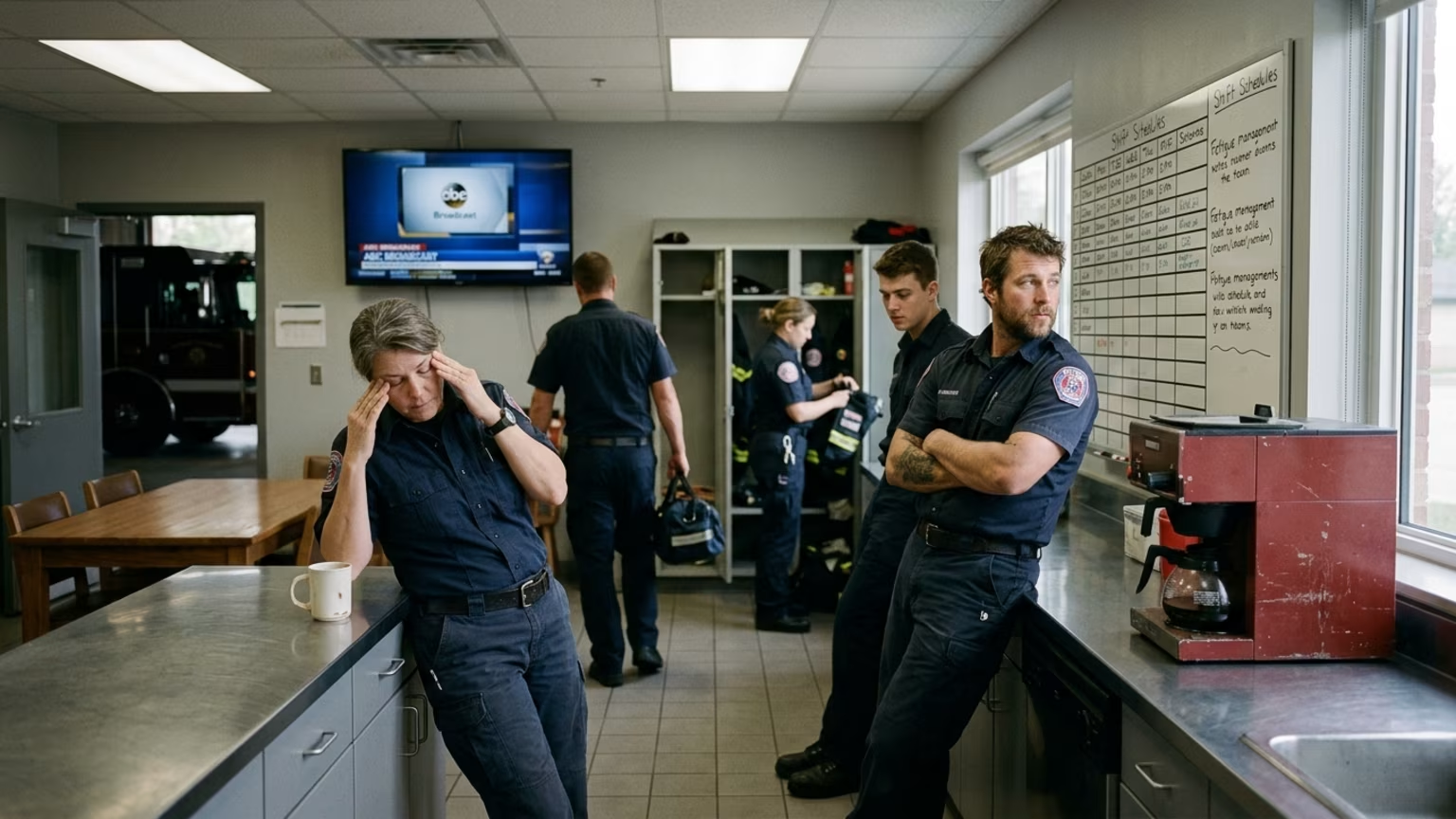

An ABC health broadcast reviewed shift work sleep risks for first responders. Review the validated recovery protocols, nap rules and circadian strategies.





On September 22, 2026, the ABC health segment What’s That Rash? reviewed the effects of night and rotating work on sleep and health for police and ambulance personnel. Presented by Tegan Taylor and physician Norman Swan, the broadcast detailed how irregular schedules interfere with biological clocks and provided practical fatigue countermeasures.
The ABC broadcast focused heavily on the mechanics of circadian strain. Swan explained that human tissues follow internal biological clocks. These clocks are synchronized almost entirely to the natural day and night cycle. Night work demands sustained alertness and physical exertion precisely when biological signals are promoting sleep.
This fundamental conflict explains why daytime rest is substantially poorer for emergency workers. Personnel must attempt to sleep against the presence of daylight and ordinary household activity. This biological mismatch extends beyond simple tiredness. Night workers often face reduced physical activity and a higher risk of weight gain because of these altered patterns.
The program detailed several documented associations between shift work and severe long-term health outcomes. These included an increased breast cancer risk in women and a higher likelihood of cardiovascular disease. The broadcast also noted elevated rates of digestive complaints, obesity, diabetes and negative mental health effects. However, the hosts stressed that these associations do not prove night work alone causes these conditions.
Isolating shift work as a single cause is clinically difficult. Other contributing factors like poor diet and physical inactivity heavily complicate the available data. High workplace stress, smoking, social isolation and household interruptions also play major roles in responder health. The ABC segment highlighted fatigue-related road safety as an immediate and pressing concern.
This risk spikes significantly when a worker drives home after a tiring night shift. The discussion explicitly identified police and ambulance personnel among the occupations that rely heavily on night work. The segment grouped these responders alongside airline staff and healthcare workers who face similar biological demands. When evaluating the scope of this issue, accurate workforce data remains critical for understanding the overall impact.
The page's published text contained a corrupted workforce statistic, displaying fragmented wording like "15% 20" and "up to a fifth of the workforce." Because the exact percentage appears corrupted in the text, it should not be reproduced as a clean statistic without verifying the original audio broadcast.
The broadcast reinforced the necessity of treating roster design as a core recovery variable. General medical advice strongly prefers predictable schedules over chaotic or constantly shifting duty hours. Swan advised that a predictable forward sequence is the safest approach when schedule rotation is absolutely necessary. This means moving sequentially from a morning shift to an afternoon shift and then to a night shift.
Abrupt or random transitions severely damage the body's ability to achieve circadian adaptation. Moving directly from a morning shift to a night shift forces the biological clock into a state of acute confusion. Predictability gives emergency personnel the critical advance notice needed to adjust their sleep timing before a night rotation begins. Personnel can support this process by building a structured sleep plan designed for extended tours.
While forward rotation represents expert medical guidance, the broadcast did not present it as a universal operational standard. The commonly discussed roster in the segment consisted of three roughly eight-hour periods. These periods covered morning, afternoon and night coverage. However, the program recognized that this exact configuration does not apply to all emergency service organizations.
The primary objective remains practical risk reduction. Eliminating night work entirely is impossible for police officers, firefighters and ambulance crews. Any sleep advice must account for the harsh operational reality of emergency services. Ambulance call volume, police critical incidents and unexpected fire alarms routinely destroy theoretically ideal sleep windows.
Mandatory overtime and long commuting times further shrink the available hours for physical recovery between active shifts. The ABC discussion places the responsibility for predictable scheduling partly on employers, recognizing that schedule changes cannot compensate for inadequate staffing.
While medical experts support predictable rosters, applying mathematical prediction to emergency schedules remains highly complex. A systematic review of biomathematical fatigue models in emergency medical services highlighted severe evidence gaps. The review found insufficient high-quality evidence to support the direct application of these models to ambulance operations. Researchers identified only one eligible peer-reviewed study on the subject.
This critical evidence gap matters deeply for departments attempting to automate their scheduling systems. A fatigue prediction software model might appear technically advanced without having been adequately validated in actual field conditions. Relying solely on automated scores to manage fatigue carries significant operational risk until more rigorous research emerges. True fatigue mitigation requires more than just algorithmic scheduling software.
Organizations must combine any technical tool with protected rest opportunities and responsive field supervision. Department leaders should consider fatigue reporting systems and strict limits on excessive work duration. However, the available medical evidence does not prove that any single fatigue model is universally effective across emergency medical services. Operational leaders must critically evaluate commercial scheduling tools before fully integrating them into their dispatch protocols.
The ABC broadcast outlined several individual countermeasures to help emergency personnel manage irregular duty hours. These actionable strategies target the immediate physical demands of night work and the transition back to daytime rest.
Napping before a night shift can noticeably improve baseline alertness for emergency responders. The segment noted that this strategy is highly relevant for police, doctors, nurses and airline staff. However, the program did not establish that a single nap duration works perfectly for every individual. Workload and the opportunity to sleep after the shift remain important practical caveats.
For personnel who are too fatigued to drive safely after duty, the advice was highly specific. The program recommended finding a quiet place for a short 10-minute nap before continuing the journey. A brief nap may reduce immediate sleepiness, but it is not equivalent to full recovery from accumulated sleep debt. It should never be treated as proof that a severely fatigued worker is fully fit for safety-critical duties.
Artificial light serves as a powerful biological tool when managing night work. Deliberate light exposure can effectively support sustained alertness during the active work period. However, personnel must intentionally reduce bright morning light exposure immediately after a night shift concludes. The program recommended wearing sunglasses on the journey home to make it easier to wind down.
Keeping the bedroom entirely dark is also crucial for supporting adequate daytime sleep.
Caffeine should be treated as a temporary alertness aid rather than a substitute for actual sleep. Swan recommended using small amounts of caffeine, like tea or a single coffee shot, rather than unrestricted consumption. The program advised stopping caffeine approximately two to three hours before intended sleep to protect daytime rest. This specific recommendation differs from some first responder guidance that advises an even longer cutoff period.
The safest practical rule is to observe how long caffeine remains active for the individual user. Workers must prioritize protecting their planned sleep window above all else. ABC acknowledged that evidence about caffeine use during waking hours and its effect on subsequent sleep remains limited. Emergency personnel should front-load their caffeine intake early in the shift to minimize lingering metabolic strain.
Irregular eating patterns heavily impact the overall health and recovery of shift workers. Swan advised maintaining regular meals as much as practically possible. This rule applies even when the clock time of those meals completely differs from a standard daytime schedule. Preparing nutritious meals in advance makes personnel less dependent on limited or unhealthy overnight food options.
Proper meal planning supports maintaining steady energy during unpredictable shifts. This approach directly reinforces the value of using practical meal frameworks to maintain steady energy on unpredictable schedules.
The broadcast examined how physical exercise interacts with shift work and operational alertness. Exercise was described as generally beneficial for overall health and potentially useful for maintaining alertness during sluggish periods. However, the evidence regarding the best timing for exercise relative to a night shift remains mixed. Workers must experiment carefully so pre-shift workouts do not leave them physically exhausted before their duty begins.
When behavioral adjustments fail, the segment provided specific guidance on medical interventions and sleep aids. ABC strongly discouraged the routine reliance on sleeping pills to force the body to adapt to rotating shifts. The program distinguished melatonin from conventional chemical sedatives, noting its specific role in managing circadian strain. The hosts advised workers to discuss persistent sleep problems, melatonin use or any medication with a general practitioner.
Repeated inability to sleep, loud snoring or witnessed breathing pauses require professional medical assessment. Workers should avoid aggressive self-experimentation when dealing with these severe symptoms.
The medical understanding of occupational fatigue continues to develop far beyond general shift work advice. A separate report on emergency physicians provided interesting insights into sleep outcomes. This pilot study found that changing the timing of overnight work was associated with lower inflammatory markers. The physicians in the study also reported overall better sleep outcomes following the schedule adjustment.
While this finding is promising, it involves hospital-based emergency physicians rather than field-based police or ambulance crews. The results should not be generalized to all emergency personnel without significant clinical qualification. Future studies must test these altered shift timings directly in operational field environments. Current emergency service fatigue research still relies far too heavily on generalized shift work data.
General data rarely accounts for mandatory overtime, rapid shift returns or unpredictable critical incidents. A trade publication for emergency physicians recently highlighted the complex nature of occupational recovery. This publication argued that recovering from a night shift involves far more than simply achieving adequate sleep. True recovery requires precise nutrition timing, adequate time between shifts for physiological down-regulation and the deliberate management of family demands.
Operational leaders must recognize that biological reset takes longer than a standard commute and a quick nap. By evaluating their own shift rosters for adequate sleep opportunity, personnel can stay informed on these critical occupational developments.
Shift commanders and training officers struggle to maintain crew readiness when erratic eating patterns compound severe sleep debt. Managing nutrition, hydration and energy when meal timing is inconsistent requires a systematic approach, and operational capability stabilizes when Rescuris builds that framework. We help emergency professionals implement practical metabolic habits that respect the reality of irregular shifts and demanding workloads. Explore Resources
Rescuris publishes evidence-aware guidance for firefighters, police officers, paramedics and other first responders on fitness, recovery, sleep, nutrition, stress resilience and long-term capability.






Read practical guidance on first responder fitness, recovery, sleep, nutrition and resilience for demanding work and a long, active career.
read the blog
