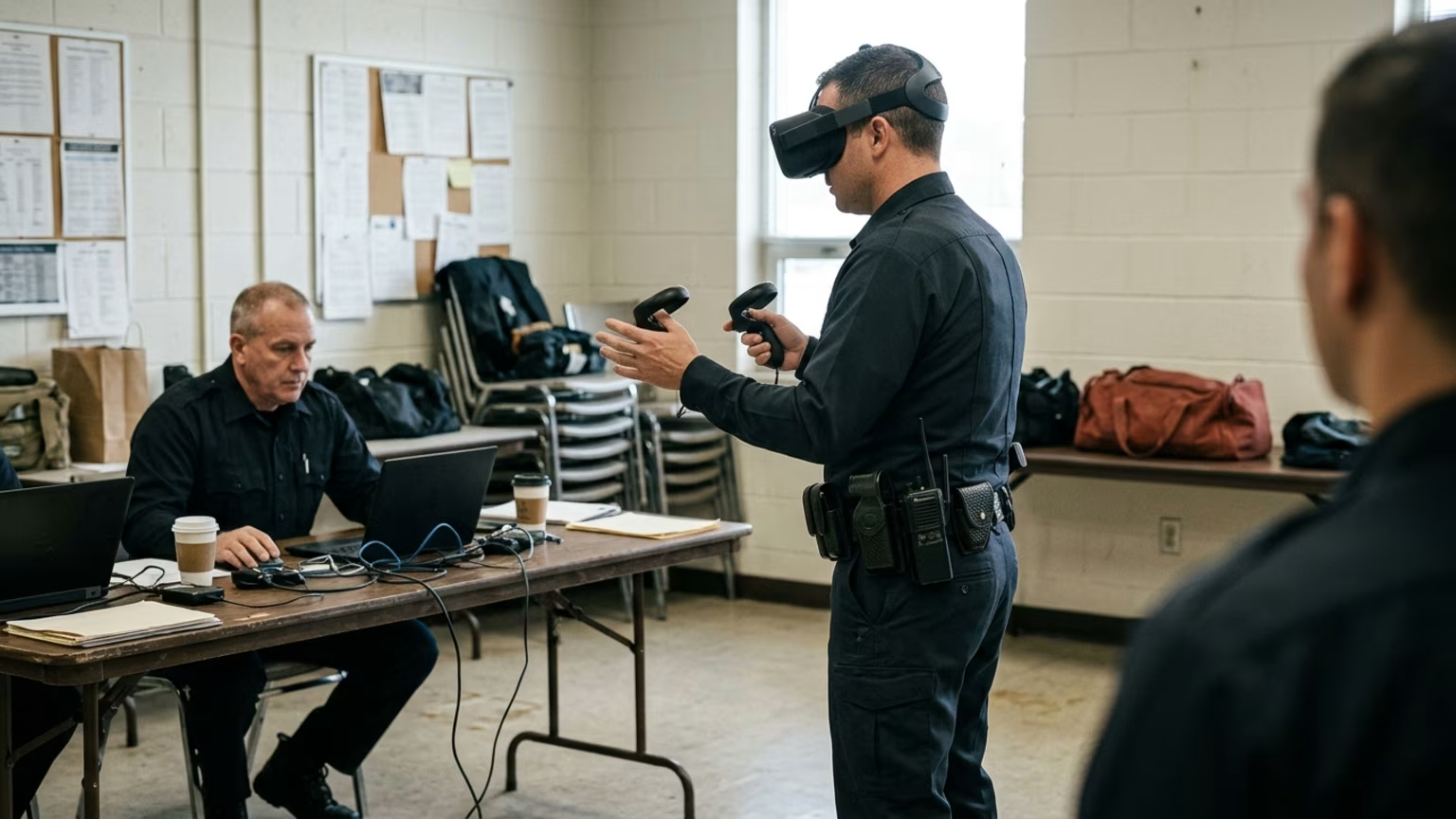

Fort Worth Police and UTA are testing an AI-supported VR system for de-escalation training. See how controlled stress exposure translates to duty readiness.





In September 2026, reports detailed an ongoing effort by the Fort Worth Police Department and the University of Texas at Arlington to develop an AI-supported virtual-reality system for de-escalation training. The initiative supplements traditional role-play exercises with repeated controlled exposure to high-pressure scenarios. As agencies evaluate methods to improve decision-making under stress, this technology offers a venue for safe practice. Implementing these tools reflects a growing administrative focus on managing operational tension before personnel face live field environments.
The project relies on a grant from the U.S. Department of Justice called the Virtual Reality De-escalation Site-Based Initiative. According to the Fort Worth Report, the grant exceeds $750,000, was awarded in October 2024, and is scheduled to end in September 2027. Software development took a year to complete. Data collection began in the summer of 2026 with 27 volunteers from the police department, My Health My Resources healthcare providers, and UTA students.
The setup utilizes a Meta Quest 3 headset, the Unity game engine for scenario creation, and Google's Gemma conversational AI. A training session lasts roughly an hour, simulating situations such as mental-health crises and domestic violence. The Fort Worth Report states that the system can vary scenario difficulty based on trainee responses. This adaptability provides a structured environment for officers to practice verbal tactics.
KERA reported that the tool evaluates officer statements and displays positive or negative feedback in real time. A more detailed performance summary follows the completion of the exercise. This immediate evaluation cycle allows trainees to recognize their communication patterns quickly. Repeated exposure to this feedback loop aims to refine judgment during complex interactions.
The technological foundation of this initiative required substantial preparation before any officers tested the system. According to the Fort Worth Report, the software development phase spanned a full year. This extended timeline highlights the complexity of converting speech to text, processing it, and generating spoken responses. Building a realistic conversational interface remains a significant technical challenge for interactive training modules.
The initial testing phase provided a baseline for how the artificial intelligence manages complex social dynamics. Data collection involved participants navigating recorded simulated situations to refine the accuracy of the software. This early interaction data helps developers understand the pace and variability of human responses during crisis interventions. Gathering diverse input from healthcare providers and students adds necessary context to the simulated encounters.
This development illustrates a growing operational shift toward managing the cognitive load of high-stakes emergency response. Fort Worth officer and training instructor Jorge Lopez noted that repeated practice in a controlled setting helps personnel make better decisions under stress. Safe and realistic practice creates a venue for personnel to manage their physical and mental reactions. This controlled stress exposure directly relates to how emergency professionals adapt their physical readiness for unpredictable shifts.
Agencies are recognizing that decision-making under pressure requires more than conceptual knowledge alone. By practicing communication skills in a simulation, personnel can isolate their cognitive responses without the immediate physical threat of an actual call. We know that maintaining focus during high-stress law enforcement training demands careful attention to nervous system regulation. Managing this operational strain helps prevent cumulative fatigue from eroding judgment over a long career.
Emergency response work imposes significant demands on the body and the mind simultaneously. High-tension calls trigger autonomic responses that elevate heart rates, alter breathing mechanics, and expend vital energy stores. Practicing stress modulation in a virtual setting can help responders recognize their baseline arousal levels. Recognizing these physiological shifts allows personnel to apply targeted recovery strategies once their shift concludes.
The physical realities of shift work often compound the difficulty of making clear decisions during field incidents. Sleep disruption, irregular meal timing, and extended hours leave first responders vulnerable to degraded cognitive performance. Tools that allow for repeated practice help build mental frameworks that hold up even when physical fatigue sets in. This translates into more resilient operational capabilities when crews face consecutive high-intensity dispatches.
Operational capability relies heavily on the ability to maintain clear communication when conditions deteriorate. Virtual simulation provides a space where the penalty for poor word choice is simply negative feedback rather than physical escalation. This environment allows personnel to experiment with tone, pacing, and listening skills safely. Developing these communication habits in a sterile setting builds a stronger foundation for unpredictable field deployments.
The compounding effects of repeated high-stress encounters often dictate the trajectory of a career in emergency services. By incorporating simulation into the training curriculum, agencies can actively address the cognitive wear that accompanies emergency work. Providing structured venues for stress inoculation demonstrates a commitment to sustainable operational practices. These targeted interventions ultimately support the long-term health and functional capability of the workforce.
Immersive technology often generates assumptions that it can replace traditional foundational learning methods entirely. However, the researchers involved in the Fort Worth project explicitly challenged the idea that virtual reality operates as a standalone solution. UTA associate professor Shuchi Deb cautioned that the technology is better suited to procedural practice than conceptual instruction. She noted that conceptual knowledge still requires traditional classroom teaching.
The introduction of new technology also frequently leads to premature operational rollout before comprehensive field testing occurs. Lopez urged caution regarding the rapid adoption of new platforms. He stated that tools should be tested, evaluated, and supported by the community before departments invest time and money. This measured approach means that training tools actually support targeted occupational training programs rather than distracting from them.
Historically, live role-play has served as the primary mechanism for stress inoculation in law enforcement academies. Early enthusiasm for artificial intelligence suggested that virtual avatars could completely eliminate the need for live actors. The current project frames the technology as a supplement to traditional methods rather than a wholesale replacement. Acknowledging these limitations helps departments maintain rigorous instructional standards across all training environments.
Procuring logistics for academy integration remains a significant hurdle for new instructional technologies. The Fort Worth Report described the department as still procuring the necessary logistics for full implementation. Recognizing the gap between development and routine use prevents unrealistic expectations about immediate departmental changes. Personnel should view these systems as evolving tools rather than immediate fixes for complex occupational challenges.
The capability of an artificial intelligence program to judge human empathy remains a complex area of development. KERA reported that the tool evaluates officer statements and displays positive or negative feedback in real time. However, the available reporting does not show how closely this automated feedback has been validated against real-world clinical outcomes. Agencies must carefully consider how they interpret automated scores regarding subjective interpersonal skills.
The push toward automation should never overshadow the critical role of experienced training officers. While the system can vary scenario difficulty and provide immediate analysis, it lacks the nuanced perspective of a veteran instructor. Human oversight remains essential to contextualize the automated feedback and relate it to departmental policy. Maintaining this balance means that technology serves the curriculum rather than dictating it.
While virtual simulation remains in development for many departments, active personnel can apply the underlying principles of controlled stress exposure immediately. The goal is to separate operational decision-making from the physical stress response during irregular shifts. First responders can practice small, deliberate routines to regulate their nervous systems when moving between unpredictable environments. Building this capacity reduces the physiological tax of repeated emergency responses over time.
Personnel can implement brief cognitive resets following high-tension situations to help lower their baseline stress before the next dispatch. This might involve controlled breathing protocols or quick grounding techniques while returning to the station. Structuring these physical resets validates the need for intentional recovery. Recognizing these moments of decompression helps shift-working professionals sustain their energy across extended tours.
The intersection of cognitive fatigue and physical exertion requires proactive management throughout a career. When mental strain accumulates from complex decision-making, physical recovery often suffers due to elevated tension. Responders should evaluate their training intensity based on the cognitive demands of their recent shifts. Aligning physical workouts with occupational stress helps prevent overtraining and supports long-term duty readiness.
The transition from high-alert field environments to off-duty rest is a critical period for physical restoration. Personnel who practice stress modulation can de-escalate their own arousal levels more effectively after their shift ends. Establishing a consistent transition routine signals the body that it is safe to prioritize restorative functions. This approach helps vital recovery systems operate efficiently despite the presence of operational tension and unpredictable workloads.
In the field, the ability to slow down a rapidly developing situation is a critical operational skill. Personnel can practice recognizing the physical cues of their own escalating stress, such as shallow breathing or muscle tension. Identifying these physiological markers allows responders to implement a tactical pause before taking decisive action. This deliberate pacing helps preserve cognitive bandwidth for the most critical phases of an intervention.
Cognitive exertion during challenging dispatches depletes energy stores just as physical labor does. Shift workers must prioritize adequate fuel to support both physical recovery and mental sharpness. Planning consistent meals around unpredictable calls helps stabilize blood sugar and prevents sharp drops in focus. Recognizing the link between energy availability and operational readiness is vital for maintaining performance standards.
The current implementation of the virtual reality program represents an early phase of testing rather than a finalized operational standard. The Fort Worth Report notes that the project team hopes to expand the system to multiuser scenarios for team training. They also intend to introduce stress factors designed to better mimic real-world tension during the exercises. Tracking how these future features influence long-term officer capability will require sustained evaluation.
As agencies look toward artificial intelligence to supplement traditional methods, the crucial metric remains real-world operational translation. Future research must determine whether recognizing verbal cues in a headset translates into improved communication during chaotic field incidents. Until peer-reviewed outcome data confirms these benefits, departments should treat virtual reality as a supplemental practice environment. Integrating these tools thoughtfully helps them support practical stress skills without replacing foundational veteran experience.
The broader implications for first responder health and performance will emerge as longitudinal data becomes available. Analysts should observe whether repeated virtual stress exposure translates into measurable reductions in physical fatigue. Evaluating how officers recover from high-stress calls after undergoing this specific training will provide valuable insights. These subsequent studies will clarify the true utility of immersive technology for career longevity.
While the current grant focuses on law enforcement de-escalation, the methodology may eventually influence other emergency services. Fire and EMS departments face similar cognitive demands when managing complex, high-stakes incidents. Observing how police agencies validate and refine these systems can guide future implementations for medical and rescue personnel. The ongoing development in Fort Worth serves as a notable case study for evaluating new duty performance strategies.
As the project moves toward potential multiuser scenarios, the logistical demands on the department will inevitably increase. Coordinating team-based virtual reality sessions requires dedicated space, equipment maintenance, and synchronized scheduling. Administrators must evaluate whether the resource investment justifies the intended improvements in unit cohesion. Tracking the scalability of these platforms will inform how smaller agencies approach similar technological adoptions.
The ultimate measure of any training intervention is its impact on community safety and officer resilience. Future assessments must look beyond the immediate feedback provided within the headset to measure tangible field results. Reductions in the use of force, fewer civilian complaints, and improved officer retention are critical indicators of success. Transparent reporting on these metrics will dictate the long-term viability of immersive simulation in emergency services.
Relying on supplemental simulation technology to practice communication skills is a useful departmental step, and translating those controlled stress exposures into sustainable off-duty routines is where our work begins. Because recovering from accumulated physical wear without losing duty readiness remains a continuous challenge for active personnel, Rescuris translates complex physiological research into practical recovery protocols. We help first responders manage the realities of irregular schedules. Explore Resources
Rescuris publishes evidence-aware guidance for firefighters, police officers, paramedics and other first responders on fitness, recovery, sleep, nutrition, stress resilience and long-term capability.






Read practical guidance on first responder fitness, recovery, sleep, nutrition and resilience for demanding work and a long, active career.
read the blog
