

Connect actual job demands with duty-fitness priorities, using a task-informed approach that accounts for individual capacity and changing work.





Task-informed duty fitness is physical preparation built around the work a person actually does. It means identifying relevant job tasks and using them to choose priorities such as strength or aerobic fitness. The starting point is the work, not a workout label.
A loaded stair climb describes a demand. “Get fitter” does not. A useful task description also captures the equipment and setting involved. Duration and frequency help distinguish an occasional demanding effort from work that must be sustained or repeated.
This approach gives training a clear reference point: the capabilities needed for a particular role under its actual working conditions.
The Oxford University Press chapter Tactical Strength and Conditioning describes substantial differences between responder roles. Structural firefighting can involve advancing charged hoses and climbing stairs with equipment. Wildland firefighting includes a different combination of fire-line construction and hiking with external loads over rough terrain.
Equipment changes the demand. The chapter reports that protective equipment adds about 22 kg for structural firefighters, increasing metabolic and cardiovascular demands. That figure describes the equipment burden reported in the chapter rather than a load carried during every task.
For police officers, the chapter describes work that can shift quickly from sedentary activity to sprinting or defensive tactics. Preparing only for prolonged steady effort would leave that sudden change in demand out of the planning discussion. Preparing only for short intense efforts would also overlook the chapter’s broader case for maintaining several fitness qualities.
The operational relevance is readiness across different kinds of work. The chapter connects aerobic and muscular fitness with firefighter task performance and discusses flexible preparation as a way to manage fatigue. This puts training effort in context: a demanding session is useful only in relation to the capability being developed and the person doing it.
The evidence has boundaries. The chapter identifies unknown energy requirements for essential police tasks performed in protective equipment and says law enforcement has no universally accepted physical-fitness standard. The supplied evidence also does not establish a validated task-to-training prescription for EMTs and paramedics. This framework supports planning rather than an all-role exercise program or an injury-prevention guarantee.
The chapter discusses strength, power, muscular endurance, aerobic fitness and anaerobic fitness as relevant dimensions of occupational preparation. The following breakdown translates those dimensions and the reported equipment constraints into practical planning categories. These are interpretations of job demands rather than exercise prescriptions.
These categories overlap. A single equipment carry can raise questions about strength and sustained effort. The purpose of separating the qualities is to make priorities clearer, not to divide the body into independent systems.
Begin with a realistic description of duties rather than a generic occupational label. The research brief supports recording the task and its load alongside movement and duration. Environment and equipment also belong in that description, as does how often the work occurs.
“Carry equipment” is a starting phrase rather than a complete demand profile. Carrying equipment on level ground and taking it upstairs describe different movement conditions. Recording that distinction gives the training discussion something specific to address without assuming that either task has the same importance in every role.
A useful starting point is to describe personal duty demands before selecting training priorities. The aim is a recognizable account of the work rather than an exhaustive catalogue of everything that could happen.
Use occupational examples to prompt investigation, not to fill gaps with assumptions. Structural and wildland firefighters should not automatically receive the same task profile simply because both work in firefighting. The chapter’s descriptions show why the setting matters.
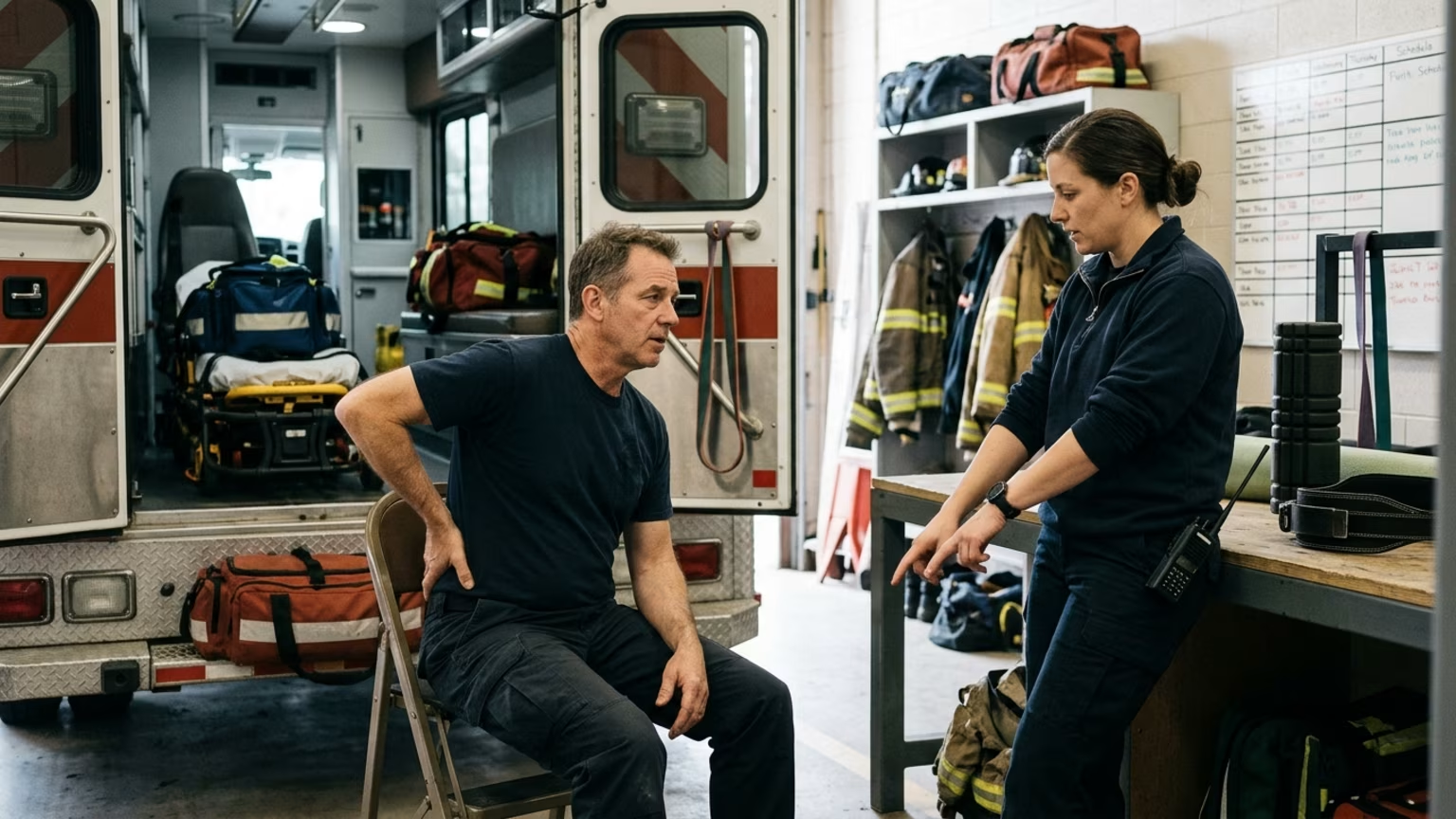
For EMS personnel, patient transfers and prolonged standing can be prompts for local assessment. Establish whether those activities are relevant to the role and describe their actual conditions before assigning them training importance. A task named in a general article is not evidence that every EMT or paramedic performs it with the same frequency or equipment.
This distinction also keeps the discussion useful across a mixed team. Shared employment does not establish an identical physical workload.
Once the tasks are described, connect them to broad physical qualities. Loaded stair climbing can bring aerobic capacity and muscular endurance into the discussion. Awkward lifting or carrying can bring strength and trunk control into view. Restrictive equipment adds questions about movement tolerance.
Write down the reasoning behind each connection. “Aerobic capacity matters because this role includes sustained loaded travel” is more informative than “everyone needs more cardio.” It leaves a clear basis for revisiting the priority when the task changes.
Avoid forcing every task into a single category. The chapter’s discussion of firefighter performance connects several fitness dimensions with occupational tasks. A useful task map can therefore identify a leading priority while retaining other relevant qualities.
The chapter supports maintaining several fitness dimensions for unpredictable work rather than specializing in one quality alone. A task map helps decide which qualities deserve attention within that broader preparation.
The practical distinction is between an emphasis and an exclusive focus. Identifying strength as a priority does not remove aerobic fitness from the role. Identifying sustained movement as a frequent demand does not make force production irrelevant.
This is also a useful place to consider how duty preparation fits other training goals. The occupational task description provides a reference point for that discussion. It helps separate a personal training preference from a capability that the work calls on.
The chapter argues that preparation should account for individual ability and operational needs. It cautions that identical group training may provide an inappropriate stimulus for recruits with different fitness levels.
That matters even when people share the same task list. A common occupational demand establishes what preparation is for, but it does not establish that everyone needs the same session. Ability-based training is one approach discussed in the chapter for addressing that difference.
Fatigue belongs in this decision too. The authors discuss flexible programming and minimum-effective-dose principles as approaches to maintaining or improving performance while managing fatigue. The practical implication is to consider the training stimulus alongside current capacity rather than treating completion of an identical workload as the goal.
The chapter describes both general fitness tests and job-simulated assessments. Examples include victim drags and pack marches as well as obstacle negotiation. These assessments address related but different questions: general fitness qualities and the capacity to perform job tasks.
A task map helps keep those questions connected. It gives a reason for selecting an assessment and a context for interpreting what it measures. Listing a job simulation here is not an instruction to reproduce demanding occupational conditions independently.
Revisit priorities when duties or equipment change, or when the person’s capacity changes. The chapter discusses transitions into roles with different demands and recommends flexible preparation for unpredictable work. Accounting for poor sleep when planning training is another way to keep the discussion tied to actual conditions rather than a fixed calendar alone.
A useful training priority has a traceable connection to the job. It identifies a demand and the physical qualities that demand may involve. It also leaves room for differences in individual capacity and changing duties.
The next review does not need to begin with a new workout. It can begin by checking whether the existing priorities still match the work.
Which duties does your current training prepare you for, and what would you change after comparing those duties with your present capacity?
Turning job tasks into training priorities is a decision Rescuris supports through research-led editorial guidance. Its coverage helps emergency-service professionals consider strength alongside endurance and mobility across a demanding career, with body composition and recovery included in the discussion rather than separated from the goal of lasting physical capability.
Rescuris publishes evidence-aware guidance for firefighters, police officers, paramedics and other first responders on fitness, recovery, sleep, nutrition, stress resilience and long-term capability.





Read practical guidance on first responder fitness, recovery, sleep, nutrition and resilience for demanding work and a long, active career.
read the blog
