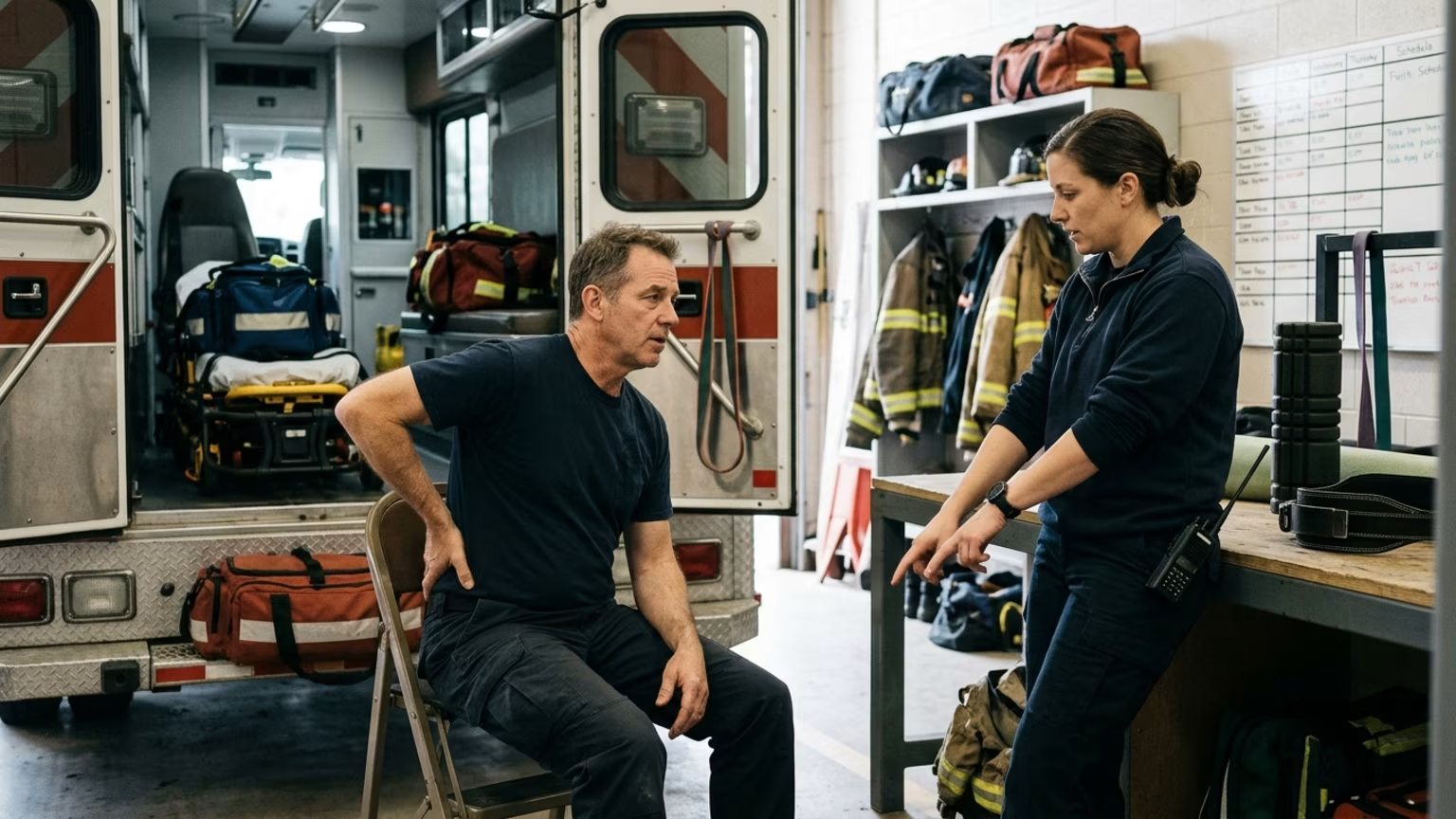

A practical review of recurring back strain for first responders, covering task patterns, shift demands, equipment fit and qualified assessment.





What should first responders review when back strain keeps recurring? Review recurring task demands, vehicle and equipment fit, physical preparation and recovery needs, with qualified assessment for persistent or worsening pain.
A 2026 integrative review of five studies reported an average low-back-pain prevalence of 67.73% among the military-police populations examined. Reported risk factors included equipment load and prolonged sitting. Vehicle vibration, trunk rotation and psychosocial factors were also identified.
The review describes low-back pain as multifactorial. That means its account involves several kinds of exposure rather than one universal explanation. The practical reason to examine a pattern is to consider those demands together instead of automatically assigning the problem to the most recent lift.
These findings concern reported low-back pain rather than confirmation of a muscle-strain diagnosis. The prevalence figure belongs to the selected military-police studies, not to first responders as a whole. The associations do not establish what caused an individual worker’s symptoms.
The ergonomics guidance discussed below is practitioner advice rather than a validated prevention trial. Across this source set, there is no established exercise or recovery prescription, clinical triage timetable or measured retirement-health benefit. A work-demand review is therefore a way to organize useful questions, not a diagnostic or treatment protocol.
Start with recurring work demands and the conditions surrounding them. A useful review separates what happened from the explanation someone assigns to it. It also includes the work setup and individual capacity instead of treating movement technique as the entire issue.
A public-safety ergonomics article describes police work that can alternate between extended vehicle time and demanding tasks such as lifting and restraint. Its practical recommendation is to examine the combined demands of the work alongside equipment setup and the officer’s capacity.
A 2026 chapter on firefighting describes load carrying, climbing, repetitive tool use and strenuous exertion. These descriptions provide starting points for a task review. They do not mean that every firefighter or police officer has the same exposure pattern.
Useful questions for a discussion include:
For a paramedic or EMT, patient and equipment movement can be framed as questions within that review. The point is to describe the actual task and setting rather than transfer a police-specific finding directly to EMS work.
The ergonomics article recommends considering whether task demands are sustainable for the individual officer. That makes physical preparation relevant, but it keeps the job itself in view.
A capacity discussion can ask what the role requires and how current preparation relates to those requirements. It should also keep equipment fit and task design on the agenda. Training should not become a substitute for reviewing a demanding work setup or obtaining clinical assessment.
Rescuris’s discussion of job-relevant movement patterns provides a related starting point for thinking about physical preparation. Here, the useful question is how conditioning relates to the job, not which exercise supposedly explains or fixes every episode.
A short description can help structure a conversation with a supervisor or qualified professional. Useful details include the task involved and the equipment in use. The surrounding work sequence and available space can also belong in that description.
“Repeated rotation was part of the task” is an observation. “Rotation caused the pain” is a conclusion. Keeping those statements separate leaves room to assess several demands without turning the review into self-diagnosis.
Follow the actual sequence of duty and recovery opportunities rather than assuming a predictable workday. The purpose is to understand when demands occurred and what surrounded them, not to impose an unsupported timetable for training or rest.
The police ergonomics article’s description of extended vehicle time alternating with demanding activity makes sequence a useful discussion point. A review can consider the transitions between tasks as well as each task on its own.
Useful timing questions include:
For nights or rotating schedules, the discussion should reflect the schedule that occurred rather than an idealized routine. A planned recovery window and the time actually available may be different. Describing that difference is more useful than treating a disrupted plan as a failure of commitment.
Conditioning and recovery belong in the same conversation as occupational demands. For example, the review can distinguish work-related carrying from additional training rather than placing them in separate categories with no connection. Any discussion of changes should remain specific to the role and individual rather than defaulting to a universal shift-work routine.
Begin with the interaction between the worker and the setup, not a shopping list. The public-safety ergonomics article specifically recommends reviewing vehicle fit and equipment distribution as part of an officer’s task-demand assessment.
Its police-focused prompts include:
These points support a conversation about how the setup works during actual duties. A belt can be considered alongside the seat rather than in isolation. Equipment placement can be discussed in relation to the movements required to reach it.
For other emergency services, these are prompts for reviewing role-specific equipment and procedures. The relevant question is which interactions deserve attention in that job, not whether police equipment findings automatically apply elsewhere.
The firefighting chapter also discusses lighter tools and redesigned packs as ergonomic approaches. It notes that implementation may be uneven across agencies and regions. That places equipment design within the discussion while keeping attention on what is actually available in a particular workplace.
A useful equipment review therefore asks what the current setup requires of the worker. It does not begin with the assumption that a new product is the answer. Fit and layout deserve attention alongside task demands and capacity.
Because the goal should be lasting physical capability rather than simply tolerating the current workload. A long-term review can keep recurring symptoms and changing job demands visible in health and training discussions.
One useful question is whether the same work pattern keeps returning without being meaningfully reviewed. Another is whether physical preparation still reflects current duties and capacity. These questions connect immediate readiness with a longer view without making continued discomfort a test of toughness.
A personal record of symptoms and occupational demands offers a place to organize that history. For this topic, relevant entries could include recurring tasks and equipment concerns, along with assessments already received. The purpose is to retain a useful account rather than construct an explanation without professional input.
The retirement-focused priority is straightforward: keep long-term health in the conversation while reviewing present-day work. Neither training goals nor the pressure to complete a shift should make that longer view disappear.
The next useful topic is how ergonomic task review and job-specific conditioning can be discussed together without allowing one to replace the other.
NIOSH’s October 2026 eNews lists a toolbox talk on lifting and carrying to prevent back injuries. Lifting-and-carrying guidance is a relevant subject for a workplace discussion alongside the task patterns described here.
For the conditioning side, a useful next read is how training priorities can change across a career. Keep the central question consistent: what does the work require, and how should preparation account for lasting capability?
Back-strain advice falls short when immediate work output becomes its only measure of success. Rescuris addresses that mismatch with evidence-led writing on duty fitness and recovery, giving emergency-service professionals a clearer basis for weighing performance advice against physical capability and health across a demanding career.
Rescuris publishes evidence-aware guidance for firefighters, police officers, paramedics and other first responders on fitness, recovery, sleep, nutrition, stress resilience and long-term capability.


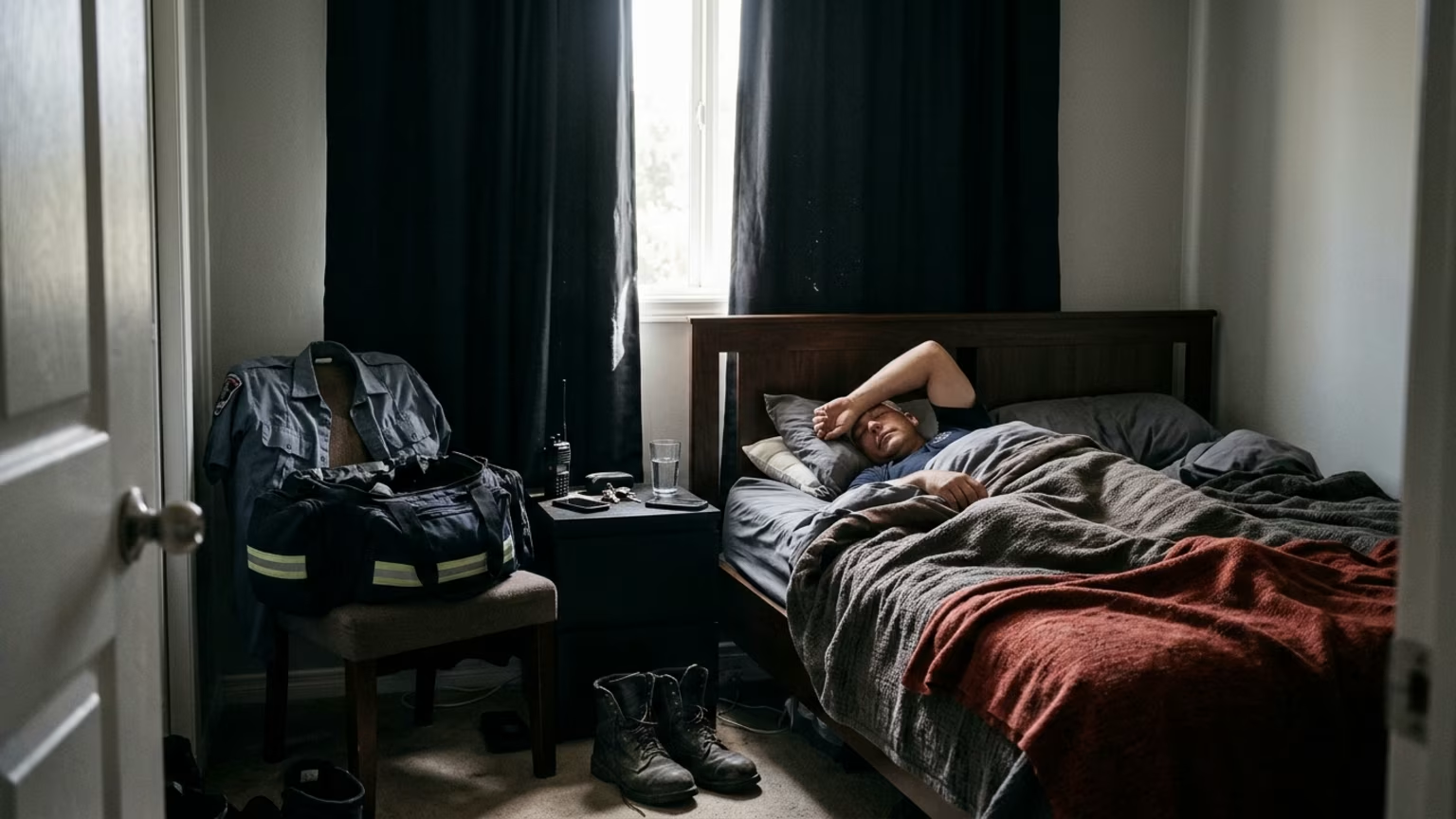

Read practical guidance on first responder fitness, recovery, sleep, nutrition and resilience for demanding work and a long, active career.
read the blog
