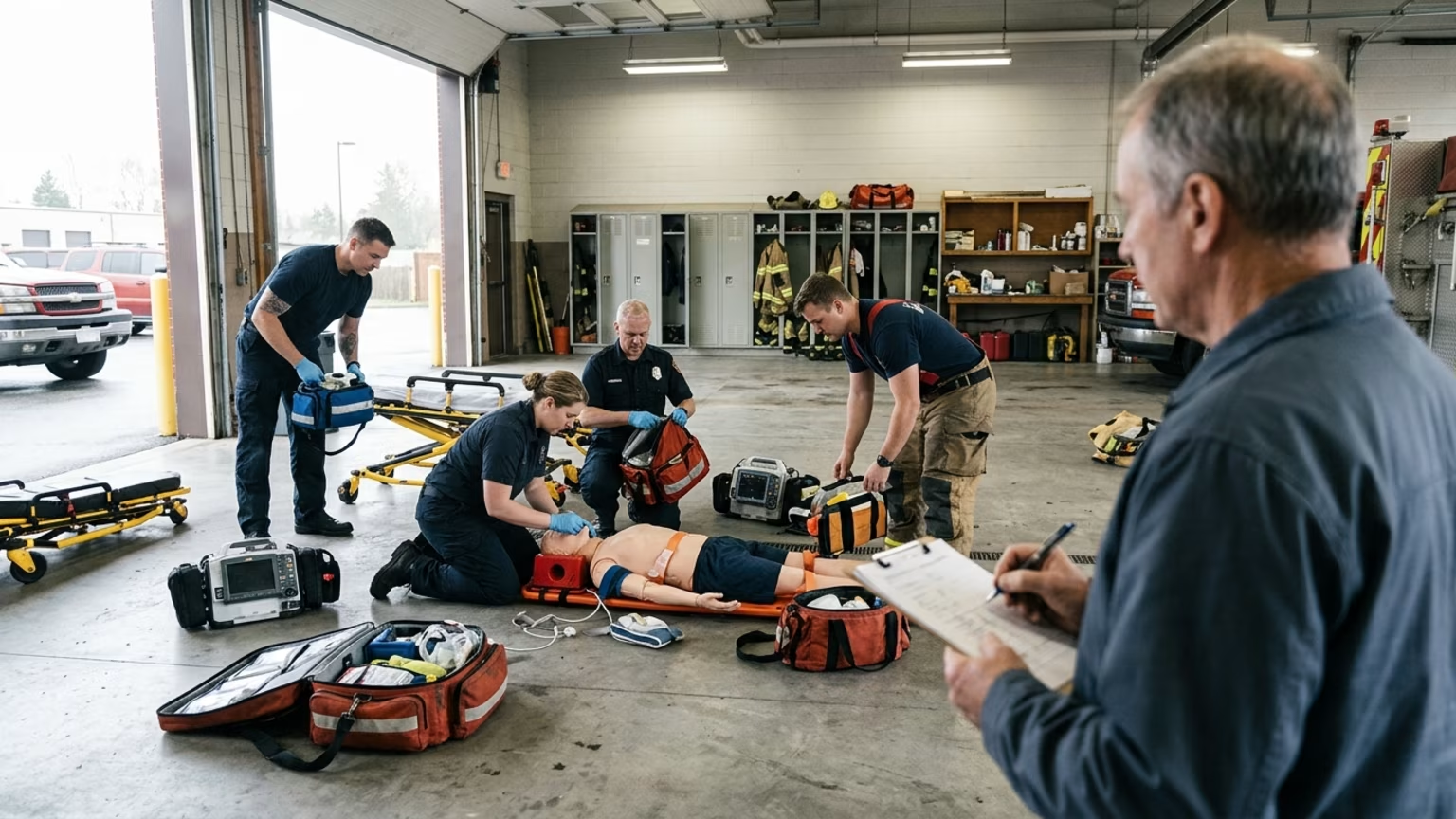

A recent review examines how simulation training impacts emergency response skills. It evaluates the critical gap between classroom confidence and field competence.





On October 5, 2026, researchers published a narrative review in Advances in Medical Education and Practice examining how simulation-based training impacts emergency response skills. The authors evaluated literature published from January 2010 through July 2026 to assess varied learning formats across diverse populations.
The narrative review synthesized English-language literature across major academic databases. The researchers systematically searched PubMed, Web of Science, and Scopus to gather data on emergency skills training. They examined applications in both prehospital and hospital contexts to understand how different groups learn. The study evaluated training for critical tasks like bleeding control, airway management, team CPR, and mass casualty response.
The authors reviewed training formats ranging from traditional manikins and role-play exercises to advanced virtual reality environments. The findings suggest that these simulated environments generally support positive gains in immediate knowledge and technical performance. The review highlights specific instances where foundational understanding improved significantly following structured simulation practice.
In one cited example, a school-based first-aid course saw participant knowledge scores rise from 53 percent to 88 percent. Another analyzed study evaluated an online-simulation-bedside protocol for emergency medical teams. That group achieved an average team CPR skill score of 90.09 alongside reported improvements in clinical reasoning. These specific data points demonstrate the potential for structured simulation to build measurable proficiency in controlled settings.
Despite these positive indicators, the review introduces a substantial operational caveat for emergency service professionals. The authors conclude that evidence linking these simulated improvements directly to real clinical practice remains limited. Training environments offer a level of controlled predictability that an actual emergency scene lacks entirely. The translation from a controlled classroom to an unpredictable field incident requires more robust real-world verification.
These findings strongly validate the ongoing shift toward integrated training models in modern emergency services. Educators understand that isolated technical drills do not always prepare crews for complex incident management under stress. The review explicitly identifies feedback, structured debriefing, realistic scenarios, and periodic retraining as critical design elements. Incorporating these components helps build a more resilient operational framework.
Applying these elements directly supports emergency professionals who work extended shifts with constantly interrupted sleep. Training departments can use these structural findings to design continuing education that reinforces team behaviors without overwhelming fatigued personnel. This approach mirrors the operational practice of conducting structured debriefings that protect cognitive function after demanding field deployments. Progressive skill development allows trainers to establish foundational competencies before exposing crews to highly complex stressors.
The emphasis on teamwork and psychological safety during simulation aligns directly with sustainable career practices. Crews must practice communicating clearly under artificial stress to maintain those habits during actual critical responses. Creating a psychologically safe training space allows responders to make and correct errors without fear of administrative reprisal. A department can use these findings to justify prioritizing collaborative team simulations over isolated online certification modules.
Furthermore, recognizing that skill retention varies across different learning models allows agencies to customize their education calendars. The authors highlight periodic refresher training as a necessary consideration for maintaining operational readiness. First responders often experience long periods of routine calls punctuated by sudden high-acuity events. Regular, realistic practice helps bridge the gap between those infrequent but critical field occurrences.
A persistent assumption in tactical and medical training is that feeling prepared directly correlates with actual field readiness. The narrative review explicitly challenges this notion by warning against conflating self-reported confidence with objectively demonstrated competence. Feeling ready to handle a mass casualty incident does not automatically mean a responder will execute triage protocols flawlessly on scene. This distinction is vital for departments relying heavily on post-training satisfaction surveys.
The researchers highlighted a specific disaster-role-play study to illustrate this critical operational distinction. In that scenario, medical students reported that their confidence using the START classification system increased from 28.2 percent to 65.7 percent. While increased confidence can help reduce initial hesitation on scene, training officers must still verify that technical skills actually match the reported comfort level. Self-reported readiness is only one component of comprehensive professional evaluation.
The review also tempers industry expectations regarding advanced augmented and virtual reality tools. While virtual reality offers novel ways to simulate hazardous environments, the authors present these newer tools as complements rather than proven replacements. Practical constraints like high initial costs, technical support needs, and technology obsolescence remain significant administrative hurdles. Virtual systems also suffer from limited haptic feedback, which restricts their utility for tasks requiring precise physical manipulation.
Physiological reactions to immersive technology can also disrupt established training schedules and individual participation. The review cites estimates that cybersickness affects 15 percent to 40 percent of users across various applications. Training leaders must account for these adverse physical reactions when mandating virtual reality sessions for active-duty crews. It is counterproductive to mandate a training modality that actively induces nausea or severe visual fatigue in a significant portion of the workforce.
Emergency service educators and operational leaders can make several immediate adjustments based on these documented findings. The first necessary step is completely decoupling subjective confidence surveys from actual technical skill assessments. Departments should evaluate both physical tasks and team behaviors objectively using clearly defined rubrics. Evaluating performance this way aligns with assessing specific physical and operational demands across all phases of a responder's career.
Programs also need to schedule targeted refresher training to combat inevitable skill decay over time. The review noted that retention results varied widely across the different studies and learner populations analyzed. Because there is no single optimal retraining interval established, agencies should monitor their own internal quality assurance metrics. Tracking actual field performance will help administrators determine exactly when specialized refresher sessions are necessary.
When integrating new technology, purchasing committees must weigh the high operational costs against the specific skill being taught. Advanced simulators are highly valuable for practicing complex team coordination and communication under artificial stress. However, expensive virtual systems may be entirely unnecessary for basic procedural repetition or initial familiarization. Departments should prioritize investments that allow for highly realistic physical practice coupled with immediate analytical feedback.
Instructors should also implement a layered approach to scenario design for all incoming personnel. Foundational skills must be practiced in low-stress environments before moving to complex, multi-unit integration exercises. Rushing trainees into chaotic simulations before they master basic interventions often degrades performance and creates unnecessary psychological strain. Building complexity gradually respects the cognitive load limits of individuals who are already managing chronic occupational fatigue.
As simulation technology continues to evolve rapidly, the emergency response sector requires more rigorous operational data. The authors of the review recommend that future research prioritize rigorous multicenter studies with much longer follow-up periods. Evaluating training retention over several months or years is critical for professionals facing decades of demanding occupational service. Short-term studies simply cannot capture how well skills endure the realities of shift work and chronic physical stress.
The research focus must also shift heavily toward measuring actual patient-level outcomes and real-world clinical transfer. Controlled simulation scores are useful baseline benchmarks, but the ultimate goal is improving actual field execution during unpredictable incidents. Future studies must determine whether practicing in a virtual environment tangibly reduces scene time or improves vital clinical interventions. Understanding this transfer rate will help crews get better at recognizing cognitive patterns during high-pressure situations in the field.
Until that comprehensive longitudinal data becomes available, simulation remains a vital but inherently incomplete preparedness tool. Emergency personnel should view these advanced systems as safe environments to test protocols and identify critical communication gaps. Relying solely on simulated success to project operational readiness ignores the chaotic variables present in every active emergency scene. Tracking how future studies connect these simulated environments to verifiable field data will be essential for occupational health leaders.
Ultimately, balancing technological training advancements with practical field experience requires continuous, objective analysis. Training officers must stay updated on new literature to separate proven educational methods from commercial technology hype. By focusing on evidence-based design elements like structured debriefing and realistic scenarios, departments can better prepare their personnel. Preparing crews effectively without adding unnecessary cognitive or physical burden is the core challenge of modern operational instruction.
Designing simulation programs to build objective competence is a vital operational decision, and translating those training demands into sustainable daily health practices is where our work begins. When professionals face the ongoing challenge of balancing strength, endurance, mobility and body composition across a demanding career, Rescuris evaluates the available evidence to provide practical operational guidance. Explore Resources
Rescuris publishes evidence-aware guidance for firefighters, police officers, paramedics and other first responders on fitness, recovery, sleep, nutrition, stress resilience and long-term capability.






Read practical guidance on first responder fitness, recovery, sleep, nutrition and resilience for demanding work and a long, active career.
read the blog
