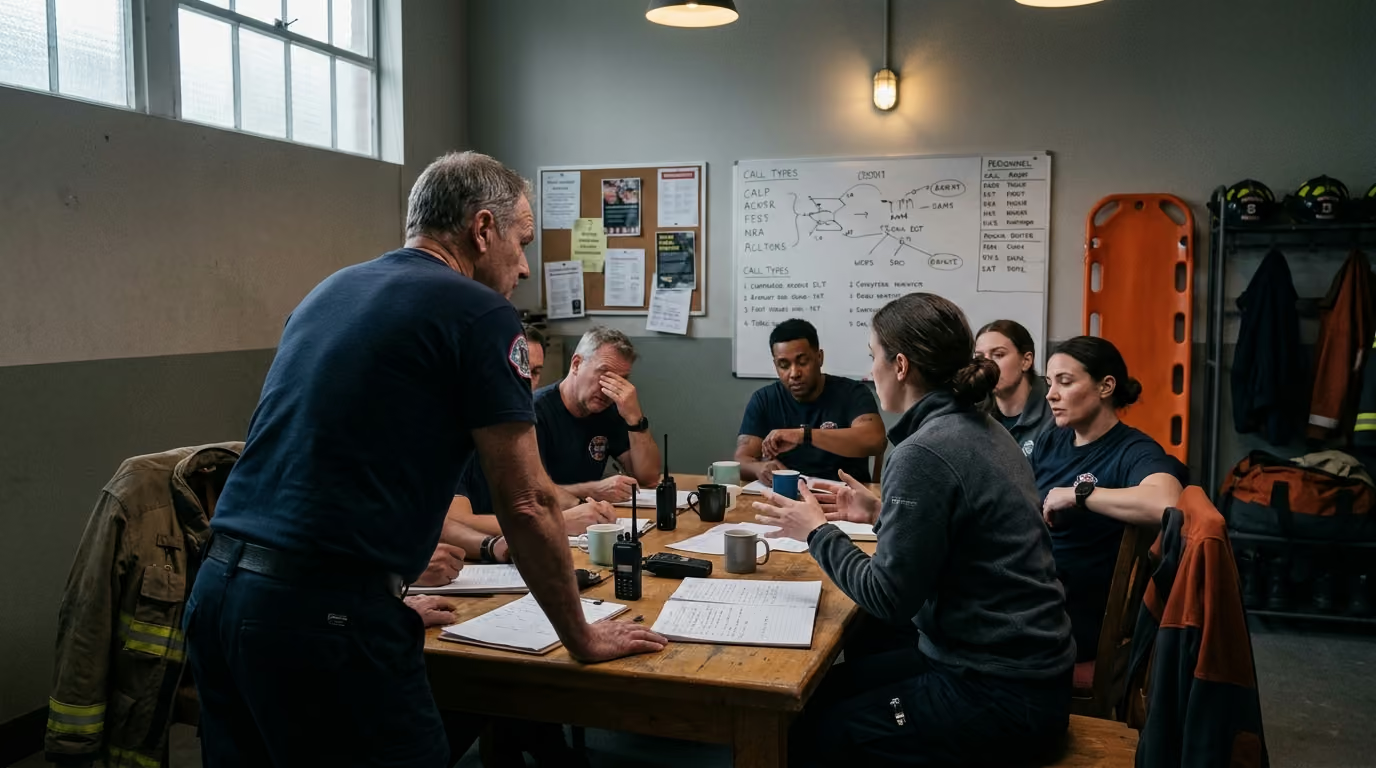

High-stress emergency scenes trigger common cognitive traps, but structured debiasing frameworks help first responders maintain clear judgment under extreme operational pressure.





Most errors on emergency scenes do not stem from a lack of physical courage or technical skill. They happen because the human brain relies on rapid mental shortcuts when processing high-stakes, incomplete information under intense time pressure.
In high-consequence environments, cognitive biases operate as predictable patterns of thinking that systematically distort risk assessment, assessment of scene hazards, and clinical judgment. Managing these mental traps does not require abandoning pattern recognition. It requires deliberate, short cognitive safeguards that force crews to question assumptions before an initial miscalculation becomes irreversible.
Human cognition relies on two primary modes of reasoning. Cognitive scientists classify these modes as Type 1 and Type 2 thinking. Both systems serve distinct functions during emergency operations, yet each carries unique vulnerabilities.
Type 1 reasoning operates automatically, rapidly, and with minimal conscious effort. It uses intuitive pattern matching developed through prior training and field experience. When a firefighter identifies a flashover warning sign, Type 1 processing triggers an immediate retreat. This fast processing allows personnel to initiate life-saving actions without hesitation. The primary vulnerability of Type 1 thinking is its reliance on unverified assumptions, initial impressions, and recent memorable events.
Type 2 reasoning is deliberate, analytical, and cognitively demanding. It systematically weighs alternatives, calculates risks, and evaluates conflicting data points. Responders need Type 2 reasoning when managing complex hazardous materials incidents, atypical clinical presentations, or multi-agency operations. The limitation of Type 2 processing is its speed. It consumes working memory and mental energy, which deplete rapidly under physical exhaustion and acute stress.
Emergency decision-making requires adaptive switching between these two modes. Responders cannot analyze every variable from scratch while a building burns or a patient deteriorates. The objective is knowing when an intuitive Type 1 judgment is vulnerable and needs a rapid Type 2 review.
Research shows that cognitive errors play a major role in adverse outcomes. A systematic review published in emergency medicine literature estimated that 5.7 percent of emergency department visits involve at least one diagnostic error. When extrapolated across approximately 130 million annual emergency department visits, this rate accounts for roughly 7.4 million diagnostic errors and 371,000 serious misdiagnosis-related harms annually. More than two-thirds of those severe harms are concentrated in just 15 diseases, occurring primarily when conditions present with atypical symptoms.
Data from studies evaluating emergency room physicians indicates that cognitive factors contribute to up to 96 percent of analyzed diagnostic errors. When researchers classified the distribution of cognitive biases in emergency care, overconfidence appeared in 22.5 percent of cases. Confirmation bias appeared in 21.2 percent, availability bias in 12.4 percent, and anchoring bias in 11.4 percent.
A study of clinical diagnostic errors among physicians in Japan found that anchoring bias was present in 60.0 percent of cases. Premature closure occurred in 58.5 percent, availability bias in 46.2 percent, and hassle bias in 33.1 percent. That study observed an average of 3.08 cognitive biases per diagnostic error case. Emergency care environments showed an adjusted odds ratio of 3.96 for cognitive bias involvement compared to standard settings.
Biases rarely operate in isolation on an incident scene. An initial anchor leads to confirmation bias, which accelerates premature closure and is reinforced by overconfidence.
Emergency environments create fertile ground for several distinct cognitive traps. Recognizing how these biases manifest in the field allows crews to catch errors before they lead to adverse outcomes.
Anchoring occurs when a responder fixates excessively on an initial piece of information, interpretation, or label. Subsequent information is filtered through that first impression rather than evaluated objectively.
In emergency medical services and fire rescue, anchors frequently originate from dispatch notes, initial triage tags, or bystander accounts. For example, a crew dispatched to an "intoxicated person down" may anchor on substance use. They may overlook signs of traumatic brain injury, hypoglycemia, or stroke because every subsequent finding is attributed to intoxication.
Warning signs of anchoring include:
Confirmation bias is the tendency to search for, favor, and interpret data in ways that confirm an existing hypothesis while ignoring contradictory evidence.
A paramedic who believes a patient is hyperventilating due to a panic attack may focus entirely on the patient's anxiety. They may discount subtle signs of metabolic acidosis, pulmonary embolism, or early sepsis. Similarly, an incident commander convinced that a fire is confined to a single room may prioritize reports of knockdown while ignoring persistent thermal signatures in the attic space.
Warning signs of confirmation bias include:
Availability bias causes responders to judge an event as more probable simply because similar examples come readily to mind. This mental availability is driven by recency, emotional intensity, or recent media attention.
After responding to a difficult pediatric cardiac arrest, a crew may view every subsequent pediatric respiratory call through an exaggerated lens of catastrophic airway failure. Conversely, if a crew responds to six consecutive false fire alarms at an industrial facility, availability bias suggests that the seventh alarm is also false. This assumption delays the deployment of protective equipment and aggressive size-up.
Warning signs of availability bias include:
Normalcy bias leads individuals to interpret disaster warnings and anomalous cues as indicators of ordinary, non-threatening conditions. This bias causes responders and the public to underestimate the likelihood and impact of extreme events.
In structure fires, occupants often delay evacuation because they interpret early smoke as burnt food or an HVAC malfunction. Emergency personnel can also fall prey to normalcy bias during slow-onset disasters, severe weather events, or hazardous material releases. An incident officer might assume that an industrial alarm indicates a routine system test, delaying perimeter isolation and community notification.
Warning signs of normalcy bias include:
Premature closure occurs when a decision-maker accepts an initial explanation or plan and terminates the assessment process prematurely.
This trap is closely tied to anchoring. The key distinction is that premature closure stops the search for concurrent problems. In trauma management, finding an obvious extremity fracture may cause a responder to terminate the secondary assessment, missing occult internal hemorrhage. In technical rescue, securing the primary hazard may lead a team to ignore secondary electrical or atmospheric risks.
Warning signs of premature closure include:
Overconfidence involves holding excessive certainty in an early clinical impression or tactical assessment. Responders may overestimate their ability to manage complex variables without additional assistance. This bias prevents officers from requesting second-alarm resources early in an escalating incident.
Omission bias is the inclination to avoid action when an intervention carries perceived risk, driven by the fear of directly causing harm. This can delay critical interventions such as needle decompression, aggressive airway management, or structural evacuation orders.
Action bias is the opposite impulse: feeling compelled to intervene immediately because physical action feels psychologically preferable to observation. Action bias can lead to premature structural entry, unnecessary medications, or uncoordinated tactical maneuvers before a proper size-up is complete.
Emergency services work under operational conditions that systematically degrade analytical thinking. Physical exhaustion, circadian disruption, environmental stress, and high-tempo task switching erode cognitive capacity.
Shift work, night operations, and extended duty periods create chronic sleep debt. Research indicates that sleep loss disproportionately degrades prefrontal cortex functions, including working memory, sustained vigilance, and flexible reasoning.
When cognitive fatigue sets in, the brain conserves energy by defaulting to automatic Type 1 heuristics. A fatigued crew is significantly more prone to anchoring on initial dispatch information and closing evaluations prematurely. Understanding baseline recovery through practical strategies, such as structured fatigue baselines for shift personnel, highlights how operational fatigue undermines situational awareness and safety.
Incident scenes bombard responders with high volumes of sensory data. Audible alarms, radio chatter, flashing emergency lights, hostile bystanders, and personal protective equipment create massive cognitive friction.
Under acute stress, the sympathetic nervous system triggers physiological arousal that narrows the perceptual field. This response, often termed cognitive tunnel vision, restricts divided attention. A paramedic managing an unstable airway in a loud room may focus entirely on the laryngoscope blade. They may fail to notice that the patient's pulse oximetry is falling or that the monitor displays a lethal dysrhythmia.
Emergencies demand rapid decisions with incomplete information. Time pressure prevents crews from conducting exhaustive differential diagnoses or multi-variable risk matrices. When seconds count, the brain naturally reaches for the most accessible interpretation.
This environment makes systematic analytical reasoning impractical as a sole strategy. Crews need rapid physical and cognitive grounding habits between incidents to shed residual tension. Practicing structured between-call recovery skills helps clear sympathetic hyperarousal and restores baseline mental flexibility.
Steep organizational hierarchies within fire, police, and emergency medical agencies can amplify individual cognitive errors. When a company officer or senior clinician anchors on a specific theory, junior personnel may notice contradictory evidence but hesitate to voice concerns.
This communication breakdown transforms an individual cognitive bias into a collective operational failure. If organizational culture equates questioning an assumption with insubordination, critical scene data remains unshared.
To counteract cognitive traps without causing operational paralysis, emergency crews require short, structured debiasing frameworks. These tools force deliberate cognitive pauses at critical points in an incident.
The ABCD framework provides a rapid four-step mental checkpoint that can be executed verbally in under thirty seconds.
Identify the initial working assumption, dispatch label, or preliminary impression.
Actively scan the scene and patient data for objective findings that contradict the initial anchor.
State the most dangerous alternative explanation that could produce similar symptoms or conditions.
Formulate a tactical or clinical action plan that accounts for the dangerous alternative while gathering more data.
This model balances immediate action with ongoing cognitive vigilance across evolving incidents.
Address immediate, reversible life threats and scene hazards without delay. Maintain airway, breathing, and circulation. Isolate obvious electrical or structural threats. Rapid Type 1 pattern recognition drives this phase.
Once immediate threats are stabilized, state the working hypothesis using provisional language. Instead of declaring "this is a simple heat exhaustion case," state "our provisional working theory is heat exhaustion." This linguistic framing keeps the assessment open to modification.
Identify what features do not match the provisional hypothesis. Define the most critical alternative condition. Establish clear reassessment triggers: "If mental status does not improve within five minutes of active cooling, we immediately pivot to managing this as severe central nervous system pathology."
When evaluating ambiguous incidents, crews often focus exclusively on the most probable explanation. This model forces the team to balance probability against operational consequence.
This model prevents teams from ignoring low-probability, high-consequence threats during dynamic calls.
Rather than requiring continuous analytical monitoring, crews should embed mandatory cognitive pause points at natural transitions during an incident.
Implement a ten-second pause:
At each pause point, the team leader asks: "What has changed, what remains unexplained, and what evidence would prove our current plan wrong?"
Individual debiasing strategies are insufficient when fatigue and sensory overload degrade personal working memory. Robust operational safety requires team-based communication mechanisms that distribute cognitive monitoring across the entire crew.
Agencies operating in high-risk environments must establish cultural norms that make professional challenge a standard safety function. The Two-Challenge Rule empowers any team member to halt an operation if an unaddressed safety hazard or diagnostic error is observed.
Once the formal safety trigger is invoked, the leader must acknowledge the observation and confirm or adjust the operational plan. Practicing these communication habits is a core element of building operational readiness through shared support systems, ensuring psychological safety translates into field capability.
For complex or high-consequence interventions, conduct a rapid verbal brief that takes less than 60 seconds. One crew member is assigned to outline the case:
This practice removes the stigma from arguing against the prevailing group consensus, neutralizing groupthink and confirmation bias.
Transfer of care and command transitions are highly vulnerable to anchoring bias. When a transferring provider begins a handoff with their personal diagnostic conclusion, the receiving provider inherits that mental anchor.
To mitigate this vulnerability, structure handoffs around objective physiological and environmental data before sharing provisional interpretations:
Ambiguity fuels cognitive bias. Closed-loop communication verifies that critical information is transmitted, understood, and executed without assumption.
When a team leader issues an instruction:
When dynamic events occur, such as sudden patient decompensation, resource failure, or hazard boundary expansion, call an immediate dynamic huddle:
Integrating structured micro-breaks and communication checks prevents cognitive narrowing during long shifts. Personnel can maintain sharp situational awareness by incorporating rapid operational resets during demanding shifts.
Addressing cognitive bias requires dismantling several pervasive myths regarding human performance and decision-making in emergency services.
A common objection to debiasing tools is that responders do not have time for deliberate reflection during life-threatening crises.
Debiasing does not mean delaying critical interventions for airway obstruction, active hemorrhage, or immediate flashover threats. It means applying selective cognitive forcing during natural tactical transitions. A five-second mental checkpoint prevents minutes of misdirected effort on an incorrect operational path.
While static checklists are effective for standardizing mechanical sequences like equipment checks, they do not eliminate cognitive bias during dynamic decision-making.
Checklists can become mindless compliance rituals under stress. If an operator ticks boxes without processing the underlying data, anchoring and confirmation bias remain unchecked. Checklists must include active inquiry triggers that ask what findings do not fit the standard profile.
In high-stress environments, collecting excessive information can degrade decision quality. Unfiltered data streams create cognitive overload, amplify noise, and generate false patterns that reinforce confirmation bias.
The goal is not maximizing information volume. The goal is identifying high-yield, decision-relevant data points that distinguish competing hypotheses and clarify operational risk.
While years of service build a deep reservoir of intuitive pattern recognition, experience does not eliminate cognitive vulnerability. In fact, seasoned personnel can be more vulnerable to overconfidence and availability bias.
An experienced responder has seen thousands of routine presentations. When faced with an atypical, life-threatening condition that mimics a benign case, their deep library of common patterns can delay recognition of the outlier. Expertise should serve as a reason for disciplined cognitive scrutiny, not an exemption from it. Managing long-term occupational wear and preventing physical and mental breakdown helps maintain the cognitive flexibility required to navigate complex calls.
Every decision-making strategy involves operational trade-offs. Emergency leaders must balance the risk of analytical hesitation against the danger of impulsive, bias-driven action.
In time-critical scenarios involving immediate threats to life, execute immediate stabilization protocols without hesitation. Do not pause to evaluate complex differential alternatives while an active structural collapse is underway or a patient requires immediate CPR.
Debiasing frameworks are designed for the post-stabilization phase, ambiguous presentations, evolving tactical deployments, and unexplained treatment failures. Knowing when to rely on automatic Type 1 execution and when to engage Type 2 analysis is the hallmark of sound field judgment.
Decision-making capability is tied to physiological and psychological health. Chronic hypervigilance, cumulative occupational stress, and unresolved trauma impair the brain's executive networks, making personnel more susceptible to cognitive fatigue, emotional reactivity, and decision errors.
When cognitive bias manifests as chronic brain fog, persistent operational dread, uncharacteristic irritability on scene, or severe sleep disruption, these signs point toward systemic fatigue. These symptoms indicate that the nervous system is locked in chronic sympathetic overload.
First responders experiencing persistent cognitive fatigue, intrusive call memories, or depression should seek guidance from qualified healthcare professionals. Occupational health physicians, licensed mental health clinicians specializing in emergency services, and peer support teams provide structured care to restore cognitive performance and resilience. Further professional resources are available within specialized stress and mental performance guidance.
Building operational resilience requires acknowledging the biological limits of the human brain under continuous pressure. Supporting recovery, regular sleep patterns, and physical conditioning protects decision-making capacity across a long career.
Sustainable operational capability relies on pairing rapid technical skill with disciplined cognitive safeguards that keep decision-making clear when scene conditions are chaotic.
Stay connected for research-led guidance on duty fitness, shift-work sleep, injury recovery, stress, nutrition and career longevity. Practical ideas for first responders who want to stay capable on the job, recover well and protect their health for the long run.



Read practical guidance on first responder fitness, recovery, sleep, nutrition and resilience for demanding work and a long, active career.
read the blog



