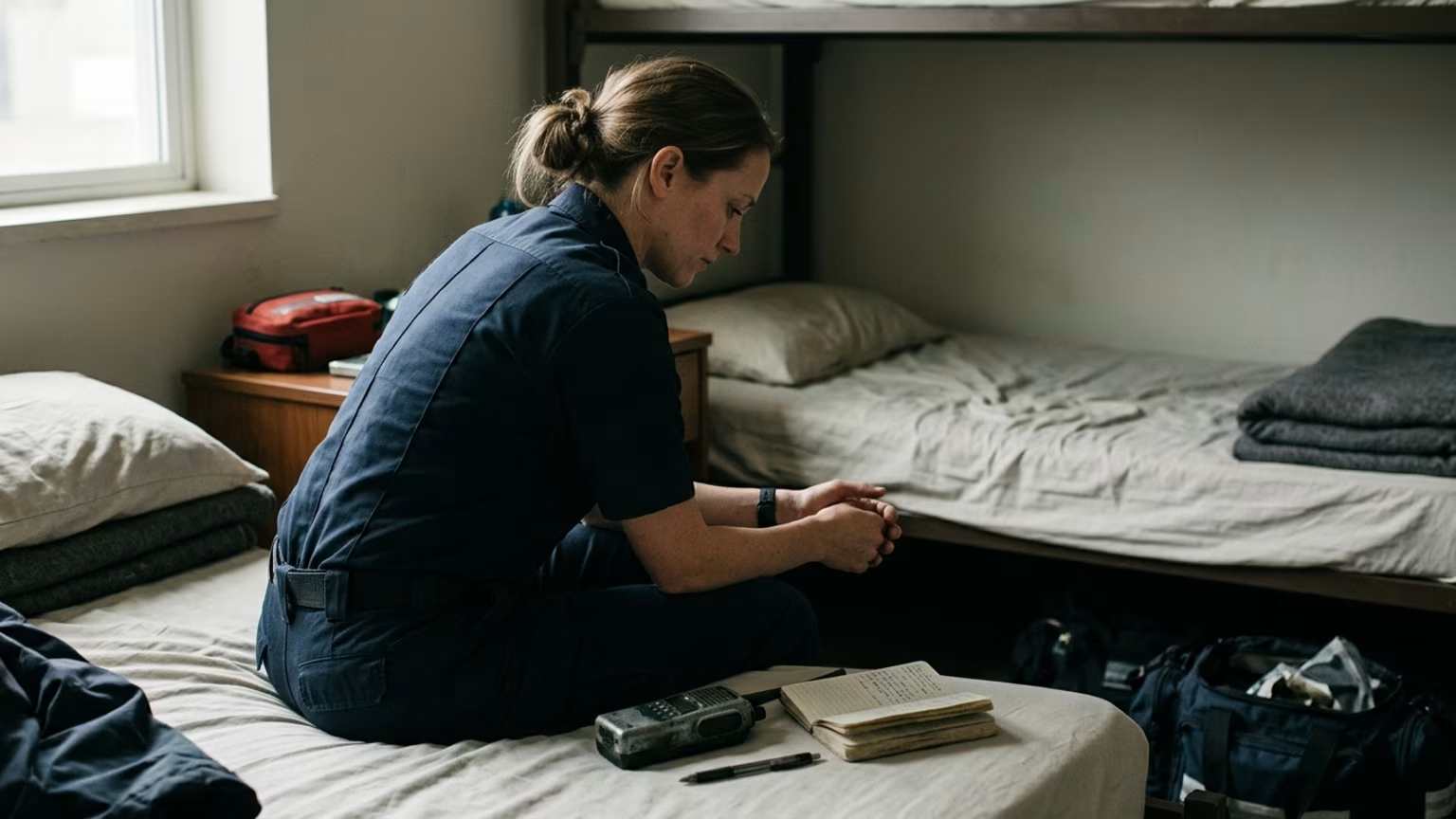

A practical focus routine helps first responders organize attention and manage stress during unpredictable calls without relying on unrealistic wellness advice.





The civilian wellness industry often claims that specific breathing exercises can clear your mind and remove all uncertainty. This advice implies that physiological calmness guarantees perfect decisions under pressure. For first responders, breathing and attention techniques are only basic performance supports. They organize immediate attention, but they never replace rigorous equipment checks or tactical procedures.
Civilian wellness advice fails under extreme operational stress because it ignores the autonomic realities of emergency work. A recent review focused on policing argues that high acute stress can contribute to the degradation of skilled motor performance. The same review supports evidence-informed training practices to address that specific operational risk. When an alarm sounds, the body rapidly shifts into high arousal to prepare for immediate physical demands.
Attempting to force the nervous system into a relaxed state during a high-pressure call is biologically counterproductive. Firefighting naturally involves high cardiovascular strain. A scoping review identifies inadequate cardiorespiratory fitness as a serious performance and health concern in these conditions. If a responder attempts prolonged breath holds while wearing heavy gear in a hot environment, they risk compromising their oxygen supply.
A sudden surge of adrenaline drastically alters how the brain processes information. Peripheral vision decreases as the eyes lock onto the most immediate threat. Hearing can become muffled or hyper-sensitive depending on the environment. These biological shifts prepare the body to fight or move quickly. They do not prepare the mind to solve complex tactical problems.
Lowering a physiological stress response does not automatically improve cognitive function or situational awareness. One laboratory study examined brief breathing techniques before a standard social-stress task. The breathing groups showed less stress reactivity than the control group. However, cognitive-test performance did not differ among the groups at all.
Feeling less stressed does not mean you are assessing threats accurately or making better tactical choices. The disconnect happens because civilian research often separates physical readiness from mental focus. In an emergency setting, these factors are permanently linked. Acute physiological changes limit fine motor skills regardless of how calm you feel.
These physiological limitations become obvious during extended shifts. Responders deal with irregular sleep, mandatory overtime and sudden transitions from rest to high-speed action. A paramedic might go from a quiet station to managing a critical trauma in a matter of minutes. This rapid escalation creates a massive spike in cardiovascular strain and adrenaline.
You cannot pause a complicated vehicle extrication to close your eyes and practice mindfulness. Attention naturally narrows when a responder faces an immediate threat or a complex task. This attentional narrowing is useful for prioritizing the very first job on a scene. It helps a police officer secure a specific area or helps a paramedic locate a major hemorrhage.
Excessive narrowing quickly turns into dangerous tunnel vision during chaotic calls. A responder locked onto one single task might miss changing environmental hazards or approaching bystanders. The physical environment actively works against sustained mental clarity. Structural fires, severe weather, chaotic crowds and loud sirens constantly degrade cognitive capacity.
Responders must process conflicting dispatch information while moving heavy equipment across uneven terrain. Those working on unpredictable schedules often carry cumulative fatigue into these high-intensity moments. Sleep disruption from night shifts severely limits a responder's ability to process new information quickly. A responder controls very little about the scene upon arrival.
They must establish immediate life-safety priorities while acknowledging that much of the situation remains unknown. Relying solely on a breathing technique to stay grounded often leads to delayed action. The operational reality demands a method that supports quick decisions without ignoring the inherent chaos of the job. Standard wellness routines simply do not survive this environment.
Shift supervisors know that severe sleep debt drastically reduces reaction time. A responder working mandatory overtime may operate with a severe cognitive deficit. This fatigue makes it harder to assess risks and communicate clearly. Focus techniques only work when built upon a foundation of adequate physical recovery.
A functional focus protocol for emergency service requires a multidimensional approach to readiness. It must integrate physical capacity, procedural competence and stress regulation into a single unified system. Mental preparation should always sit alongside concrete operational checks rather than replacing them. The goal is organized movement, not total relaxation.
The corrected approach treats focus as an active physical process. Responders can use targeted breathing to manage arousal, but they must keep their eyes open and their bodies moving. A reported study describes a box-breathing pattern using four-second intervals. A responder can adapt this concept using a few easy breaths that fit their current physical load.
The technique must remain flexible to accommodate heavy protective gear and high thermal strain. This protocol relies on alternating between narrow focus and deliberate environmental scanning. A responder deliberately narrows their attention to confirm their first operational priority. Once that immediate task is secure, they intentionally widen their scan to take in the larger scene.
This cycle helps prevent tunnel vision while keeping the responder engaged with their surroundings. Regular practices for managing cognitive load during high-pressure incidents are critical during these rapid transitions. The protocol also integrates brief verbal or mental cues tied to physical actions. These cues are simple cognitive anchors used during major operational transitions.
A responder might use a short reset cue when stepping out of an emergency vehicle or entering a structure. This systematic approach helps emergency professionals break dangerous routine habits during unpredictable events. You must actively manage your attention bandwidth during a call.
An effective protocol limits the amount of new information processed at one time. By breaking a complex scene into smaller operational steps, you reduce cognitive overload. This step-by-step approach prevents the nervous system from becoming completely overwhelmed. Organized action is always more effective than frantic multitasking.
A proper field routine respects these biological limitations. It builds cognitive resilience through repetition and structured habits rather than relying on sheer willpower. Responders who build adaptable fitness systems to manage physical fatigue already understand that consistency matters more than intensity. The same principle applies to mental focus under pressure.
The evidence supports a practical transition routine that organizes attention without claiming to control the entire scene. Responders can implement this field-compatible sequence before and during high-pressure calls. Small and repeatable attention resets work much better than complex visualization exercises.
Retired responders dealing with persistent anxiety or trauma symptoms should not treat a brief focus routine as clinical care. Brief breathing exercises are operational tools for active duty. They do not resolve severe sleep disruption, panic symptoms or long-term occupational impairment. Anyone experiencing persistent mental health challenges should seek professional support rather than relying on field tactics.
True operational focus does not erase the chaos of an emergency scene, but it provides a steady anchor to navigate the uncertainty.
Field training officers and squad leaders often struggle to build reliable focus routines for their crews, but that operational gap closes when Rescuris designs the training. Sleep disruption from nights, rotating shifts, overtime and unpredictable calls fractures cognitive resilience, and we help emergency professionals establish practical attention systems that actually work under stress.
Rescuris publishes evidence-aware guidance for firefighters, police officers, paramedics and other first responders on fitness, recovery, sleep, nutrition, stress resilience and long-term capability.






Read practical guidance on first responder fitness, recovery, sleep, nutrition and resilience for demanding work and a long, active career.
read the blog
