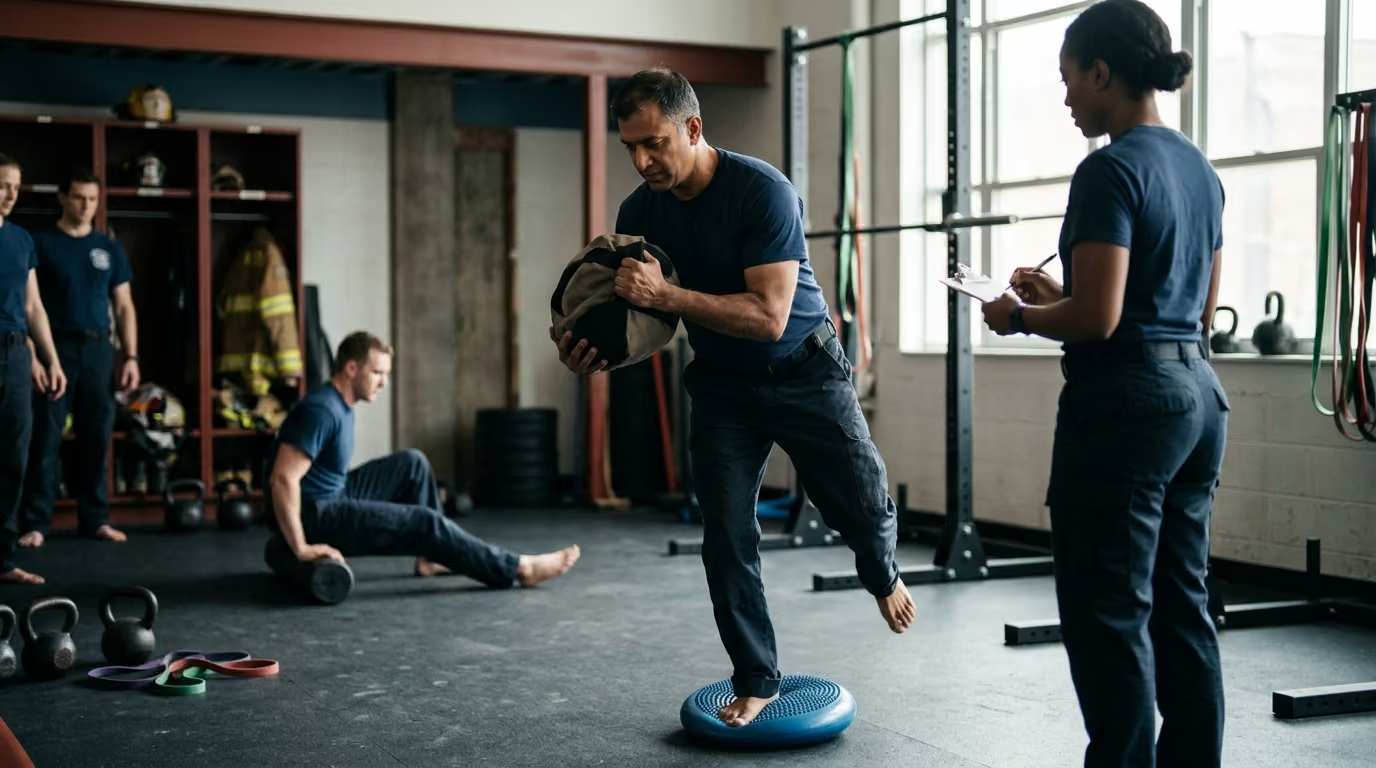

Enhanced balance control and movement precision prepare first responders to conquer shifting rubble, slick stairwells, and uneven embankments under demanding field conditions.





Standing motionless on a squishy foam pad in clean athletic shoes does almost nothing to prepare a first responder for dynamic operational hazards. In emergency services, balance is rarely about holding a static posture in a quiet room. It is the active physical capacity to manage, shift, or rapidly recover your center of gravity across slick stairs, shifting debris, unyielding curbs, and dark hallways while carrying heavy external loads.
True operational stability requires sensory integration, joint-level force absorption, and rapid motor corrections across the ankle, knee, hip, and trunk. When visual feedback is degraded by dense smoke or darkness, your nervous system must instantly reweight its reliance toward proprioceptive signals from your feet and vestibular signals from your inner ear. Building this resilience requires progressive exposure to single-leg deceleration, unexpected perturbations, carried implements, and operational footwear.
Scientific research treats balance as a dynamic sensorimotor loop rather than an isolated muscle trait. To maintain equilibrium, your central nervous system continuously gathers and integrates information from three primary sensory streams. These streams are the visual system, the vestibular system of the inner ear, and the somatosensory or proprioceptive system embedded within muscles, tendons, joint capsules, and the skin of the feet.
Proprioception provides the internal map of joint angles, limb positions, muscle tension, and surface pressure. Research published in physical therapy and sports medicine literature shows that proprioceptors in the foot and ankle complex serve as the preferred sensory input for balance adjustments during quiet standing and level walking. When one sensory channel experiences interference, the nervous system performs sensory reweighting. This process shifts reliance to the remaining functional inputs to prevent a catastrophic fall.
The limits of stability define the boundaries of this system. On a firm surface with an unencumbered body, healthy adults can shift their center of gravity roughly 12.5 degrees forward and backward, and approximately 16 degrees laterally, before being forced to take a step. These theoretical boundaries shrink drastically when surface friction drops, ground compliance changes, or carried equipment alters body mass distribution.
Systematic reviews examining single-leg balance training demonstrate that targeted balance exercises produce measurable gains in postural control. Evidence compiled across multiple trials confirms that balance adaptations occur across varied training doses, ranging from brief single sessions to multi-week protocols totaling hundreds of minutes. These gains appear in both static and dynamic testing environments.
Proprioceptive exercise programs also demonstrate strong preventative value for lower-extremity joint health. Systematic reviews of athletic cohorts show that structured balance and joint-position training significantly reduces the incidence and recurrence of lateral ankle sprains. While these athletic trials do not perfectly replicate the physical demands of dragging a charged hoseline or carrying an extraction stretcher down a wet embankment, the underlying neurophysiology transfers directly to occupational physical readiness.
Fireground and rescue environments introduce an unforgiving mix of intrinsic and extrinsic balance disruptors. Extrinsic hazards include wet tile, pooled fluids, loose gravel, collapsed drywall, hidden holes, discarded tools, and low-visibility stairways. Intrinsic hazards include central nervous system fatigue from long shift rotations, localized muscular exhaustion, restricted joint mobility, and delayed cognitive processing.
Operational footwear and protective ensembles substantially alter human biomechanics. Structural firefighting boots, thick bunker gear, heavy body armor, and self-contained breathing apparatus add mass while changing the body's natural center of mass. Research evaluating firefighters working in full protective ensembles demonstrates that 45 pounds of gear shifts the resting center of gravity backward and increases total postural sway.
Stiff, protective outsoles blunt the fine tactile feedback normally transmitted through the mechanoreceptors on the bottom of the foot. Thick structural boots also restrict ankle dorsiflexion and plantarflexion. When ankle motion is constrained, the body cannot easily use small ankle corrections to steady itself. Instead, the nervous system is forced to rely on larger, more energetically expensive hip strategies to stay upright.
Cognitive distraction further erodes postural stability on scene. First responders rarely have the luxury of staring at their feet while traversing dangerous terrain. You must scan for structural hazards, monitor patient vital signs, communicate across radio channels, and track crew members. This divided attention drains processing bandwidth, slowing reactive stepping responses when a foot unexpectedly slips or catches on an obstruction.
Recovering from an unexpected slip or trip requires a coordinated motor hierarchy across the lower body and trunk. The human body manages balance perturbations through three distinct physical strategies: the ankle strategy, the hip strategy, and the stepping strategy. Resilient responders must develop proficiency across all three rather than over-relying on a single joint.
The ankle strategy serves as the initial sensor and fine-tuning mechanism. When you encounter small, low-velocity shifts in your center of mass on a stable surface, the muscles surrounding the ankle contract to push your center of pressure back into balance. Adequate ankle dorsiflexion, strong foot intrinsics, and reactive peroneal muscles are necessary to catch minor missteps before they become joint injuries.
The knee acts as the primary force-dissipation and deceleration buffer. During rapid descents, jumps across debris, or sudden drops, the knee flexes to absorb kinetic energy and control deceleration. Training must reinforce multi-planar knee control, preventing excessive inward collapse while allowing the joint to absorb dynamic loads across varied foot angles. Building this lower-body resilience aligns with broader principles found within our duty fitness training methodologies.
The hip and trunk form the high-amplitude recovery engine. When an unexpected surface change is too large or too rapid for the ankle to handle, the hip strategy takes over. Rapid flexion, extension, and abduction of the hip quickly reposition the mass of the pelvis and torso. Strong hip abductors, deep gluteal stabilizers, and a rigid, responsive trunk allow you to make aggressive corrections without collapsing.
Stepping is not a sign of balance failure. When a perturbation pushes your center of mass outside your physical base of support, taking a rapid, decisive recovery step is the safest way to prevent a catastrophic fall. Field training must encourage rapid protective stepping rather than forcing personnel to remain frozen in place during drills.
Developing dependable operational balance requires a systematic progression. Moving directly to complex, unstable circus drills without mastering basic joint stiffness and force absorption creates poor movement compensations. Follow this structured five-phase framework to build movement control that holds up under operational stress.
Phase 1 establishes basic joint alignment, foot tripod mechanics, and quiet postural stability. Begin on a flat, firm floor with minimal external distraction. Responders should focus on distributing body weight evenly across three points of the foot: the heel, the base of the big toe, and the base of the fifth toe.
Mastery in this phase requires quiet foot control without aggressive clawing of the toes or visible hip shaking. Once an individual can hold clean single-leg positions for 30 seconds, they are ready to progress to movement-based challenges.
Operational environments require catching your mass while moving through space. Phase 2 introduces multi-planar stepping, single-leg landing mechanics, and controlled deceleration. These exercises train the stretch-shortening cycle of the calf and quad to absorb landing forces smoothly.
Focus on landing quietly during all jumping and stepping drills. A loud foot strike indicates poor eccentric force absorption, which increases impact stress on the passive structures of the knee and lower back.
Once dynamic control is solid on predictable surfaces, you must challenge the sensory inputs driving balance. Phase 3 systematically degrades visual and somatosensory feedback. This forces the central nervous system to speed up sensory reweighting and rely more heavily on vestibular and deep joint mechanoreceptors.
Perform eyes-closed and low-light drills in clear spaces near secure handholds. The goal is to safely expose the nervous system to sensory deprivation, not to create unnecessary fall risks during training.
Phase 4 bridges general athletic preparation and operational reality. Introduce occupational footwear, protective garments, uneven terrain simulations, and asymmetrical carried loads. This phase conditions the body to manage the shifted center of mass caused by protective equipment.
Pay close attention to pelvic alignment during offset carries. Do not let the carried weight pull your torso into side-bending. Maintain a tall posture and a level pelvis to build anti-lateral flexion endurance.
The final phase introduces unpredictability and divided attention. In the field, you rarely know exactly when your foot will slip or when a structural element will shift. Phase 5 develops rapid reactive stepping, visual scanning, and dual-task coordination.
Integrate these movements into your broader physical preparation schedule. You can manage training fatigue across busy operational cycles by exploring our guide on effective minimum-dose training approaches.
Field-specific balance drills should directly reflect the physical challenges encountered during emergency responses. Applying progressive stability strategies to common operational situations reduces the likelihood of lower-limb injuries.
Descending a wet, debris-strewn stairwell while carrying an extraction tool or medical pack is a high-risk operational task. The descent places high eccentric demands on the quadriceps and calf complex, while low surface friction increases slip risk.
Traversing structural rubble, collapsed materials, or rutted outdoor terrain requires rapid ankle adjustment and quick visual scanning. Responders who stare directly down at their boots lose situational awareness, while those who never look down risk catching an edge on a hidden void.
Attics, crawlspaces, damaged vehicles, and narrow hallways limit the width of your base of support. In these tight environments, you cannot take a wide recovery step to correct a balance loss.
Transporting a backboard, stokes basket, or carry chair down an unpaved slope places high lateral shear loads on the ankles and knees. The responder must manage their own balance while adapting to the shifting weight of the patient and the movements of other crew members.
Many conventional fitness routines misapply balance training, producing fatigue without building useful movement capabilities. Avoid these common mistakes when designing balance and movement control programs for operational personnel.
Standing on highly unstable circus equipment, such as upside-down stability balls or extreme wobble boards, drastically reduces your force output. It forces the nervous system to adopt rigid, co-contracted survival postures that do not transfer to field locomotion. Instead of building operational strength, it simply trains you to survive on an unstable apparatus.
Build balance on firm, predictable ground first, progress to compliant surfaces like foam pads or turf, and then add movement, speed, and carried loads. The real world provides instability through surface angles, slick textures, and external momentum. Train for those conditions rather than artificial balance props.
Many fitness instructors treat taking a step during a balance exercise as a failure. In operational environments, refusing to step when your center of mass crosses your base of support guarantees a severe fall.
Teach responders to recognize when an ankle or hip strategy is insufficient and encourage rapid, decisive protective stepping. Drills that demand a quick recovery step onto a designated target build safer real-world reflexes.
Placing an untrained recruit directly into heavy structural turnout gear, an air pack, and stiff boots for complex balance drills can mask underlying mobility or strength deficits. The responder may use the rigidity of the boot to prop themselves up, hiding poor ankle dorsiflexion and weak foot intrinsics.
Establish clean barefoot or flat-shoe movement mechanics in gym attire first. Once single-leg deceleration, hip stability, and trunk stiffness are demonstrated, systematically add boots, turnout gear, breathing apparatus, and carried tools.
Movement control and balance training place distinct demands on the nervous system and the musculoskeletal framework. To prevent acute injuries during training and ensure long-term career durability, adhere to clear safety guardrails.
Fatigue degrades proprioceptive sensitivity and lengthens motor reaction times. Conducting high-risk plyometric landing drills or aggressive perturbation training at the very end of a punishing shift invites acute joint trauma. Schedule demanding balance and reactive drills when the nervous system is relatively fresh, or introduce them as low-volume components within your general warm-up.
For personnel managing accumulated physical wear, monitoring daily readiness helps prevent overtraining injuries. Learn more by reading our complete guide on autoregulation and training readiness frameworks.
Balance deficits and joint instability are not always solved through conditioning drills alone. Structural joint damage, unresolved nerve trauma, and inner-ear dysfunction require professional clinical evaluation rather than continued gym training.
Consult a licensed physical therapist, athletic trainer, or occupational physician if you experience any of the following warning signs:
A qualified physical therapist can perform objective joint laxity testing, assess mechanoreceptor sensitivity, and conduct formal vestibular evaluations. Attempting to push through mechanical instability or inner-ear pathology with high-intensity field drills can turn minor joint wear into a career-ending injury. Dedicated rehabilitation resources can be accessed through our injury prevention and recovery library.
Consistent balance and movement control training preserves joint integrity and maintains mission-ready capability across a demanding emergency-response career.
Stay connected for research-led guidance on duty fitness, shift-work sleep, injury recovery, stress, nutrition and career longevity. Practical ideas for first responders who want to stay capable on the job, recover well and protect their health for the long run.



Read practical guidance on first responder fitness, recovery, sleep, nutrition and resilience for demanding work and a long, active career.
read the blog



