

A practical reading of ONU Health’s firefighter briefing on exposure, cardiac strain, heat and trauma, with clear limits on what the evidence establishes.





ONU Health updated its firefighter-health briefing on October 29, 2026. The article brings cancer-related exposure, cardiac strain, heat illness and trauma-related stress into one short overview. Its practical themes include respiratory protection and decontamination alongside health checks, heat management and peer support.
For firefighters thinking beyond the next shift, the value is in seeing those subjects together. Protection during an incident and health support between shifts belong in the same career-long conversation. The update provides a starting point for that discussion rather than evidence that a particular wellness program has improved outcomes.
ONU Health describes its article as a summary of five public-health sources. It is consumer-facing educational information, not original research or a new clinical guideline. Its recommendations should therefore be read as practical guidance rather than newly established requirements for every firefighter or department.
The briefing groups concerns into cancer-related exposure, sudden cardiac events during exertion in heat, heat illness and trauma-related stress including PTSD. It connects these concerns with prevention and support topics that can be discussed through departmental safety and occupational-health systems.
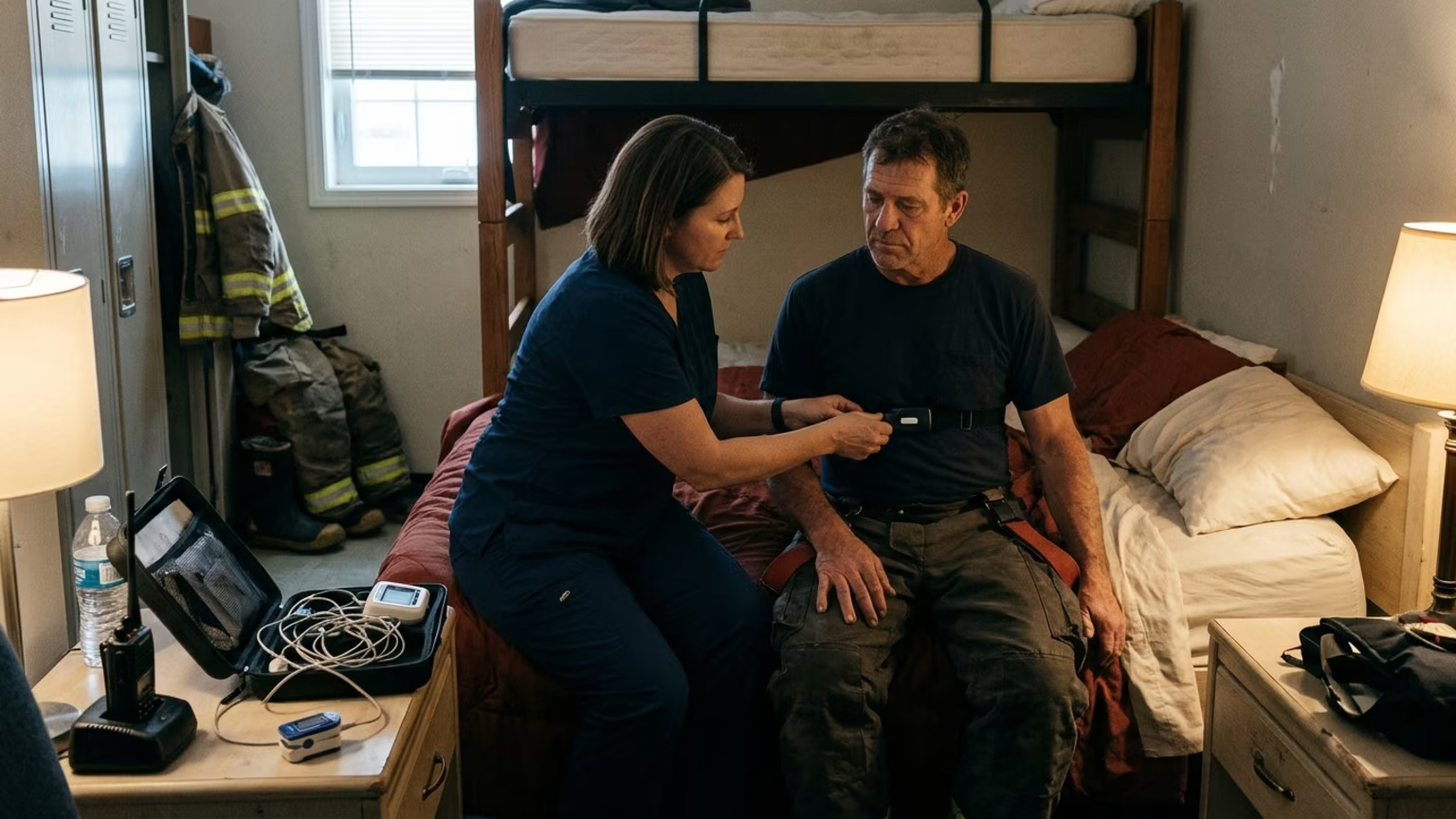
The page is also associated with ONU’s sleep, activity and recovery-tracking product. ONU explicitly says it does not assess cardiac risk, contamination or PTSD. It does not replace occupational health or service medicals, and the page directs readers toward qualified professionals and employer rules.
That boundary matters when interpreting health technology alongside wellness advice. A product’s ability to track sleep or activity should not be confused with the medical and occupational assessments that ONU says it does not provide.
The briefing’s useful contribution is organizational: it places several health concerns in the same view. A department-level discussion can address contaminated equipment and respiratory protection alongside physical strain, rehabilitation and access to support. Those topics need not compete for attention simply because they fall under different parts of a wellness program.
For individual firefighters, this is a way to organize questions rather than another set of personal performance targets. Some questions concern working practices and protective equipment. Others belong in a confidential conversation with occupational health or a qualified healthcare professional.
Retired personnel can also use the briefing’s exposure and symptom topics to prepare for healthcare conversations. It does not establish screening schedules tailored to retirees. Its relevance after service is as a discussion prompt, not a ready-made medical plan.
ONU’s briefing reports that the International Agency for Research on Cancer classified occupational exposure as a firefighter as Group 1, “carcinogenic to humans,” in 2022. This is a hazard classification. It does not predict that every firefighter will develop cancer or establish the cause of a particular person’s illness.
The briefing highlights respiratory protection during firefighting and overhaul. It also recommends prompt gear and skin decontamination, with contaminated equipment kept out of cabs and living spaces. ONU presents cleaning as a way to reduce exposure but does not quantify the reduction or report intervention-study results for these recommendations.
NIOSH’s October 2026 airport-firefighter bulletin provides a more specific foundation for respiratory decisions. It describes hazards from smoke, hazardous chemicals and gases. It advises departments to assess expected hazards and select an appropriately NIOSH-approved respirator through their respiratory-protection program.
That supports a hazard-based discussion rather than the assumption that one respirator choice suits every task. Useful questions for departmental review include:
These questions connect ONU’s broad advice with NIOSH’s emphasis on departmental hazard assessment. They do not prescribe a replacement for an existing respiratory-protection program.
For training context, NIOSH also points firefighters to a free 45-minute contamination-control course developed with the Fire Safety Research Institute. It is a learning resource, not a substitute for local procedures.
The strongest numerical context comes from a separate cardiac-death analysis. According to the American College of Cardiology’s summary, a 2026 report in JACC: Advances analyzed 3,401 U.S. on-duty firefighter deaths from 1990 through 2025. It found that 43% were cardiac in origin.
Within the cardiac-death group, coronary artery disease was involved in 57% and left ventricular hypertrophy in 79%. These findings describe recorded deaths. They do not establish how common hidden cardiac conditions are across the firefighter workforce or show that a particular screening change would prevent a death.
In coverage of the findings, the American College of Cardiology reported researchers’ concern that current screening approaches may miss some relevant conditions. This raises a question about assessment quality rather than a reason to dismiss routine medical care.
The practical translation is a discussion with occupational health about how assessment relates to personal health history and occupational demands. No single routine test should be interpreted as a complete answer to every cardiac concern. Personal decisions about evaluation belong with qualified clinicians, not a consumer checklist or tracking device.
ONU’s briefing recommends cardiovascular fitness and health checks. Those remain topics for discussion rather than proof that a particular exercise schedule or examination package will prevent an event. Rescuris’s coverage of questions around firefighter cardiac screening offers related editorial context without turning this briefing into a testing recommendation.
NIOSH explains that firefighting protective clothing can trap heat and increase physiological strain. That strain can contribute to heat-related illness. This is a reason to account for the burden of protective equipment, not to treat protection as optional.
ONU’s briefing recommends crew rotation, rehydration and cooling in rehabilitation areas during prolonged incidents. These are practical themes to review against department policy and local occupational-health guidance. The briefing does not establish universal drinking amounts, work-rest intervals or return-to-work thresholds.
For a departmental review, the useful questions concern how rehabilitation is organized and how crews access rotation and cooling during prolonged work. The discussion should keep protection and heat management together rather than presenting them as opposing choices.
This is also where career longevity needs an operational meaning. Recovery cannot be reduced to advice about what an individual should do after leaving work when the guidance itself includes incident-level rehabilitation. Further reading on heat strain and protective equipment provides context for that connection.
ONU recommends peer support and early contact with occupational health when sleep, mood or temper changes. It also lists trauma-focused therapies as an option when offered. Those are support pathways to discuss with qualified providers rather than treatment instructions.
The briefing does not present comparative trial results or quantify the effects of peer support or a particular PTSD intervention. Its recommendations should not be turned into claims that checking in with colleagues prevents a defined clinical outcome.
The practical distinction is between opening a conversation and providing assessment or treatment. A colleague check-in can be part of the support described by ONU. Persistent changes in sleep, mood or temper are also prompts for contact with occupational health rather than something the crew must interpret alone.
For readers weighing these roles, how peer support fits into trauma recovery is a related discussion. Keeping professional care visible avoids asking a peer-support relationship to carry responsibilities the briefing does not assign to it.
Cardiovascular assessment remains an open research question. The authors discussed in ACC coverage called for further work to understand mechanisms and determine better approaches to firefighter risk evaluation. The relevant follow-up is which evaluation methods provide useful information for this workforce, not simply whether a screening package contains more tests.
Monitoring technology is another area to watch carefully. NIST describes research in progress on continuous heart-health monitoring during firefighter training and emergency response. It says further research is underway toward deployment. This is development work, not evidence that a validated real-time system is ready for routine operational use.
A broader question is how future evaluations will measure the results of prevention efforts across the subjects assembled in ONU’s briefing. Can exposure-control practices be linked to measured changes in exposure? Which support approaches produce meaningful health outcomes? How can those findings inform workable departmental decisions?
For now, the briefing’s contribution is to bring related concerns into a shared discussion. Its strongest use is as a prompt to examine protection, rehabilitation and access to qualified care together while keeping recommendations separate from demonstrated results.
Beyond this briefing lies the task of choosing which performance advice deserves a place in a long career, and Rescuris brings research-led editorial guidance to that judgment. Its coverage helps emergency-service professionals sort short-term readiness claims from longer-term health priorities while respecting irregular duty and the need for recovery.
Rescuris publishes evidence-aware guidance for firefighters, police officers, paramedics and other first responders on fitness, recovery, sleep, nutrition, stress resilience and long-term capability.




Read practical guidance on first responder fitness, recovery, sleep, nutrition and resilience for demanding work and a long, active career.
read the blog
